Science & A.I. · Quantum physics
Empty space is not empty. Even in a perfect vacuum, cooled to absolute zero and stripped of every particle, an irreducible energy remains, humming quietly beneath everything. It is called zero-point energy — and it is one of the most fascinating, and most abused, ideas in all of physics.
Zero-point energy is real. It has been measured in the laboratory. It is tied to one of the deepest unsolved problems in science. And it is also the favourite prop of a century of pseudoscience, invoked to sell “free energy” devices that violate the laws of physics.
Separating the genuine physics from the fantasy is the purpose of this article. The truth is stranger and more disciplined than the myths: a restless quantum vacuum that shapes real forces, points to a cosmic mystery, and yet stubbornly refuses to power your home.
We will build the picture carefully: what zero-point energy is, how we know it is real, why it connects to the largest questions in cosmology, and exactly where the free-energy dream runs aground on the hard laws of physics. By the end, the genuine article should be easy to tell from the counterfeit.
There is a simple way to see the gap between the physics and the myth. Zero-point energy is famous outside physics and nearly absent inside it: searching arXiv titles on 1 September 2026 turned up 86 papers with “zero-point energy” in the title, and 3,118 with “Casimir”. Run again on 6 October 2026, the counts were 85 and 3,144.
The measurable consequence of the vacuum has about thirty-seven times the literature of the phrase used to sell free-energy devices. Physicists do not write about zero-point energy; they write about the forces it produces, because those can be measured.
That ratio is the cleanest available answer to the question this article exists to settle. The physics is real and it is being worked on constantly. It is simply not being worked on under the name the pseudoscience uses.
What zero-point energy actually is
In everyday physics, an object at absolute zero — the coldest temperature possible — should have no energy of motion at all. It should sit perfectly still. Quantum mechanics forbids this, and the reason is the uncertainty principle.
The uncertainty principle says a particle cannot have both a perfectly definite position and a perfectly definite motion at once. If a particle were truly motionless at a fixed point, both would be known exactly, which nature does not allow. So even at absolute zero, a quantum system must retain a minimum, irreducible jitter of energy.
That leftover is zero-point energy: the lowest energy a quantum system can possess, which is not zero. A simple quantum oscillator, for example, retains a ground-state energy even when every possible ounce of heat has been removed. This is not a quirk of one system but a universal feature of the quantum world.
The idea traces back to the earliest days of quantum theory in the work of Max Planck and Albert Einstein, and it has been part of the standard framework of physics for over a century. It is not fringe science; it is textbook science.
How physics stumbled onto it
The idea did not arrive fully formed. It emerged from the same crisis that gave birth to quantum theory itself: the puzzle of how hot objects radiate light. In 1900 Max Planck solved that puzzle by proposing that energy comes in discrete packets, the first quantum idea.
A little over a decade later, refining his theory, Planck found his equations contained a stubborn extra term: a residual energy that persisted even when all heat was removed. This leftover, which would not go away, was the mathematical seed of zero-point energy, though its full meaning took years to appreciate.
As quantum mechanics matured in the 1920s, the zero-point term stopped looking like an accident and started looking like a necessity. The uncertainty principle demanded it. Far from being a blemish to be removed, it turned out to be woven into the deepest structure of the theory, and later experiments would prove it was physically real.
The quantum vacuum is a restless place
Extend this idea from a single particle to the fields that fill all of space, and you arrive at the quantum vacuum. In modern physics, empty space is not a passive void but a seething sea of fields, each carrying its own zero-point energy that can never be switched off.
These fields are constantly fluctuating. Physicists describe the vacuum as filled with “virtual particles” that flicker into and out of existence too briefly to be caught directly. This is not poetic licence; it is how the mathematics of quantum field theory describes the lowest-energy state of empty space.
Crucially, this restless vacuum is the ground floor of reality — the lowest energy state available. Nothing sits below it. That single fact, easy to state and easy to forget, is what ultimately dooms the dream of extracting limitless free energy from the vacuum, as we will see.
The Casimir effect: proof you can measure
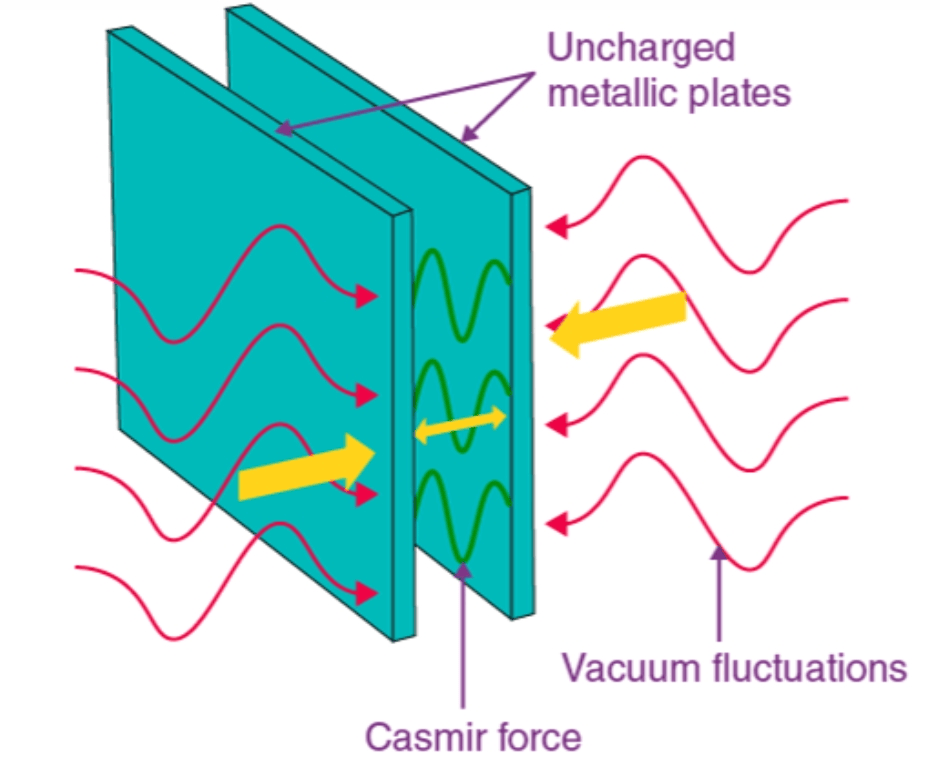
If the quantum vacuum has real energy, it should have real, measurable effects. It does. In 1948 the Dutch physicist Hendrik Casimir predicted the most famous of them, now called the Casimir effect.
Place two flat, uncharged metal plates extremely close together, a fraction of the width of a human hair apart. The gap between them restricts which vacuum fluctuations can fit, so there are fewer of them between the plates than outside. The imbalance produces a tiny but genuine force pushing the plates together.
For decades this remained a theoretical prediction, too delicate to confirm. Then in 1997 the physicist Steve Lamoreaux measured the Casimir force directly, using a sensitive torsion pendulum, and found agreement with theory at the level of about 5 per cent. A year later Umar Mohideen and Anushree Roy measured it more precisely with an atomic force microscope. The energy of the vacuum was no longer an abstraction; it had been weighed.
The Casimir effect is now routinely measured and even matters to engineers building microscopic machines, where the attraction between closely spaced parts can cause them to stick. The quantum vacuum, it turns out, reaches right into the nanoscale devices of modern technology.
The experiments have kept getting more inventive. Casimir’s original prediction was for two perfectly parallel plates, which are fiendishly hard to hold level at such tiny separations; a team in Padua finally managed it in 2002, confirming the force to within about 15 per cent. In 2001 researchers at Bell Labs used the Casimir force to move a tiny seesaw-like silicon device, a microelectromechanical system, showing that the vacuum can actually push machinery around.
Then came the surprises. In 2009 Jeremy Munday, Federico Capasso and Adrian Parsegian showed that with the right materials immersed in a liquid, the Casimir force can push surfaces apart rather than pull them together. And in 2018 a team at the University of Maryland measured a Casimir torque: a twist exerted through the vacuum between materials whose optical properties depend on direction. The vacuum, it turns out, can attract, repel and rotate.
Turning the Vacuum into Light
The most striking experiment of all came in 2011. Theorists had long predicted that a mirror moving fast enough, near the speed of light, should shake real photons out of the vacuum, turning virtual particles into light that a detector can count. It is called the dynamical Casimir effect, and moving a real mirror that fast is impossible.
A team at Chalmers University of Technology in Sweden found a way round it. They built a superconducting circuit whose effective electrical length could be changed billions of times a second, behaving like a mirror swinging back and forth far faster than any physical object could. Out of the circuit came pairs of microwave photons, with the correlations the theory predicted. Light had been made from empty space.
It is tempting to read this as energy from nothing. It is not. The energy in every photon came from the electrical drive that kept the “mirror” moving; the vacuum supplied the pattern, not the power. That is the same lesson as the static Casimir effect, seen from a different angle: the vacuum can be shaped and coaxed, but it never pays the bills.
What “virtual particles” really mean
Popular accounts often describe the vacuum as boiling with virtual particles that pop in and out of existence. The phrase is vivid but easily misunderstood, and it is worth being careful about what it actually means.
Virtual particles are not tiny objects that briefly become real and could be scooped up. They are a way physicists calculate the behaviour of quantum fields — a bookkeeping device for the fluctuations of those fields. What is genuinely real are the measurable effects, such as the Casimir force and the Lamb shift, that these calculations correctly predict.
The distinction matters because so much pseudoscience leans on the literal image of free particles waiting to be harvested from empty space. The vacuum fluctuations are real in their consequences, but they are the restless ground state of quantum fields, not a reservoir of free particles or free energy sitting there for the taking.
A second fingerprint: the Lamb shift
The Casimir effect is not the only evidence. In 1947 the physicist Willis Lamb measured a tiny shift in the energy levels of the hydrogen atom that classical theory could not explain. The cause was the atom’s electron interacting with the fluctuating quantum vacuum around it.
This Lamb shift was a landmark. It gave direct experimental support to the idea that the vacuum fluctuations are real and have measurable consequences, and it helped drive the development of quantum electrodynamics, the extraordinarily precise theory of light and matter.
The explanation followed within weeks. In August 1947 Hans Bethe published a short calculation showing that the electron’s interaction with the fluctuating electromagnetic field of the vacuum could account for most of the shift Lamb had measured. Refining that calculation became one of the founding tasks of quantum electrodynamics.
Lamb shared the 1955 Nobel Prize in Physics with Polykarp Kusch, who had shown that the electron’s magnetism is very slightly stronger than Dirac’s equation predicts. The two discoveries were fingerprints of the same restless vacuum, and explaining both to many decimal places is still one of the most precise agreements between theory and experiment in all of science.
Between the Lamb shift and the Casimir effect, the reality of zero-point energy rests on solid, repeatedly confirmed experimental ground. Any honest account must start from the fact that this is established physics, not speculation. The controversy begins only when people ask what can be done with it.
The deepest mystery: the vacuum catastrophe
Zero-point energy sits at the centre of one of the most embarrassing unsolved problems in all of physics. When theorists add up the energy the quantum vacuum should contain, they get an answer that is staggeringly, absurdly large.
Astronomers, meanwhile, can measure the actual energy of empty space, because it drives the accelerating expansion of the universe — the phenomenon attributed to dark energy. The measured value is real but tiny. The gap between the theoretical prediction and the observed reality is roughly 120 orders of magnitude, a one followed by 120 zeros.
This is sometimes called the vacuum catastrophe or the cosmological constant problem, and it has been described as the worst prediction in the history of physics. Something is profoundly wrong or missing in how we combine quantum theory with gravity, and no one yet knows what.
Far from being solved, zero-point energy thus points to the frontier of physics. It connects the smallest scales, the quantum jitter of empty space, to the largest, the fate of the entire cosmos — and the failure to reconcile them is a clue that a deeper theory awaits.
Zero-point energy and the birth of the cosmos
The reach of vacuum energy extends to the very beginning of the universe. In the leading cosmological picture, the early cosmos underwent a burst of extraordinarily rapid expansion, and quantum fluctuations of the fields filling space were stretched to enormous scales during it.
Those stretched fluctuations are thought to be the seeds from which all cosmic structure grew. The slight unevenness they imprinted became the gravitational scaffolding for galaxies, stars and, eventually, us. If that picture is right, the galaxies in the night sky are the magnified echoes of quantum jitter in the infant universe.
This is a striking inversion of the free-energy fantasy. Zero-point energy did not build a perpetual-motion machine; it may have helped build the cosmos. The same restless vacuum that resists being tapped for power is written into the largest structures we can observe.
The free-energy myth — and why it fails
Here is where genuine physics collides with a century of wishful thinking. If empty space is full of energy, the reasoning goes, surely we could tap it for a limitless, clean supply. Countless inventors have claimed devices that harvest “free energy” from the vacuum. Every such claim, on examination, has failed.
The reason is simple, and it is the point to remember above all others. Zero-point energy is the lowest energy state there is. To extract usable energy from any system, energy must flow from a higher state to a lower one, as water flows downhill. But there is nothing below the vacuum for its energy to fall into. It is already the bottom of the hill.
You cannot draw net energy from a system that is already in its ground state, any more than a ball resting at the bottom of a valley can roll further down to power a mill. This is not an engineering obstacle to be overcome with a cleverer device; it is a consequence of the laws of thermodynamics and quantum mechanics themselves.
The Casimir effect sometimes confuses people here, because the plates do move and do a little work as they are pulled together. But that is a one-time release, like a stretched spring relaxing; pulling the plates apart again costs at least as much energy. There is no cycle that yields a net gain, and so no free lunch. Even the 2011 experiment that made light from the vacuum drew every bit of that light’s energy from the power supply driving it.
How to spot the pseudoscience
Zero-point energy is a magnet for scams, so a few warning signs are worth keeping in mind. Be sceptical of any device claimed to produce more energy than it consumes, of appeals to suppressed inventors and secret conspiracies, and of impressive-sounding quantum vocabulary used without any testable detail.
Genuine science invites scrutiny; it publishes methods, submits to peer review and allows independent replication. Free-energy claims almost never survive that process, and typically retreat behind excuses when asked for a controlled, independent test. The absence of a working, verified device after a century of trying is itself telling.
None of this diminishes the real phenomenon. It is precisely because zero-point energy is genuine and profound that its name carries enough authority to be misused. Understanding the true physics is the best defence against those who trade on the mystery.
What zero-point energy is genuinely good for
If it cannot power your house, what is it good for? Quite a lot, in fact, once the fantasy is set aside. The Casimir force is a real consideration in designing the tiny mechanical systems used in sensors and microchips, where components sit close enough for vacuum forces to matter.
Zero-point effects also set fundamental limits on the precision of measurements, and the most sensitive instruments on Earth now engineer the vacuum to get past them. The LIGO gravitational-wave detectors inject “squeezed” light, in which the vacuum’s unavoidable jitter is pushed out of the quantity being measured and into one that matters less.
In 2023 the LIGO team reported that a refined version of this trick cut the detectors’ quantum noise near 1,000 vibrations per second by a factor of 1.6 at the Hanford site and 1.9 at Livingston. It extended how far away the detectors could hear merging neutron stars by 15 to 18 per cent, which corresponds to up to 65 per cent more detections. Researchers even study how the vacuum can be shaped and manipulated in other settings, an active area of experimental physics that has nothing to do with free energy.
In chemistry, zero-point energy is not optional trivia but a working number. It affects the true energy of every molecule, subtly shifting the rates of reactions and the strengths of bonds. Chemists routinely include it in their calculations, and ignoring it would give wrong answers. The quantum jitter of the ground state is quietly present in every substance around you.
It has even reached the pharmacy. A bond between carbon and deuterium, the heavy form of hydrogen, has a lower zero-point energy than the ordinary carbon–hydrogen bond, so it takes more energy to break. Swap a few hydrogens in a drug for deuterium and the body may break the drug down more slowly. In 2017 the US Food and Drug Administration approved deutetrabenazine, a treatment for the involuntary movements of Huntington’s disease built on exactly this idea: a medicine whose design rests on zero-point energy.
And its greatest value may be as a guide to deeper theory. The vacuum catastrophe is a signpost pointing toward whatever framework finally unites quantum mechanics and gravity. In that sense, zero-point energy is not a power source but a profound clue about the structure of reality.
What remains genuinely open
It is fair to ask whether future physics might change the picture. After all, the vacuum catastrophe shows our understanding of vacuum energy is incomplete. Could a deeper theory reveal a way to tap it after all?
Honesty requires two answers at once. Yes, our theory of vacuum energy is unfinished, and the mismatch with observation is a genuine sign that something fundamental is missing. But no, that incompleteness offers no known route to free energy. The barrier is not a gap in a specific calculation; it is the basic principle that energy cannot be extracted from a system already in its lowest state.
A future theory could well change how we understand what the vacuum energy is, why it takes the value it does, and how it relates to gravity. What no serious physics anticipates is that it will hand us a perpetual power source. The open questions are profound, but they point toward understanding, not toward a magic battery.
That is the correct posture toward zero-point energy: humble about what we do not know, firm about what we do. The vacuum keeps its deepest secret — why its energy is what it is — while giving up no free lunch along the way.
The honest wonder
Strip away the hype and what remains is arguably more remarkable than the myth. Empty space is not empty. It carries an irreducible energy that shapes measurable forces, that leaves fingerprints on atoms, and that connects to the accelerating expansion of the entire universe.
You do not need a fictional free-energy machine to be astonished by this. The real zero-point energy is a genuine mystery at the edge of human knowledge, honestly acknowledged as unsolved. That is a rarer and more valuable thing than a false promise: a true frontier.
The next time you hear zero-point energy invoked to sell a miracle, remember the two halves of the truth. The physics is real, measured and beautiful; the free-energy machine is not, and never will be. Holding both facts at once is what it means to take the quantum vacuum seriously.
Frequently asked questions
What is zero-point energy in simple terms?
It is the lowest possible energy a quantum system can have, which is not zero. Because of the uncertainty principle, even at absolute zero a system retains an irreducible jitter of energy. Extended to the fields filling space, it means the vacuum itself carries energy.
Is zero-point energy real or just theory?
It is real and experimentally confirmed. The Casimir effect, predicted in 1948 and measured in 1997, and the Lamb shift, measured in 1947, both demonstrate the physical consequences of vacuum fluctuations. This is established, textbook physics.
Can we use zero-point energy as a power source?
No. Zero-point energy is the lowest energy state that exists, and usable energy can only be extracted when it flows to a lower state. There is nothing below the vacuum for it to fall into, so no net energy can be harvested. “Free energy” devices claiming otherwise do not work.
What is the Casimir effect?
A tiny force between two closely spaced uncharged surfaces, caused by the difference in vacuum fluctuations inside and outside the gap. Predicted by Hendrik Casimir in 1948 and measured by Steve Lamoreaux in 1997, it is usually attractive, but with the right materials it can repel, as shown in 2009, and it can even exert a twist, as measured in 2018.
Why is zero-point energy linked to dark energy?
The energy of empty space drives the accelerating expansion of the universe, attributed to dark energy. Quantum theory predicts a vacuum energy about 120 orders of magnitude larger than what is observed — the cosmological constant problem, one of physics’ deepest unsolved puzzles.
How can I tell real ZPE science from a scam?
Be wary of any device claimed to output more energy than it uses, of appeals to suppressed inventors, and of quantum buzzwords with no testable detail. Genuine science publishes methods and allows independent replication; free-energy claims consistently fail that test.
Are virtual particles real?
Their effects are real, but they are not tiny objects that briefly become tangible. “Virtual particles” is a way of calculating the behaviour of quantum fields. What can be measured are consequences like the Casimir force, not free particles waiting to be captured from the vacuum.
Who discovered zero-point energy?
The concept grew out of Max Planck’s early quantum work in the 1900s and 1910s, where a residual energy term appeared that did not vanish at absolute zero. It was later understood as a necessary consequence of the uncertainty principle as quantum mechanics developed in the 1920s.
Can light really be made from empty space?
In a sense, yes. In 2011 researchers at Chalmers University of Technology used a superconducting circuit that acted like an extremely fast-moving mirror, and detected pairs of photons created from vacuum fluctuations. The energy came from the electrical drive, so this is not free energy, but it showed that virtual photons can be turned into real ones.
Is zero-point energy used in any real technology?
Yes, though not as a power source. LIGO’s gravitational-wave detectors use squeezed light to reduce vacuum noise, which in 2023 increased their detection range by 15 to 18 per cent. Engineers designing microscopic machines must account for the Casimir force, and a Huntington’s disease drug approved in 2017 relies on the lower zero-point energy of deuterium bonds.
Has anyone won a Nobel Prize for vacuum effects?
Yes. Willis Lamb shared the 1955 Nobel Prize in Physics for measuring the Lamb shift in hydrogen, with Polykarp Kusch, who measured the electron’s slightly enhanced magnetism. Both effects arise from the quantum vacuum, and explaining them helped found quantum electrodynamics.
Further reading on Web News For Us
Sources
Primary peer-reviewed research:
- Casimir, H. B. G. (1948). On the attraction between two perfectly conducting plates. Proceedings of the Koninklijke Nederlandse Akademie van Wetenschappen, 51, 793. (Original prediction of the Casimir effect.)
- Casimir, H. B. G., & Polder, D. (1948). The influence of retardation on the London–van der Waals forces. Physical Review, 73, 360. doi.org/10.1103/PhysRev.73.360
- Lamb, W. E., & Retherford, R. C. (1947). Fine structure of the hydrogen atom by a microwave method. Physical Review, 72, 241. doi.org/10.1103/PhysRev.72.241
- Lamoreaux, S. K. (1997). Demonstration of the Casimir force in the 0.6 to 6 µm range. Physical Review Letters, 78, 5. doi.org/10.1103/PhysRevLett.78.5
- Mohideen, U., & Roy, A. (1998). Precision measurement of the Casimir force from 0.1 to 0.9 µm. Physical Review Letters, 81, 4549. doi.org/10.1103/PhysRevLett.81.4549
- Weinberg, S. (1989). The cosmological constant problem. Reviews of Modern Physics, 61, 1. doi.org/10.1103/RevModPhys.61.1
- Riess, A. G., et al. (1998). Observational evidence from supernovae for an accelerating universe and a cosmological constant. The Astronomical Journal, 116, 1009. doi.org/10.1086/300499
- Perlmutter, S., et al. (1999). Measurements of Ω and Λ from 42 high-redshift supernovae. The Astrophysical Journal, 517, 565. doi.org/10.1086/307221
- Bethe, H. A. (1947). The electromagnetic shift of energy levels. Physical Review, 72, 339 (DOI: 10.1103/PhysRev.72.339).
- The Nobel Prize in Physics 1955: Willis E. Lamb and Polykarp Kusch. NobelPrize.org.
- Bressi, G., Carugno, G., Onofrio, R. & Ruoso, G. (2002). Measurement of the Casimir force between parallel metallic surfaces. Physical Review Letters, 88, 041804 (DOI: 10.1103/PhysRevLett.88.041804).
- Chan, H. B., et al. (2001). Quantum mechanical actuation of microelectromechanical systems by the Casimir force. Science, 291, 1941 (DOI: 10.1126/science.1057984).
- Munday, J. N., Capasso, F. & Parsegian, V. A. (2009). Measured long-range repulsive Casimir–Lifshitz forces. Nature, 457, 170 (DOI: 10.1038/nature07610).
- Wilson, C. M., et al. (2011). Observation of the dynamical Casimir effect in a superconducting circuit. Nature, 479, 376 (DOI: 10.1038/nature10561).
- Somers, D. A. T., et al. (2018). Measurement of the Casimir torque. Nature, 564, 386 (DOI: 10.1038/s41586-018-0777-8).
- Ganapathy, D., et al. (LIGO) (2023). Broadband quantum enhancement of the LIGO detectors with frequency-dependent squeezing. Physical Review X, 13, 041021 (DOI: 10.1103/PhysRevX.13.041021).
- US Food and Drug Administration. Drugs@FDA: Austedo (deutetrabenazine), NDA 208082, approved 3 April 2017. accessdata.fda.gov.
Institutional / science background:
- US Department of Energy — DOE Explains: Quantum Mechanics
- NobelPrize.org — Physics 2011: the accelerating universe and dark energy
Baryon. (2025, March 27). The Zero-Point Energy Revolution: Unveiling the Secrets of the Quantum Realm. Web News For Us. https://webnewsforus.com/zero-point-energy-revolution-quantum/
Baryon. “The Zero-Point Energy Revolution: Unveiling the Secrets of the Quantum Realm.” Web News For Us, 27 March 2025, https://webnewsforus.com/zero-point-energy-revolution-quantum/. Accessed 18 October 2026.