Query SIMBAD, the astronomical database of record, for everything catalogued in the Alpha Centauri system, and one entry stands out from the rest. Alongside the stars and the planets there is an object called alf Cen Bb, and the database classifies it with a single blunt code: err.
That is the entry for a planet announced in 2012 as the closest world ever found beyond our solar system — a discovery that made headlines everywhere and was later shown to be an artefact of how the data had been processed. It does not exist. SIMBAD keeps the record anyway, flagged as an error, which is a more honest memorial than most retracted science gets.
The rest of the catalogue is more encouraging, and more precise than most accounts of this system suggest. Alpha Centauri A and B sit at a parallax of 742.12 milliarcseconds, putting them 4.395 light years away. Proxima Centauri, at 768.07, is measurably closer at 4.246 light years — and the catalogues disagree about its planets: when we queried both on 6 October 2026, SIMBAD confirmed one and listed two as candidates, while the NASA Exoplanet Archive counted two as confirmed.
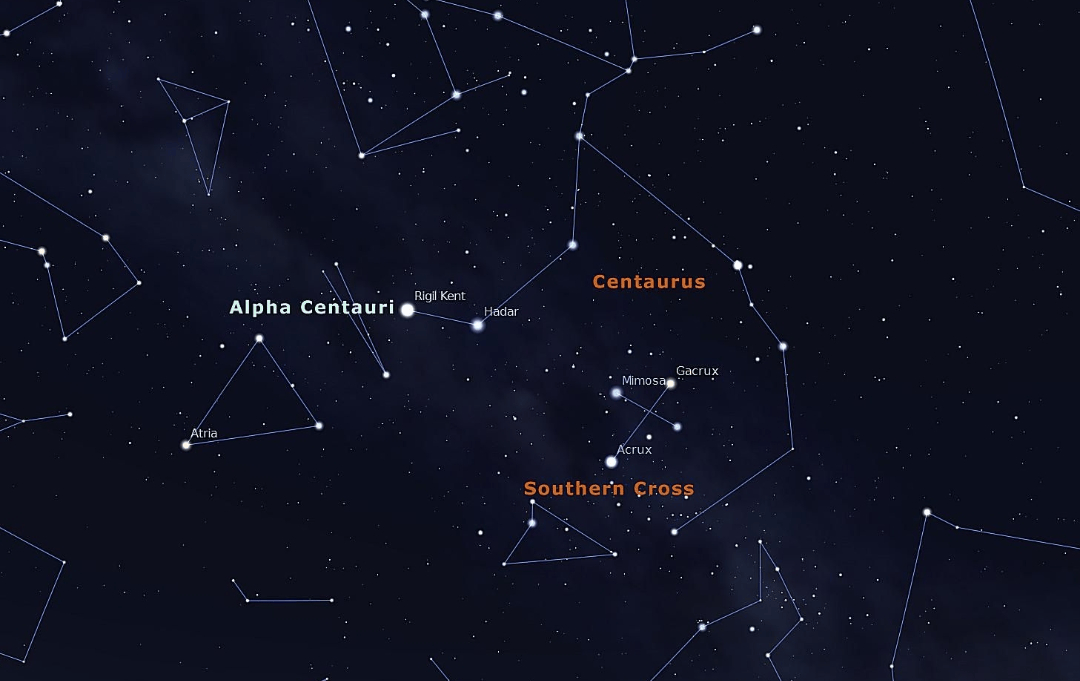
Step outside on a clear night in the Southern Hemisphere, find the Southern Cross, and trace a line from its long axis. You will land on a brilliant point of light that looks like a single star. It is not. It is an entire star system — and it is the closest one to our own.
Alpha Centauri sits just 4.4 light-years away. In cosmic terms, it is our next-door neighbour — the first stop any future interstellar mission would aim for, and the most promising nearby place to search for planets beyond our Sun.
And in August 2025 it delivered one of the most tantalising results in modern astronomy: evidence, from the James Webb Space Telescope, of a possible giant planet orbiting a Sun-like star right next door. The signal is real but faint, seen once and not yet confirmed. This is the full story of the system, its worlds, and why it matters.
What Is the Alpha Centauri System?
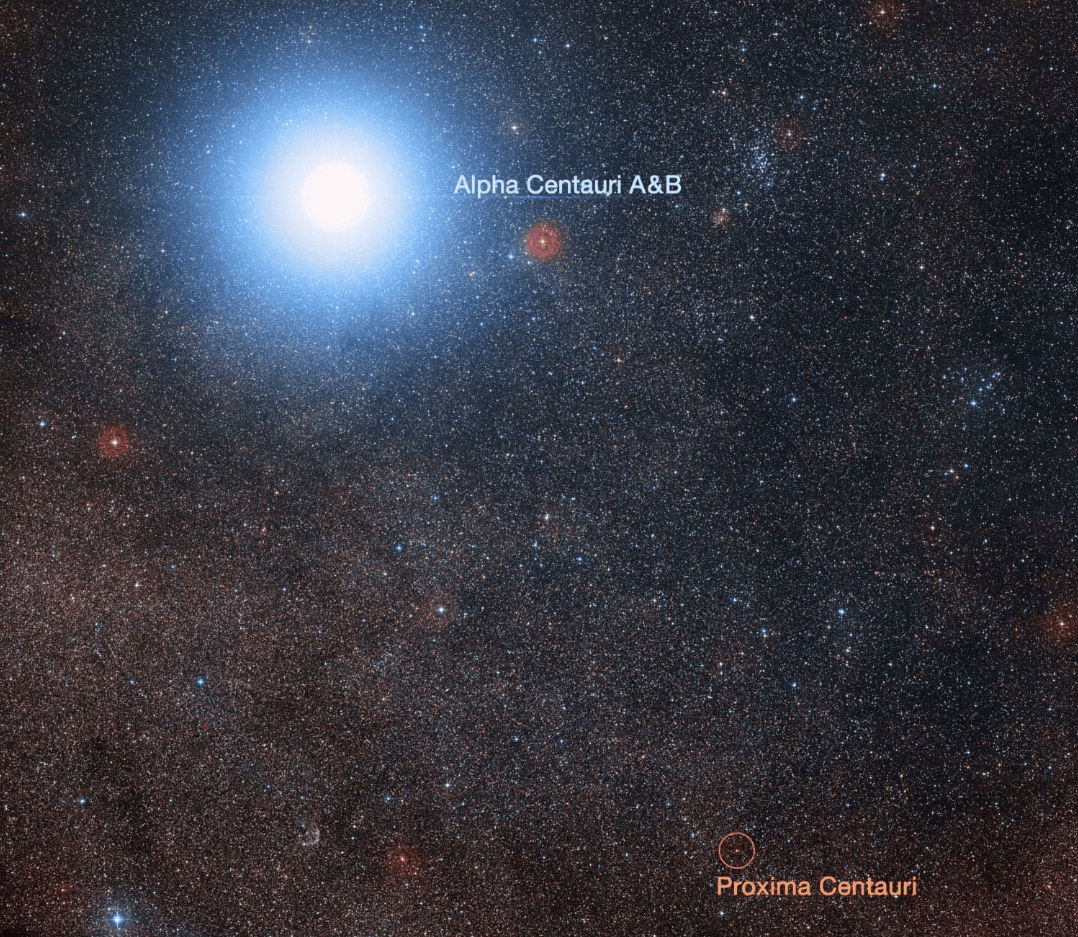
Alpha Centauri is a triple-star system in the southern constellation Centaurus. What looks like one star to the naked eye is actually three, bound together by gravity. It is the nearest stellar system to the Sun.
Alpha Centauri A (Rigil Kentaurus) is a G-type star remarkably similar to our Sun — about 1.1 times the Sun’s mass and somewhat brighter. Together with its partner B, it shines as the third-brightest star in the night sky, after Sirius and Canopus, and A is the closest true “solar twin” to Earth.
Alpha Centauri B (Toliman) is a slightly smaller, cooler K-type star, around 0.9 solar masses and about half the Sun’s brightness. Stars A and B orbit their common centre of gravity roughly every 79 years, sometimes drawing as close as the Sun-to-Saturn distance.
Proxima Centauri is the odd one out — a faint red dwarf of just 0.12 solar masses, orbiting the central pair at a great distance. Despite its dimness, it holds a special title: at 4.24 light-years, it is the single closest star to our Sun, and it hosts a confirmed system of planets.
The three stars could hardly be more different. Alpha Centauri A is so like our Sun in mass, temperature, and colour that it is often used as a benchmark for what a “solar twin” looks like. Studying it is, in a sense, studying our own star from the outside.
Alpha Centauri B, cooler and more orange, is the kind of long-lived K-type star some astronomers consider especially promising for life — stable, abundant, and gentler than hotter stars over billions of years. Proxima, by contrast, is a tiny, turbulent red dwarf, the most common type of star in the galaxy.
In a single system, then, we have examples of three of the most important classes of star in the Milky Way, close enough to study in detail. That alone makes Alpha Centauri an extraordinary natural laboratory.
How the System Was Discovered
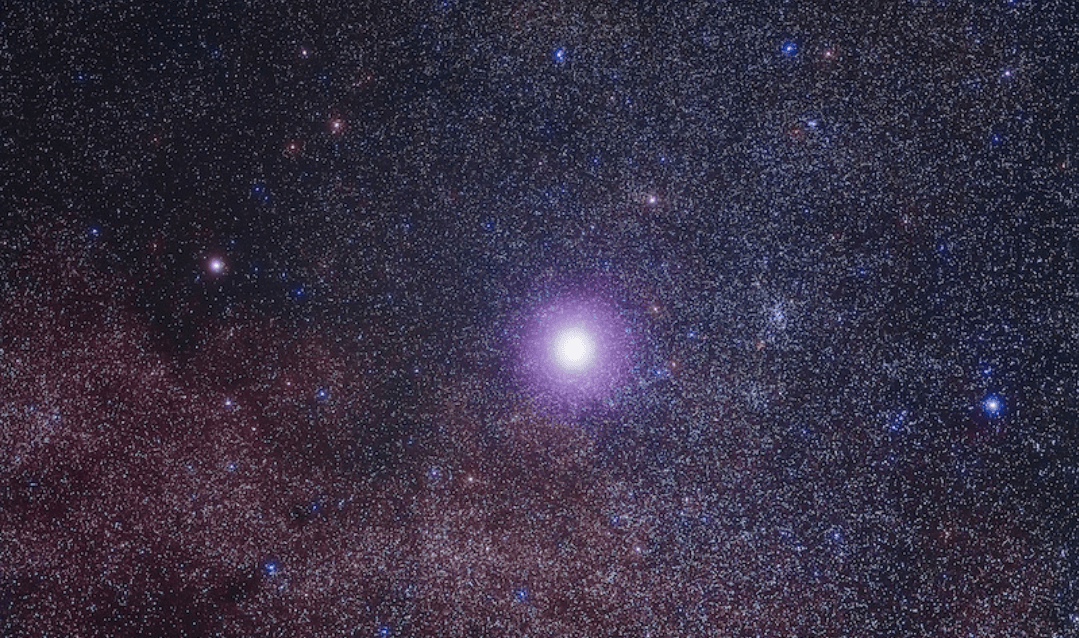
Alpha Centauri has been visible to humanity for as long as people have looked south. It appears in the sky lore of Aboriginal Australian cultures and was catalogued by ancient astronomers, but its true nature took centuries to uncover.
In 1839, the Scottish astronomer Thomas Henderson became one of the first people to measure the system’s distance, using stellar parallax — the tiny apparent shift of a nearby star against distant background stars as Earth orbits the Sun. He had made his measurements at the Cape of Good Hope years earlier but hesitated to publish, and Friedrich Bessel’s distance to the star 61 Cygni appeared first, in 1838.
In 1915, the Scottish-born astronomer Robert Innes, working in South Africa, discovered the faint red dwarf now called Proxima Centauri and recognised it as part of the system — and as the closest known star to the Sun.
The modern era of discovery arrived in 2016, when astronomers at the European Southern Observatory found a planet orbiting Proxima Centauri — a milestone in the search for worlds beyond our own. The same techniques that map this system illuminate star-forming regions like the Orion Nebula.
How Far Away Is It, Really?
At about 4.4 light-years, Alpha Centauri is close by the standards of the galaxy — but “close” in space is still almost unimaginably far. For the bright pair, 4.395 light-years works out to about 41.6 trillion kilometres; for Proxima, about 40.2 trillion.
To put it in perspective, light itself — the fastest thing in the universe — takes more than four years to make the trip. The precise distance is measured using parallax, refined enormously by the European Space Agency’s Gaia mission, which has charted the positions of nearly two billion stars.
The travel time exposes the real challenge. NASA’s Voyager 1, the most distant spacecraft ever launched, was moving at about 17 kilometres per second in 2024. At that speed, the 40 trillion kilometres to Proxima would take roughly 75,000 years. Crossing even to our nearest neighbour is a civilisation-scale problem.
The Planets of Proxima Centauri
The red dwarf Proxima Centauri is the best-studied planet host in the system, with a confirmed family of worlds — including one that has driven a decade of excitement.
Proxima b, announced in 2016 by a team led by Guillem Anglada-Escudé, is a roughly Earth-mass planet orbiting within the star’s habitable zone — the region where liquid water could exist. It circles Proxima every 11.2 days, a testament to how close a habitable-zone orbit sits around a cool, dim red dwarf.
Proxima d, reported as a candidate in 2022 and confirmed in 2025 with the NIRPS spectrograph, is a sub-Earth roughly a quarter of Earth’s mass on a tight 5-day orbit — one of the lightest exoplanets ever detected by the radial-velocity method. A third signal, the candidate super-Earth Proxima c, remains less certain; the 2025 study found only inconclusive evidence for it.
The 2025 confirmation came from NIRPS, an infrared spectrograph at the European Southern Observatory’s La Silla site, which took 420 spectra of Proxima over 159 nights and measured the star’s wobble with a typical precision of about half a metre per second, roughly walking pace. The NASA Exoplanet Archive now lists Proxima b at about 1.06 Earth masses on an 11.2-day orbit and Proxima d at about 0.26 Earth masses on a 5.1-day orbit.
The catch is that Proxima is a flare star. It unleashes powerful bursts of radiation that could strip the atmosphere from a close-orbiting planet, making the true habitability of Proxima b an open and hotly debated question.
The flares are not hypothetical. In March 2016 the Evryscope camera array caught a superflare in which Proxima briefly brightened about 68 times in visible light, enough to be seen with the naked eye from a dark site, releasing roughly ten times more energy than any flare previously recorded from the star. The team estimated that at least five such superflares happen every year.
In May 2019 five observatories, from radio dishes to the Hubble Space Telescope, recorded an even more violent outburst. In far-ultraviolet light Proxima brightened more than 14,000 times, and the initial burst lasted under ten seconds. A planet in Proxima b’s orbit is bathed in such events, which is why its habitability is genuinely uncertain.
The 2025 Breakthrough: A Candidate Planet at Alpha Centauri A
For decades, the two Sun-like stars A and B resisted every attempt to find planets around them. In August 2025, that changed — tentatively. NASA announced that the James Webb Space Telescope had found evidence of a possible giant planet orbiting Alpha Centauri A.
Using the coronagraph on its Mid-Infrared Instrument (MIRI) to block the star’s overwhelming glare, Webb recorded in August 2024 a faint point of light, about 1.5 arcseconds from Alpha Centauri A, which at that distance is roughly twice the Earth-Sun distance. It was some 18,000 times fainter than the star at the infrared wavelength observed. The findings were published as two papers in The Astrophysical Journal Letters, led by Charles Beichman and Aniket Sanghi.
The details matter. The point source was detected at a signal-to-noise ratio of 4 to 6, equivalent to roughly 3.3 to 4.3 sigma, well short of the threshold astronomers use to claim a discovery. Because only one of the planned observations succeeded that August, the team could not rotate the telescope to check the source from a second angle. They did rule out a background star or a foreground object.
If confirmed, the object is a gas giant of roughly 90 to 150 Earth masses, around the mass of Saturn, about the size of Jupiter and at a temperature of about 225 kelvin, close to minus 50 degrees Celsius. Its likely orbit takes two to three years, is noticeably elongated and is tilted by about 50 degrees to the orbit of A and B, inside the star’s habitable zone. Because it is a gas giant, it could not host life as we know it — but any large moons around it would be intriguing targets.
Then came a twist. When astronomers looked again in February and April 2025, the planet had vanished. Follow-up observations found nothing where the object had been.
Rather than abandon the result, the team simulated many possible orbits. If the object is the same as a faint source seen by the European Southern Observatory’s Very Large Telescope in 2019, they found a 52 per cent chance that it would have been too close to the star’s glare to be seen in both follow-ups. The “disappearing planet” is what an eccentric orbit would predict — but also what a statistical fluke would look like. When we checked on 6 October 2026, no confirming observation had been published.
The same observations set a remarkable record of their own. They found no detectable warm dust around Alpha Centauri A, setting a limit only a few times the brightness of the dust in our own Solar System, more than ten times tighter than for any other star. If the planet is confirmed, it would be the closest planet to Earth ever found orbiting in the habitable zone of a Sun-like star — a discovery made possible by the extraordinary sensitivity of the James Webb Space Telescope.
Why Finding Planets Around A and B Is So Hard
It might seem strange that the nearest Sun-like stars are among the hardest places to hunt for planets. The difficulty comes down to light and geometry.
Alpha Centauri A and B are both bright, and they sit close together in the sky, moving quickly as they orbit each other. Even when a coronagraph masks one star, the glare of its partner floods the view, drowning out the feeble light of any planet.
The system also lies in the crowded galactic plane, thick with background stars that can masquerade as planets. As the JPL team put it, these were among the most challenging direct-imaging observations ever attempted — requiring a custom-designed observing sequence built for this single target.
What the Catalogue Actually Records
Popular accounts of Alpha Centauri tend to blur confirmed detections, candidate detections and withdrawn detections into a single hopeful picture. The professional catalogue does not. Here is every object SIMBAD lists for this system, with the status it actually carries.
- Alpha Centauri A — spectral type G2V, a near-twin of the Sun. Parallax 742.12 mas.
- Alpha Centauri B — K1V, a smaller, cooler orange dwarf at the same distance.
- Proxima Centauri — M5.5Ve, a red dwarf, parallax 768.07 mas and therefore genuinely the nearest star to the Sun.
- Proxima Centauri b — classified simply as a planet. Confirmed.
- Proxima c and Proxima d — both carry a question mark in SIMBAD. The NASA Exoplanet Archive, following the 2025 NIRPS study, counts d as confirmed; it does not list c.
- Alpha Centauri Ab — also a candidate, the possible world around the Sun-like primary.
- Alpha Centauri Bb — classified err. Withdrawn.
The distinction between those last categories matters, and the Bb episode is the reason. In 2012 a team reported an Earth-mass planet orbiting Alpha Centauri B every 3.2 days, detected through tiny wobbles in the star’s spectrum. It would have been the closest exoplanet to Earth. In 2015 Vinesh Rajpaul, Suzanne Aigrain and Stephen Roberts reanalysed the same data and showed that the signal almost certainly came from the pattern of nights on which the star had been observed, not from a planet: a “ghost in the time series”, as their paper put it. The detection did not survive. The catalogue entry remains as a flagged error.
This is worth holding in mind when reading about the candidate world around Alpha Centauri A. A candidate is a signal that has passed some tests and not yet others. Around these particular stars, detection is unusually difficult: A and B orbit each other closely enough that their light contaminates measurements of both, which is precisely the environment that produced a false positive last time.
There is a second detail the catalogue settles quietly. Proxima’s larger parallax means it is closer to us than A and B by about 0.15 light years — roughly 1.4 trillion kilometres. The three stars are gravitationally bound, but Proxima orbits the central pair at a great distance, and at present it happens to lie on our side of them. The nearest star to the Sun is a red dwarf far too faint to see with the naked eye.
Whether Proxima is truly bound to the other two was itself an open question for a century. In 2017 Pierre Kervella and colleagues used precise velocity measurements to show that it is: Proxima circles the central pair about once every 550,000 years on an elongated orbit, coming within about 4,300 times the Earth–Sun distance at its closest and swinging out to about 13,000. Today it is near the far end of that orbit.
Could Any of These Worlds Host Life?
The question that draws everyone to Alpha Centauri is whether any of its worlds could be habitable. The honest answer is: we do not yet know, and the obstacles are real.
Proxima b sits in its star’s habitable zone, but its close orbit likely leaves it tidally locked — one face permanently toward the star, one in eternal night. That could create extreme temperature differences, though a thick atmosphere might redistribute heat.
The larger threat is radiation. Red dwarf flares can be violent enough to erode a planet’s atmosphere over time, and whether Proxima b has held onto one is unknown. The 2025 gas-giant candidate around Alpha Centauri A, meanwhile, is the wrong kind of world for life — but its very existence hints that smaller, rocky planets could be waiting to be found around our nearest Sun-like stars.
Breakthrough Starshot: Humanity’s First Interstellar Mission
Because it is the nearest system, Alpha Centauri is the natural first target for any attempt to send a probe to another star. The most serious proposal is Breakthrough Starshot, announced in 2016 with $100 million in initial funding.
The concept is radical: gram-scale nanocraft, each carrying tiny cameras and sensors on a lightweight sail, accelerated to around 20 percent of the speed of light by a ground-based array of powerful lasers.
At that speed, the journey would take roughly 20 years, followed by a further four years for the data — including possible images — to travel back to Earth by radio. It would be the first time humanity received a close-up look at another star system.
The engineering hurdles are immense: surviving collisions with interstellar dust at relativistic speed, aiming the lasers with fantastic precision, and communicating across light-years with a device the size of a stamp. In September 2025 Scientific American reported that the project had stalled. Its executive director, Pete Worden, said in an email: “We have put the program on hold and are working to transition portions to others.” Research on light sails continues in university laboratories, but the mission itself is not moving forward.
How to Find Alpha Centauri in the Night Sky
For observers in the Southern Hemisphere, Alpha Centauri is easy to find and unmistakable once you know where to look. It is one of the two bright “pointer stars” near the Southern Cross.
First locate the Southern Cross (Crux). Then look to the two bright stars pointing toward it — the brighter of the pair is Alpha Centauri, which to the naked eye is the third-brightest star in the night sky.
To the naked eye it looks like a single golden star. Through even a modest telescope, it splits into the beautiful double of Alpha Centauri A and B. Proxima, being extremely faint, requires a larger telescope and a good star chart. Note that from most of the Northern Hemisphere — anywhere above about 29°N — the system never rises above the horizon.
The Missions Built to Search This System
Because Alpha Centauri is so close and so promising, astronomers are building instruments specifically to study it. One is TOLIMAN, a small space telescope led by the University of Sydney with support from the Breakthrough Initiatives.
TOLIMAN — named after an old term for the star — is designed to detect the tiny wobble that an Earth-like planet would induce in Alpha Centauri A or B, using ultra-precise astrometry rather than direct imaging. It is remarkably small: a telescope with a 12.5-centimetre aperture inside a 16-unit CubeSat, roughly the size of a small suitcase, which its team described in 2026 as under construction. It is a rare case of a mission built to study one target.
On the ground, the European Southern Observatory’s Extremely Large Telescope, with its 39-metre mirror, is expected to be powerful enough to directly image and analyse planets in the system, potentially even probing Proxima b’s atmosphere. After construction delays, ESO announced in March 2025 that the telescope’s first light is planned for March 2029, with scientific observations beginning in December 2030.
Together with Webb’s ongoing observations, these instruments mean the next decade could transform Alpha Centauri from a bright point of light into a mapped, characterised system of worlds — the first neighbouring planetary system we truly come to know.
Why Alpha Centauri Matters
Alpha Centauri is more than a bright dot in the southern sky. It is a natural laboratory for understanding how planetary systems form and survive around stars like our own — and around the small red dwarfs that make up most of the galaxy.
Because it is so close, anything we find there can be studied in far greater detail than more distant systems, making it our best testing ground for the search for life beyond Earth. The stars themselves also let us trace the life cycles that shape all suns, a story told in our article on the complete life cycle of stars.
And it sharpens one of the oldest questions we can ask: if our nearest neighbour has planets, how common are worlds like ours across the galaxy — and why have we not yet heard from anyone? That puzzle is the subject of our article on the Fermi paradox and the great silence.
When you next look south and find that golden point of light, remember you are looking at the doorstep of interstellar space — the nearest place we might one day reach, and a system that, in 2025, may have shown us its first planet.
Frequently Asked Questions
How far is Alpha Centauri from Earth?
The two bright stars of the Alpha Centauri system lie about 4.4 light-years away (4.395 by the latest parallax), or roughly 41.6 trillion kilometres. Their red dwarf companion, Proxima Centauri, is slightly closer at 4.25 light-years, making it the single nearest star to the Sun. Light from the system takes over four years to reach us.
Does Alpha Centauri have planets?
Yes. Proxima Centauri hosts at least one confirmed planet, the roughly Earth-mass Proxima b in its habitable zone, and the NASA Exoplanet Archive also counts the smaller Proxima d as confirmed. In August 2025 the James Webb Space Telescope team reported a candidate Saturn-mass gas giant around Alpha Centauri A, seen once in 2024 at modest significance and not yet confirmed.
What was the “disappearing planet” at Alpha Centauri A?
JWST detected a candidate planet around Alpha Centauri A in August 2024, but follow-up observations in February and April 2025 failed to see it. Rather than a false alarm, computer simulations showed that in about half of the plausible stable orbits, the planet would have moved too close to the star’s glare to be visible during those follow-ups — consistent with a real planet on an elliptical orbit.
Could humans travel to Alpha Centauri?
Not with current technology in any practical timeframe. Voyager 1, travelling at about 17 kilometres per second, would need roughly 75,000 years to reach Proxima. The Breakthrough Starshot initiative proposed tiny laser-propelled sails that could make the trip in about 20 years, but in 2025 its leaders said the programme had been put on hold.
Is Alpha Centauri visible from the Northern Hemisphere?
Only partially. Alpha Centauri sits far in the southern sky and is visible only from latitudes below roughly 29°N. Observers across most of Europe, the United States, and Canada cannot see it at all, while it is a prominent, easy-to-find star throughout the Southern Hemisphere.
Could Proxima b support life?
It is possible but uncertain. Proxima b orbits within its star’s habitable zone, but its close orbit likely leaves it tidally locked, and Proxima Centauri is a flare star whose radiation bursts could strip a planet’s atmosphere. Whether Proxima b retains a protective atmosphere — the key to habitability — is one of the most important open questions in exoplanet science.
What happened to the planet announced around Alpha Centauri B?
In 2012 astronomers reported an Earth-mass planet, Alpha Centauri Bb, on a 3.2-day orbit. A 2015 reanalysis showed the signal almost certainly came from the timing of the observations rather than from a planet. The SIMBAD database now classifies the object as an error.
Is Proxima Centauri really part of the Alpha Centauri system?
Yes. A 2017 study using precise velocity measurements showed that Proxima is gravitationally bound to Alpha Centauri A and B, circling them roughly once every 550,000 years. It is currently near the far point of that orbit and happens to lie on our side of the pair, slightly closer to us than A and B.
Further Reading
Sources
- NASA — Webb Finds New Evidence for Planet Around Closest Solar Twin (7 August 2025)
- NASA Jet Propulsion Laboratory — press release and mission details
- Beichman, Sanghi, Mawet, et al. (2025). Candidate gas giant orbiting Alpha Centauri A — two papers accepted in The Astrophysical Journal Letters.
- Anglada-Escudé, G., et al. (2016). “A terrestrial planet candidate in a temperate orbit around Proxima Centauri.” Nature, 536, 437 (DOI: 10.1038/nature19106).
- Faria, J. P., et al. (2022). “A candidate short-period sub-Earth orbiting Proxima Centauri.” Astronomy & Astrophysics, 658, A115 (DOI: 10.1051/0004-6361/202142337).
- Suárez Mascareño, A., et al. (2025). “Diving into the planetary system of Proxima with NIRPS: Breaking the metre per second barrier in the infrared.” Astronomy & Astrophysics, 700, A11 (DOI: 10.1051/0004-6361/202553728).
- NASA Exoplanet Archive — Planetary Systems table, host Proxima Cen (queried 2 October 2026).
- European Southern Observatory — Planet Found in Habitable Zone Around Nearest Star (2016).
- Breakthrough Initiatives — Breakthrough Starshot mission concept.
- European Space Agency — Gaia mission (stellar parallax and distances).
- SIMBAD Astronomical Database, CDS Strasbourg — Alpha Centauri system objects and parallaxes (queried 22 August 2026)
- Beichman, C., et al. (2025). “Worlds Next Door: A Candidate Giant Planet Imaged in the Habitable Zone of α Cen A. I.” The Astrophysical Journal Letters (DOI: 10.3847/2041-8213/adf53f).
- Sanghi, A., et al. (2025). “Worlds Next Door: A Candidate Giant Planet Imaged in the Habitable Zone of α Cen A. II.” The Astrophysical Journal Letters (DOI: 10.3847/2041-8213/adf53e).
- Howard, W. S., et al. (2018). “The First Naked-Eye Superflare Detected from Proxima Centauri.” The Astrophysical Journal Letters, 860, L30 (DOI: 10.3847/2041-8213/aacaf3).
- MacGregor, M. A., et al. (2021). “Discovery of an Extremely Short Duration Flare from Proxima Centauri Using Millimeter through Far-Ultraviolet Observations.” The Astrophysical Journal Letters, 911, L25 (DOI: 10.3847/2041-8213/abf14c).
- Kervella, P., Thévenin, F. & Lovis, C. (2017). “Proxima’s Orbit Around α Centauri.” Astronomy & Astrophysics, 598, L7 (DOI: 10.1051/0004-6361/201629930).
- Rajpaul, V., Aigrain, S. & Roberts, S. (2016). “Ghost in the Time Series: No Planet for Alpha Cen B.” Monthly Notices of the Royal Astronomical Society: Letters, 456, L6 (DOI: 10.1093/mnrasl/slv164).
- NASA Science. “Voyager 1” mission page (speed 17.0 km/s, August 2024). science.nasa.gov.
- Scoles, S. (16 September 2025). “The Quiet Demise of Breakthrough Starshot, a Billionaire’s Interstellar Mission to Alpha Centauri.” Scientific American.
- Tuthill, P., et al. (2026). “The TOLIMAN mission: A low-cost space telescope for high precision narrow-angle astrometry.” arXiv:2603.14683.
- European Southern Observatory (14 March 2025). “Telescope first light for ESO’s Extremely Large Telescope now planned for March 2029.” eso.org.
Baryon. (2025, September 18). Alpha Centauri: Uncovering Mysteries About Our Nearest Stellar Neighbour. Web News For Us. https://webnewsforus.com/alpha-centauri-the-nearest-star-system/
Baryon. “Alpha Centauri: Uncovering Mysteries About Our Nearest Stellar Neighbour.” Web News For Us, 18 September 2025, https://webnewsforus.com/alpha-centauri-the-nearest-star-system/. Accessed 12 October 2026.