The stars are impossibly far away. Our fastest spacecraft would take tens of thousands of years to reach even the nearest one. For interstellar travel to become real, we need a fundamentally new way to push a spacecraft.
In 2024, two researchers proposed one. Jeff Greason and Gerrit Bruhaug suggested firing a beam of electrons, accelerated to near the speed of light, to drive a probe toward another star.
The idea sounds like science fiction. But it is built on a real and surprising piece of physics — one that could sidestep the biggest weakness of every other beam-powered scheme yet proposed.
This article explains how relativistic electron beam propulsion would work, why it might succeed where lasers struggle, the formidable challenges it faces, and what it could mean for humanity’s first journey to the stars.
It is worth stressing at the outset that this is a serious scientific proposal, not science fiction. It was published in a peer-reviewed aerospace journal, and its beam physics rests on well-established principles. Its authors are equally clear about what it does not yet have: a working way for the probe to use the beam.
It is worth knowing how small this field is. Interstellar propulsion has one of the smallest research literatures in physics: the arXiv archive held ten papers with “interstellar travel” in the title and 23 with “light sail” when we searched it on 1 September 2026. Re-run on 3 October 2026, the counts were ten and 24.
Thirty-three papers, for the problem of reaching another star. The proposal described below is a peer-reviewed contribution to a field that could hold its entire titled output in a single folder.
That is not a criticism of the work. It is the reason a single well-argued paper can still shift the conversation here, and the reason nobody should mistake this subject for an engineering programme in progress.
Why Interstellar Travel Is So Hard
The core problem is distance. The nearest star system, Alpha Centauri, lies about 4.37 light-years away — some 41 trillion kilometres.
Chemical rockets, the workhorses of spaceflight, are hopelessly slow for this task. NASA’s Voyager 1, one of the fastest craft ever launched, would need more than 70,000 years to cover that distance.
The reason is the tyranny of the rocket equation. A rocket must carry its own fuel, and that fuel adds mass, which requires still more fuel to accelerate — a punishing spiral.
To reach a nearby star within a human lifetime, a probe must travel at a significant fraction of the speed of light. No rocket carrying its own propellant can realistically do that.
That single constraint has shaped decades of interstellar research, and it points toward one clear conclusion: to go fast, the spacecraft must leave its engine at home. The destination itself is profiled in our article on Alpha Centauri, the nearest star system.
The Beam-Powered Idea: Leave the Engine at Home
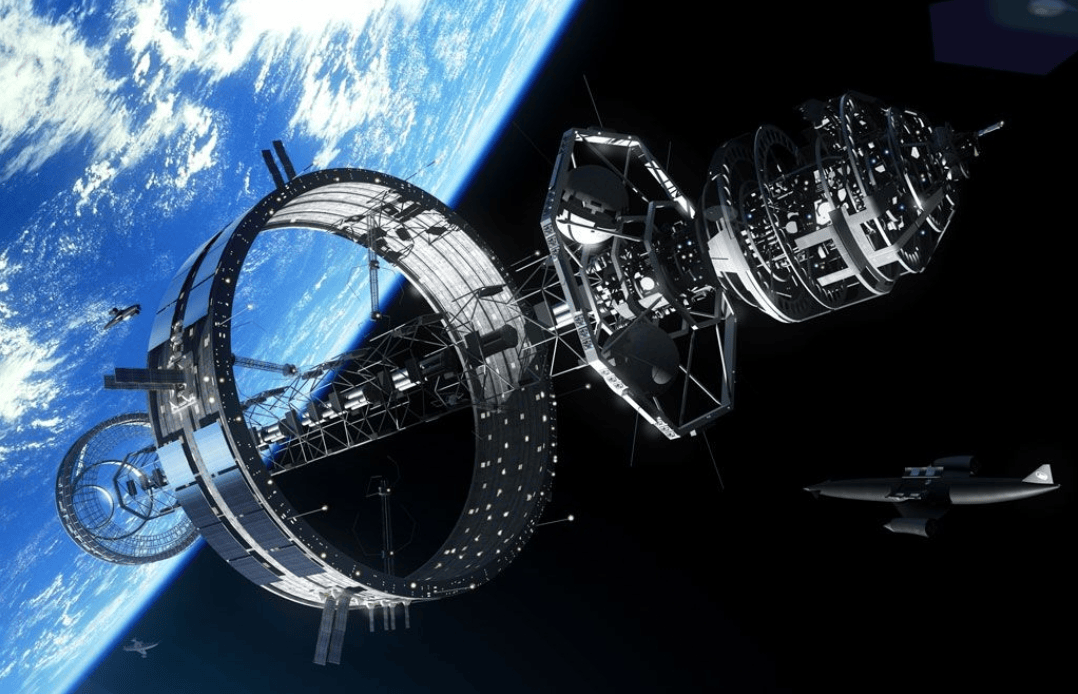
The way around the rocket equation is beamed propulsion. Instead of carrying fuel, the spacecraft is pushed from behind by a powerful beam generated back in the solar system.
The huge, heavy power source stays home. In the simplest version the probe carries only a lightweight “sail” to catch the beam, so almost none of the launch energy is wasted hauling fuel.
This is the principle behind Breakthrough Starshot, which proposes pushing a tiny lightsail with a giant laser array. Greason and Bruhaug’s proposal shares the philosophy but changes the beam itself.
Instead of a beam of light, they propose a beam of matter — specifically, electrons accelerated to relativistic speeds. That change turns out to have a profound advantage.
A Short History of Beamed Propulsion
The idea of pushing a spacecraft with an external beam is not new. In the 1980s, the physicist Robert Forward worked out detailed designs for enormous laser-driven lightsails aimed at nearby stars.
Around 1991, Robert Zubrin and Dana Andrews introduced the magnetic sail, showing that a loop of superconducting wire could interact with charged particles to produce thrust.
Particle-beam propulsion was studied too, but always ran into the same wall: ordinary charged beams spread apart far too quickly to be useful across interstellar gaps.
Other schemes fire streams of tiny solid pellets, or macroparticles, at a probe. They can reach long distances too, but the paper notes that affordable versions proposed so far top out at about 2% of light speed.
The Greason-Bruhaug proposal revives the particle-beam approach by exploiting relativistic focusing — the piece of physics that earlier studies had not fully harnessed. It marries an old dream to a newer insight.
The Key Insight: Relativistic Beams Stay Focused
Every beam-powered scheme faces the same enemy: divergence. Over vast distances, a beam spreads out, and once it is wider than the sail, most of its energy misses the target.
A beam of electrons should be especially prone to this. Electrons all carry negative charge, so they repel one another fiercely, pushing the beam apart almost immediately.
This is exactly why particle beams have long been dismissed for propulsion. At everyday speeds, their own electric repulsion blows them apart within a short distance.
But something remarkable happens when the electrons move at nearly the speed of light. A fast-moving stream of charge is also an electric current, and currents generate magnetic fields.
That magnetic field pulls the electrons together, opposing their electric repulsion. This inward magnetic pinch grows stronger the closer the beam gets to light speed.
At relativistic speeds, the outward electric push and the inward magnetic pull very nearly cancel. The beam’s tendency to spread collapses dramatically — it stays tight over enormous distances.
This is the heart of the proposal. A relativistic electron beam can, in principle, remain focused far longer than a slow one — potentially staying useful out to distances a laser of similar size could not match.
Nature already does something similar. The paper points out that well-collimated beams of charged particles are routinely seen in space — in solar flares, in the current sheet that shapes the Sun’s magnetic field, in interstellar filaments tens of light years long, and in astrophysical jets that stretch across 100,000 light years.
There is also a second way to hold the beam together. A beam travelling through the thin plasma that fills space can be pinched by it, and a beam that relies on that effect could use far less energetic electrons — around 50 megaelectronvolts rather than 19 gigaelectronvolts — which would also make it much easier to steer and receive.
How a Relativistic Electron Beam Works

The beam would be produced by a particle accelerator — the same class of machine physicists use to study fundamental particles, scaled up for propulsion.
Accelerators use powerful electromagnetic fields to drive charged particles to enormous energies. For this concept, electrons would be pushed to speeds within a whisker of light itself.
The authors place the accelerator close to the Sun, on a statite: a craft that hovers in place rather than orbiting, held up against the Sun’s gravity by pushing on the solar wind with a magnetic sail or a plasma magnet. Sunlight is so intense there that heat-tolerant thermionic converters could turn it into electricity at gigawatt scale with far less collecting area than would be needed near Earth.
The location is a practical choice. Near Earth, a solar array large enough to supply a gigawatt would need a collecting area about 800 metres in radius. Light pressure alone cannot hold heavy converters in place near the Sun, which is why the statite pushes on the solar wind instead, at about 0.04 astronomical units — roughly the distance of the Parker Solar Probe’s closest approaches.
As the electrons stream outward, their relativistic self-focusing keeps them collimated. The beam acts less like a spreading spray and more like a taut, coherent rope of charge.
When that stream of fast particles reaches the spacecraft, the probe has to turn it into motion. That step, as the next section explains, is the part nobody has yet worked out.
Catching the Beam: The Unsolved Step
A probe cannot simply absorb a relativistic electron beam head-on — the energy would vaporise it. How it should receive the beam is, in the authors’ own words, a problem “we currently consider unsolved”. They set out two possible approaches.
One is a magnetic sail, or magsail: a large loop of superconducting wire carrying an electric current, whose magnetic field spreads around the spacecraft like an invisible bubble and bends passing charged particles aside.
Bending the beam steals its momentum without heating the ship, but the paper points out two drawbacks. Reflecting electrons this fast gives no more thrust per unit of power than reflecting light would, and a 19-gigaelectronvolt beam is so stiff that it would take an extremely strong magnetic field, spread over a large volume, to turn it.
The other approach treats the beam as a supply of energy rather than of push. The probe would use it to throw out its own reaction mass, like an electric rocket — ideally at around 6.5% of the speed of light for a probe heading to 10%. No such engine exists, and the authors say they do not yet have a satisfactory design; they suspect it will involve coupling the beam into a plasma.
That candour matters. The beam physics is well established; the receiver is a research problem, and the paper presents itself as an invitation to solve it.
The Physics of the Push
Reaching a tenth of light speed is fundamentally a problem of energy. The paper’s own example makes the scale plain: a 1,000-kilogram probe, about the mass of a Voyager spacecraft, moving at 20% of light speed carries about 1.8 billion billion joules of kinetic energy.
That is roughly as much energy as the whole world uses in a day, according to the Energy Institute’s figures, delivered to a single small spacecraft. At the paper’s more modest target of 10% of light speed, the energy needed falls to about a quarter of that — still an enormous amount to send across space.
Light carries momentum equal to its energy divided by the speed of light, which is why laser sails need such enormous power. An electron moving at nearly the speed of light carries almost exactly the same momentum for its energy, so an electron beam is not inherently a stronger push than a laser of the same power.
Where it can win is time. The power a beam needs to reach a given speed falls as the distance over which it pushes grows. A beam that stays on target for weeks or months, across hundreds of astronomical units, can deliver the same energy with far less power than one that must do the job in minutes.
Using that energy to drive a rocket helps further. For missions whose final speed is well below the speed of the beam itself, expelling reaction mass needs less power for a given thrust than pushing directly with the beam’s momentum — which is why the authors lean towards that option despite its difficulty.
Efficiency is everything at interstellar scales. Even a modest gain in how much of the beam’s power becomes motion can be the difference between a workable mission and an impossible one.
Why Not Just Use Lasers?
Breakthrough Starshot, the best-known interstellar concept, uses a laser rather than a particle beam. So why propose electrons at all?
The answer is range. Breakthrough Starshot envisages a laser array whose beam stays useful for only about 0.1 astronomical units, so it must accelerate a gram-scale chip violently in a matter of minutes.
An electron beam held together by relativistic effects, or pinched by the thin plasma of space, could stay useful beyond 100 astronomical units, and perhaps as far as 1,000 — thousands of times further. In the paper’s example, a 1-gigawatt beam 10 metres in radius at the transmitter would still be only 40 metres in radius beyond 100 astronomical units, if its electrons carried about 19 gigaelectronvolts each.
That longer push is what could make a heavier probe possible: about a tonne, the mass of Voyager, rather than the gram-scale chips Starshot envisions, accelerated gently over weeks instead of minutes.
The other difference is where the power comes from: a statite near the Sun rather than a vast array on Earth. The laser-based rival is discussed in our article on Alpha Centauri and Breakthrough Starshot.
That rival has stalled. In September 2025 Scientific American reported that Breakthrough Starshot, announced in 2016 with a promised $100 million, had been put on hold. Its executive director, Pete Worden, was quoted as saying: “We have put the program on hold and are working to transition portions to others.” The magazine estimated that about $4.5 million had actually been spent.
The Numbers: Speed, Distance, and Power
The goal is to reach a meaningful fraction of light speed — in the range of ten percent, fast enough to cross to Alpha Centauri in a little over forty years.
The beam would do its work early. It would push the probe over the first stretch of the journey — beyond 100 astronomical units, perhaps as far as 1,000 — for weeks or months, before divergence finally weakens it.
After that acceleration phase, the probe coasts the rest of the way, carrying no engine and burning no fuel — a dart flung across the dark.
The power required is staggering: the authors expect practical interstellar beams to need a gigawatt or more, sustained for weeks. Generating and directing that much energy is one of the central challenges of the whole idea.
Even so, the researchers argue the energy budget is more favourable than a comparable laser system — a claim that, if it holds, would make particle beams a serious contender.
The Hard Problems
This is a concept, not a blueprint, and the obstacles are formidable. Each one represents a genuine frontier of engineering.
Receiving the beam. The authors call this unsolved: neither a magnetic sail nor a beam-powered rocket has a convincing design yet, and without one the rest of the system has nothing to push.
Pointing accuracy. The beam must stay locked onto a target moving away at a tenth of light speed, across astronomical distances. The paper notes that the beam would have to be steered along the probe’s predicted path, because at these speeds correcting it by feedback from the probe is very challenging.
Residual divergence. Relativistic focusing reduces spreading but does not eliminate it. Over interstellar distances, even a tiny divergence eventually widens the beam beyond the sail.
Power generation. The paper’s answer is a gigawatt-class solar power station hovering near the Sun, built from heat-tolerant thermionic converters. Nothing like it has been built, and it would sit closer to the Sun than any spacecraft except the Parker Solar Probe has flown.
Deceleration. A probe arriving at Alpha Centauri at a tenth of light speed would flash past in hours. Slowing it down to study the system is an even harder problem than launching it.
The receiver itself. Whatever form it takes, it must survive a long journey and handle a gigawatt-class beam without being destroyed by the heat — unproven engineering in every version.
The Deceleration Problem
Reaching a star is only half the challenge. A probe arriving at a tenth of light speed would cross the entire Alpha Centauri system in a matter of hours, gathering only a fleeting glimpse.
There is no beam waiting at the far end to slow it down. The probe must brake using only what it carries — and that is genuinely hard.
The Sunbeam paper does not tackle braking at all. One idea from the wider literature is that a magnetic sail could act as a brake: by pushing against the thin gas and charged particles of interstellar space, a magsail can behave like a parachute.
As the probe nears its target, the star’s own outflowing wind of particles could provide extra drag against the sail, helping to shed speed without any onboard fuel.
Whether this braking is sufficient remains an open question — and in the electron-beam scheme the probe may not carry a magnetic sail at all, if the beam ends up powering an onboard rocket instead.
How It Compares to Other Interstellar Concepts
Relativistic electron beams are one of several serious proposals for crossing interstellar space, each with its own strengths and weaknesses.
Fusion rockets would carry their own reactor, avoiding the pointing problem, but they must haul immense fuel and rely on fusion technology we have not yet mastered.
Antimatter engines offer the highest possible energy density, but producing and storing antimatter in useful quantities is far beyond current capability.
Beamed concepts, whether laser or particle, share the great advantage of leaving the power source at home. The electron-beam approach’s distinctive edge is range: a beam that stays focused far longer than a laser could deliver its energy with far less power.
No single approach is a clear winner yet. Each explores a different corner of what physics permits, and progress in one often informs the others.
What It Could Enable

If the challenges could be met, the payoff would be historic. A probe could reach Alpha Centauri within the working life of the scientists who launched it.
For the first time, humanity could gather close-up data on another star system — its planets, its habitability, perhaps even signs of life — rather than observing from afar.
The authors also point out that the same beams, at lower power and over shorter ranges, could speed up missions inside the solar system, which would make sensible first tests of the technology long before any interstellar attempt.
Beamed power could also serve missions that never leave — delivering energy across the solar system to spacecraft, outposts, or instruments far from the Sun.
And it would bear on one of the deepest questions we can ask: if interstellar travel is possible for us, why have we seen no sign of anyone else? That puzzle is explored in our article on the Fermi paradox.
From Proposal to Reality
It is important to be clear about where this stands. Relativistic electron beam propulsion is an early-stage concept, published in a peer-reviewed journal but far from any test flight.
The value of such work is not an imminent mission. It is identifying a physically sound path that had been overlooked, and showing it deserves serious study.
Greason chairs the Tau Zero Foundation, a non-profit that supports interstellar research, and Bruhaug is a physicist at Los Alamos National Laboratory. Their paper, titled “Sunbeam: Near-Sun Statites as Beam Platforms for Beam-Driven Rockets”, appeared in the journal Acta Astronautica in 2024, and a revised preprint followed in June 2025.
They list what should come next: studies of how relativistic electron beams excite waves in plasma, which might lead to a compact receiver; a closer look at beams of heavy ions such as lead nuclei; and shorter-range tests inside the solar system.
Realising it would take decades and advances across many fields — power, accelerators, superconductors, and control systems. But every interstellar mission begins as a physics argument on paper.
The history of spaceflight is full of ideas once dismissed as fantasy that later flew. The question is not whether this exact design will launch, but whether the physics it uncovers points the way.
Why This Matters
Interstellar travel is often treated as pure fantasy, forever beyond reach. Proposals like this one matter because they move the conversation from “impossible” to “here is a specific problem to solve.”
The relativistic focusing of electron beams is real, established physics. Applying it to propulsion turns a known effect into a genuine engineering avenue.
Whether or not this particular scheme ever flies, it widens the map of what might be achievable — and keeps the dream of reaching the stars grounded in testable science.
The universe it would let us explore is stranger and vaster than we knew, as discoveries like a newly found giant cosmic structure keep reminding us. The tools that reveal it, from the James Webb Space Telescope to beamed propulsion, are how we reach outward.
A beam of electrons, fired across the void, may one day carry the first human-made object to another star. For now, it carries something almost as valuable: a credible reason to believe the journey is possible at all.
Every era of exploration began with a calculation that showed the impossible might be merely difficult. This proposal is one such calculation — a careful, peer-reviewed argument that the physics of the beam allows it, with one large piece still missing — and the stars, for the first time in a long time, look a little closer than before.
Frequently Asked Questions
What is relativistic electron beam propulsion?
It is a proposed interstellar propulsion method in which a beam of electrons, accelerated to near the speed of light, delivers energy to a spacecraft from a power station hovering near the Sun. Jeff Greason and Gerrit Bruhaug proposed it in a 2024 paper in the journal Acta Astronautica. How the spacecraft would turn the beam into thrust — with a magnetic sail or an onboard beam-powered rocket — is, by the authors’ own account, still unsolved.
Why do the electrons need to travel near light speed?
At everyday speeds, a beam of electrons blows itself apart because the negatively charged particles repel one another. Near light speed, the moving charges create a magnetic field that pulls the beam together, almost cancelling that repulsion. This relativistic self-focusing keeps the beam tightly collimated over enormous distances — the key advantage of the concept.
How is this different from Breakthrough Starshot?
Breakthrough Starshot uses a powerful laser to push a reflective lightsail over about 0.1 astronomical units, while this concept uses an electron beam that could stay focused beyond 100 astronomical units. An electron beam carries no more momentum per unit of energy than light, but its far longer range means it could deliver the same energy at lower power, to a much heavier probe. Starshot itself was put on hold in 2025.
How fast could such a probe travel?
The proposal targets speeds around ten percent of the speed of light for a probe of about a tonne. At that pace, a probe could reach Alpha Centauri, 4.37 light-years away, in a little over forty years — within a human lifetime, and vastly faster than any chemical rocket, which would take tens of thousands of years.
What is a magnetic sail?
A magnetic sail, or magsail, is a large loop of superconducting wire carrying a current, which creates a magnetic field around the spacecraft and deflects passing charged particles instead of absorbing them. In the electron-beam paper it plays two roles: it is one possible way for the probe to catch the beam, and it is how the beam station near the Sun would hover on the solar wind.
Is this technology close to being built?
No. It is an early-stage, peer-reviewed concept, not a mission in development. Major challenges remain in receiving the beam, generating the power, pointing the beam and decelerating at the destination. Realising it would take decades of advances, but the proposal establishes the beam itself as a physically credible path worth serious study.
Why does the beam need to stay focused so far?
Because the power a beam needs to reach a given speed falls as the distance over which it pushes grows. A laser that is useful for only about 0.1 astronomical units must accelerate its probe violently in minutes, which demands immense power and limits the probe to grams. A beam useful beyond 100 astronomical units could push a tonne-scale probe gently for weeks or months instead.
Where would the beam come from?
From a statite: a spacecraft that hovers near the Sun instead of orbiting it, held in place by pushing on the solar wind with a magnetic sail or a plasma magnet. At that distance sunlight is intense enough for heat-tolerant thermionic converters to generate gigawatts of electricity, which an accelerator would turn into the electron beam.
What happened to Breakthrough Starshot?
Announced in 2016 with a promised $100 million to send laser-pushed chips to Alpha Centauri, Starshot was reported by Scientific American in September 2025 to have been put on hold, with parts of the work being transferred to others. The magazine estimated that about $4.5 million had actually been spent. Research on light sails continues in universities.
Further Reading
Sources
- Greason, J. & Bruhaug, G. (2024). “Pushing a probe to Alpha Centauri using a relativistic electron beam.” Acta Astronautica (DOI: 10.1016/j.actaastro.2024.08.037).
- Greason, J. & Bruhaug, G. (2024). Preprint of the same paper. arXiv:2407.09414.
- Universe Today — Pushing a Probe to Alpha Centauri Using a Relativistic Electron Beam (January 2025).
- NASA — background on advanced propulsion concepts and magnetic sails.
- Scientific American — How a Billionaire’s Plan to Reach Another Star Fell Apart (Sarah Scoles, 16 September 2025)
- Zubrin & Andrews — Magnetic Sails and Interplanetary Travel, Journal of Spacecraft and Rockets 28, 197–203 (1991)
- Energy Institute — Statistical Review of World Energy 2025 (world primary energy consumption, 2024)
- arXiv — title search for “interstellar travel” and “light sail” (searched 3 October 2026)
Baryon. (2025, February 27). Relativistic Electron Beam Propulsion: Could a Beam of Electrons light up our Interstellar Dreams. Web News For Us. https://webnewsforus.com/relativistic-electron-beam-interstellar-travel/
Baryon. “Relativistic Electron Beam Propulsion: Could a Beam of Electrons light up our Interstellar Dreams.” Web News For Us, 27 February 2025, https://webnewsforus.com/relativistic-electron-beam-interstellar-travel/. Accessed 8 October 2026.
Your point of view caught my eye and was very interesting. Thanks. I have a question for you.