A disagreement that better instruments were supposed to dissolve instead became a field. We dated it. Counting arXiv papers with “Hubble tension” in the title, year by year: none in 2015, one in 2016, none in 2017, two in 2018 — then 25 in 2019.
It has not come back down. 36 in 2020, 52 in 2021, 44 in 2022, 60 in 2023, 57 in 2024, 58 in 2025. Six consecutive years at roughly fifty papers a year, on a subject that had no name at the start of them.
That shape is the argument of this article in one line. A measurement error gets smaller as the data improve. This got a vocabulary, a conference circuit and a steady publication rate instead.
When two measurements of the same quantity disagree, the usual remedy is better data. Sharpen the instruments, enlarge the sample, and the gap closes as the errors shrink.
The Hubble tension has done the opposite. Over more than a decade, both sides of this disagreement have become dramatically more precise — and the conflict between them has become more severe, not less. What began as a mild discrepancy that most cosmologists expected to evaporate has hardened into one of the most serious problems in physics.
That trajectory is the real story. A disagreement that survives better measurement is not a measurement problem. It is either a systematic error that two entirely independent methods have somehow both concealed, or it is a sign that the standard model of cosmology is missing something.
There is a number at the very heart of cosmology that measures how fast the universe is expanding. It is called the Hubble constant. And right now, our two best ways of measuring it flatly disagree.
One method looks at the early universe and gives one answer. Another looks at the nearby universe and gives a value about eight percent higher.
That gap should not exist. Both methods are precise, both are independent, and both have been checked exhaustively. The disagreement has only grown sharper with time.
This is the Hubble tension — one of the deepest unsolved problems in modern physics. It may be a hidden error. Or it may be the first crack in our entire model of the cosmos.
This article explains what the Hubble constant is, how each side measures it, why the gap has only grown, and what it might finally reveal about the universe.
What Is the Hubble Constant?

In the 1920s, Edwin Hubble and Georges Lemaître found that distant galaxies are moving away from us — and the farther a galaxy is, the faster it recedes. The universe is expanding.
The Hubble constant, written H₀, is the rate of that expansion. It is measured in kilometres per second per megaparsec — the speed a galaxy recedes for every megaparsec of distance.
A megaparsec is about 3.26 million light-years. So a Hubble constant of 70 means a galaxy one megaparsec away recedes at roughly 70 kilometres every second.
This single number is fundamental. It sets the age of the universe, its size, and how it will evolve — which is exactly why a disagreement over its value is so serious.
Two Ways to Measure the Universe
There are two fundamentally different routes to the Hubble constant, and the tension lives in the gap between them.
The first works forward from the early universe. It takes the physics of the infant cosmos, measured with great precision, and predicts what the expansion rate should be today.
The second works directly in the nearby universe. It measures the actual distances and speeds of galaxies around us and reads off the expansion rate we truly observe.
In a healthy theory, both should give the same answer. They do not — and understanding why requires looking at each method in turn.
The Early-Universe Value: Planck and the CMB
The early-universe measurement comes from the cosmic microwave background — the faint afterglow of the Big Bang, released when the universe was about 380,000 years old.
The European Space Agency’s Planck satellite mapped this radiation across the whole sky with exquisite precision. Its tiny temperature ripples encode the composition and geometry of the young universe.
Feeding that data into the standard model of cosmology yields a Hubble constant of 67.4 kilometres per second per megaparsec, with an uncertainty of well under one percent.
This is not a direct measurement of today’s expansion. It is a prediction — what H₀ must be if the standard model is correct and we extrapolate forward 13.8 billion years.
Crucially, the same value emerges from an entirely separate early-universe probe: baryon acoustic oscillations, the frozen sound waves imprinted in the distribution of galaxies. The early-universe answer is robust.
The Late-Universe Value: The Cosmic Distance Ladder
The nearby measurement uses a chain of distance markers called the cosmic distance ladder. Each rung calibrates the next, reaching ever farther out.
The first rung is parallax — the tiny shift in a nearby star’s position as Earth orbits the Sun. It gives direct, geometric distances to stars in our own galaxy.
The second rung is Cepheid variable stars. These pulsate at a rate tied precisely to their true brightness, so measuring their pulse reveals their distance.
The third rung is Type Ia supernovae — exploding white dwarfs that all reach nearly the same peak brightness. They are visible across billions of light-years, extending the ladder deep into the expanding universe.
The SH0ES team, led by Nobel laureate Adam Riess, has spent years refining this ladder with the Hubble Space Telescope. Their result is a Hubble constant of about 73 kilometres per second per megaparsec.
That is a direct measurement of the real, present-day expansion — and it sits stubbornly above the value the early universe predicts.
How Big Is the Disagreement?
The gap between roughly 67 and 73 might sound small. In cosmology, it is enormous.
The significance of the disagreement now stands at around five standard deviations, often called five sigma. That is the traditional threshold physicists use to declare a genuine discovery.
In plain terms, the odds that this is a random statistical fluke are less than one in a million. The two numbers are not going to drift into agreement.
Either there is a subtle, shared error hiding in one of the methods — or the standard model of cosmology is missing something real about how the universe works.
A Tension That Refuses to Fade
When the discrepancy first surfaced in the early 2010s, most cosmologists expected it to melt away. Early measurements are noisy, and small gaps often close as data improve.
The opposite happened. As both the early- and late-universe measurements grew more precise, their error bars shrank — but the values themselves did not budge toward each other.
The significance climbed steadily, from around two sigma a decade ago to roughly five sigma today. Better data made the problem worse, not better.
That trajectory is the opposite of what a statistical fluke or a simple error usually does. It is the signature of a real, physical effect that our current model cannot accommodate.
Did the James Webb Telescope Solve It?
For years, the leading suspicion was that the Cepheid rung of the ladder was flawed. In crowded galaxies, nearby stars might blur together and bias the brightness measurements.
The James Webb Space Telescope offered a clean test. Its sharper infrared vision can separate Cepheids from their neighbours far better than Hubble could.
The verdict, reported by Riess and colleagues, was decisive. Webb’s measurements confirmed the Hubble Cepheid distances almost exactly — the crowding was not causing the tension.
This was a turning point. It closed off the most popular “boring” explanation and pushed the field toward taking the tension seriously as a physical puzzle. The telescope behind that test is covered in our article on the James Webb Space Telescope.
The Coma Cluster Result

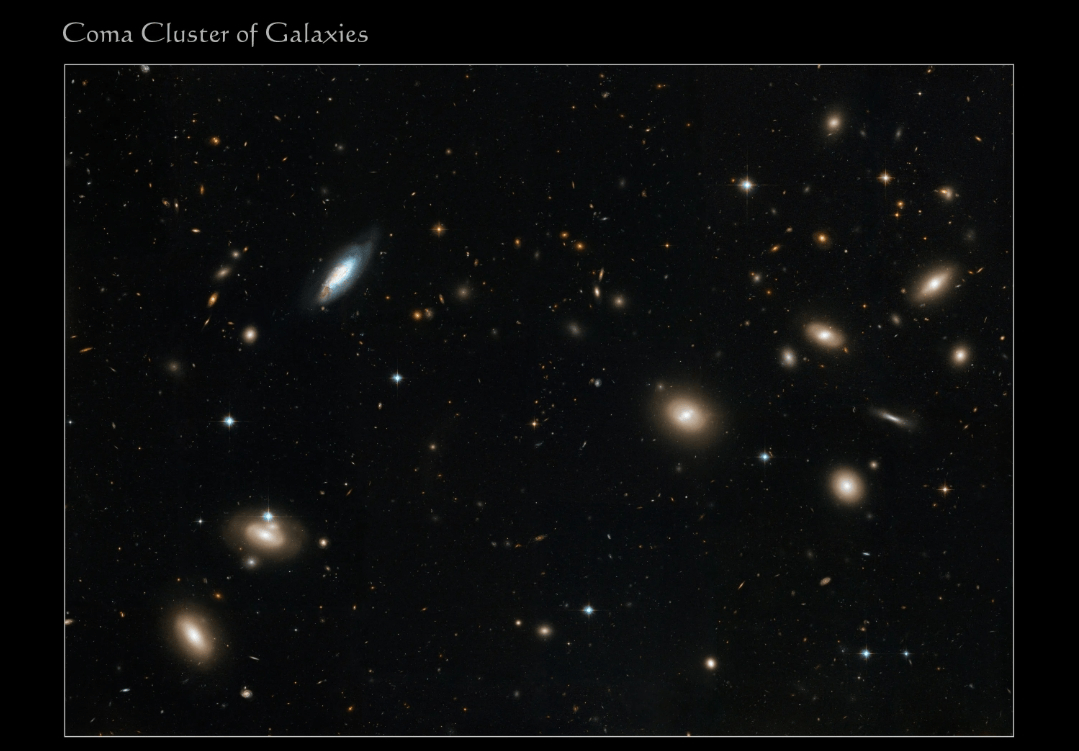
A recent measurement has sharpened the puzzle further. A team led by Dan Scolnic of Duke University and Adam Riess of Johns Hopkins targeted the Coma Cluster, a dense swarm of over a thousand galaxies about 320 million light-years away.
The Coma Cluster is close enough to reach with the distance ladder yet far enough that the pure expansion of space dominates its motion. That makes it an excellent independent anchor.
Using Type Ia supernovae in the cluster, the team measured its distance precisely. The result pointed to a high Hubble constant, in line with the other local measurements.
Far from easing the tension, the Coma result reinforced it. Yet another independent handle on the nearby universe landed on the high side of the divide.
Independent Referees: Lensing, Masers, and Red Giants
If only two methods disagreed, one might simply be wrong. What makes the tension so hard to dismiss is that many independent techniques have weighed in.
Strong gravitational lensing measures the expansion using the time delays between multiple images of a lensed quasar. It lands near the high, local value — and is fully independent of the distance ladder. The method is explained in our article on gravitational lensing.
Water megamasers — natural microwave lasers in distant galaxies — give geometric distances with no ladder at all. They too favour a high Hubble constant.
One method sits in between. The tip of the red-giant branch, an alternative distance marker championed by Wendy Freedman, has yielded intermediate values around 70 — neither fully confirming nor resolving the split.
This scatter is itself informative. The nearby universe consistently gives values at or above 70, while the early universe insists on 67 — a stand-off across many methods.
The Disagreement That Grew Under Better Instruments
The most informative thing about this problem is not the size of the gap but its history. Trace how the two measurements have evolved and the pattern is the reverse of what a measurement error would produce.
When the discrepancy first appeared, the error bars on both sides were wide enough that the two values overlapped uncomfortably rather than contradicting each other outright. The general expectation was that it would resolve in the ordinary way — someone would find an uncorrected systematic, the numbers would converge, and the episode would become a footnote.
Instead both measurements got sharper and stayed put. The early-universe value derived from the cosmic microwave background settled around 67.4 kilometres per second per megaparsec with an uncertainty well under one unit. The late-universe value from the distance ladder settled around 73, also with tight errors. Neither side moved towards the other. As the uncertainties shrank, the statistical significance of the disagreement climbed past three sigma, then four, and beyond five — the threshold at which particle physicists declare a discovery.
That is a genuinely unusual thing to happen in science, and it constrains the explanations. A hidden systematic in one measurement should, as precision improves, either shift the value or widen the error — not hold a wrong answer steady with increasing confidence. And the independent referees described below make a single culprit harder still: gravitational lensing time delays, water masers and tip-of-the-red-giant-branch distances are methods with almost nothing in common, and they have not produced a clean verdict for either camp.
One caution belongs here, because it is where honest cosmologists disagree. A five-sigma tension between two measurements is not the same as a five-sigma detection of new physics. Sigma quantifies how unlikely the disagreement is if both measurements are correct and correctly understood — it says nothing about which of those assumptions has failed. Systematics that are shared, subtle or simply unimagined do not announce themselves in the error budget, and the history of cosmology contains more than one confident anomaly that later dissolved.
What can be said firmly is this. The tension has now survived a generation of instruments explicitly built to resolve it, including the James Webb Space Telescope. Whatever the answer turns out to be, it is no longer the kind of problem that better photographs of the same objects will settle.
Could It Be a Mistake?
The most cautious explanation is that a systematic error lurks somewhere, unnoticed. Science has been fooled by hidden biases before.
But the room for such an error keeps shrinking. Webb ruled out Cepheid crowding, multiple ladder-free methods agree with the local value, and the early-universe result is backed by two separate probes.
For a systematic error to explain everything, it would have to be shared across techniques that have almost nothing in common. That is possible, but increasingly hard to imagine.
Each year the “mistake” explanation grows less comfortable, and the “new physics” explanation grows harder to avoid.
The Standard Model Under Strain
The framework connecting the two measurements is called Lambda-CDM — the standard model of cosmology. It describes a universe built from ordinary matter, cold dark matter, and dark energy.
This model has been extraordinarily successful. It explains the cosmic microwave background, the abundance of light elements, and the large-scale web of galaxies with remarkable accuracy.
The early-universe Hubble value is not measured directly — it is derived by assuming Lambda-CDM and extrapolating forward. That assumption is precisely what the tension calls into question.
If the local measurements are right and the model is sound, the two numbers should match. Their stubborn disagreement suggests a missing ingredient somewhere between the Big Bang and today.
That is why physicists no longer treat the tension as a nuisance to be explained away. They increasingly treat it as a clue — a place where the standard model may be quietly breaking down.
Could It Be New Physics?
If both measurements are right, then the model connecting them must be wrong. This is where the tension becomes genuinely exciting.
A leading idea is early dark energy — a burst of extra repulsive energy in the infant universe that faded quickly, changing the early-universe calibration and raising the predicted H₀.
The appeal of early dark energy is that it targets the right moment. By acting only in the first fraction of the universe’s history, it can nudge the predicted expansion rate upward without spoiling later successes.
But it is not a clean fix. Adding early dark energy tends to worsen agreement with other data, such as the detailed clustering of galaxies, creating fresh tensions as it relieves the old one.
Other proposals invoke new lightweight particles, subtle changes to the properties of neutrinos, or modifications to gravity itself on cosmic scales.
None of these is confirmed, and each brings its own difficulties. But the fact that serious theorists are exploring them shows how far the mainstream has moved.
Resolving the tension with new physics would be the biggest change to our cosmic model in decades — potentially as significant as the discovery of dark energy itself.
The DESI Result: Is Dark Energy Changing?

The tension has recently been joined by a second cosmological surprise. The Dark Energy Spectroscopic Instrument, or DESI, is mapping the positions of tens of millions of galaxies across a third of the sky.
DESI measures how cosmic structure has grown over time using baryon acoustic oscillations — the same primordial sound waves that anchor the early-universe measurement.
Its recent data releases have hinted at something startling: dark energy may not be constant after all. Its strength appears to have changed subtly over cosmic history.
If confirmed, evolving dark energy would overturn a core assumption of the standard model — and could be deeply connected to the Hubble tension. The nature of that force is explored in our article on dark energy, the invisible force pushing the universe apart.
The DESI hint is not yet a confirmed discovery, and the significance depends on how the data are combined. But together with the Hubble tension, it suggests our cosmic model may be fraying at more than one seam.
The Next Generation of Instruments
A wave of new observatories is arriving to attack the problem from every side.
The Vera C. Rubin Observatory will catch thousands of Type Ia supernovae, sharpening the local ladder. The European Euclid mission is mapping dark energy’s grip on cosmic structure across billions of years.
Gravitational-wave detectors add a completely new tool. Merging neutron stars act as “standard sirens,” giving distances directly from the physics of the wave, with no ladder at all.
The first such measurement came in 2017, from the neutron-star merger GW170817. It yielded a Hubble constant near the middle of the range, though with large uncertainty from a single event.
The power of sirens is that they sidestep every rung of the traditional ladder. They do not rely on Cepheids, supernovae, or the early-universe model — an entirely fresh line of evidence.
As detectors improve and catch more mergers, their combined precision will sharpen. Within a few years, standard sirens may deliver a decisive, independent verdict on the tension.
That is the real hope of the coming decade: not one better measurement, but many independent ones, converging until the universe is forced to reveal which number is right.
Why the Hubble Tension Matters
The Hubble tension is not a squabble over a decimal place. The Hubble constant underpins our entire picture of the cosmos.
It sets the age of the universe, its size, and the balance between its ingredients — ordinary matter, dark matter, and dark energy. A shift in H₀ ripples through all of it.
The invisible components most affected are explored in our articles on dark matter and on the vast structures that shape the cosmos.
Most importantly, moments like this are how physics advances. Small, stubborn discrepancies have repeatedly cracked open into revolutions — from the orbit of Mercury to the birth of quantum theory.
The universe is telling us, through two numbers that will not agree, that our understanding is incomplete. Following that clue is exactly how the next chapter of cosmology will be written.
For now, the honest answer is that no one knows which value is correct, or whether both may need revising. That uncertainty is not a failure of science — it is science working exactly as it should.
A number first sketched by Edwin Hubble a century ago has become the sharpest edge in modern cosmology. Wherever the resolution leads, it promises to reshape how we understand the size, age, and destiny of everything.
Frequently Asked Questions
What is the Hubble tension?
The Hubble tension is the persistent disagreement between two ways of measuring the Hubble constant, the universe’s expansion rate. Measurements based on the early universe give about 67.4 km/s/Mpc, while measurements based on the nearby universe give about 73 km/s/Mpc. The roughly eight percent gap now stands at around five sigma — statistically far too large to be chance.
What is the Hubble constant?
The Hubble constant (H₀) measures how fast the universe is expanding, expressed in kilometres per second per megaparsec. It describes how quickly a galaxy recedes from us for every megaparsec (about 3.26 million light-years) of distance. It is one of the most fundamental numbers in cosmology, setting the age, size, and fate of the universe.
Did the James Webb Space Telescope resolve the tension?
No — it deepened it. Webb was expected to test whether errors in Cepheid distance measurements were causing the tension. Instead, its sharper infrared observations confirmed the earlier Hubble Space Telescope measurements almost exactly, ruling out that explanation and strengthening the case that the tension is real rather than a measurement artefact.
What is the Coma Cluster and why does it matter here?
The Coma Cluster is a dense cluster of over a thousand galaxies about 320 million light-years away. It is close enough to measure with the distance ladder yet far enough that cosmic expansion dominates its motion, making it a valuable independent anchor. A recent Type Ia supernova measurement of its distance pointed to a high Hubble constant, reinforcing the tension rather than easing it.
Could the tension be explained by new physics?
Possibly. Leading proposals include early dark energy — a brief burst of repulsive energy in the infant universe — as well as new lightweight particles, altered neutrino properties, or modifications to gravity. None is confirmed, but the failure of “boring” explanations has pushed many cosmologists to take new-physics ideas seriously. Recent DESI hints of evolving dark energy add to the picture.
Why does the Hubble tension matter?
Because the Hubble constant underpins the age, size, and composition of the universe, a genuine discrepancy signals that our standard cosmological model is incomplete. Historically, small unexplained discrepancies — like the orbit of Mercury — have led to major scientific revolutions. Resolving the tension could reveal fundamentally new physics about dark energy, gravity, or the early universe.
Further Reading
Sources
- Planck Collaboration (2020). “Planck 2018 results. VI. Cosmological parameters.” Astronomy & Astrophysics, 641, A6 (DOI: 10.1051/0004-6361/201833910).
- Riess, A. G., et al. (2022). “A Comprehensive Measurement of the Local Value of the Hubble Constant (SH0ES).” The Astrophysical Journal Letters, 934, L7 (DOI: 10.3847/2041-8213/ac5c5b).
- Riess, A. G., et al. (2023). “Crowded No More: The Accuracy of the Hubble Constant Tested with JWST.” The Astrophysical Journal Letters, 956, L18 (DOI: 10.3847/2041-8213/acf769).
- Freedman, W. L., et al. (2019). “The Carnegie-Chicago Hubble Program: A Measurement of H₀ from the Tip of the Red Giant Branch.” The Astrophysical Journal, 882, 34 (DOI: 10.3847/1538-4357/ab2f73).
- Pesce, D. W., et al. (2020). “The Megamaser Cosmology Project. XIII. Combined Hubble Constant Constraints.” The Astrophysical Journal Letters, 891, L1 (DOI: 10.3847/2041-8213/ab75f0).
- Scolnic, D., Riess, A. G., et al. (2025). Distance to the Coma Cluster and a local measurement of H₀, The Astrophysical Journal Letters. See NASA — Hubble Space Telescope mission and results.
- DESI Collaboration — DESI DR2 Results II: cosmological constraints and evolving dark energy, arXiv:2503.14738 (2025).
Baryon. (2025, March 9). The Hubble Tension Deepens: Why the Universe’s Expansion Rate Remains a Cosmological Mystery. Web News For Us. https://webnewsforus.com/hubble-tension-cosmological-mystery/
Baryon. “The Hubble Tension Deepens: Why the Universe’s Expansion Rate Remains a Cosmological Mystery.” Web News For Us, 9 March 2025, https://webnewsforus.com/hubble-tension-cosmological-mystery/. Accessed 8 October 2026.