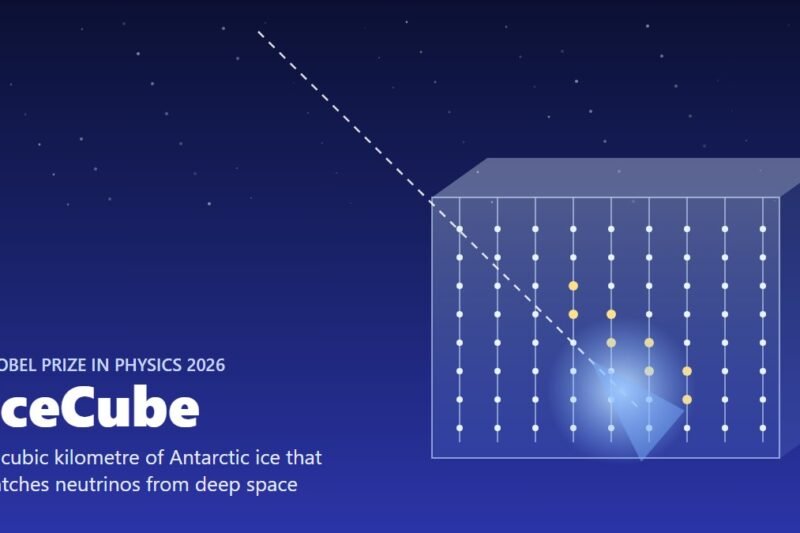
The three most sensitive dark matter detectors ever built sit deep underground in South Dakota, Italy and China. Between them they have now accumulated roughly nine tonne-years of exposure — and they have detected no dark matter at all.
What they have started detecting is neutrinos. In December 2025 the LZ collaboration announced both a new record exclusion limit and the first glimpses of neutrinos streaming from the core of the Sun. That is not an incidental result. It is the arrival of the boundary physicists call the neutrino fog — the point where solar and atmospheric neutrinos mimic the very signal being hunted.
The detectors are not failing. They are working perfectly, and what they are finding is the floor. After forty years of searching, the leading candidate for dark matter is running out of room to hide — and this article is about what that means for a substance we are certain exists.
In 1933, a Swiss astronomer with a reputation for being difficult pointed a telescope at the Coma Cluster — a swarm of more than a thousand galaxies bound by gravity, some 320 million light-years away — and found something that did not add up.
Fritz Zwicky measured how fast the galaxies were moving. Based on the visible mass of all the stars he could see, the cluster’s gravity should have been nowhere near strong enough to hold them together at those speeds. They should have flown apart long ago.
Something invisible had to be supplying the missing gravitational glue — roughly 400 times more mass than he could see. He called it dunkle Materie. Dark matter.
Almost no one took him seriously. Zwicky was brilliant but abrasive, and his idea sat largely ignored for forty years.
Then, in the 1970s, the American astronomer Vera Rubin studied the rotation of stars inside spiral galaxies, including our own, and found the same problem — with far more precision and far less room for doubt.
Rubin’s work was, in the end, decisive — the evidence that turned dark matter from a curiosity into a crisis the whole field had to confront.
She spent decades measuring galaxies with painstaking care, and was widely regarded as deserving of a Nobel Prize she never received before her death in 2016. Her galaxies did the arguing for her.
Today, dark matter is one of the best-supported conclusions in cosmology, backed by gravitational lensing, the cosmic microwave background, galaxy rotation curves, and the large-scale structure of the universe.
And yet, more than ninety years after Zwicky, not a single dark matter particle has ever been directly detected in any laboratory on Earth.
Roughly 27% of everything that exists is dark matter. Ordinary matter — every star, planet, person, and atom of breathable air — accounts for less than 5%. The remaining 68% is dark energy, a separate mystery entirely. We live in a universe we can mostly only infer.
Today the search for dark matter is usually described as a hunt for the WIMP, so we counted what physicists are actually writing about. Of the 20,400 arXiv papers with “dark matter” in the title on 1 September 2026, 824 name the WIMP. 4,600 name the axion.
The field has already moved, and it moved before the detectors ran out of room. Papers on the candidate that dominated three decades of experiment are outnumbered more than five to one by papers on the candidate that dominates none of them.
A title count measures attention, not truth, and it cannot tell you which particle is real. What it can show is that the theoretical community repositioned itself well ahead of the null results described below.
How We Know Something Invisible Is There
The case for dark matter does not rest on a single observation. It rests on multiple independent lines of evidence, gathered with different methods, decades apart, by different groups — all pointing to the same conclusion.
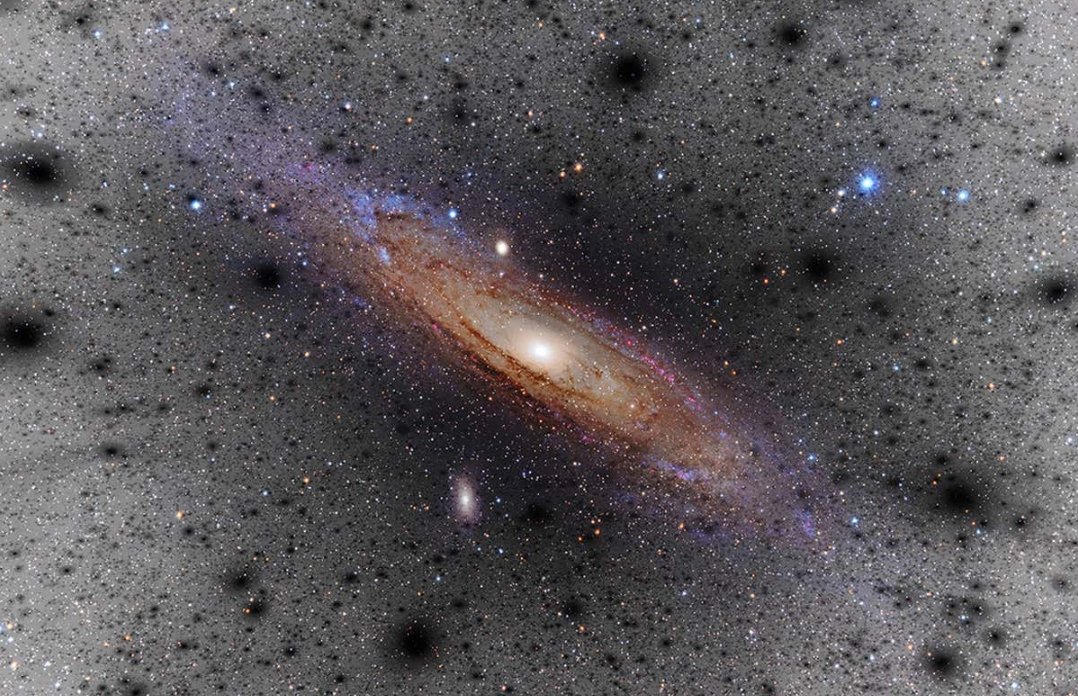
Vera Rubin’s galaxy rotation studies, made with instrument-builder Kent Ford through the 1970s and 1980s, remain the most intuitive. Newtonian gravity predicts that stars farther from a galaxy’s centre — like planets farther from the Sun — should orbit more slowly.
Mercury laps Neptune many times over. The same logic should apply to a galaxy.
It does not. Rubin found that stars at the outer edges of spiral galaxies orbit at roughly the same speed as those near the centre. The rotation curve is flat, exactly as it should not be if only visible matter were present.
The only fit is that each galaxy sits inside a vast, invisible halo of extra mass, extending far beyond the glowing disc — a scaffold that does not shine but governs how the galaxy spins.
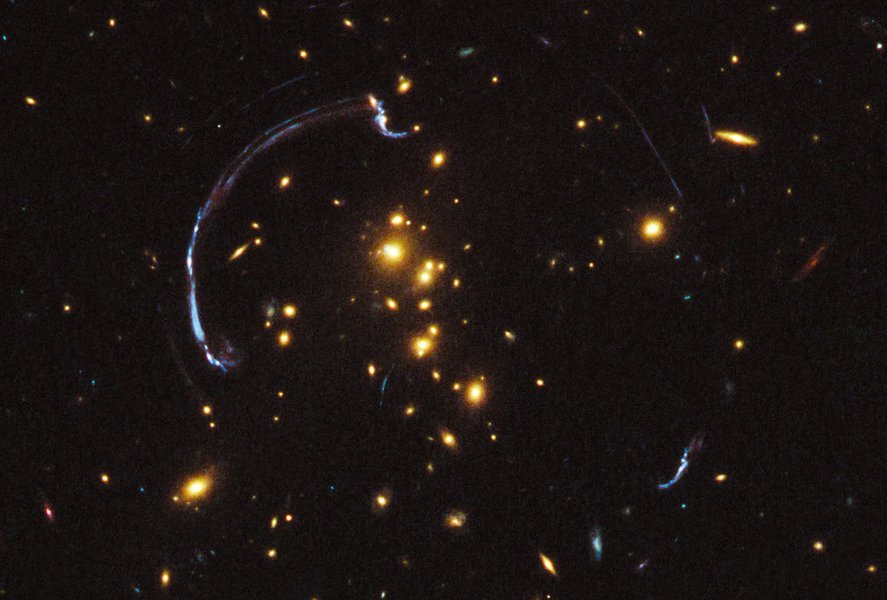
The second line comes from gravitational lensing — the bending of light by mass, predicted by Einstein. As light from a distant galaxy passes a massive foreground object, its path bends, distorting the background galaxy’s shape.
By measuring these distortions, astronomers map how much mass lies along the line of sight without ever seeing it. For how this works, see our guide to gravitational lensing: how the universe uses gravity as a telescope.
The third comes from the cosmic microwave background — the afterglow of the Big Bang, mapped in fine detail by the Planck satellite. The pattern of temperature ripples encodes the exact ratio of ordinary matter, dark matter, and dark energy in the early universe.
Planck pins dark matter at about 26.8% of the total energy content — a figure consistent with rotation curves and lensing, despite arriving from an entirely different method and epoch.
Dark matter is not only a distant abstraction. If current halo models are right, a faint stream of it is passing through your body as you read this — billions of particles every second, so weakly interacting that they leave no mark at all.
Our whole solar system is thought to be ploughing through a local sea of it as the Sun orbits the galaxy.
The underground detectors are, in essence, patient traps waiting for one of those countless ghosts to strike a nucleus just once, hard enough to notice — perhaps only a handful of times a year in tonnes of ultra-pure xenon.
That we know the quarry is there at all, despite how faint it is, is one of the quiet triumphs of modern physics.
The Bullet Cluster: Dark Matter’s Smoking Gun
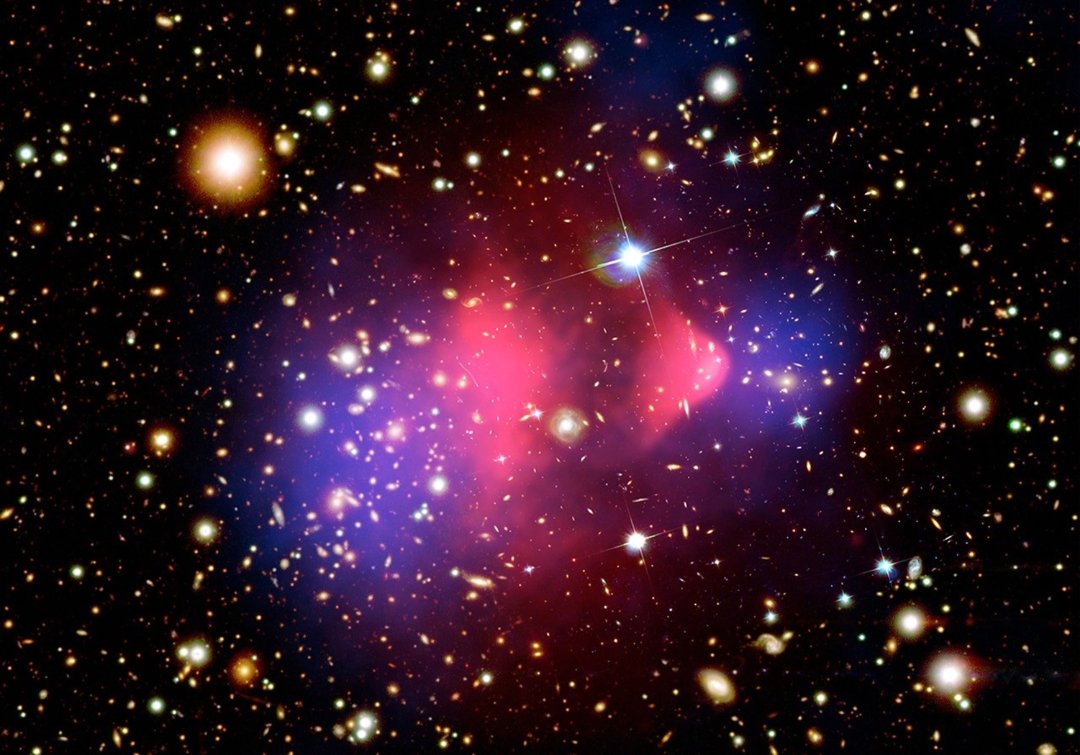
If one observation moved dark matter from compelling inference to near-certainty, it is the Bullet Cluster — the wreck of a collision between two galaxy clusters, observed by NASA’s Chandra X-ray Observatory and the Hubble Space Telescope in the early 2000s.
When two clusters collide, three components behave in three ways. The galaxies are so sparsely spread that they pass through each other, like two swarms of insects.
The hot intracluster gas — most of the ordinary visible matter — interacts, slows, and piles up in the middle, like cars in a motorway pile-up. And the dark matter interacts so weakly that it sails straight through, emerging on the far side untouched.
Astronomers used lensing to map where the total mass actually was. The result, published by Douglas Clowe and colleagues in 2006, was unambiguous: the mass was not where the hot gas had piled up.
It sat in two separate clumps well ahead of the gas — exactly where you would expect if most of each cluster’s mass had passed straight through.
This is a direct visual demonstration — an actual map, not an inference — that most of the mass in these clusters is something that does not behave like ordinary matter.
The Bullet Cluster remains one of the strongest arguments against theories that try to explain galactic motion without dark matter at all.
The Alternative: Could Gravity Itself Be Wrong?
Not every physicist accepts dark matter. A minority argue that the real problem is our theory of gravity, not a missing substance. The best-known alternative, Modified Newtonian Dynamics or MOND, proposes that gravity behaves slightly differently at the very low accelerations found in the outskirts of galaxies.
MOND is genuinely good at one thing: it predicts the flat rotation curves of individual galaxies with remarkable economy, using no invisible matter at all. For that reason it has never quite gone away.
But it struggles where dark matter succeeds. It cannot easily explain galaxy clusters, the detailed pattern of the cosmic microwave background, or — most tellingly — the Bullet Cluster, where the mass and the visible matter are cleanly separated in space.
Modifying gravity does not obviously produce that separation; a substance that passes through collisions does. Most cosmologists therefore treat dark matter as the far better fit to the full body of evidence, while acknowledging that a complete theory has yet to arrive.
What Dark Matter Might Actually Be
Knowing dark matter exists is not the same as knowing what it is. This is the deepest unsolved problem in the field, and after decades of ever more sensitive searches, the leading candidates have shifted in ways that reflect both progress and frustration.
WIMPs — Weakly Interacting Massive Particles — led the field for most of forty years. They would carry real mass but interact only via gravity and the weak force, ghosting through the Earth, through you, through a detector almost every time.
Their appeal was theoretical: they emerge naturally from supersymmetry, a once-promising extension of the Standard Model.
To catch one, physicists built vast underground tanks of liquid xenon, shielded by kilometres of rock, watching for the faint flash of a WIMP striking a nucleus.
The LUX-ZEPLIN experiment in South Dakota and XENONnT at Gran Sasso in Italy are the state of the art — and so far both have found nothing, pushing the sensitivity limits orders of magnitude beyond detectors from a decade ago.
That long silence matters. The leading xenon experiments have now reached what researchers call the “neutrino fog” — the point where background interactions from solar and atmospheric neutrinos become nearly indistinguishable from the WIMP signal itself, fundamentally limiting how much further this method can go.
The field, by its own account, has entered a mature phase: not a dead end, but a point demanding a strategic pivot rather than simply bigger tanks.
Axions have gained ground as attention shifts. Proposed in 1977 by Roberto Peccei and Helen Quinn to solve an unrelated puzzle — the strong CP problem — the axion turned out, almost by accident, to be an excellent dark matter candidate.
It would be extraordinarily light, perhaps billions of times less massive than a WIMP, and would convert into a detectable photon inside a strong magnetic field.
The Axion Dark Matter Experiment at the University of Washington — a microwave cavity inside a powerful superconducting magnet, tuned slowly across possible axion masses — is the flagship hunt. No confirmed signal yet, but the technique is entirely different from xenon detectors and free of the neutrino-fog limit.
Primordial black holes are a third possibility — not a new particle at all, but compact objects formed directly from density ripples in the first fraction of a second after the Big Bang, before any star existed.
In the right mass range, they could account for some or all of dark matter with no new physics. Gravitational-wave observatories such as LIGO have tightened the constraints by hunting for their mergers, though the idea survives in specific mass windows.
Part of what reshuffled these candidates was a silence elsewhere. Supersymmetry predicted new particles that the Large Hadron Collider was expected to find; through years of running at record energies, none have appeared.
That absence did not disprove WIMPs, but it removed much of the theoretical scaffolding that made them the obvious favourite — and pushed axions, sterile neutrinos, and other lighter possibilities up the list.
Sterile neutrinos are one such contender: hypothetical cousins of the known neutrinos that would interact even more weakly, feeling only gravity. Some astronomers have chased hints of their decay in the X-ray glow of galaxy clusters, though no result has yet held up to scrutiny.
The honest summary is that the true identity of dark matter remains genuinely open.
The New Maps: What 2025 and 2026 Have Revealed
Even without a direct detection, the past two years have produced the most detailed maps of dark matter’s distribution ever assembled — and a new generation of instruments is only beginning.
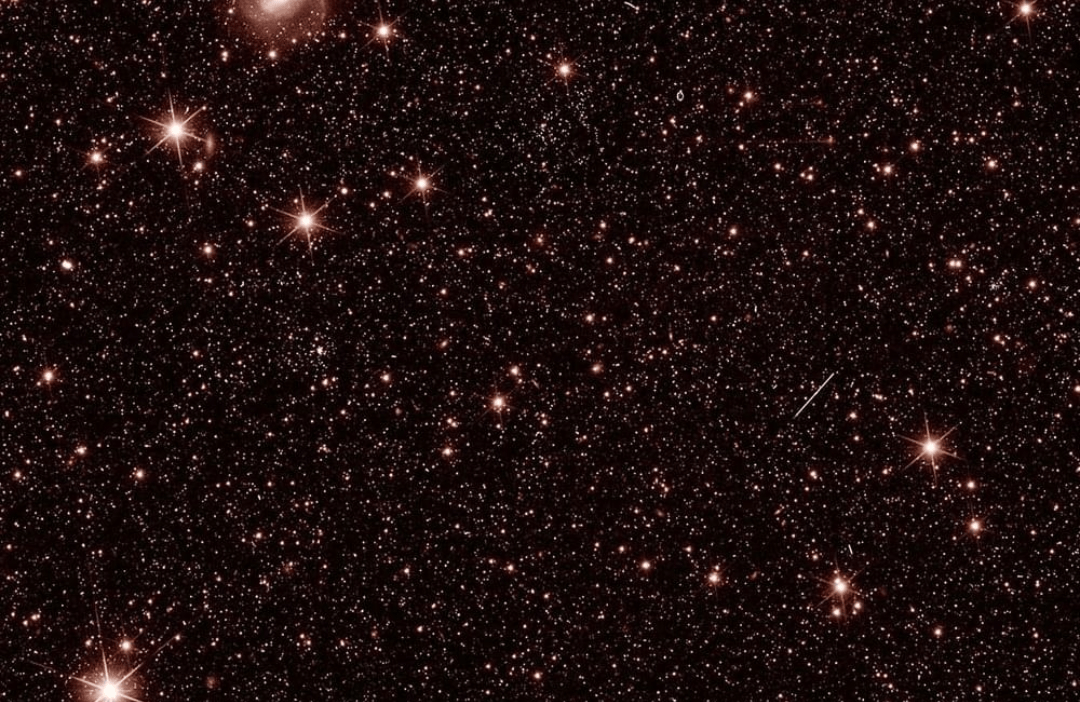
In January 2026 a team led by Diana Scognamiglio published in Nature Astronomy a new map of dark matter built from the James Webb Space Telescope’s COSMOS-Web survey. Rather than zooming in on individual clusters, it measured the faint distortion that intervening mass imprints on the shapes of background galaxies — about 129 of them per square arcminute — across a contiguous patch of sky 0.77 by 0.70 degrees, and reconstructed the invisible mass responsible at more than twice the resolution of earlier Hubble maps, sharp to about one arcminute. The breadth matters as much as the sharpness. High-resolution dark matter maps have often been built around individual massive clusters, where the lensing signal is strongest. A contiguous field records how the invisible mass is laid out across ordinary stretches of the universe as well — the scaffolding between the peaks, not only the peaks themselves — and that full pattern is what any successful theory of dark matter ultimately has to reproduce.
The researchers called it a crucial first step toward everything astronomy will next learn about dark matter, and are now extending the work into a three-dimensional reconstruction.
The Vera C. Rubin Observatory, on Cerro Pachón in Chile, released its first engineering images in June 2025 and, after a period of commissioning and optimisation, began its ten-year Legacy Survey of Space and Time on 30 June 2026.
Conceived in the 1990s as a dedicated Dark Matter Telescope before being broadened, Rubin is expected to catalogue around 20 billion new galaxies over a decade-long survey, mapping the cosmic web — the vast filamentary structure sculpted directly by dark matter’s gravity.
With a field of view nearly ten times larger than any comparable instrument, Rubin will detect subtle weak-lensing distortions across the entire southern sky.
It will work alongside the European Space Agency’s Euclid telescope, launched in 2023, and NASA’s Nancy Grace Roman Space Telescope, each surveying different scales. Astronomers increasingly call this a golden age of dark-universe exploration.
For the connected puzzle driving cosmic acceleration, see our guide to dark energy: the invisible force pushing the universe apart.
These maps do more than locate dark matter — they test its nature. The way invisible mass clumps on small scales can distinguish between rival candidates: cold, slow-moving dark matter builds abundant small structures, while lighter or “warmer” particles smooth them away.
By charting the cosmic web in unprecedented detail, Rubin and its partners may narrow down what dark matter is without ever catching a single particle, reading its identity from the architecture it has built.
The Search That Keeps Finding Nothing
Three experiments dominate the direct search for dark matter, and all three work on the same principle: fill a tank with liquid xenon, bury it deep enough to shield it from cosmic rays, and wait for a passing particle to knock into a xenon nucleus hard enough to produce a flash of light.
- LZ, in a former gold mine in South Dakota, reported results from 4.2 tonne-years of exposure.
- XENONnT, beneath the Gran Sasso mountain in Italy, has published searches at 3.1 tonne-years, and a light dark matter search using 7.8 tonne-years of ionisation-only data.
- PandaX-4T, in the China Jinping Underground Laboratory, has reported 1.54 tonne-years.
Every one of these has returned the same headline result: no confirmed dark matter signal. What they produce instead are exclusion limits — statements of the form “if a particle of this mass interacted this strongly, we would have seen it, and we did not.” With each run those limits tighten, and the space where the leading candidate could still be hiding contracts.
That candidate is the WIMP — the Weakly Interacting Massive Particle, which for four decades was the consensus expectation. Its appeal was that a particle with roughly the mass and interaction strength suggested by particle physics would naturally be produced in the right abundance to account for dark matter. That coincidence looked like a clue. The searches have now ruled out most of the range where it was expected to sit.
And now the detectors have reached the neutrino fog. Neutrinos from the Sun and from cosmic-ray collisions in the atmosphere scatter off xenon nuclei in almost exactly the way a dark matter particle would. Below a certain sensitivity that background becomes irreducible — you cannot shield against neutrinos, and you cannot distinguish their recoils event by event. LZ detecting solar neutrinos is a genuine scientific achievement and simultaneously a signal that this experimental approach is nearing its physical limit.
None of this weakens the evidence that dark matter exists — the galactic rotation curves, the lensing, the Bullet Cluster and the cosmic microwave background all still stand, and they are described above. What has weakened is one specific guess about what it is made of. The field is now widening its search towards axions, sterile neutrinos and lighter candidates that these xenon detectors were never designed to catch. Forty years of null results have not disproved dark matter. They have disproved our first confident theory of it.
What LZ Actually Reported in December 2025
The December 2025 result deserves precision, because it is easy to summarise as one more null. Using 417 live days of data collected between March 2023 and April 2025 in ten tonnes of liquid xenon, nearly a mile underground at the Sanford Underground Research Facility in South Dakota, LZ found no sign of WIMPs with masses between 3 and 9 GeV — the first time the experiment had looked below 9 GeV — and set the world’s most stringent limits above 5 GeV.
In the same data it made the first statistically significant detection of boron-8 solar neutrinos by coherent elastic neutrino–nucleus scattering, in which a neutrino nudges an entire xenon nucleus rather than a single particle within it. The result reached 4.5 sigma, comfortably past the three-sigma level physicists treat as evidence. Those neutrinos are born in fusion reactions in the core of the Sun, so the same instrument built to catch dark matter has become a probe of the Sun’s interior.
That is the neutrino fog described earlier, arriving on schedule. It is a genuine measurement, and a sign that this detector design is approaching the floor of what it can distinguish from the background. LZ is scheduled to collect more than 1,000 live days by 2028, and its collaboration is developing a larger successor, XLZD, intended to hunt WIMPs while also studying neutrinos, the Sun and cosmic rays. The next generation of direct detection has, in effect, been designed around the fog rather than in the hope of escaping it.
None of this changes the balance of evidence set out in this article. The astronomical case that dark matter exists — from galaxy rotation to the Bullet Cluster to the new lensing maps — rests on gravity, and grows stronger with every survey. What the laboratory searches keep narrowing is not whether dark matter is there, but what it could be made of — and, after four decades, how little room the long-time favourite has left to hide in.
What Scientists Say
The mood in the field is a mix of patience and genuine excitement. Researchers behind the 2026 Webb map frame it as the foundation for a decade of discovery to come, and astronomers describe near-universal anticipation for what Rubin will reveal about the cosmic web.
At the same time, the field’s own 2025 reviews describe a mature phase — a shift away from isolated anomalies toward disciplined, statistically rigorous, multi-messenger strategies. Dark matter still makes up roughly 85% of all the matter in the universe, and its fundamental nature remains, for now, unknown.
Why This Matters: Dark Matter Is Why Galaxies — and We — Exist
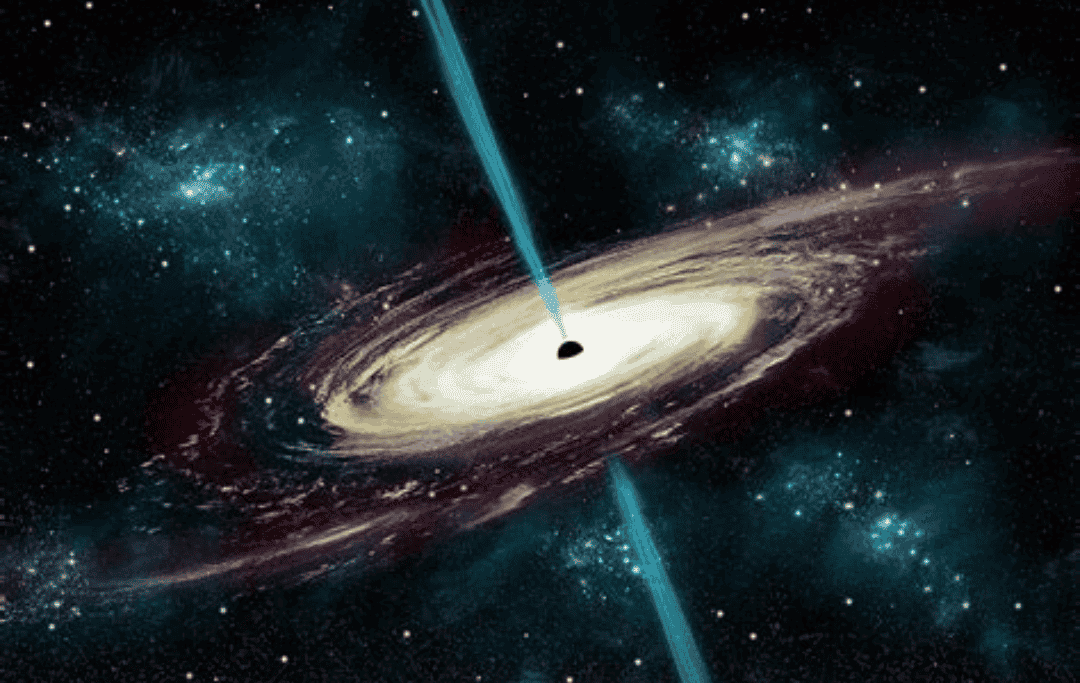
Dark matter is not a peripheral curiosity. It is structural. Without it, the universe we observe could not have formed in anything like its present shape.
In the early universe, matter was spread almost perfectly evenly, with only faint density ripples.
Ordinary matter alone, buffeted by intense radiation, could not have amplified those ripples fast enough to build galaxies and clusters within 13.8 billion years — radiation pressure would have smoothed them out almost as quickly as gravity tried to grow them.
Dark matter solves this because it ignores radiation entirely.
While ordinary matter was still being pushed around, dark matter was already collapsing under its own gravity, carving the deep wells — dark matter halos — into which gas later fell, cooled, and condensed into the first stars.
Galaxies did not form in spite of dark matter. They formed because of it.
This is why the new maps matter so much.
They are not cataloguing an invisible substance for its own sake — they are reconstructing the architecture of cosmic history, tracing how the universe assembled itself from featureless plasma into galaxies, stars, planets, and ultimately the chemistry of life.
That chemistry runs all the way down to the DNA in every living cell — built from atoms forged in stars that could only form because dark matter pulled the early universe’s gas together in the first place.
There is a striking humility in all of this. The substance that shaped every galaxy, seeded every star, and made the chemistry of life possible is one we have never held, never seen, and cannot yet name.
We have measured its gravity to exquisite precision and remain ignorant of what it is.
Ninety years after Zwicky’s dismissed calculation, dark matter stands as both one of science’s greatest confirmed discoveries and one of its deepest open questions.
Whether the answer arrives from a xenon tank deep underground, an axion cavity, or a sky-wide survey from Rubin, it will rank among the most important findings of the century. For now, the universe keeps its largest secret in plain sight.
Frequently Asked Questions
What is dark matter in simple terms?
Dark matter is an invisible form of matter that emits, absorbs, and reflects no light, but exerts gravity on everything around it. It makes up about 27% of the universe — roughly five times more than all the ordinary matter in stars and planets — and is known only through its gravitational effects, never having been directly detected.
What is the difference between dark matter and dark energy?
They are entirely different things that share the word “dark.” Dark matter exerts gravitational attraction and holds galaxies together. Dark energy is a property of space with a repulsive effect, driving the accelerating expansion of the universe. Dark matter is about 27% of the universe; dark energy about 68%.
Has dark matter ever been directly detected?
No. Despite decades of sensitive experiments — underground detectors like LUX-ZEPLIN and XENONnT, and axion searches like ADMX — no dark matter particle has ever been caught in a laboratory. All evidence is indirect. Direct-detection experiments have now reached the “neutrino fog,” where background neutrino signals are hard to separate from a possible dark matter one.
Could dark matter be black holes instead of a new particle?
Possibly — this is the primordial black hole hypothesis. These would be black holes formed from density fluctuations in the first instant after the Big Bang, not from dying stars. Gravitational-wave observatories like LIGO have constrained the idea by searching for their mergers, narrowing but not eliminating the mass ranges where they could account for dark matter.
Why can’t telescopes just see dark matter directly?
Because it does not interact with light at all — it emits, absorbs, and reflects no radiation of any wavelength, so no telescope can image it. Astronomers detect it only through gravity: how it bends light, how it sets galaxy rotation speeds, and how it shaped the cosmic microwave background.
What would happen if dark matter did not exist?
Galaxies as we know them likely could not have formed within the age of the universe — ordinary matter’s density ripples were too small and slow-growing to assemble them in time. Spiral galaxies like the Milky Way would also fly apart, since their visible mass alone cannot hold stars at the rotation speeds we actually observe.
Further Reading
Sources
- Rubin, V.C. & Ford, W.K. (1970) — Rotation of the Andromeda Nebula from a spectroscopic survey of emission regions. The Astrophysical Journal 159:379.
- Clowe, D. et al. (2006) — A direct empirical proof of the existence of dark matter. The Astrophysical Journal 648:L109.
- Scognamiglio, D. et al. (26 January 2026) — An ultra-high-resolution map of (dark) matter. Nature Astronomy.
- PandaX-4T Collaboration (2025) — Dark matter search results from 1.54 tonne-year exposure of PandaX-4T. Physical Review Letters 134:011805.
- Lawrence Berkeley National Laboratory (8 December 2025) — LZ sets a world’s best in the hunt for galactic dark matter.
- Vera C. Rubin Observatory (30 June 2026) — Rubin begins the Legacy Survey of Space and Time.
- Clowe, D. et al. — A Direct Empirical Proof of the Existence of Dark Matter (2006), the Bullet Cluster
- Rubin, V. C. & Ford, W. K. — Rotation of the Andromeda Nebula (1970)
- National Geographic — The most detailed dark matter map ever, JWST (Jan 2026)
- Vera C. Rubin Observatory — Unravelling the dark universe
- ICRC 2025 — Dark Matter Session Proceedings
- Brown University — LZ sets new record and glimpses solar-core neutrinos (December 2025)
- Dark matter implications from the LZ, PandaX-4T and XENONnT data, arXiv (2025)
Baryon. (2025, April 27). Dark Matter: The Invisible Substance Holding the Universe Together. Web News For Us. https://webnewsforus.com/dark-matter-the-invisible-universe/
Baryon. “Dark Matter: The Invisible Substance Holding the Universe Together.” Web News For Us, 27 April 2025, https://webnewsforus.com/dark-matter-the-invisible-universe/. Accessed 17 October 2026.