Before September 2015, every black hole ever discussed was an inference. Astronomers watched stars orbit something unseen, or gas heat up as it fell towards nothing, and reasoned backwards. Nobody had ever detected one directly.
The latest gravitational-wave catalogue, GWTC-5.0, published in May 2026, brings the cumulative total to 390 candidate signals, each judged more likely than not to have come from space rather than from the instruments. Almost all of them are black holes colliding. In a single decade the field went from zero direct observations to hundreds, and from a theoretical object to a population with measurable masses and spins.
That shift is the most important thing that has happened in this subject since Hawking, and it changed what the open questions are. This article covers the physics — horizons, radiation, the information paradox — and then what 390 detections have actually taught us that theory alone could not.
A black hole is a region of spacetime where gravity is so extreme that nothing — not matter, not radiation, not light itself — can escape once it crosses a specific boundary. That boundary is the event horizon.
It is one of the most consequential concepts in modern physics — not merely a feature of exotic astrophysical objects, but a testing ground for our deepest theories about space, time, information, and reality itself.
Black holes were once considered mathematical curiosities — solutions to Einstein’s equations that probably did not exist in nature. That view has been overturned completely. We now know they are common.
Every large galaxy appears to host a supermassive black hole at its centre, including our own Milky Way. Stellar-mass black holes are thought to be common throughout the galaxy, although only a small number have been identified, almost all because they orbit a visible star. And in 2019 and 2022, the Event Horizon Telescope produced the first direct images of black hole shadows, turning theory into observed reality.
But the most profound questions about black holes are not observational — they are theoretical. Stephen Hawking’s discovery that black holes are not truly black introduced a paradox that has driven physics for fifty years and remains unsolved. This is what black holes are, how they form, what happens at the event horizon, and why the information paradox runs so deep.
Formation: How Black Holes Are Born
Stellar-mass black holes form from the deaths of the most massive stars. When a star more than roughly twenty times the Sun’s mass exhausts its nuclear fuel, the outward pressure of fusion that balanced gravity for its entire life ceases. Gravity wins.
The core collapses catastrophically in a fraction of a second, compressing matter to densities beyond anything any known force can support. The result is a singularity — a region where current physics breaks down — surrounded by an event horizon. The star’s outer layers may be blown off in a supernova, although theory suggests that some massive stars collapse with little or no explosion.
Not every collapse makes a black hole. Stars roughly 8 to 20 solar masses typically form neutron stars — city-sized objects denser than an atomic nucleus. Above about 20 solar masses, even the neutron star collapses further into a black hole. The dividing line depends on the star’s composition and rotation and is not precisely known.
Gravitational waves are starting to probe that dividing line. On 29 May 2023 LIGO recorded GW230529, the merger of a neutron star with an object of 2.5 to 4.5 solar masses, heavier than the heaviest known neutron stars and lighter than the lightest black holes previously found in our galaxy. The most probable reading is a light black hole sitting in what had looked like a gap between the two populations.
This continuum of stellar death is explored in our articles on the complete life cycle of stars and on neutron stars, the universe’s most extreme survivors.
Supermassive black holes — the monsters at galactic centres, from millions to tens of billions of solar masses — have a murkier origin. They were already present when the universe was less than a billion years old, implying mechanisms that operated fast in the early cosmos.
The James Webb Space Telescope has pushed the puzzle earlier still. In 2023 astronomers combined Webb images with X-ray data from NASA’s Chandra observatory to find a black hole of roughly 10 to 100 million solar masses in a galaxy seen when the universe was less than 500 million years old. They argued that a black hole so large, so early, favours “heavy seeds” formed by the direct collapse of gas clouds rather than the remnants of the first stars.
Candidate mechanisms include the direct collapse of massive gas clouds, the merging of many stellar-mass black holes, or the rapid accretion of seed black holes. Active galactic nuclei — among the most luminous objects in the universe — are powered by matter falling into these giants, converting energy far more efficiently than nuclear fusion.
The Event Horizon: The Point of No Return
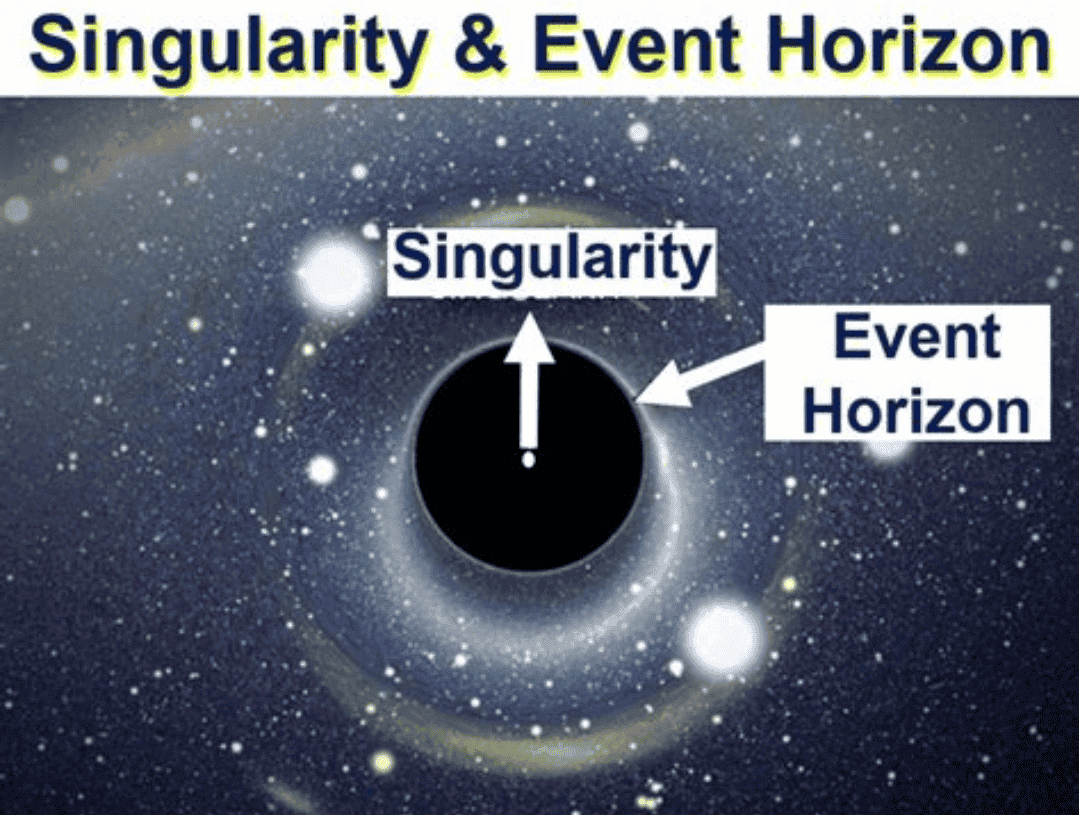
The event horizon is the defining feature of a black hole — the boundary beyond which escape becomes impossible. It is not a physical surface. There is no wall or membrane a falling observer would feel as they crossed it.
It is a surface in spacetime defined purely by cause and effect: events inside the horizon can never send a signal to events outside it. The threshold is causal, not material.
For a non-rotating (Schwarzschild) black hole, the horizon is a sphere whose radius is proportional to mass. A one-solar-mass black hole has a Schwarzschild radius of about 3 kilometres. Sagittarius A*, the roughly 4-million-solar-mass giant at the Milky Way’s centre, has a Schwarzschild radius of about 12 million kilometres, so its horizon would fit comfortably inside the orbit of Mercury.
To a distant observer, an object falling in appears to slow and redden as it nears the horizon, seeming to freeze there forever — an effect of gravitational time dilation. To the falling object itself, crossing is unremarkable, with no local signal that the line has been passed.
The fate beyond depends on size. Near a stellar-mass black hole, tidal forces would stretch and shred a body long before the horizon. At a supermassive black hole, the horizon is so large that tidal forces there are mild — a freely falling observer could cross without immediate harm, though their fate is still sealed.
Real black holes rotate, so they are described by the Kerr solution rather than the Schwarzschild one. Rotation adds the ergosphere — a region outside the horizon where spacetime itself is dragged around so violently that nothing can stay still — and the possibility of extracting rotational energy through the Penrose process.
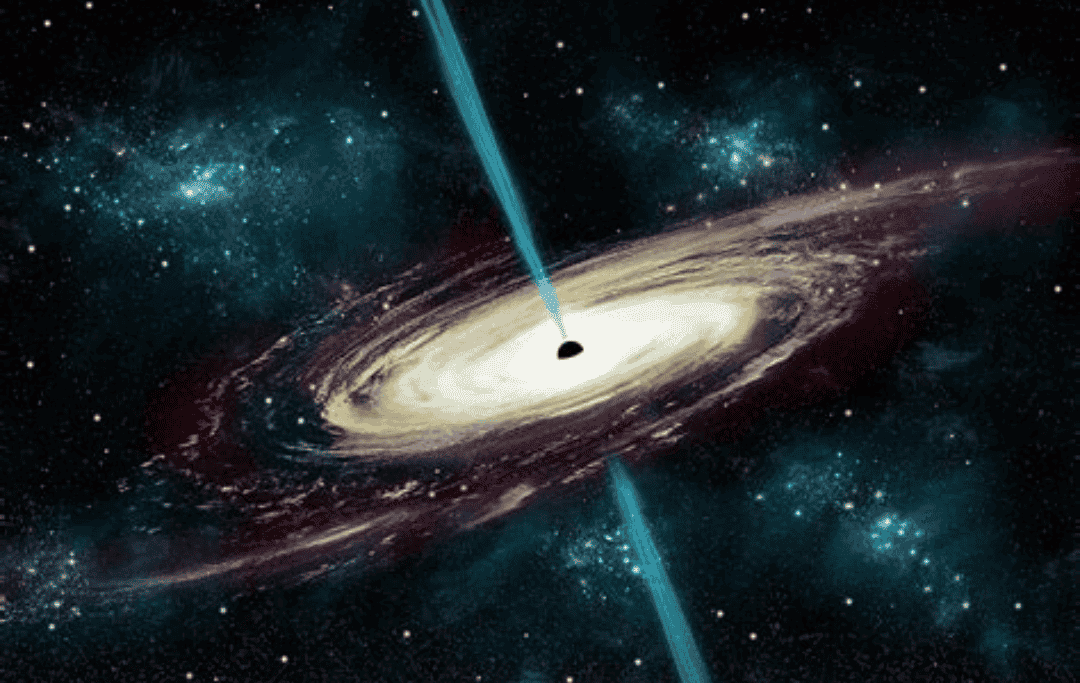
The related Blandford-Znajek mechanism, which taps that rotational energy magnetically, is thought to power the enormous relativistic jets seen shooting from active galactic nuclei and gamma-ray bursts.
Hawking Radiation: Black Holes Are Not Black
In 1974, Stephen Hawking published one of the most remarkable results in the history of physics. Applying quantum field theory to the curved spacetime near an event horizon, he showed that black holes are not truly black — they emit thermal radiation at a temperature inversely proportional to their mass.
This radiation, now called Hawking radiation, is a purely quantum effect with no classical counterpart. It emerges from the behaviour of quantum fields in the vacuum right at the edge of the horizon.
The intuitive picture, though not exact, captures the physics. The quantum vacuum is not empty — it seethes with virtual particle-antiparticle pairs constantly appearing and annihilating. Near the horizon, a pair can form with one partner inside and one outside.
The outside particle can escape as real radiation, while its partner falls in carrying negative energy that reduces the black hole’s mass. Over immense spans of time, this slow bleed causes the black hole to evaporate entirely.
For astrophysical black holes the temperature is absurdly low. A one-solar-mass black hole has a Hawking temperature near 60 nanokelvin — far colder than the 2.7-kelvin cosmic microwave background, meaning stellar-mass black holes currently absorb more energy from the sky than they emit.
Hawking radiation becomes significant only for very small black holes, and evaporating any macroscopic one would take vastly longer than the current age of the universe. None has ever been directly detected — yet the result is profound, uniting general relativity, quantum mechanics, and thermodynamics in a single stroke.
Black Hole Thermodynamics
Hawking’s result was prefigured by Jacob Bekenstein, who in 1972-73 proposed that black holes must have entropy — a measure of disorder — proportional to the area of their event horizon. It was a shocking claim.
Classically, black holes seemed to break the second law of thermodynamics: throw entropy into one and it vanishes, apparently lowering the universe’s total entropy. Bekenstein argued the entropy was not destroyed but stored in the horizon’s area.
In 1973 James Bardeen, Brandon Carter and Hawking set out four laws of black hole mechanics — an exact parallel to ordinary thermodynamics, with horizon area playing the role of entropy and surface gravity the role of temperature. At first it looked like a formal analogy. Hawking’s 1974 discovery that black holes radiate showed it was real: black holes are genuine thermodynamic objects.
The Bekenstein-Hawking entropy formula states that a black hole’s entropy is one quarter of its horizon area measured in Planck units, built from the Planck length, the scale at which quantum effects on gravity are expected to matter. It is believed to encode deep truths about quantum gravity.
Reproducing that formula from a microscopic theory is now a key test of any candidate theory of quantum gravity. Andrew Strominger and Cumrun Vafa did so in string theory in 1996 for a special class of black holes, and loop quantum gravity has reproduced it under its own assumptions — one of the field’s genuine successes.
The Information Paradox
Black hole evaporation creates one of the deepest paradoxes in physics. Quantum mechanics is unitary — information is never destroyed. The quantum state of a system evolves so that, in principle, the initial state can always be reconstructed from the final one.
But suppose a black hole forms from a collapsing star, swallows matter for billions of years, then evaporates completely via Hawking radiation. What happens to the information about everything that fell in?
Hawking argued in a 1976 paper that the radiation is exactly thermal — carrying no information about what was consumed. If that is right, evaporation destroys information, violating quantum mechanics itself. This is the black hole information paradox.
Every resolution is uncomfortable. If information is truly lost, quantum mechanics must be rewritten with consequences reaching far beyond black holes. If it escapes in the radiation, it must hide in subtle quantum correlations Hawking’s calculation missed — provable only with a full theory of quantum gravity we do not yet possess.
The prevailing view — shaped by Juan Maldacena, Andrew Strominger, Raphael Bousso, and many others — is that information is preserved and escapes in the radiation, but that showing how demands physics beyond Hawking’s semiclassical approach. Hawking himself changed his mind. In 2004 he conceded a bet with the physicist John Preskill that information is lost, and in a 2005 paper he argued that it is preserved.
A major recent advance concerns the Page curve, named after Don Page, who showed in 1993 how the entanglement of the radiation should rise and then fall over an evaporation if information escapes. In 2019 two groups, one led by Geoff Penington and the other by Ahmed Almheiri and colleagues, showed how to obtain that curve from gravity calculations. It is strong theoretical evidence that unitarity survives, even though a complete microscopic account remains out of reach.
The paradox ties directly to entanglement and the nature of spacetime. The ER=EPR conjecture — discussed in our article on quantum entanglement — proposes that the entanglement between escaping and infalling particles is a microscopic wormhole linking them. For how such bridges connect to cosmic structure, see our article on the wormhole solution.
The First Images: M87* and Sagittarius A*
In April 2019, the Event Horizon Telescope collaboration published the first direct image of a black hole — the supermassive object at the centre of galaxy M87, now called M87*, weighing about 6.5 billion solar masses.
The image showed a bright ring of light, bent around the black hole by its gravity, surrounding a dark central region called the shadow. The shadow is not the horizon itself: for a black hole like M87* it is about two and a half times larger, because light passing near the horizon is captured or bent away. A theoretical prediction had become a photograph.
In May 2022, the same team imaged Sagittarius A*, the 4-million-solar-mass black hole at the heart of our own galaxy. It was harder to capture than M87*: its smaller size means the glowing gas around it changes over minutes rather than days or weeks, demanding sophisticated time-averaging.
Both images match general relativity’s predictions for the shadow of a rotating Kerr black hole, providing the most direct strong-gravity tests of Einstein’s theory yet achieved. Future networks aim to record the accretion in motion and probe relativity to still higher precision.
The test has been repeated. Images made from observations a year later, in 2018, and published in 2024 showed M87*’s ring with the same size, while its brightest region had shifted — what is expected when turbulent gas swirls around a shadow fixed by the black hole’s mass.
What 390 Detections Have Actually Taught Us
The Gravitational Wave Open Science Center publishes the catalogue’s events. With GWTC-5.0 the cumulative list reached 390 candidates, and the centre’s public list held 391 on 5 October 2026. That archive has settled several questions that decades of theory could not.
It began with GW150914, recorded on 14 September 2015 and announced in February 2016: two black holes of about 36 and 29 solar masses merging some 1.3 billion light-years away, with about three suns’ worth of energy leaving as gravitational waves in a fraction of a second. At Earth the wave changed the length of LIGO’s 4-kilometre arms by about one part in 10²¹. The 2017 Nobel Prize in Physics went to Rainer Weiss, Barry Barish and Kip Thorne for the detection.
Black holes of unexpected mass exist. Before 2015, stellar-mass black holes were expected to cluster around ten solar masses, based on the X-ray binaries we could study. The gravitational-wave population includes many considerably heavier — objects of thirty, fifty and more solar masses that the pre-2015 sample had almost entirely missed, because a black hole with no companion feeding it emits no X-rays and was therefore invisible to the older method.
The record so far is GW231123, detected on 23 November 2023: two black holes of roughly 137 and 101 solar masses, both spinning fast, with a combined mass of about 190 to 265 suns. The heavier one sits in or above a range, roughly 60 to 130 solar masses, where theory says collapsing stars should rarely leave black holes at all.
The new population sent astronomers back to look closer to home. In 2024 the Gaia mission found a dormant black hole of about 33 solar masses some 1,900 light-years away, orbiting an old star poor in heavy elements — the most massive stellar black hole known in our galaxy, and the kind of object gravitational waves had suggested must exist. In 2022 Hubble observations had revealed the first isolated stellar-mass black hole, detected only by how its gravity shifted and brightened the light of a background star.
The horizon behaves as general relativity predicts. Each merger ends with a ringdown, as the newly formed black hole settles into a stable shape and its vibrations decay. The frequencies of that ringing depend on the mass and spin of the remnant, and general relativity makes precise predictions about them. Across hundreds of events those predictions have held, which is a strong test of the theory in exactly the regime where it might have been expected to fail.
The latest catalogue’s tests of general relativity draw on 168 events. In every one, subtracting the best-fit prediction left nothing but detector noise; in one combined ringdown analysis the prediction sat in the tails of the results, which the authors attribute to the still limited sample.
The clearest single test came from GW250114, recorded on 14 January 2025 and the loudest signal yet. Its two black holes, of about 33 and 32 solar masses, were close cousins of the first detection in 2015, but the signal was far cleaner. Analysts picked out more than one tone in the ringdown, and they confirmed a prediction Hawking made in 1971: the total area of black hole horizons cannot decrease. The final black hole’s horizon was larger than the two original horizons combined.
Two black holes have been imaged, and only two. The Event Horizon Telescope produced pictures of M87* in 2019 and Sagittarius A* in 2022. Both required a planet-sized network of radio dishes observing on a few nights in April 2017, followed by years of analysis, and both are supermassive objects — the only ones close enough and large enough on the sky to resolve. Every other black hole remains, visually, a point.
Set against that, notice what the archive contains none of. Hawking radiation has never been observed. The effect described earlier in this article is theoretically well motivated and almost universally accepted, but for a stellar-mass black hole it is fantastically faint — far colder than the cosmic microwave background that surrounds it, and therefore swamped. The single most famous prediction in black hole physics remains entirely untested by observation, which is worth stating plainly given how often it is described as established fact.
The nearest thing to a test has come from the laboratory. In 2019 Jeff Steinhauer’s group at the Technion in Israel reported an analogue black hole made from a flowing cloud of ultracold rubidium atoms, in which sound, rather than light, cannot escape. The sound radiation it emitted was thermal, at the temperature Hawking’s formula predicts for that system. It shows the mathematics behaves as Hawking said; it says nothing directly about gravity, and no astrophysical black hole has yet been caught radiating.
Why Black Holes Matter
Black holes are where our two great theories of physics collide. General relativity governs the vast, curved spacetime around them; quantum mechanics governs the vacuum at their horizons. At the singularity, both fail at once.
That makes them the single most important laboratory we have for the search for quantum gravity — the theory that would unite the very large and the very small. Much of the most exciting theoretical physics of the past fifty years has come from taking black holes seriously.
They also shaped the career of the physicist most associated with them. The story of how one man turned these objects into a lifelong quest is told in our review of Stephen Hawking’s A Brief History of Time.
Frequently Asked Questions
What is a black hole?
A black hole is a region of spacetime where gravity is so extreme that nothing — not light, not matter, not any signal — can escape once it crosses the event horizon. Black holes form from the gravitational collapse of massive stars and are fully described by just three properties: mass, electric charge, and angular momentum (rotation).
What is the event horizon?
The event horizon is the boundary of a black hole — the surface beyond which escape becomes causally impossible. It is not a physical surface but a region in spacetime defined by the structure of light paths. A falling observer would notice nothing special upon crossing it, but could never again send a signal back to the outside universe.
What is Hawking radiation?
Hawking radiation is thermal radiation emitted by black holes due to quantum effects near the event horizon. Predicted by Stephen Hawking in 1974, it arises because quantum field theory in curved spacetime allows energy to leak from the black hole’s gravitational field. It causes black holes to slowly lose mass and eventually evaporate — though on timescales far longer than the current age of the universe for any macroscopic black hole.
What is the black hole information paradox?
It arises from the conflict between Hawking’s result — that black holes emit featureless thermal radiation carrying no information about what fell in — and quantum mechanics, which requires information to be conserved. If information is destroyed in evaporation, quantum mechanics must be modified. The prevailing view is that information is preserved but that proving how requires a complete theory of quantum gravity.
Have black holes been directly observed?
Yes. The Event Horizon Telescope produced the first direct images of black hole shadows in 2019 (M87*) and 2022 (Sagittarius A*). The LIGO, Virgo and KAGRA observatories have recorded gravitational waves from hundreds of black hole mergers, with 390 candidates in the GWTC-5.0 catalogue, and individual stellar-mass black holes have been identified through their gravitational pull on companion stars.
How massive can black holes be?
They span an enormous range. Stellar-mass black holes run from about 3 to more than 100 solar masses; the heaviest merger yet, GW231123, involved black holes of roughly 137 and 101. Intermediate-mass black holes are rarer: the strongest candidate, at the heart of the star cluster Omega Centauri, has at least 8,200 solar masses, inferred in 2024 from seven fast-moving stars. Supermassive black holes range from millions to tens of billions of solar masses and sit at the centres of most large galaxies.
What would happen if you fell into a black hole?
It depends on the black hole. Near a stellar-mass black hole, the difference in gravity between your head and feet would stretch you apart well before you reached the horizon. At a supermassive black hole the horizon is so large that you could cross it without feeling anything special, though you could never send a signal back out. To a distant observer, you would appear to slow down and redden, never quite crossing.
How far away is the nearest known black hole?
The nearest confirmed one is Gaia BH1, a black hole of about 9.6 solar masses orbiting a Sun-like star roughly 1,600 light-years away, identified in 2022 from the Gaia mission’s measurements of the star’s wobble. It poses no danger: at that distance its gravity on the Solar System is utterly negligible.
Has Hawking’s area theorem been tested?
Yes. In 1971 Hawking predicted that the total area of black hole horizons can never decrease. Analysis of GW250114, the loudest gravitational-wave signal recorded so far, found to high confidence that the black hole left after the merger had a larger horizon than the two original black holes combined.
Further Reading
Sources
- Hawking, S. W. (1975). “Particle creation by black holes.” Communications in Mathematical Physics, 43, 199–220 (DOI: 10.1007/BF02345020).
- Bekenstein, J. D. (1973). “Black Holes and Entropy.” Physical Review D, 7, 2333 (DOI: 10.1103/PhysRevD.7.2333).
- Penrose, R. (1965). “Gravitational Collapse and Space-Time Singularities.” Physical Review Letters, 14, 57 (DOI: 10.1103/PhysRevLett.14.57).
- Event Horizon Telescope Collaboration (2019). “First M87 Event Horizon Telescope Results. I.” The Astrophysical Journal Letters, 875, L1 (DOI: 10.3847/2041-8213/ab0ec7).
- Event Horizon Telescope Collaboration (2022). “First Sagittarius A* EHT Results. I.” The Astrophysical Journal Letters, 930, L12 (DOI: 10.3847/2041-8213/ac6674).
- Almheiri, Hartman, Maldacena, Shaghoulian & Tajdini (2021). “The entropy of Hawking radiation.” Reviews of Modern Physics, 93, 035002 (DOI: 10.1103/RevModPhys.93.035002).
- Gravitational Wave Open Science Center — full event catalogue through GWTC-5.0 (retrieved 22 August 2026)
- Abbott, B. P., et al. (2016). “Observation of Gravitational Waves from a Binary Black Hole Merger.” Physical Review Letters, 116, 061102 (DOI: 10.1103/PhysRevLett.116.061102).
- Abac, A. G., et al. (2024). “Observation of Gravitational Waves from the Coalescence of a 2.5–4.5 M☉ Compact Object and a Neutron Star.” The Astrophysical Journal Letters, 970, L34 (DOI: 10.3847/2041-8213/ad5beb).
- Muñoz de Nova, J. R., Golubkov, K., Kolobov, V. I. & Steinhauer, J. (2019). “Observation of Thermal Hawking Radiation and Its Temperature in an Analogue Black Hole.” Nature, 569, 688 (DOI: 10.1038/s41586-019-1241-0).
- Hawking, S. W. (1971). “Gravitational Radiation from Colliding Black Holes.” Physical Review Letters, 26, 1344 (DOI: 10.1103/PhysRevLett.26.1344).
- Bardeen, J. M., Carter, B. & Hawking, S. W. (1973). “The Four Laws of Black Hole Mechanics.” Communications in Mathematical Physics, 31, 161 (DOI: 10.1007/BF01645742).
- Hawking, S. W. (1976). “Breakdown of Predictability in Gravitational Collapse.” Physical Review D, 14, 2460 (DOI: 10.1103/PhysRevD.14.2460).
- Page, D. N. (1993). “Information in Black Hole Radiation.” Physical Review Letters, 71, 3743 (DOI: 10.1103/PhysRevLett.71.3743).
- Strominger, A. & Vafa, C. (1996). “Microscopic Origin of the Bekenstein-Hawking Entropy.” Physics Letters B, 379, 99 (DOI: 10.1016/0370-2693(96)00345-0).
- Hawking, S. W. (2005). “Information Loss in Black Holes.” Physical Review D, 72, 084013 (DOI: 10.1103/PhysRevD.72.084013).
- Almheiri, A., Engelhardt, N., Marolf, D. & Maxfield, H. (2019). “The Entropy of Bulk Quantum Fields and the Entanglement Wedge of an Evaporating Black Hole.” Journal of High Energy Physics, 2019, 63 (DOI: 10.1007/JHEP12(2019)063).
- Penington, G. (2020). “Entanglement Wedge Reconstruction and the Information Paradox.” Journal of High Energy Physics, 2020, 2 (DOI: 10.1007/JHEP09(2020)002).
- El-Badry, K., et al. (2023). “A Sun-like Star Orbiting a Black Hole.” Monthly Notices of the Royal Astronomical Society, 518, 1057 (DOI: 10.1093/mnras/stac3140).
- Sahu, K. C., et al. (2022). “An Isolated Stellar-mass Black Hole Detected through Astrometric Microlensing.” The Astrophysical Journal, 933, 83 (DOI: 10.3847/1538-4357/ac739e).
- Bogdán, Á., et al. (2024). “Evidence for Heavy-Seed Origin of Early Supermassive Black Holes from a z ≈ 10 X-ray Quasar.” Nature Astronomy, 8, 126 (DOI: 10.1038/s41550-023-02111-9).
- Event Horizon Telescope Collaboration (2024). “The Persistent Shadow of the Supermassive Black Hole of M87. I.” Astronomy & Astrophysics, 681, A79 (DOI: 10.1051/0004-6361/202347932).
- Gaia Collaboration, Panuzzo, P., et al. (2024). “Discovery of a Dormant 33 Solar-Mass Black Hole in Pre-release Gaia Astrometry.” Astronomy & Astrophysics, 686, L2 (DOI: 10.1051/0004-6361/202449763).
- Häberle, M., et al. (2024). “Fast-moving Stars Around an Intermediate-mass Black Hole in ω Centauri.” Nature, 631, 285 (DOI: 10.1038/s41586-024-07511-z).
- LIGO Scientific, Virgo & KAGRA Collaborations (2025). “GW231123: A Binary Black Hole Merger with Total Mass 190–265 M☉.” The Astrophysical Journal Letters, 993, L25 (DOI: 10.3847/2041-8213/ae0c9c).
- LIGO Scientific, Virgo & KAGRA Collaborations (2025). “GW250114: Testing Hawking’s Area Law and the Kerr Nature of Black Holes.” Physical Review Letters, 135, 111403 (DOI: 10.1103/kw5g-d732).
- LIGO Scientific, Virgo & KAGRA Collaborations (2026). “GWTC-5.0: Observations from the Second Part of the Fourth LIGO-Virgo-KAGRA Observing Run and Updates to the Gravitational-Wave Transient Catalog.” arXiv:2605.27225.
- LIGO Scientific, Virgo & KAGRA Collaborations (2026). “GWTC-5.0: Tests of General Relativity.” arXiv:2607.19293.
Baryon. (2025, August 18). Black Holes Explained: The Cosmic Abyss, Event Horizons and Hawking’s Information Paradox. Web News For Us. https://webnewsforus.com/black-holes-event-horizons-and-hawkings/
Baryon. “Black Holes Explained: The Cosmic Abyss, Event Horizons and Hawking’s Information Paradox.” Web News For Us, 18 August 2025, https://webnewsforus.com/black-holes-event-horizons-and-hawkings/. Accessed 11 October 2026.
Thanks for sharing. I read many of your blog posts, cool, your blog is very good. Real Science Journalism covered.