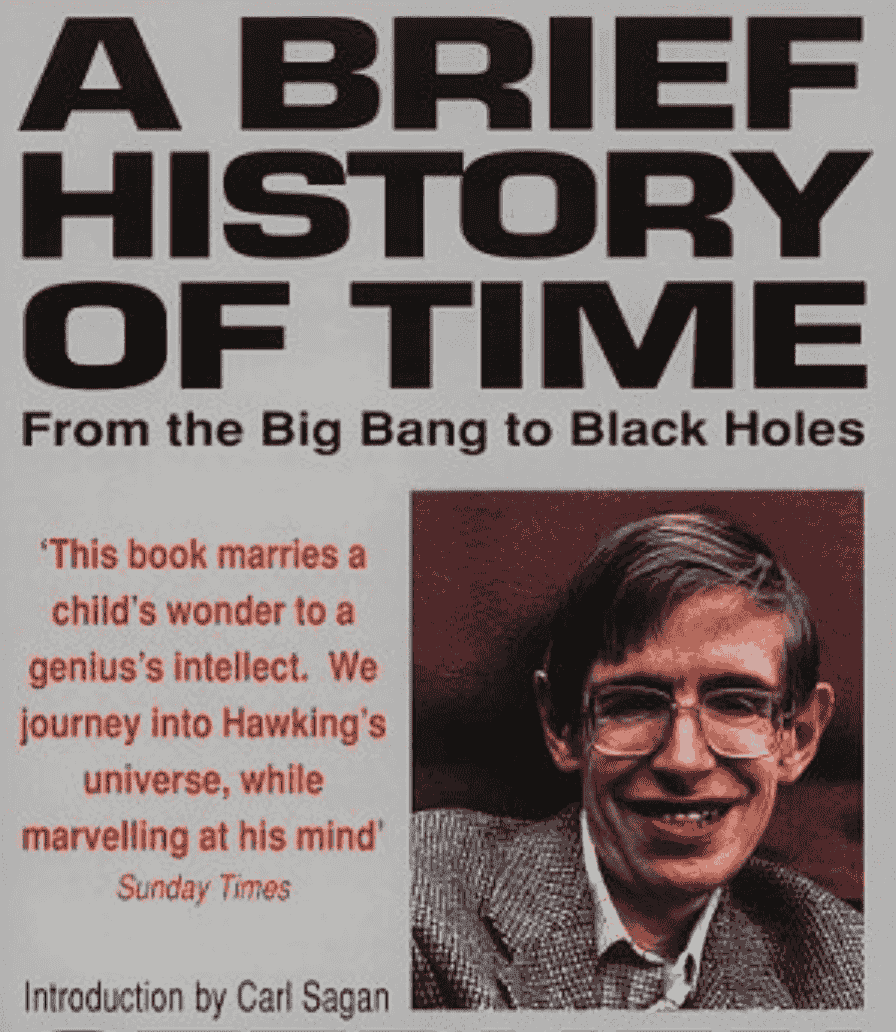
Nearly forty years after publication, A Brief History of Time is still the book most people name when asked to name a science book. That makes it worth doing something reviews rarely do: checking its claims against what actually happened next.
Two of the book’s central positions did not survive. Hawking argued that information falling into a black hole is destroyed forever. In February 1997 he and Kip Thorne formally bet John Preskill that this was so. On 21 July 2004, at a conference in Dublin, Hawking conceded, and handed Preskill a baseball encyclopedia. Thorne has never publicly conceded.
The book also expressed real optimism that a complete unified theory might be within reach before long. Nearly four decades on, there is still no accepted theory of everything. Neither of these is a failure of the book. They are the reason it remains worth reading — it is a record of a first-rate mind being publicly, productively wrong.
On 1 April 1988 — April Fools’ Day, which Hawking later called appropriate — a slim book appeared in bookshops with an unlikely ambition: to explain the origin, structure, and possible end of the universe to readers with no background in physics at all. Someone had warned Hawking that every equation he included would halve the sales. He included exactly one: E = mc².
A Brief History of Time: From the Big Bang to Black Holes went on to sell more than ten million copies in some 40 languages, spend a record 237 weeks on the Sunday Times bestseller list and 147 on the New York Times list, and turn a physicist confined to a wheelchair, speaking through a voice synthesiser, into one of the most recognisable scientists on Earth. It remains one of the best-selling and least-finished books in publishing history — famously “the most unread bestseller of all time,” in the words repeated by critics for decades. That reputation is not entirely fair to the book, and this is the story of what it actually contains, why it mattered, and why it still does.
The book’s most famous idea has never been observed, and its most famous mistake has a literature of its own. The arXiv archive, checked on 9 October 2026, held 901 papers with “Hawking radiation” in the title and 109 on the information paradox.
More than nine hundred papers on radiation nobody has ever detected from a real black hole. The theoretical case is strong enough that its existence is widely assumed, and the practical problem is that the effect from a stellar-mass black hole is far too faint to measure against the cosmic background.
The paradox is smaller because it is harder: 109 titled papers, no agreed resolution, and one public concession by the author of the book below.
The Physicist Behind the Book
Stephen Hawking was diagnosed with a slow-progressing form of motor neurone disease in 1963, at the age of twenty-one, shortly after beginning his graduate work at Cambridge. He was told he had roughly two years to live. He lived for 55 more, becoming the Lucasian Professor of Mathematics at Cambridge — the chair once held by Isaac Newton — a position he held for thirty years.
His scientific reputation was built well before the book existed. With Roger Penrose, he proved that Einstein’s general relativity implies the universe must have begun from a singularity — a result now known as the Penrose-Hawking singularity theorems. In 1974, he predicted that black holes are not perfectly black at all: they slowly emit radiation and, over immense timescales, evaporate. This process, now called Hawking radiation, was controversial at first and is today regarded as one of the most important results in theoretical physics — a genuine bridge between quantum mechanics and gravity, the two theories the book itself is built around.
By the mid-1980s, having lost his voice after a tracheotomy, Hawking communicated through a speech-generating device controlled first by a handheld switch and later by a single cheek muscle. It was in this state — internationally respected among physicists, almost unknown to the public, and increasingly unable to speak — that he decided to write a book for everyone else.
From the Big Bang to Black Holes

The book opens, famously, with an anecdote about a public lecture on astronomy, at the end of which an elderly woman in the audience declares that the universe is really a flat plate resting on the back of a giant tortoise. Asked what the tortoise stands on, she replies that it is turtles all the way down. Hawking uses the story to introduce the central question of the book: what is our universe actually resting on, and how do we know?
The image is older than the anecdote. In 1690 the English philosopher John Locke poked fun at “the Indian philosopher” who held that the world rested on an elephant and the elephant on a tortoise, an echo of Hindu cosmology, in which the Earth is borne up by great elephants and a world-turtle. The joke Hawking told has a long pedigree.
From there, the book moves chronologically through the history of cosmological thought — Aristotle’s geocentric universe, Ptolemy’s epicycles, Copernicus’s heliocentrism, Galileo’s telescope, Kepler’s ellipses, and Newton’s laws of motion and gravity — before arriving at the two pillars of twentieth-century physics: Einstein’s general relativity, which describes gravity as the curvature of space-time caused by mass, and quantum mechanics, which governs the strange probabilistic behaviour of particles at the smallest scales.
The heart of the book is the collision between these two frameworks. General relativity predicts singularities — points, such as the birth of the universe and the centre of a black hole, where its own equations break down. Quantum mechanics predicts that nothing can ever be perfectly still or perfectly empty, thanks to the uncertainty principle. Hawking’s own career was built on the places where these two theories are forced to confront each other, and much of the book is an attempt to explain, without mathematics, what that confrontation reveals: black holes that are not entirely black, singularities that quantum effects might soften, and a universe whose beginning may not require a beginning at all.
The No-Boundary Proposal and Imaginary Time
Among the book’s most ambitious ideas is the no-boundary proposal, developed by Hawking with the physicist James Hartle in 1983. Standard cosmology describes the universe expanding from a singularity — a moment where time itself begins, and where the question “what happened before the Big Bang?” becomes meaningless, since there was no “before.”
Hartle and Hawking proposed something stranger: that if you treat time, mathematically, using what physicists call imaginary time — a formal device where time behaves more like an additional dimension of space — the sharp edge of the Big Bang singularity smooths away entirely. In this picture, asking what came before the beginning of the universe becomes akin to asking what lies north of the North Pole
The question does not have an answer because it is not a well-formed question; the universe, in this model, simply has no boundary in time, past or future. It remains one of the most genuinely difficult ideas in the book, and one of the most quietly radical proposals in modern cosmology — an attempt to make the universe’s beginning a consequence of physical law rather than an unexplained starting assumption.
It is also contested. In 2017 Job Feldbrugge, Jean-Luc Lehners and Neil Turok argued in Physical Review Letters that, when the calculation is done carefully, the no-boundary proposal does not produce a smooth beginning at all. Supporters responded with a revised version, which the same critics in turn challenged. The idea remains a serious research programme, not settled cosmology.
Wormholes, Time Travel, and the Arrows of Time

Later editions of the book added a chapter on wormholes and time travel, prompted by the explosion of public interest following the book’s initial success. Wormholes are hypothetical tunnels through space-time, permitted in principle by general relativity, that could in theory connect two distant points in the universe — or two distant points in time.
Hawking is careful to explain why they remain firmly theoretical: keeping a wormhole open would require a form of matter with negative energy density, something no confirmed physics currently provides, and any attempt at time travel raises paradoxes, such as the classic scenario of a traveller preventing their own birth, that most physicists take as evidence against the possibility rather than a puzzle to be solved.
The book also introduces what have become known as the arrows of time — the several distinct senses in which time seems to move in only one direction. The thermodynamic arrow is the steady increase of disorder, or entropy, described by the second law of thermodynamics. The psychological arrow is the direction in which we remember the past but not the future. The cosmological arrow is the direction in which the universe is expanding rather than contracting.
Hawking spends real effort probing whether these three arrows must always point the same way, and concludes that our own existence as observers may only be possible in the stretch of cosmic history where they do — an early, elegant example of what physicists call anthropic reasoning.
The Search for a Theory of Everything
The book’s final movement concerns the long, unfinished search for a single theory that would unify gravity with the other fundamental forces — electromagnetism and the strong and weak nuclear forces. Einstein spent the last three decades of his life chasing such a unified field theory and never found it. Hawking devotes real attention to string theory, the leading candidate in his own era, which proposes that the fundamental constituents of reality are not point particles but tiny, vibrating one-dimensional strings, with different vibrational patterns corresponding to different particles.
Hawking closes with the hope that had, by his own account, animated the entire project: that a complete theory would eventually be simple enough, and its implications important enough, for it to be broadly understood — so that everyone, not only scientists, could take part in the discussion of why the universe exists at all, rather than not existing. Whether such a theory has been found remains an open question in physics to this day; string theory itself remains unconfirmed, and the search for a unified account of gravity and quantum mechanics is still one of the central unsolved problems in the field.
What the Book Got Wrong
A popular science book is usually reviewed on how clearly it explains the consensus of its moment. A Brief History of Time deserves a harder test, because Hawking was not summarising other people’s work — he was arguing for positions of his own. Some of them lost.
The information paradox. Hawking’s greatest result, Hawking radiation, implies that black holes evaporate. That raised a question the book takes a firm line on: what happens to everything that fell in? Hawking argued the information is genuinely destroyed — which, if true, breaks a foundational rule of quantum mechanics, that information is never lost.
Most physicists disagreed. On 6 February 1997, Hawking and Kip Thorne formalised the disagreement in a written wager against John Preskill of Caltech, who held that information must be preserved. The loser would provide the winner with an encyclopedia — a reference work from which information can always be recovered.
On 21 July 2004, at a conference in Dublin, Hawking announced he had changed his mind. He now believed black hole horizons fluctuate in a way that allows information to leak back out, scrambled but not destroyed. He conceded the bet and gave Preskill a copy of Total Baseball: The Ultimate Baseball Encyclopedia, joking that he perhaps should have handed over its ashes instead. Thorne declined to concede, and has still not done so.
The honest position today is that Thorne’s reluctance was reasonable. Hawking’s 2004 argument did not settle the question, and the black hole information paradox remains an open and actively contested problem. Readers coming to the book now should know that its confident treatment of information loss is not merely outdated — it was disowned by its own author, in public, twenty years ago.
Hawking kept working on the problem. His 2005 paper set out the Dublin argument in full, and in 2016, with Malcolm Perry and Andrew Strominger, he proposed that black holes carry “soft hair”: faint quantum imprints on the horizon that might store a record of what fell in.
The biggest step since came from younger theorists. In 2019 two groups, one led by Geoffrey Penington and the other by Ahmed Almheiri, Netta Engelhardt, Donald Marolf and Henry Maxfield, calculated how the hidden information in an evaporating black hole should change over time and found that it rises and then falls, the pattern expected if information eventually escapes. Many physicists now think information is preserved. How it gets out, and whether calculations done in simplified model universes apply to real black holes, is still argued over.
The theory of everything. The book’s closing chapters carry a real sense that a complete unified theory might be close. That optimism was widely shared in the late 1980s, when string theory appeared to be converging. It has not happened. String theory did not produce a unique testable framework, loop quantum gravity has not displaced it, and there is still no experimentally confirmed theory uniting gravity with quantum mechanics.
Set against those, what has held up is striking. Black holes really do emit radiation in theory and the result stands as Hawking’s enduring contribution. The Big Bang picture survived and strengthened. The book’s central instinct — that cosmology, quantum mechanics and thermodynamics are pieces of one puzzle — is now simply how the subject is done. A book whose author later argued publicly against one of its main claims is not a discredited book. It is an unusually honest snapshot of physics in motion.
What Has Been Tested Since
Hawking’s ideas have also faced experiments he did not live to see. The cleanest concerns a rule the book explains in its chapter on black holes: the area of a black hole’s event horizon can never shrink. When two black holes merge, the new one must have at least as much horizon area as the pair it replaced.
On 14 January 2025 the two LIGO detectors in the United States recorded the clearest black-hole collision yet observed: two objects of about 33.6 and 32.2 times the mass of the Sun merging into one of about 62. The signal was clean enough to measure the horizon areas before and after. In a paper published in September 2025, the collaboration reported that the final area was larger than the two starting areas combined, as Hawking’s rule requires, with far more confidence than a 2021 test on the first detection of 2015 could manage.
Hawking radiation itself is another matter. For a black hole with the mass of the Sun, the predicted temperature is about sixty billionths of a degree above absolute zero, far colder than the 2.7-degree glow left over from the Big Bang. Such a black hole absorbs more than it emits, and its Hawking glow is hopelessly beyond detection.
Physicists have built imitations instead. In ultracold clouds of atoms, a flowing fluid can trap sound waves the way a horizon traps light. Jeff Steinhauer’s group at the Technion in Israel reported sound-wave versions of Hawking radiation in such a system in 2016 and, in a 2019 paper in Nature, a thermal spectrum at the temperature the theory predicts. These analogues test the mathematics, not black holes themselves.
Hawking also lost two famous bets besides the one settled in Dublin. In the mid-1970s he bet Thorne that the X-ray source Cygnus X-1 was not a black hole, a wager the book describes as an insurance policy: if black holes turned out not to exist, he would at least win something. He conceded in 1990. And having bet the physicist Gordon Kane $100 that the Higgs boson would never be found, he admitted after CERN’s announcement in July 2012, “It seems I have just lost $100.”
Why the Book Became a Phenomenon
The commercial success of A Brief History of Time surprised almost everyone involved, including its author. Several explanations are usually offered. The near-total absence of mathematics — a deliberate choice, prompted by the warning that each equation would cost half the readership — made the book approachable in a way few serious physics texts had ever been. Hawking’s own gift for analogy and quiet humour carried readers through genuinely difficult concepts without condescension. And the story of the author himself, visibly and severely disabled yet producing work of this ambition, gave the book a human dimension that pure science writing rarely has.
The astrophysicist Carl Sagan, who wrote the introduction to the first edition, recalled attending a Royal Society ceremony in London in 1974 and watching a young man in a wheelchair slowly sign his name in a book whose earliest pages carried the signature of Isaac Newton. Sagan called Hawking a worthy successor to Newton and to Paul Dirac, both former holders of the same Cambridge chair — a lineage explored further in our article on Paul Dirac, the physicist who predicted antimatter. Even then, Sagan wrote, Hawking was already a legend.
Later Editions and Adaptations
The book’s success generated a small publishing industry of its own. An illustrated edition followed in 1996, adding photographs, diagrams, and computer-generated images to make the concepts even more accessible. A tenth-anniversary edition updated the science to reflect new discoveries. In 2005, Hawking co-wrote A Briefer History of Time with the physicist Leonard Mlodinow, a shorter and further simplified version aimed at readers who had found even the original too demanding.
The film director Errol Morris adapted the book into a 1991 documentary — Steven Spielberg, an admirer of Hawking, had suggested Morris for the job — which combined material from the book with interviews of Hawking, his colleagues, and his family: a biographical portrait rather than a straightforward filmed lecture. A companion six-part television series, Stephen Hawking’s Universe, followed in 1997. The book’s cultural reach extended further still: Hawking made cameo appearances as himself in Star Trek: The Next Generation and The Simpsons, cementing his status as one of the few working theoretical physicists to become a genuine popular icon in his own lifetime.
The Question of God
One thread of the book generated more debate than any other: Hawking’s repeated, careful engagement with the idea of God. He does not resolve the question, and readers on both sides of it have long claimed the book as support for their view. What Hawking does is note that if physics could ever produce a truly complete theory — one requiring no external cause or starting assumption — then there would be, in his words, nothing left for a creator to do.
Whether the universe needs a first cause at all, or whether a no-boundary model of the kind he and Hartle proposed removes the need for one, is a question he leaves open rather than answered, and it is precisely that openness, together with his evident respect for the scale of the question, that many readers found unexpectedly moving in a book of physics.
The “Unread Bestseller” Reputation
The book’s reputation as the most bought and least finished bestseller of all time has become something of a running joke in publishing circles, and it is not entirely without basis. In 2014 the mathematician Jordan Ellenberg devised a tongue-in-cheek “Hawking Index” from the passages Kindle readers highlight most. A Brief History of Time scored 6.6 per cent, suggesting that the typical reader’s highlighting petered out early. Ellenberg himself called the exercise unscientific and done for fun.
Hawking himself was reportedly aware of the reputation and untroubled by it, taking the view, according to those who knew him, that a book bought and partly read, sitting prominently on a shelf, still did more to spread curiosity about the universe than a book never bought at all. Whatever the precise completion rate, the book undeniably succeeded at its stated goal: bringing genuinely difficult physics into millions of homes that would otherwise never have encountered it.
Hawking’s Later Life and Legacy
Hawking continued working for three decades after the book’s publication, producing further popular titles including The Universe in a Nutshell and, with Mlodinow, The Grand Design. He died on 14 March 2018, at the age of 76, on the anniversary of Einstein’s birth. He had been born on 8 January 1942, three hundred years to the day after the death of Galileo.
His ashes were interred at Westminster Abbey on 15 June 2018, between the graves of Isaac Newton and Charles Darwin, under a stone carrying his formula for the entropy of a black hole — recognition of a body of work that had, in the span of a single working life, reshaped how physicists think about black holes, the birth of the universe, and the deep partnership between gravity and quantum theory.
His death prompted tributes from across science and public life, but perhaps the most fitting came during that service. The European Space Agency’s Cebreros antenna in Spain beamed a recording of his voice, set to music by Vangelis, towards the black hole 1A 0620-00, about 3,500 light-years away — a final message sent into precisely the kind of object that had defined his scientific life. For a very different mind that also reshaped its field against the odds, see our article on Srinivasa Ramanujan.
Why It Still Matters
Some of the science in A Brief History of Time has moved on. String theory has not delivered the unified account Hawking hoped for. Observational cosmology since 1988 has added chapters the original book could not have written: the discovery of the universe’s accelerating expansion in 1998, the detection of gravitational waves in 2015, and, in April 2019, thirteen months after his death, the first image of the shadow of a black hole. But the core of the book has aged remarkably well: the explanations of black holes, the Big Bang, and the tension between relativity and quantum mechanics remain sound introductions to questions physicists are still working on.
Its real legacy, though, may be less about the specific physics than about what it proved was possible: that a book almost entirely free of mathematics could carry millions of ordinary readers into genuinely difficult ideas about space, time, and the origin of everything, and leave many of them changed by the experience. That is a rarer achievement than the science itself, and it is the reason the book is still worth reading nearly four decades after an April Fools’ Day publication date that turned out to be no joke at all.
Frequently Asked Questions
What is A Brief History of Time about?
It is Stephen Hawking’s 1988 popular-science book explaining cosmology and theoretical physics to non-specialists: the Big Bang, black holes, the nature of time, general relativity, quantum mechanics, and the search for a unified theory of physics. It uses almost no mathematics, containing only a single equation.
Why did the book become so successful?
Its near-absence of mathematics, Hawking’s clear and often humorous writing style, and the compelling personal story of a severely disabled physicist producing ambitious work all contributed. It sold more than ten million copies in some 40 languages and spent a record 237 weeks on the Sunday Times bestseller list.
What is the no-boundary proposal?
Developed with physicist James Hartle in 1983, it uses a mathematical device called imaginary time to smooth away the sharp singularity of the Big Bang, proposing that the universe has no boundary in time — meaning the question of what happened “before” the beginning may not be meaningful, much like asking what lies north of the North Pole.
Is A Brief History of Time hard to read?
It is written for general readers and avoids mathematics almost entirely, but many readers still find sections challenging, particularly on quantum mechanics and imaginary time. It has a reputation as one of the most purchased but least finished bestsellers ever published, though its central ideas are genuinely accessible with careful reading.
What is Hawking radiation?
Hawking radiation is the prediction, made by Stephen Hawking in 1974, that black holes are not perfectly black but slowly emit radiation because of quantum effects near their event horizon, losing mass and eventually evaporating over immense timescales. It has never been detected from a real black hole, whose glow would be far too faint, but laboratory analogues built from ultracold atoms behave as the theory predicts.
How did Stephen Hawking write the book despite his illness?
By the time the book was written, Hawking had lost his voice following a tracheotomy and communicated through a speech-generating device, initially controlled with a handheld switch and later by a single cheek muscle. He worked closely with his editor to make dense physics concepts as clear as possible for general readers.
Further Reading
Sources
- The Official Stephen Hawking Website — A Brief History of Time
- Hawking — Black Hole Explosions?, Nature 248, 30 (1974)
- Nobel Prize Foundation — Background on Penrose-Hawking Singularity Theorems
- American Physical Society — 21 July 2004: Hawking concedes bet on black hole information loss
- Nature — The 50-year-old black hole puzzle that still challenges quantum physics (2024)
- Hawking — Particle Creation by Black Holes, Communications in Mathematical Physics 43, 199 (1975)
- Hartle & Hawking — Wave Function of the Universe, Physical Review D 28, 2960 (1983)
- LIGO Scientific, Virgo and KAGRA Collaborations — GW250114: Testing Hawking’s area law and the Kerr nature of black holes, Physical Review Letters 135, 111403 (2025)
- Muñoz de Nova, Golubkov, Kolobov & Steinhauer — Observation of thermal Hawking radiation and its temperature in an analogue black hole, Nature 569, 688 (2019)
- Steinhauer — Observation of quantum Hawking radiation and its entanglement in an analogue black hole, Nature Physics 12, 959 (2016)
- Hawking — Information loss in black holes, Physical Review D 72, 084013 (2005)
- Hawking, Perry & Strominger — Soft hair on black holes, Physical Review Letters 116, 231301 (2016)
- Penington — Entanglement wedge reconstruction and the information paradox, Journal of High Energy Physics 2020, 002 (2020)
- Almheiri, Engelhardt, Marolf & Maxfield — The entropy of bulk quantum fields and the entanglement wedge of an evaporating black hole, Journal of High Energy Physics 2019, 063 (2019)
- Feldbrugge, Lehners & Turok — No smooth beginning for spacetime, Physical Review Letters 119, 171301 (2017)
Baryon. (2025, March 18). A Book That Inspired Generations: Review of Stephen Hawking’s “A Brief History of Time”. Web News For Us. https://webnewsforus.com/stephen-hawkings-a-brief-history-of-time/
Baryon. “A Book That Inspired Generations: Review of Stephen Hawking’s “A Brief History of Time”.” Web News For Us, 18 March 2025, https://webnewsforus.com/stephen-hawkings-a-brief-history-of-time/. Accessed 17 October 2026.
Thanks for sharing. I read many of your blog posts, cool, your blog is very good.