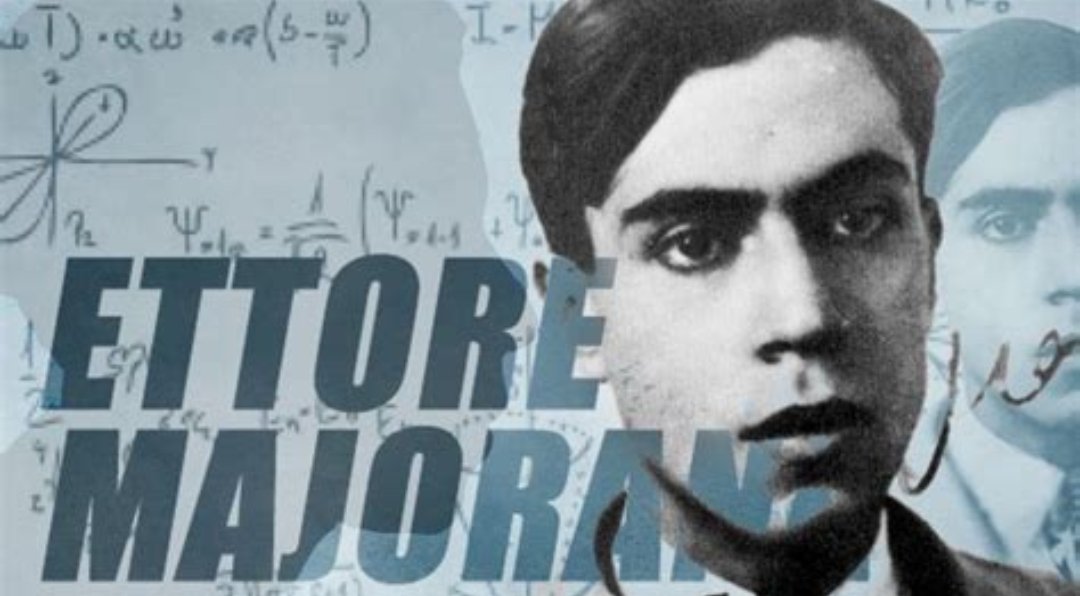
Ettore Majorana disappeared in March 1938 and was never found. That is the part of the story everyone knows, and it is the least interesting thing about him.
The year before he vanished he published a paper in Il Nuovo Cimento proposing that a particle could be its own antiparticle. It was a modification of Dirac’s equation, and at the time there was no known particle it applied to.
Nearly ninety years later, that paper defines one of the largest open questions in particle physics. Whether the neutrino is a Majorana particle is being tested right now by large experiments deep underground, and the answer bears on why the universe contains matter at all. The disappearance is a mystery. The physics is a live experiment.
In the spring of 1938, a 31-year-old Italian physicist boarded a ship from Palermo to Naples. He had written two letters that read like farewells. He was never confirmed seen again.
No body was found. No sighting was ever verified beyond doubt. Ettore Majorana — a man Enrico Fermi ranked alongside Galileo and Newton — simply vanished. Physics has been haunted by it ever since.
But the mystery is only half the story. He also left behind an idea so far ahead of its time that physics is still catching up with it — and that, in 2025, Microsoft put at the centre of a quantum computing chip whose underlying physics is still disputed.
That idea came from one significant paper, and we counted what it became. By 1 September 2026 the arXiv archive held 3,363 papers with “Majorana” in the title, and 719 on neutrinoless double beta decay — the experiment that would settle his question. Re-run on 5 October 2026, the counts were 3,386 and 727.
More than three thousand titles. A man who published nine papers and disappeared at 31 now titles more papers than most physicists manage to write.
The disappearance is unsolved and probably unsolvable. The physics is neither: it is an active experimental programme with a specific measurement that will either find his particle or rule it out.
The Experiment His Paper Started
Majorana’s 1937 paper, “Symmetric theory of the electron and positron”, fills fourteen pages of Il Nuovo Cimento and was, for its era, almost speculative. It asked what happens if you write Dirac’s equation so that a particle and its antiparticle are the same object. The mathematics is consistent. Like much of his work, it drew little attention for twenty years; interest began to grow only from 1957. The question of whether nature uses it was left open, and remains open.
Every matter particle we have confirmed is a Dirac particle: the electron has the positron, the proton has the antiproton, and the two are distinguishable. Even the neutron, which has no charge, has a distinct antineutron, because it is built from quarks that do. A few force-carrying particles, such as the photon, are their own antiparticles, but they are not particles of matter. The neutrino is the one fundamental particle of matter for which the answer is genuinely unknown, because it is electrically neutral and not built from anything else. Charge is what usually distinguishes a particle from its antiparticle, and the neutrino has none.
There is one experiment that could settle it, and it is being attempted right now in laboratories buried under mountains around the world. It is called neutrinoless double beta decay. In ordinary double beta decay, two neutrons in a nucleus convert to protons at the same moment and emit two electrons and two antineutrinos. If the neutrino is its own antiparticle, the neutrino released at one of those conversions can be absorbed at the other, so nothing escapes but the two electrons — which then carry away all the energy between them, a single sharp value that detectors can look for.
That signature is unmistakable and has never been seen. Experiments using germanium, xenon and tellurium have run for years deep underground, shielded from cosmic rays, and every one has returned a null result. The highest limit so far, from the KamLAND-Zen experiment in Japan with 745 kilograms of enriched xenon, puts the half-life for the process beyond 3.8 × 10²⁶ years — some sixteen orders of magnitude longer than the age of the universe. The absence of a detection does not disprove the idea; it means that if the process happens at all, it is extraordinarily rare.
The stakes explain the expense. If neutrinos are Majorana particles, lepton number is not conserved, and a mechanism becomes available for the early universe to have produced slightly more matter than antimatter — the reason anything exists rather than a cosmos of pure radiation. Masataka Fukugita and Tsutomu Yanagida proposed this route, now called leptogenesis, in 1986. A short paper written by a 30-year-old in 1937, months before he boarded a ship and was never seen again, is the theoretical basis for one of the most expensive questions in physics.
The Experiments Racing to Settle It
Three materials lead the search. In Japan, KamLAND-Zen dissolved xenon enriched in the isotope xenon-136 in a large tank of liquid scintillator, which glows when a charged particle passes through it. Its complete data set, published in 2025, found no signal and set the half-life limit of 3.8 × 10²⁶ years.
Beneath the Apennine mountains, at Italy’s Gran Sasso laboratory, LEGEND-200 operates germanium crystals enriched in germanium-76 inside a bath of liquid argon. Its first results, combined with those of its predecessors GERDA and the Majorana Demonstrator, which ran nearly a mile underground in South Dakota and carried his name, set a limit of 1.9 × 10²⁶ years. Nearby, CUORE cools close to a thousand tellurium dioxide crystals to ten thousandths of a degree above absolute zero and listens for the faint heat of a decay; in 2022 it reported a limit of 2.2 × 10²⁵ years for tellurium-130.
The next generation is designed to reach much further. LEGEND-1000, a tonne of enriched germanium, is designed to be able to discover the decay even if its half-life is as long as 1.3 × 10²⁸ years, given ten years of running. That would cover the range expected if the neutrino masses follow what physicists call the inverted ordering.
If the signal appears, a rule of particle physics, the conservation of lepton number, will have been broken, and the neutrino will be the particle Majorana described. If it never appears, the question will not be closed; the neutrino could still be a Majorana particle whose decay is too rare for any planned experiment to see.
The Boy Who Made Fermi Stop and Listen
Ettore Majorana was born in Catania, Sicily, in 1906, into a family of scientists and intellectuals. His gifts showed early. Family stories describe him doing complex mental arithmetic as a small child, treating it as play rather than effort.
At the University of Rome he switched from engineering to physics in 1928 and entered the orbit of Enrico Fermi, already one of Europe’s most respected physicists. Their first real encounter has become physics folklore, and Fermi’s colleague Emilio Segrè set it down. Fermi needed the solution of a difficult equation for his new statistical model of the atom, and had spent a week computing it with a small hand calculator.
Majorana, sceptical, went home, recast the equation in a different form and solved it without any calculator. When he came back and compared his slip of paper with Fermi’s notebook, the results matched exactly, and, in Segrè’s telling, he could not hide his amazement. Decades later the physicist Erasmo Recami found Majorana’s own pages: he had reached the answer by two independent methods.
Fermi’s verdict came later and was unambiguous. After the disappearance, as the young physicist Giuseppe Cocconi recalled, Fermi described the categories of scientists: those who do their best without going far, those of high standing who make important discoveries, and then geniuses like Galileo and Newton. Ettore, he said, was one of them. Fermi was not a man given to flattery.
The Particle That Is Its Own Opposite
Majorana published only nine papers in his lifetime — a remarkably small output for someone of his reputation. But one of them, from 1937, is still discussed in physics departments today.
The first, written with his friend Giovanni Gentile Jr. in 1928, and the next few dealt with atomic spectra and chemical bonds. A 1932 paper on atoms in a changing magnetic field worked out how a particle’s spin can be flipped; extended by Isidor Rabi in 1937 and by Felix Bloch and Rabi in 1945, it became part of the theory behind the radio-frequency method still used to flip the spins of neutrons. Another 1932 paper wrote down a relativistic equation for particles of any spin. In 1933 came a theory of the forces holding nuclei together, and in 1937 the paper that bears on the neutrino.
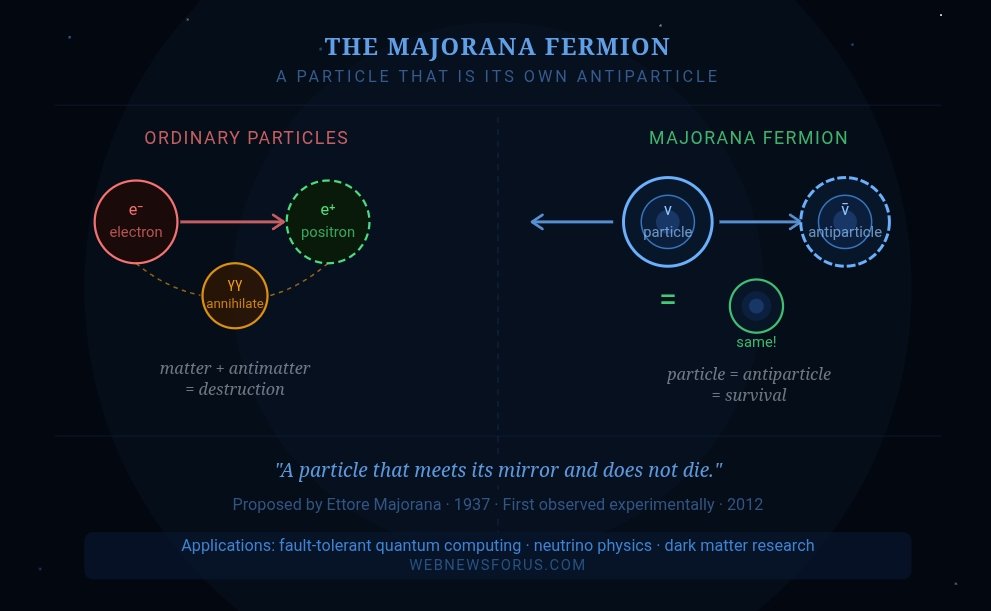
Every particle, in standard physics, has a distinct antiparticle. The electron has the positron. When matter meets antimatter, both annihilate. Paul Dirac had shown this mathematically a few years earlier — the story is told in our article on Paul Dirac, the physicist who predicted antimatter.
Majorana proposed something Dirac’s framework didn’t require. Certain neutral particles, such as the neutrino, might not need a distinct antiparticle at all. They could simply be their own opposite.
This theoretical entity is now called a Majorana fermion. For decades it stayed pure mathematics, since no one could even confirm neutrinos had mass. That changed in 1998, when the Super-Kamiokande experiment in Japan found that neutrinos change type as they travel, which is possible only if they have mass — reopening Majorana’s question sixty years on.
The idea later found a second home, far from particle physics. In 2001 the physicist Alexei Kitaev showed that certain superconducting wires could host Majorana zero modes: not new fundamental particles but collective states of many electrons that behave mathematically like Majorana’s solution. In 2012 a team at Delft University of Technology reported signals in a semiconductor nanowire consistent with them, a result that drew worldwide attention.
A larger claim followed in 2018, when a Nature paper from a team led at Delft reported the “quantised” conductance expected of a Majorana mode. After an investigation of its data, the authors retracted it in March 2021. The search for a clean, undisputed confirmation is still active.
The stakes go beyond curiosity. Information stored jointly in a pair of well-separated Majorana zero modes is not held in any one place, so local noise, the bane of ordinary quantum bits, should struggle to disturb it. In February 2025 Microsoft unveiled Majorana 1, a chip built to host and control such states. The accompanying Nature paper reported a way to read out the stored state, and Nature’s editors noted in its peer-review file that the results did not represent evidence that Majorana zero modes were present.
In June 2026 the physicist Henry Legg argued in the same journal that the devices appeared to lack the robust superconducting gap that interpretation requires, and Microsoft published a reply defending its work. The same month Microsoft announced Majorana 2, which swaps aluminium for lead and reports that the stored state survived for more than 20 seconds, over a thousand times longer than before. Those results appeared as a preprint, not a peer-reviewed paper, and critics noted that only one of the two measurements a working qubit needs had been shown. A company is betting serious engineering on physics Majorana wrote down in 1937; whether the particles are really there is still argued in the journals.
Leipzig, Heisenberg, and a Mind Turning Inward
In early 1933, with Fermi’s encouragement, Majorana travelled to Leipzig to work alongside Werner Heisenberg, one of the founders of quantum mechanics. He stayed about six months.
Heisenberg had just published his own theory of the forces inside the nucleus, and he persuaded Majorana to publish his different version; the “Majorana force” it introduced is still part of nuclear physics. “I have good relations with Heisenberg,” Majorana told his mother in February. He also spent time in Copenhagen, at Niels Bohr’s institute, where Victor Weisskopf later recalled discussing quantum electrodynamics with him.
After he returned to Rome later that year, colleagues noticed a change. He came to the institute less and less, and for the next four years he published nothing.
He had not stopped working. His sister Maria recalled him studying at home for many hours, day and night, and a January 1936 letter to his uncle Quirino, himself a noted experimental physicist, mentions that he had been occupied for some time with quantum electrodynamics.
The Disappearance
On Friday 25 March 1938, in Naples, Majorana wrote to Antonio Carrelli, director of the physics institute where he taught, that he had taken a decision that had become inevitable, and apologised for the trouble his “sudden disappearance” would cause. He would keep a fond memory of everyone there, he wrote, “at least until eleven o’clock tonight, and possibly even after”. He wrote another letter addressed to his family. That night he took the ship to Palermo.
From Palermo the next day, Saturday 26 March, he sent Carrelli a telegram and a second letter asking him to disregard the first: the sea had rejected him, he wrote, and he would return. He is believed to have taken the overnight ship back to Naples. Whether he ever disembarked has never been established.
Italian authorities searched. Fermi reportedly told his wife, Laura, that Ettore was too intelligent: if he had decided to disappear, no one would find him. In July 1938 Fermi wrote to Mussolini himself, asking for the search to be stepped up and saying that of all the Italian and foreign scholars he had met, Majorana had struck him most for depth of intellect.
The Theories That Will Not Die
The simplest explanation is suicide — that Majorana went into the sea and was never recovered. He had grown increasingly withdrawn in his final years, and the letters read, in places, like a goodbye.
But the letters contradict each other. One suggests despair. The next asks a colleague to disregard it. That is not the pattern of a settled decision.
His family never accepted that he had taken his own life. Antonino Zichichi, who came to know them, wrote that Majorana was a devout Catholic, that he had withdrawn his savings from the bank about a week before he vanished, and that the family’s belief, shared by Laura Fermi, was that he had retreated to a monastery.
A second theory holds he chose to disappear on purpose — into a monastery, or a new identity abroad, perhaps unsettled by where nuclear physics was heading. The timing complicates the most dramatic versions: nuclear fission was discovered only in December 1938, nine months after he vanished, and the paper announcing it appeared in January 1939.
Claims surfaced for decades. In 2011 Rome prosecutors reopened the case after an Italian emigrant, Francesco Fasani, produced a photograph taken in Venezuela in 1955 showing himself beside a man he knew as Mr Bini.
In February 2015 the prosecutors closed the case. Forensic experts had found that the man’s facial features matched those of Majorana’s father when superimposed, and the prosecutors concluded that Majorana had probably lived voluntarily in Valencia, Venezuela, under the name Bini between 1955 and 1959. No crime was found, so there was nothing to try. The conclusion rests on one witness and a photographic comparison; it is a finding, not a proof. Eighty-eight years on, the honest answer is that nobody knows for certain.
“If Only Ettore Were Here”
Majorana’s absence followed Fermi into the war. Antonino Zichichi wrote in 2006 that Robert Oppenheimer had told him a story from the Manhattan Project: at a meeting during the first of three crises, Fermi turned to Eugene Wigner and said, “If only Ettore were here”, and during the second, “This calls for Ettore!”
A general at the meeting, the story goes, later asked Wigner who this Ettore was and where he could be found, so that he could be brought to America. Wigner replied that he had disappeared many years before.
It is a story told at second hand, through Zichichi, decades after the events. But it fits everything else known about Fermi’s view of him. In a project staffed with some of the century’s greatest minds, the name Fermi reached for belonged to a man who had vanished years earlier.
The Search, and What He Left Behind
Majorana’s family offered a reward for information, and in July 1938 a missing-person notice appeared in the weekly Domenica del Corriere.
Some of his work outlived him on paper. An essay he had written on the value of statistical laws in physics and the social sciences was published after his disappearance by his friend Giovanni Gentile Jr., in 1942. His Naples lectures survived too: in 2004 a faithful transcription of all eleven sets of notes he had prepared for his students, six of them previously unknown, was recovered.
The Legend Within the Legend
What makes Majorana genuinely singular, beyond his fate, is the particular shape of his genius. He rarely worked toward recognition. He solved problems for the private satisfaction of solving them.
In January 1932 issues of the French journal Comptes Rendus reached Rome with notes by Irène Curie and Frédéric Joliot on a penetrating radiation from beryllium that could knock protons out of hydrogen-rich materials such as water or cellophane. Majorana saw at once, his colleagues recalled, that they had found a “neutral proton” without realising it, and before Easter he had worked out a model of the nucleus built from protons and neutrons.
He would not publish it. James Chadwick announced the discovery of the neutron in February 1932 and won the 1935 Nobel Prize for it. Majorana’s theory of the nucleus appeared only in 1933, after Heisenberg persuaded him in Leipzig.
A Professorship Won Without a Fight
In 1937 Italy held a national competition for professorships in theoretical physics, and Majorana, after years of silence, entered it, publishing for the purpose his symmetric theory of the electron and positron, which had been ready since 1933. The judging committee, chaired by Fermi, met on 25 October 1937 and was unanimous that his scientific standing was absolutely exceptional.
Rather than rank him against the other candidates, the committee asked the minister to appoint him outside the competition. Majorana was made professor of theoretical physics at Naples for “high and well-deserved fame”, and gave his first lecture on 13 January 1938. On 2 March he wrote to Gentile that he was pleased with his students, some of whom seemed determined to take physics seriously.
He should have been entering the peak of his career. Two months later, he vanished. The timing has fed nearly every theory about what happened to him since.
What Scientists Say
Fermi’s assessment has been repeated by physicists for generations, precisely because so few people ever earn it — that among the rare few who make real discoveries, an even rarer category exists: geniuses like Galileo and Newton. He placed Majorana there without hesitation.
The physicist Antonino Zichichi, who studied Majorana’s life and surviving papers for decades, titled his 2006 CERN Courier portrait of him “Ettore Majorana: genius and mystery” — physics decades ahead of its experimental confirmation, and a disappearance still unresolved.
Why Majorana Still Matters
It is tempting to treat Majorana as pure mystery story — the vanishing genius, the unsolved case, the tantalising Venezuelan sighting. That framing sells, but it undersells him.
His real legacy is a mathematical possibility, seen with almost no experimental evidence to guide him, that physics needed sixty years just to test — and is only now, in the 2020s, attempting to build into working hardware.
We do not know what happened to Ettore Majorana on that steamer. We do know what happened to his idea: it waited quietly in the mathematics, for a science advanced enough to need it. In that sense, at least, he never really disappeared at all.
A Case That Outlived Its Century
The Sicilian novelist Leonardo Sciascia devoted an entire book to the disappearance, La Scomparsa di Majorana (1975), arguing that Majorana foresaw where nuclear physics was heading and chose to vanish rather than be part of it. Some physicists disputed the theory, but the book cemented Majorana’s place in Italian popular culture.
The physicist João Magueijo later wrote A Brilliant Darkness (2009), an English-language biography that weighs the documented facts against decades of rumour.
Every few years the case returns: a new witness, a new photograph, a new book. Each revives the same question. Did one of the most gifted physicists of his generation die in 1938, or did he simply choose to become no one at all?
Frequently Asked Questions
Was Ettore Majorana ever found?
No confirmed discovery was ever made. Rome prosecutors closed the case in February 2015, concluding he had probably lived voluntarily in Valencia, Venezuela, under the name Bini between 1955 and 1959, based on a witness and a photographic comparison from the investigation reopened in 2011. The conclusion has not been independently confirmed, and his true fate remains unresolved.
What is a Majorana fermion?
A Majorana fermion is a particle that is its own antiparticle, proposed by Ettore Majorana in 1937; whether the neutrino is one remains unknown. In solid-state physics, the related Majorana zero modes are collective states of electrons rather than new particles. Signals consistent with them were first reported in 2012, but the evidence is still contested, and one headline paper was retracted in 2021.
Why did Majorana publish so little?
Majorana was notoriously indifferent to publication and professional recognition. He solved problems for his own satisfaction and often did not consider his results worth writing up, including his early insight into the neutron. Heisenberg persuaded him to publish his nuclear theory in 1933, and he published the 1937 paper only when he entered a professorship competition.
Did Majorana predict the atomic bomb?
No. Nuclear fission, the process behind the bomb, was discovered in December 1938, nine months after he disappeared. The novelist Leonardo Sciascia argued that Majorana foresaw where nuclear physics was heading and withdrew from it, but there is no documentary evidence that he anticipated a weapon.
What is Microsoft’s Majorana 1 chip?
Announced in February 2025, Majorana 1 is a Microsoft quantum processor built around a material the company calls a topoconductor, designed to host Majorana zero modes for more error-resistant quantum computing. Nature’s editors noted that the accompanying paper did not represent evidence for Majorana zero modes, a 2026 critique in Nature argued the devices lacked a robust superconducting gap, and Microsoft disputes the criticism. A successor, Majorana 2, was announced in June 2026 with results not yet peer reviewed.
When and where was Ettore Majorana born?
He was born in Catania, Sicily, on 5 August 1906, into a prominent family; his uncle Quirino Majorana was a noted experimental physicist. He studied engineering in Rome before switching to physics in 1928, and he was 31 when he disappeared in March 1938.
Has neutrinoless double beta decay ever been observed?
No. The most sensitive searches, KamLAND-Zen with xenon, LEGEND-200 and its predecessors with germanium, and CUORE with tellurium, have all reported null results. The highest half-life limit, more than 3.8 × 10²⁶ years from KamLAND-Zen in 2025, is about sixteen orders of magnitude longer than the age of the universe.
Why does it matter whether the neutrino is its own antiparticle?
If it is, a quantity called lepton number is not conserved, which would let the early universe build up a small excess of matter over antimatter through a process called leptogenesis, proposed in 1986. It would also offer a natural explanation for why neutrinos are so much lighter than every other particle of matter.
Further Reading
Sources
- CERN Courier — Ettore Majorana: Genius and Mystery
- IFLScience — The Genius Physicist Who Predicted Neutrons and Disappeared
- Microsoft — Majorana 1: A New Path for Quantum Computing
- Majorana — Teoria simmetrica dell’elettrone e del positrone, Il Nuovo Cimento (1937)
- KamLAND-Zen Collaboration — Search for the Majorana Nature of Neutrinos in the Inverted Mass Ordering Region, Physical Review Letters 130, 051801 (2023)
- Recami — Ettore Majorana: His Work and His Life (arXiv:1412.7485, 2014)
- Recami — Catalog of the Scientific Manuscripts Left by Ettore Majorana, with a Recollection (arXiv:physics/9810023)
- Recami — Majorana, the Neutron, and the Neutrino: Some Elementary Historical Remarks (arXiv:1712.02209)
- KamLAND-Zen Collaboration — Search for Majorana Neutrinos with the Complete KamLAND-Zen Dataset, Physical Review Letters 135, 262501 (2025)
- LEGEND Collaboration — First Results on the Search for Lepton Number Violating Neutrinoless Double Beta Decay with the LEGEND-200 Experiment, Physical Review Letters 136, 022701 (2026)
- CUORE Collaboration — Search for Majorana Neutrinos Exploiting Millikelvin Cryogenics with CUORE, Nature 604, 53–58 (2022)
- LEGEND Collaboration — LEGEND-1000 Preconceptual Design Report (arXiv:2107.11462)
- Fukuda et al. — Evidence for Oscillation of Atmospheric Neutrinos, Physical Review Letters 81, 1562 (1998)
- Fukugita & Yanagida — Barygenesis Without Grand Unification, Physics Letters B 174, 45 (1986)
- Kitaev — Unpaired Majorana Fermions in Quantum Wires, Physics-Uspekhi 44, 131 (2001)
- Mourik et al. — Signatures of Majorana Fermions in Hybrid Superconductor-Semiconductor Nanowire Devices, Science 336, 1003 (2012)
- Zhang et al. — Quantized Majorana Conductance, Nature 556, 74 (2018); retracted 8 March 2021
- Microsoft Azure Quantum — Interferometric Single-Shot Parity Measurement in InAs–Al Hybrid Devices, Nature 638, 651–655 (2025)
- APS Physics — Experts Weigh in on Microsoft’s Topological Qubit Claim, Physics 18, 57 (2025)
- Legg — On the Robustness of Topological Gap Detection via Transport, Nature 654, E22–E26 (2026)
- Microsoft Quantum — Reply to: On the Robustness of Topological Gap Detection via Transport, Nature 654, E27–E28 (2026)
- Science News — Microsoft’s Quantum Chip Got an Upgrade. Critics Are Still Skeptical (2 June 2026)
- Hahn & Strassmann — On the Detection and Behaviour of the Alkaline Earth Metals Formed by Irradiating Uranium with Neutrons, Die Naturwissenschaften 27, 11–15 (1939)
- ANSA — Majorana Alive in 1955–59 (4 February 2015)
Baryon. (2025, April 18). Ettore Majorana: The Genius Who Disappeared and Left Physics Forever Changed. Web News For Us. https://webnewsforus.com/ettore-majorana-vanished-left-physics/
Baryon. “Ettore Majorana: The Genius Who Disappeared and Left Physics Forever Changed.” Web News For Us, 18 April 2025, https://webnewsforus.com/ettore-majorana-vanished-left-physics/. Accessed 9 October 2026.

2 Responses