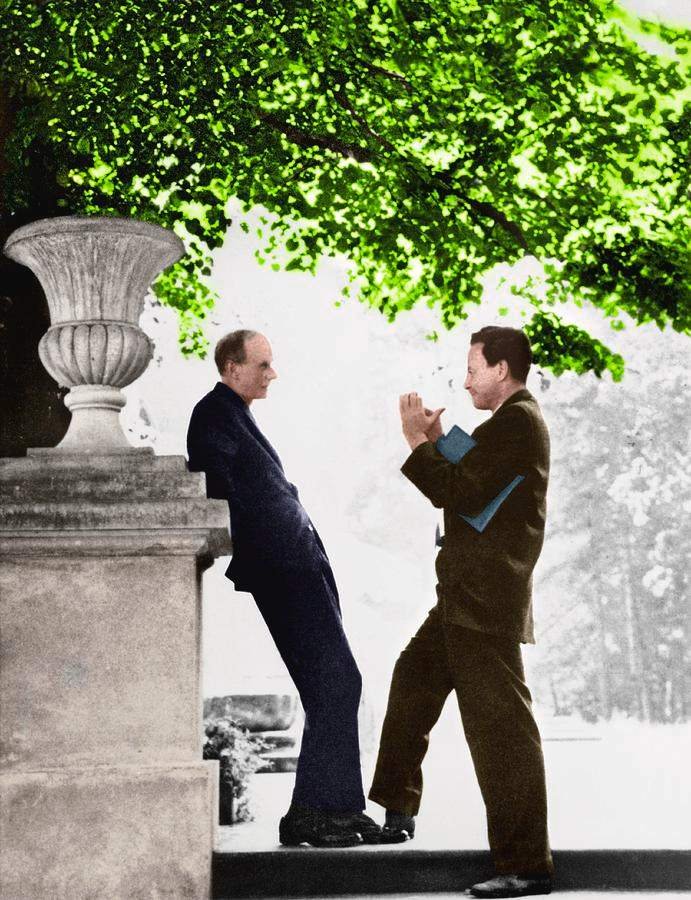
There are not many cases in the history of science where mathematics announced the existence of something nobody had looked for, described its properties, and was proved right within four years. Paul Dirac produced one of them, and the dates are a matter of record.
1928: Dirac publishes The Quantum Theory of the Electron, an equation reconciling quantum mechanics with special relativity. It has solutions with negative energy that nobody wants. 1931: in Quantised Singularities in the Electromagnetic Field, he argues those solutions describe a real particle with the electron’s mass and the opposite charge.
1933: Carl Anderson publishes The Positive Electron, reporting exactly that particle in cosmic-ray tracks. Antimatter was deduced from an equation before anyone had seen it — and a mirror image of every particle of matter was predicted on paper.
In the history of physics, a small number of individuals stand apart — not merely as gifted scientists but as architects of entirely new ways of thinking about reality. Newton. Maxwell. Einstein. And Paul Adrien Maurice Dirac.
A quiet, precise, almost pathologically reticent British physicist, Dirac produced in a few years of the late 1920s results so profound that physicists are still working through their implications today.
He predicted antimatter — an entirely new class of matter — before it was observed, from pure mathematical reasoning. He unified quantum mechanics with special relativity in an equation physicists consider one of the most beautiful in all of science.
He gave quantum mechanics much of the mathematical language it is still taught in, and took the first step toward quantum field theory. He laid the foundations on which Feynman, Schwinger, and Tomonaga built quantum electrodynamics — the most precisely tested theory in the history of science. And he did most of it before the age of 30.
Niels Bohr is said to have called him the strangest man ever to visit his institute. He was — but strange in the way the deepest truths about reality are strange: not arbitrary, but more rigorous, more precise, and more demanding than ordinary thought can easily accommodate.
And the equation he published in 1928 is still being worked on. The arXiv preprint archive, checked on 1 September 2026, held 1,146 papers with “Dirac equation” in the title, and 291 with “antimatter”. Checked again on 6 October 2026, it held 1,155 and 292.
The equation has four times the literature of the substance it predicted. That inversion is the whole story of Dirac’s method: the mathematics turned out to be more productive than the particular thing it announced, and it is now used in condensed matter and graphene physics far from its original subject.
Antimatter was the famous consequence. The equation was the durable one.
The Prediction, Dated
Scientific prediction is often described loosely. Dirac’s case is unusually clean, because each step was published and can be checked against the record.
The equation, 1928. Dirac was trying to write a description of the electron that respected both quantum mechanics and special relativity. The equation he arrived at worked — it explained electron spin, which had been inserted by hand, and predicted the electron’s magnetic moment accurately. It also had solutions describing states of negative energy, which appeared to be physical nonsense. An electron could cascade downwards into them forever, and matter would be unstable.
That magnetic-moment prediction has its own afterlife. Dirac’s equation says a number called the electron’s g-factor should be exactly 2. Experiments in the late 1940s found it slightly larger, and explaining the extra became the first great triumph of quantum electrodynamics. In 2023 a Northwestern University team measured half the g-factor as 1.00115965218059, uncertain only in the last two digits. Dirac’s 2 is the foundation; the tiny excess is everything his equation left out.
The interpretation, 1931. Dirac’s decision was to trust the mathematics rather than discard it. Having first wondered whether these states might describe protons, he concluded they required a genuinely new particle — identical to the electron in mass, opposite in charge. Nobody had observed such a thing, and there was no experimental reason to expect it. The same paper argued that the existence of a single magnetic monopole would explain why electric charge is quantised, a prediction that remains unconfirmed to this day.
The confirmation, 1932–33. Carl Anderson, photographing cosmic-ray tracks in a cloud chamber at Caltech, found a track that curved the wrong way in a magnetic field while having the mass of an electron. He first reported it in the journal Science in September 1932, cautiously calling the particles “easily deflectable positives”; his fuller paper appeared in Physical Review in 1933. Dirac shared the Nobel Prize that same year, aged 31.
It is worth being precise about what this does and does not demonstrate. Anderson was not testing Dirac’s prediction; he was surveying cosmic rays and found something unexpected. The prediction and the discovery were independent, which strengthens rather than weakens the case — the theory was not fitted to the observation after the fact.
The lasting significance is methodological. Dirac trusted an equation over intuition, and the equation turned out to know something he did not. That stance — that mathematical structure can be a guide to physical reality rather than merely a description of it — became one of the organising convictions of twentieth-century physics. It is also why the unconfirmed half of that 1931 paper, the magnetic monopole, is still being searched for nearly a century later.
The searches have become ingenious. In 2018 the MoEDAL experiment at CERN’s Large Hadron Collider used collisions of lead nuclei, which briefly create the strongest magnetic fields known in the universe, to look for monopoles pulled out of the vacuum. Its detectors were then scanned with a superconducting magnetometer for any trapped magnetic charge. The 2022 result: none. Monopoles carrying one, two or three units of Dirac’s magnetic charge are ruled out up to about 80 times the mass of a proton. The hunt continues.
Bristol, Silence, and an Unusual Education
Paul Dirac was born on 8 August 1902 in Bristol, England, to Charles Dirac, a Swiss-born French teacher, and Florence Holten, an Englishwoman. The household was shaped by his father in ways that marked Paul for life.
Charles was severe and controlling, insisting his children speak to him only in French. If Paul could not express something in French, he was to say nothing at all. The result was a child who learned early that silence was safer than imprecise speech.
This produced an extreme economy of communication that became legendary in physics circles. Dirac spoke only when he had something precise to say. He did not do small talk, did not speculate, and did not approximate.
At seminars, his questions were so exact they were sometimes mistaken for rudeness. He was not rude — he was simply constitutionally incapable of saying anything he was not certain about.
He studied electrical engineering at the University of Bristol, graduating in 1921. Unable to find engineering work in the depressed post-war economy, he took a tuition-free offer to study mathematics at Bristol for two years. By 1923 he was a research student at St John’s College, Cambridge, where he encountered quantum theory, received his doctorate in 1926, and began the work that would define his life.
The Quantum Revolution and Dirac’s Entry Into It
The mid-1920s were the most dramatic period in physics since Newton. The old quantum theory of Bohr and Sommerfeld, which explained atomic spectra without a deep foundation, was being replaced by something far more radical.
In 1925, Werner Heisenberg published matrix mechanics — a complete reformulation of quantum theory. In 1926, Erwin Schrödinger published his wave equation. The two looked entirely different but were soon shown to be mathematically equivalent.
Dirac, then a Cambridge graduate student, read Heisenberg’s paper and was captivated. Within weeks he produced his own version of quantum mechanics — more general and more transparent than either Heisenberg’s or Schrödinger’s — based on q-numbers, quantities that do not commute under multiplication.
His formulation identified the key mathematical structure of quantum mechanics: the Poisson bracket of classical mechanics replaced by the commutator of quantum operators. It became the framework all subsequent quantum theory would use.
His 1930 textbook, The Principles of Quantum Mechanics, codified his approach and became the defining text of the field. It is still in print. Its delta function and transformation theory remain part of how quantum mechanics is taught today. The famous bra-ket notation came a little later: Dirac introduced it in a short paper in 1939 and used it in the book’s third edition in 1947. For the phenomenon at the heart of that theory, see our article on quantum entanglement.
The Dirac Equation: Beauty as a Guide to Truth
By 1927, quantum mechanics was established but had a serious limitation: it was not relativistic. Schrödinger’s equation was consistent with Newtonian mechanics but not with Einstein’s special relativity — a real problem for electrons moving at high speeds inside atoms.
Earlier attempts to combine the two had produced the Klein-Gordon equation, but it gave negative probability densities, which have no physical meaning, and failed to predict the fine structure of hydrogen’s spectral lines.
Dirac approached the problem differently, guided by a conviction that became one of his most famous principles: the equations of fundamental physics must be mathematically beautiful. Ugly equations were likely wrong; beautiful ones likely right, even if their meaning was not yet understood.
This was not mysticism. It was a bet on the deep mathematical structure of nature that paid off repeatedly. The equation he sought had to be first-order in space and time and reduce to Schrödinger’s in the non-relativistic limit.
In late 1927 and early 1928, he found it. The Dirac equation, published in 1928, described the relativistic quantum mechanics of spin-1/2 particles in four coupled equations that were at once compact and extraordinarily powerful.
It immediately solved problems that had defeated others. It correctly predicted hydrogen’s fine structure. It derived the electron’s spin — previously an ad hoc postulate — from first principles, as a natural consequence of relativistic invariance. And it produced a magnetic moment for the electron matching experiment.
But it also produced something troubling: solutions with negative energy, extending to negative infinity. In classical physics this would let electrons radiate energy endlessly and fall forever — an unphysical catastrophe. Something had to be done with the negative-energy states.
The Prediction of Antimatter
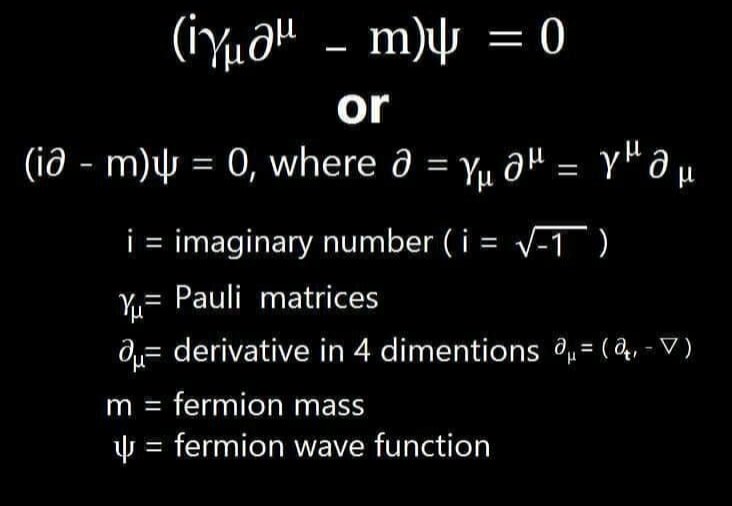
Dirac’s response was one of the most audacious theoretical moves in the history of physics. He proposed that all the negative-energy states were already filled — that the vacuum of space is a sea of electrons in negative-energy states, packed so densely that the Pauli exclusion principle keeps real electrons out. This was the Dirac sea.
If a negative-energy electron absorbed enough energy, it could jump to a positive state, leaving a hole in the sea. That hole would behave like a particle with positive energy and positive charge — the opposite of an electron.
Dirac first thought the hole might be the proton, but the mathematics showed it had to have exactly the electron’s mass. It could not be the proton, which is nearly 2,000 times heavier.
In 1931 he published his prediction: there must exist a positively charged particle with the same mass as the electron. He called it the antielectron — now the positron. The idea was so strange that many physicists assumed he was wrong.
The following year, 1932, Carl Anderson at Caltech observed exactly this particle in cosmic-ray tracks in a cloud chamber. The positron was real. Antimatter existed.
The implications were staggering. Every particle of matter must have an antimatter counterpart — identical in mass, opposite in charge. When matter and antimatter meet, they annihilate entirely into energy. Predicting an entire category of reality from pure mathematics remains one of the greatest achievements in the history of science.
Dirac shared the 1933 Nobel Prize in Physics with Schrödinger. He was 31. Characteristically, told of the prize, his first instinct, by most accounts, was to decline it — he disliked publicity — and he changed his mind only when told that refusing would draw even more attention than accepting.
Quantum Field Theory and the Path to QED
Beyond the equation and antimatter, Dirac made foundational contributions to quantum field theory — the framework treating fields, rather than particles, as the fundamental objects of nature.
In 1927 he published the first successful quantum treatment of the interaction between matter and light, introducing creation and annihilation operators — operations that add or remove a quantum from a field. These are now standard tools throughout quantum physics.
In 1933 he published a short paper in a Soviet physics journal linking quantum mechanics to a quantity from classical physics called the action. He noted that the quantum rule for getting from one moment to the next was “analogous” to an expression built from it, and left the thought there.
In 1941 a visiting physicist, Herbert Jehle, showed that paper to a young Richard Feynman at a beer party in Princeton’s Nassau Tavern. Feynman wondered what “analogous” meant and decided Dirac must mean that the two quantities were equal, up to a constant. Working it through, he found that summing contributions from every possible path reproduced quantum mechanics. He told the story in his 1965 Nobel lecture. Dirac’s seed became Feynman’s path integral, now a basic tool of quantum field theory.
Feynman diagrams also use the idea that a positron can be treated as an electron travelling backwards in time. Feynman credited that idea to his supervisor, John Wheeler, who once telephoned him to say that all electrons have the same mass and charge because they are all the same electron, zigzagging back and forth through time. It was Dirac’s particle, seen through Wheeler’s eyes. For Feynman’s life and work, see our article on Richard Feynman.
The Connection to the 2025 Nobel Prize in Physics
The 2025 Nobel Prize in Physics went to John Clarke, Michel Devoret and John Martinis “for the discovery of macroscopic quantum mechanical tunnelling and energy quantisation in an electric circuit.” In experiments in the mid-1980s they showed that a whole superconducting circuit, big enough to see, could behave as a single quantum object.
The link to Dirac is real but indirect. Those circuits are described with the general quantum mechanics Dirac helped build: states, operators and the transformation theory of his textbook. Many of today’s quantum computers use descendants of the same superconducting circuits as their qubits.
The circuits do not run on the Dirac equation itself. The Josephson junction at their heart is explained by the theory of superconductivity, in which electrons pair up and move together as one collective quantum wave. Dirac’s equation describes individual fast-moving electrons; superconducting qubits rely on the slow, collective behaviour of billions of them.
Dirac did not live to see quantum computing — he died in 1984 — but the mathematical structures he built are the language in which quantum computers are described, designed, and understood. For the full story of that prize, see our article on the Nobel Prize in Physics 2025.
Where the Dirac Equation Lives Now
The equation has turned up far from where Dirac expected. In 2005 Andre Geim and Konstantin Novoselov’s team at Manchester showed that electrons in graphene, a sheet of carbon one atom thick, behave like particles described by a two-dimensional Dirac equation with zero mass. A tabletop material was obeying the relativistic equation of 1928. Geim and Novoselov shared the 2010 Nobel Prize in Physics for their work on graphene.
Antimatter itself is now held, studied and weighed. At CERN, the BASE collaboration compared the charge-to-mass ratios of protons and antiprotons and found them identical to 16 parts per trillion in 2022. In 2025 the same team reported the first coherent control of the spin of a single antiproton, keeping its quantum state intact for about 50 seconds, a step towards even sharper matter-antimatter comparisons.
In 2023 the ALPHA collaboration released antihydrogen atoms from a magnetic trap and watched which way they went. They fell, attracted by the Earth like ordinary matter. The idea that antimatter might fall upwards, occasionally floated since Dirac’s day, was ruled out for these atoms.
And antimatter has a daily job in hospitals. Positron emission tomography, the PET scan, works by giving patients a tracer that emits positrons. Each positron soon meets an electron, the pair annihilate into two gamma rays flying in opposite directions, and detectors around the patient reconstruct where it happened. Dirac’s strange prediction is now a routine medical tool.
The Puzzle Dirac Left Behind
In his Nobel lecture in December 1933, Dirac went further than the positron. He said it was probable that “negative protons” also exist, mirror images of ordinary protons. Owen Chamberlain and Emilio Segrè found them at Berkeley in 1955, and shared the 1959 Nobel Prize in Physics for it.
In the same lecture he made a bolder guess. If the laws of nature treat positive and negative charge with complete symmetry, he said, it must be an accident that the Earth is made of electrons and protons, and it was quite possible that half the stars were made of antimatter, indistinguishable by their light. That guess has not survived. Where matter and antimatter regions met, annihilation would flood the sky with gamma rays, and a 1998 study concluded that a universe split evenly between the two is ruled out by observation.
So Dirac’s symmetry left a puzzle. If the Big Bang made matter and antimatter in equal amounts, they should have annihilated almost completely, leaving only light. Something tipped the balance. Physicists have found small differences between matter and antimatter behaviour, in kaon decays in 1964 and, by the LHCb experiment at CERN in 2025, for the first time in baryons, the family that includes protons. All the differences found so far are far too small to explain why anything is left.
The Man Behind the Equations
Dirac’s character was as distinctive as his physics, and the stories are numerous and consistent. Asked after a seminar whether he had questions, he would often say nothing. If pressed, he might state flatly that he did not understand equation three — not as a question but as a fact, leaving the speaker to work out what he meant.
His students found him demanding but scrupulously fair. He never said anything he could not justify mathematically, and was incapable of intellectual dishonesty in even the smallest form.
His principle that mathematical beauty is a guide to physical truth was a working hypothesis refined over decades. The Dirac equation was beautiful. Antimatter was beautiful. The path integral was beautiful. The uglier his later theories became, the more he distrusted them.
He married Margit Wigner, sister of the physicist Eugene Wigner, in 1937, and the marriage lasted the rest of his life. Her warmth contrasted sharply with his reserve.
The Legacy of “Mathematical Beauty”
Dirac’s conviction that beauty guides truth outlived him and became one of the most influential — and debated — ideas in theoretical physics. Generations of physicists have used mathematical elegance as a heuristic for which theories to pursue.
The approach has scored spectacular successes. General relativity, the gauge symmetries of the Standard Model, and much of modern particle physics were guided in part by aesthetic considerations of symmetry and simplicity that Dirac would have recognised.
But the principle has also drawn criticism. Some physicists argue that the modern reliance on beauty — particularly in areas like string theory, which remains experimentally unconfirmed — has led the field astray, mistaking mathematical appeal for physical truth.
Dirac himself was aware of the tension. His own beauty-guided instinct served him extraordinarily well in the 1920s, then arguably led him astray in his later, less productive decades. The principle is powerful precisely because it is not infallible — a working heuristic, not a law.
Later Years and Legacy
After his extraordinary burst of creativity, Dirac continued in theoretical physics but never again produced results of the same transformative impact. He became preoccupied with the large-number hypothesis — the observation that certain dimensionless combinations of fundamental constants are all roughly equal to very large numbers, hinting at a deep link between atomic physics and cosmology. He pursued it for the rest of his life without a satisfactory framework.
He also remained deeply uncomfortable with renormalisation — the procedure Feynman, Schwinger, and Tomonaga used to remove infinities from quantum electrodynamics. Dirac considered it mathematically illegitimate, a way of hiding genuine problems, and never accepted it even as QED matched experiment to extraordinary precision.
History has not fully resolved whether his discomfort was well-founded. Many of the deepest problems in quantum gravity involve precisely the divergences that renormalisation circumvents rather than solves.
Dirac held the Lucasian Chair of Mathematics at Cambridge — Newton’s chair — from 1932 to 1969. In his later years he moved to Florida State University in Tallahassee, working until shortly before his death in 1984, aged 82. He is buried there.
Visiting Moscow University in 1956, he chalked his most famous words on a blackboard there: “A physical law must possess mathematical beauty.” His memorial stone in Westminster Abbey, unveiled in 1995 near Newton’s monument, carries the Dirac equation.
Frequently Asked Questions
What is Paul Dirac best known for?
Dirac is best known for the Dirac equation (1928) — the relativistic quantum equation describing electrons and other fermions — which predicted antimatter and derived the electron’s spin from first principles. He shared the 1933 Nobel Prize in Physics with Erwin Schrödinger for this work.
Did Dirac really predict antimatter?
Yes. The Dirac equation’s solutions included negative-energy states, which he interpreted as holes in a sea of electrons — positively charged particles with the same mass as the electron. He predicted the positron in 1931, and Carl Anderson confirmed it experimentally in 1932. It was one of the most remarkable predictions in the history of science.
How did Dirac influence Feynman?
Feynman built directly on Dirac’s work. His path-integral formulation grew out of a 1933 Dirac paper that a colleague showed him in 1941. His positron-as-backward-electron picture came from John Wheeler, but the particle itself was Dirac’s. Feynman’s quantum electrodynamics, for which he shared the 1965 Nobel Prize, completed the quantum field theory programme Dirac began.
What is the Dirac equation?
The Dirac equation is a relativistic wave equation describing spin-1/2 particles such as electrons and quarks under both quantum mechanics and special relativity. It correctly predicted the electron’s spin and magnetic moment, the fine structure of hydrogen, and the existence of antimatter. Whether neutrinos obey it, or are their own antiparticles as Ettore Majorana proposed, is still unknown.
What is the Dirac sea?
The Dirac sea is the model Dirac proposed to explain his equation’s negative-energy solutions: the vacuum of space is a sea of electrons filling all negative-energy states, and a hole in that sea behaves as a positron. It was later superseded by quantum field theory, but it was the original framework in which antimatter was predicted.
Why was Dirac called “the strangest man”?
His extreme economy of speech, literal-mindedness, discomfort with approximation, and near-total absence of small talk made him legendary among physicists. Colleagues at Cambridge joked about a unit called “the dirac”, one word per hour, the minimum possible rate of communication. The nickname became the title of Graham Farmelo’s definitive biography, The Strangest Man.
Does antimatter fall like ordinary matter?
Yes, as far as has been tested. In 2023 the ALPHA experiment at CERN released antihydrogen atoms and found they fell towards the Earth, ruling out the idea that antimatter is repelled by gravity. More precise measurements of exactly how fast it falls are under way.
Have magnetic monopoles been found?
No. Dirac showed in 1931 that a single magnetic monopole would explain why electric charge comes in fixed units, but none has ever been detected. In 2022 the MoEDAL experiment at CERN ruled out monopoles with one to three units of magnetic charge up to about 75 GeV in mass, using the intense magnetic fields of lead-ion collisions.
Further Reading
Sources
- Nobel Prize — Paul Dirac Biography
- Dirac — The Quantum Theory of the Electron, Proc. R. Soc. A (1928)
- Dirac — Quantised Singularities in the Electromagnetic Field, Proc. R. Soc. A (1931)
- Anderson — The Positive Electron, Physical Review (1933)
- Anderson, C. D. (1932). “The Apparent Existence of Easily Deflectable Positives.” Science, 76, 238 (DOI: 10.1126/science.76.1967.238).
- Dirac, P. A. M. (1939). “A New Notation for Quantum Mechanics.” Mathematical Proceedings of the Cambridge Philosophical Society, 35, 416 (DOI: 10.1017/S0305004100021162).
- Feynman, R. P. (1965). “The Development of the Space-Time View of Quantum Electrodynamics.” Nobel Lecture. NobelPrize.org.
- The Nobel Prize in Physics 2025: John Clarke, Michel H. Devoret and John M. Martinis. NobelPrize.org.
- Fan, X., Myers, T. G., Sukra, B. A. D. & Gabrielse, G. (2023). “Measurement of the Electron Magnetic Moment.” Physical Review Letters, 130, 071801 (DOI: 10.1103/PhysRevLett.130.071801).
- Novoselov, K. S., et al. (2005). “Two-Dimensional Gas of Massless Dirac Fermions in Graphene.” Nature, 438, 197 (DOI: 10.1038/nature04233).
- Borchert, M. J., et al. (BASE) (2022). “A 16-Parts-per-Trillion Measurement of the Antiproton-to-Proton Charge–Mass Ratio.” Nature, 601, 53 (DOI: 10.1038/s41586-021-04203-w).
- Latacz, B. M., et al. (BASE) (2025). “Coherent Spectroscopy with a Single Antiproton Spin.” Nature, 644, 64 (DOI: 10.1038/s41586-025-09323-1).
- Anderson, E. K., et al. (ALPHA) (2023). “Observation of the Effect of Gravity on the Motion of Antimatter.” Nature, 621, 716 (DOI: 10.1038/s41586-023-06527-1).
- Dirac, P. A. M. (1933). “Theory of Electrons and Positrons.” Nobel Lecture, 12 December 1933. NobelPrize.org (PDF).
- Chamberlain, O., Segrè, E., Wiegand, C. & Ypsilantis, T. (1955). “Observation of Antiprotons.” Physical Review, 100, 947 (DOI: 10.1103/PhysRev.100.947).
- Cohen, A. G., De Rújula, A. & Glashow, S. L. (1998). “A Matter-Antimatter Universe?” The Astrophysical Journal, 495, 539 (DOI: 10.1086/305328).
- Christenson, J. H., Cronin, J. W., Fitch, V. L. & Turlay, R. (1964). “Evidence for the 2π Decay of the K₂⁰ Meson.” Physical Review Letters, 13, 138 (DOI: 10.1103/PhysRevLett.13.138).
- LHCb Collaboration (2025). “Observation of Charge–Parity Symmetry Breaking in Baryon Decays.” Nature, 643, 1223 (DOI: 10.1038/s41586-025-09119-3).
- Acharya, B., et al. (MoEDAL) (2022). “Search for Magnetic Monopoles Produced via the Schwinger Mechanism.” Nature, 602, 63 (DOI: 10.1038/s41586-021-04298-1).
Baryon. (2025, November 18). Paul Dirac: The Physicist Who Predicted Antimatter and Built the Foundation of Modern Physics. Web News For Us. https://webnewsforus.com/paul-dirac-antimatter-modern-physics/
Baryon. “Paul Dirac: The Physicist Who Predicted Antimatter and Built the Foundation of Modern Physics.” Web News For Us, 18 November 2025, https://webnewsforus.com/paul-dirac-antimatter-modern-physics/. Accessed 11 October 2026.
3 Responses