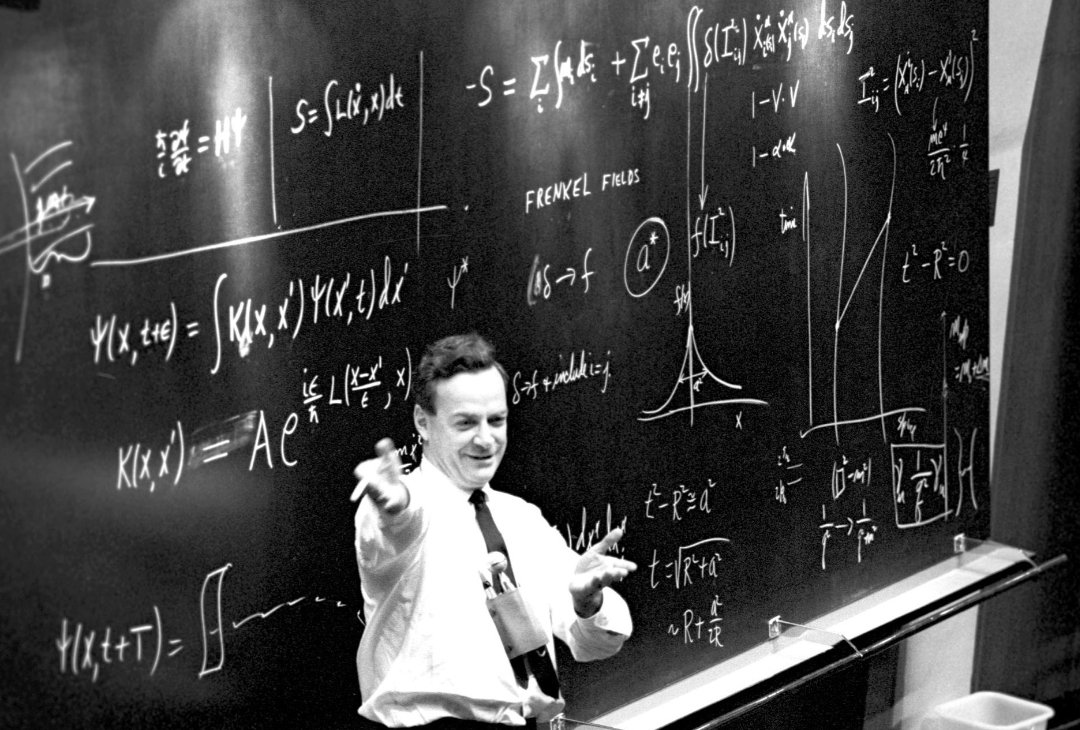
Everyone knows the image: Richard Feynman at a televised hearing, dropping a piece of O-ring rubber into a glass of iced water to show it lost resilience in the cold. It is the most replayed moment of his public life, and it is usually where the story stops.
What is rarely reported is what he wrote afterwards. Feynman’s findings were nearly left out of the Challenger commission’s report altogether, and survive as a separate section — Appendix F, hosted by NASA. We read it. It opens with a number, not a demonstration.
Estimates of the odds of losing a shuttle and its crew, he found, ranged from about 1 in 100 to 1 in 100,000 — a thousandfold disagreement inside one organisation. The high-risk figures came from the working engineers. The low ones came from management. That gap, not the rubber and the ice water, is what he actually discovered.
In February 1986, at a televised hearing of the presidential commission investigating the Space Shuttle Challenger disaster, Richard Feynman performed one of the most memorable scientific demonstrations of the twentieth century. He squeezed a piece of the rubber used in the shuttle’s O-ring seals in a small clamp, dropped it into a glass of iced water, waited a moment, and pulled it out. Released from the clamp, the cold rubber failed to spring back. In one quiet gesture he had shown, on live television, why the shuttle had torn apart seventy-three seconds after launch, killing all seven people aboard, among them the schoolteacher Christa McAuliffe.
That moment captured the essence of the man: a physicist who prized clarity over complexity, truth over authority, and curiosity above all else. Nobel laureate, safecracker, painter, bongo player, and one of the greatest teachers science has ever produced, Richard Feynman was by any measure among the most brilliant physicists of his century. He was also, by near-universal agreement, the most interesting.
This is his story — the physics, the mischief, and the quiet grief beneath the laughter — and why it still matters.
Feynman died in 1988, and his name is still everywhere in physics: a title search of arXiv on 10 October 2026 found 1,899 papers with “Feynman” in the title.
Almost none of them are about him. They are about his diagrams, his path integral, his rules for calculating — a working vocabulary that thousands of physicists use without pausing over whose name is on it. That is a rarer form of survival than citation, and a more useful one.
The Challenger appendix below shows the same habit applied outside physics: take the thing everyone is describing in words, and insist on the number underneath it.
The Boy Who Repaired Radios
Richard Phillips Feynman was born on 11 May 1918 in Far Rockaway, Queens, New York. He was shaped from the start by a father who understood something rare: that curiosity, properly nurtured, is the most powerful educational force there is.
Melville Feynman did not teach his son facts. He taught him to ask questions. On walks through the woods he would point at a bird and explain that you could learn its name in every language and still know nothing about it — the point was to watch what it did, and ask why. That was science.
By his teens, Feynman was running a small electronics repair business, fixing radios that had defeated grown men. His method unnerved people. He would stand perfectly still and think before touching anything, reason out the fault in his head, then walk over, adjust a single component, and the radio would work.
He went to MIT as an undergraduate, then to Princeton, where he recorded some of the highest scores the entrance examinations in physics and mathematics had ever seen. His doctoral supervisor was John Archibald Wheeler, one of the great theorists of the age — who quickly found that the mathematical machinery emerging from their collaboration was running ahead of what he himself could follow.
It was at this time that Feynman married his childhood sweetheart, Arline Greenbaum, in 1942 — knowing she was dying of tuberculosis, then incurable. It was Arline who gave him the motto he carried for the rest of his life: what do you care what other people think?
How Richard Feynman Remade Quantum Physics
In the 1940s, quantum electrodynamics — the theory of how light and matter interact — was a mathematical disaster. The calculations kept producing infinite answers. The theory worked beautifully at some scales and collapsed into nonsense at others.
Feynman fixed it — and in a way so original that when he first presented his results at the Pocono conference in 1948, some of the greatest minds in the room, Niels Bohr among them, were unsure what he had actually done. Bohr, who had valued Feynman’s frankness at Los Alamos, objected that his crisp particle trajectories seemed to violate the uncertainty principle itself.
What Feynman had built was an entirely new way of thinking about how particles move: the idea that a particle travelling between two points takes every possible path at once, and that the outcome emerges from how those paths interfere. This path integral formulation was not merely a new calculation — it was a new picture of quantum reality.

To make the mathematics tractable, he invented a visual shorthand: simple diagrams in which lines are particles and vertices are interactions. Feynman diagrams are now the common language of particle physics, drawn on blackboards from Caltech to CERN and printed in virtually every paper on particle interactions.
For this work, Richard Feynman shared the 1965 Nobel Prize in Physics with Julian Schwinger and Shin’ichirō Tomonaga, who had reached equivalent results independently. Asked how it felt to win, Feynman called the prize a “pain in the neck” — he had already had his real reward, he said, the day he solved the problem.
The Japanese physicist Sin-Itiro Tomonaga had begun first. Working in Tokyo, he proposed a version of quantum field theory consistent with relativity in 1942. The war pulled him into research on radar and microwave systems, and when it ended he and his students pressed on to the renormalisation that tamed the infinities. His English-language paper of 1946, in the new Japanese journal Progress of Theoretical Physics, reached physicists in the West only after the war, by which time Schwinger and Feynman were racing towards the same goal.
More Than One Revolution
Quantum electrodynamics would have been enough for most careers, but Richard Feynman kept returning to new corners of physics. In the 1950s he produced a quantum-mechanical explanation of superfluidity — the eerie, frictionless flow of supercooled liquid helium.
With Murray Gell-Mann he built a theory of the weak nuclear force, the interaction behind radioactive decay. And in the late 1960s his idea of “partons” — hard points inside protons — fed directly into the modern understanding of quarks.
Any one of these might have earned a Nobel Prize of its own. Few physicists of his century ranged so freely across so much of nature.
Los Alamos: The Youngest Mind on the Atomic Bomb
During the Second World War, Feynman was recruited at just 24 to join the Manhattan Project at Los Alamos, surrounded by the giants of the field — Bohr, Fermi, Bethe, Oppenheimer. He made an impression at once. In a November 1943 letter, J. Robert Oppenheimer wrote that Feynman was “by all odds the most brilliant young physicist here, and everyone knows this.”
He stood out for irreverence as much as brilliance. While others treated security with solemn respect, Feynman taught himself to pick the locks on the classified filing cabinets and left teasing notes inside to needle the security officers. He once opened a safe of sensitive nuclear calculations by guessing its owner had set the combination to a famous mathematical constant. He was right.
His real work was less theatrical and more important: he led a team of human “computers”, building systems to catch their errors, and helped work out how much fissile material a chain reaction required. But there was tragedy beneath the mischief. Arline was in a sanatorium near the laboratory throughout, and died in June 1945, only weeks before the Trinity test. Feynman drove through the night to be with her at the end, then returned to the bomb.
A Wobbling Plate in the Cafeteria
After the war, Richard Feynman arrived at Cornell burned out and convinced he was finished as a physicist. Grieving Arline and sickened by what the bomb had done, he decided to stop chasing important work and simply play with physics for fun.
One day in the cafeteria, a student threw a plate into the air, and Feynman noticed that the medallion on it wobbled faster than it spun. He worked out the equations for no reason beyond curiosity — and that idle problem drew him, thread by thread, back into the rotations of electrons.
The play became the QED work. The Nobel Prize, he always insisted, grew directly out of that pointless wobbling plate — the truest lesson of his life: that serious discovery often begins in delight, not duty.
The Double Slit: The Experiment That Haunted Him
Of all the puzzles in quantum mechanics, one held a special place in Feynman’s mind: the double-slit experiment. He called it “the only mystery” — the one phenomenon that, truly understood, would reveal everything strange and beautiful about the universe at its smallest scales.
Fire particles at a screen with two slits and, on the far side, you see not two bands but an interference pattern — as though each particle passed through both slits and interfered with itself. Add a detector to see which slit it really took, and the pattern vanishes. The act of looking changes the outcome.
In 2025, physicists at MIT performed the cleanest version of the experiment ever conducted, using individual atoms as the slits. The interference pattern disappeared precisely when path information became available — exactly as Feynman had described decades earlier. His intuition held, again.
He kept returning to the double slit because it resisted easy answers, and Richard Feynman trusted a good mystery more than a tidy explanation. It was, to him, the whole of quantum strangeness pressed into a single, stubborn image.
The Greatest Physics Teacher Who Ever Lived

In 1961, Feynman agreed to teach introductory physics to undergraduates at Caltech. What emerged over two years became one of the landmarks of science communication: The Feynman Lectures on Physics, now free online.
The lectures covered everything from Newton’s laws to quantum mechanics, not as a syllabus to be memorised but as a single connected story about how the world works. Feynman believed that if you could not explain something simply, you did not truly understand it.
There is a famous irony: the undergraduates the lectures were written for often found them too hard, while graduate students and professors packed the back rows. Decades later, Bill Gates — who called Feynman “the best teacher I never had” — funded the effort that put his Messenger Lectures online for the public. Feynman also wrote for general readers, most famously Surely You’re Joking, Mr. Feynman!, an unlikely bestseller that showed millions what a physicist actually notices about the world.
The lectures were never really about passing exams. They were an argument that the universe is comprehensible — and that understanding it is a pleasure available to anyone willing to look closely.
He kept explaining to the very end. In 1985 he published QED: The Strange Theory of Light and Matter, based on public lectures at the University of California, Los Angeles, in which he set out his prize-winning theory for a general audience with arrows and stopwatches instead of equations, and admitted that the theory describes nature as absurd from the point of view of common sense — while agreeing fully with experiment.
Bongos, Safes, and the Road to Tuva
What set Richard Feynman apart was that the curiosity never switched off, and never stayed inside physics. He played the bongos and the frigideira, drumming in a samba band during a stay in Brazil. He took up drawing in middle age and sold work under the pseudonym “Ofey”. He learned to pick locks, crack safes, and decode Maya hieroglyphics for fun.
Late in life he became fixated on reaching Tuva, a remote region in central Asia, purely because its capital, Kyzyl, had an improbable name and was hard to get to. He never made it — the invitation arrived days after his death — but the quest became a book, Tuva or Bust! The point was never the destination. The point was the delight of finding things out.
None of it was a distraction from the physics. For Richard Feynman, the drumming, the drawing, and the safecracking sprang from the same impulse that drove the equations — a refusal to accept that anything, anywhere, was too dull or too closed to be worth understanding.
That same restlessness produced serious science far from his own field. In a 1959 lecture titled “Plenty of Room at the Bottom,” Feynman sketched the idea of manipulating matter atom by atom — decades before the tools existed. It is now regarded as a founding vision of nanotechnology.
He backed the talk with money. Feynman offered two prizes of $1,000: one for a working electric motor that would fit inside a cube a sixty-fourth of an inch on each side, and one for shrinking a page of text 25,000 times. The engineer William McLellan built the motor within a year, by hand, which rather disappointed Feynman because it needed no new technology. The second prize was not claimed until 1985, when a Stanford graduate student, Tom Newman, wrote the first page of A Tale of Two Cities at that scale with an electron beam.
The O-Ring Moment: Science Against Bureaucracy
Feynman’s final act of public service was his most dramatic. Appointed — reluctantly, and already gravely ill with cancer — to the Rogers Commission on the 1986 Challenger disaster, he ignored the bureaucratic pace and ran his own investigation, calling engineers directly with blunt questions.
He learned that engineers at Morton Thiokol had warned NASA the night before launch that the O-rings might fail in the cold. Management overruled them, and the shuttle launched on the coldest morning in the programme’s history. The glass-of-ice-water demonstration, simple and unannounced, made the failure undeniable.
Taking the assignment had cost him. Already fighting the cancer that would kill him, he treated the six-month commission as a sacrifice of his remaining time — but he could not leave the question alone. His personal findings were so blunt about NASA’s self-deception over failure rates that they were relegated to an appendix of the official report, where they endure as a classic warning about institutions fooling themselves.
He ended his contribution to the report with a line now quoted across engineering and public life: “For a successful technology, reality must take precedence over public relations, for nature cannot be fooled.”
What Appendix F Actually Says
The document is titled “Personal Observations on the Reliability of the Shuttle”. It is short, plainly written, and still available on NASA’s own history pages. Anyone can read it in twenty minutes, and almost nobody does.
It begins by stating the problem directly. There were, Feynman wrote, enormous differences of opinion about the probability of a failure causing loss of vehicle and crew, with estimates ranging from roughly 1 in 100 to 1 in 100,000 — the higher figures coming from working engineers, the very low ones from management. He then asked what caused that disagreement and what followed from it.
The reasoning that follows is the part worth reading. A failure rate of 1 in 100,000 would mean flying the shuttle daily for roughly three hundred years and expecting to lose it once. Nothing in the flight record supported a claim of that precision. Yet the number was being used, and used in a direction that made the programme look safer than its own engineers believed it to be.
He extended the same analysis beyond the solid rocket boosters that destroyed Challenger, examining the main engines and the avionics, and found a recurring pattern. Evidence of trouble — erosion, cracking, wear appearing where none was predicted — was repeatedly reinterpreted as evidence of an acceptable margin, because previous flights had survived it. A warning sign, once survived, was being treated as proof of safety rather than as a warning.
The appendix closes with a single sentence that has outlived almost everything else in the report: “For a successful technology, reality must take precedence over public relations, for nature cannot be fooled.”
That line is widely quoted as a piece of Feynman wit. In context it is not wit at all. It is the conclusion of a technical argument about how an organisation had come to believe a number its own engineers did not accept — and it is the reason his contribution nearly did not appear in the report he had been appointed to help write.
What the Flight Record Showed
Feynman’s numbers can now be checked against what happened. The shuttle flew 135 missions between 1981 and 2011. Two ended in the loss of the vehicle and its crew, Challenger in 1986 and Columbia in 2003, killing fourteen astronauts in all. That is about one loss in every 68 flights — close to the working engineers’ estimate, and nowhere near management’s one in 100,000.
NASA eventually reached the same conclusion about its own early years. A retrospective risk analysis by the agency, presented in 2011, found that the risk of losing a shuttle and its crew did not improve appreciably over the first 25 flights, the run that ended with Challenger. It fell substantially only after the two disasters forced the main hazards into the open, by almost a factor of ten in all. Press reports of the analysis put the odds on the very first flights at about one in nine.
The pattern Feynman described in Appendix F returned with Columbia. Insulating foam had broken off the external fuel tank on earlier flights without disaster, and had come to be treated as a maintenance problem rather than a threat. During Columbia’s launch in January 2003, a piece struck the left wing; on 1 February the orbiter broke apart on re-entry. The board that investigated concluded in August 2003 that NASA’s organisational culture had as much to do with the accident as the foam itself.
The sociologist Diane Vaughan, studying the Challenger decision in a 1996 book, gave the pattern a name: the normalisation of deviance, the slow process by which an organisation comes to accept as normal a risk it once treated as unacceptable. Feynman had described it ten years earlier, in plainer words and with numbers attached.
The Philosophy of Not Fooling Yourself
Beneath the showmanship, Richard Feynman held a stern and simple creed about honesty. He distrusted certainty, welcomed doubt, and insisted that not knowing was better than pretending to know.
His most quoted principle is also his most useful: “The first principle is that you must not fool yourself — and you are the easiest person to fool.” It comes from “Cargo Cult Science”, his 1974 commencement address at Caltech, a warning about research that has the outward form of science without its inner honesty. He was equally sharp about authority, defining science, only half-jokingly, as “the belief in the ignorance of experts.”
This was not cynicism but its opposite — a conviction that honest inquiry, pursued without ego, is the most reliable path to truth we have. It is why engineers, teachers, and scientists still return to Feynman not only for the physics, but for the posture of mind.
What Scientists Say About Feynman’s Legacy
The 1965 Nobel Prize in Physics was awarded jointly to Sin-Itiro Tomonaga, Julian Schwinger and Feynman “for their fundamental work in quantum electrodynamics, with deep-ploughing consequences for the physics of elementary particles”. Three physicists had reached the same theory by different routes; in a 1949 paper Freeman Dyson showed the formulations were equivalent.
Reporting his death, United Press International quoted the MIT physicist Philip Morrison, who called him “the most original theoretical physicist of our time” and remembered a man who was “extraordinarily honest with himself and everyone else,” who “didn’t like ceremony or pomposity.” Freeman Dyson, who worked alongside him at Cornell and helped translate his ideas into a form other physicists could use, described him in a 1947 letter as “half genius and half buffoon” — and later suggested the buffoonery was itself a kind of genius, a way of staying connected to the world outside the equations.
The National Science Foundation awarded Feynman the National Medal of Science, recognising his essential contributions to the quantum theory of radiation and his illumination of the behaviour of the constituents of the atom.
Why Richard Feynman Still Matters
Feynman died on 15 February 1988. His ideas have not aged. The path integral formulation is now one of the foundational tools of quantum field theory, the framework built on the work of Dirac and his successors that underlies all of modern particle physics. Feynman diagrams appear in every analysis at CERN’s Large Hadron Collider.
More strikingly, Feynman was among the first to seriously outline the idea of the quantum computer, alongside Paul Benioff in the United States and Yuri Manin in the Soviet Union. In a 1981 lecture, published the following year, he argued that because ordinary computers cannot efficiently simulate quantum systems, you would need a computer that was itself quantum. That passing idea is now one of the most intensely pursued technologies on Earth.
He never lost the hunger for a new problem. In his final years Richard Feynman helped the young engineer Danny Hillis design the Connection Machine, one of the first massively parallel supercomputers, working out how thousands of processors could share a single task — a distant ancestor of the parallel hardware behind modern artificial intelligence.
And his lectures, free online through Caltech, are read around the world. In a world where good education remains unequal, that is its own kind of legacy — the conviction that the deepest ideas in science belong to anyone willing to engage with them honestly.
More than three decades after his death, Richard Feynman remains the rarest kind of scientist — one whose name means something to people who have never solved an equation. He is remembered not for a single formula but for a way of being in the world: curious without end, sceptical of authority, honest to a fault, and delighted, always, by the plain act of finding things out. The physics was extraordinary. The example may matter more.
Frequently Asked Questions
What is Richard Feynman best known for?
Feynman is best known for his work in quantum electrodynamics, for which he won the 1965 Nobel Prize in Physics. He invented Feynman diagrams and the path integral formulation of quantum mechanics, and is equally celebrated for his teaching, his bestselling books, and his role in exposing the cause of the 1986 Challenger disaster.
What did Feynman contribute to the Manhattan Project?
He joined at 24, working in the theoretical division under Hans Bethe. He led teams performing complex calculations, devised methods for catching computational errors, and contributed to the physics of nuclear chain reactions. He was present at the Trinity test in 1945.
What are Feynman diagrams and why do they matter?
They are simple visual representations of the equations describing how subatomic particles interact — lines for particles, vertices for interactions. They made previously impossible calculations tractable and remain in use in every particle physics laboratory in the world.
Was Feynman connected to quantum computing?
Yes. In a 1981 lecture he argued that classical computers cannot efficiently simulate quantum systems, and that a genuinely quantum computer would be needed — one of the earliest serious articulations of the idea now driving a global research effort.
Where can I read the Feynman Lectures on Physics for free?
The complete Feynman Lectures on Physics are free online at feynmanlectures.caltech.edu, made accessible by Caltech and the Feynman Lectures Website. They cover mechanics, electromagnetism, and quantum mechanics across three volumes.
Was Richard Feynman married?
Yes, three times. He married his childhood sweetheart, Arline Greenbaum, in 1942, knowing she was terminally ill with tuberculosis; she died in 1945. A second marriage, to Mary Louise Bell in 1952, ended in divorce. In 1960 he married Gweneth Howarth, with whom he had a son, Carl, and adopted a daughter, Michelle, and he remained with her for the rest of his life.
Why is Feynman so famous beyond physics?
Because he refused to separate rigour from joy. He played bongos, cracked safes, painted, and treated the whole world as something to be figured out. His bestselling memoir Surely You’re Joking, Mr. Feynman! and his gift for plain explanation made him a rare thing — a working genius the public genuinely loved.
Further Reading
Sources
- Nobel Prize — Richard P. Feynman, Biographical
- Feynman — Space-Time Approach to Quantum Electrodynamics, Physical Review 76, 769 (1949)
- MIT News — The double-slit experiment, stripped to quantum essentials (2025)
- National Science Foundation — National Medal of Science: Richard P. Feynman
- Atomic Heritage Foundation — Richard Feynman
- Rogers Commission Report, Appendix F — Personal Observations on the Reliability of the Shuttle, R. P. Feynman (NASA)
- Feynman — The Development of the Space-Time View of Quantum Electrodynamics, Nobel Lecture (1965)
- Tomonaga — On a relativistically invariant formulation of the quantum theory of wave fields, Progress of Theoretical Physics 1, 27 (1946)
- Dyson — The radiation theories of Tomonaga, Schwinger, and Feynman, Physical Review 75, 486 (1949)
- Nobel Prize — Sin-Itiro Tomonaga, Biographical
- Feynman — Simulating physics with computers, International Journal of Theoretical Physics 21, 467 (1982)
- Hamlin — Shuttle risk progression: use of the Shuttle probabilistic risk assessment to show reliability growth, AIAA Space 2011 (NASA Technical Reports Server)
- Columbia Accident Investigation Board — Report, Volume I (August 2003)
Baryon. (2026, March 9). Richard Feynman: The Nobel Prize Physicist Who Called Curiosity His Greatest Scientific Instrument. Web News For Us. https://webnewsforus.com/richard-feynman-nobel-prize-physicist/
Baryon. “Richard Feynman: The Nobel Prize Physicist Who Called Curiosity His Greatest Scientific Instrument.” Web News For Us, 9 March 2026, https://webnewsforus.com/richard-feynman-nobel-prize-physicist/. Accessed 17 October 2026.
2 Responses