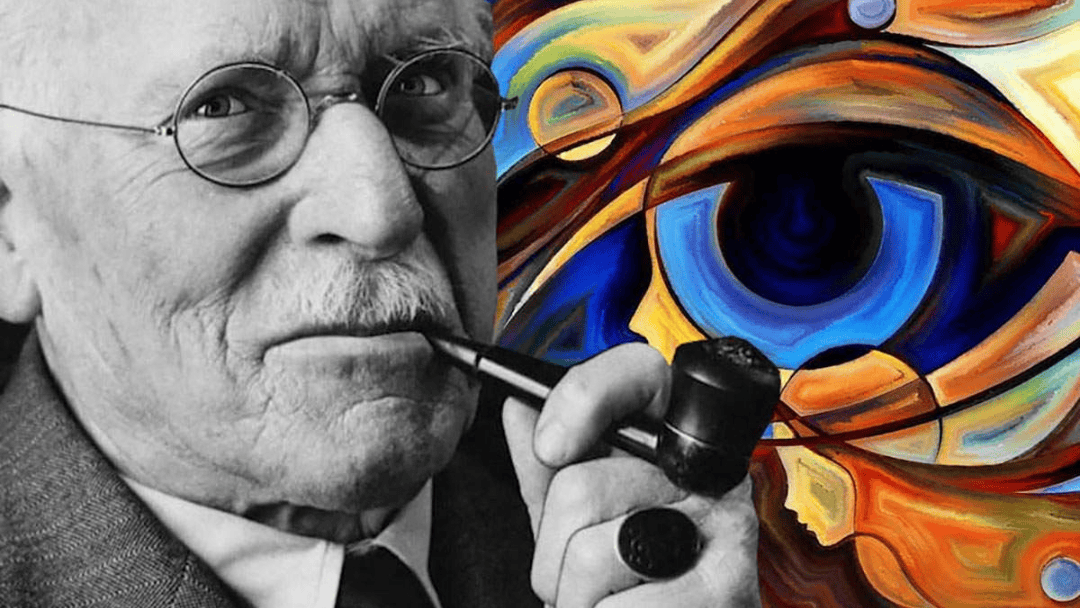
In the winter of 1913, Carl Jung sat at his desk in Küsnacht, Switzerland, and did something no respectable scientist was supposed to do. He deliberately induced visions, sinking into a waking dream state and writing down what emerged in a series of small private journals. Over the next sixteen years he copied the most important of them, with his own paintings, into a large red leather-bound folio he called Liber Novus, the Red Book.
What he found disturbed him. That October he had already experienced a waking vision of a monstrous flood covering the lowlands of northern Europe and the sea turning to blood. This was months before the First World War began, and Jung initially feared he was losing his sanity.
Later, he reframed it as the beginning of his most important work: an investigation into the deepest layers of the psyche. There, imagery was not random but structured — organised around patterns he called archetypes, appearing again and again across the myths, dreams, and visions of many cultures.
For most of the twentieth century, this work sat in an uncomfortable space between science and something harder to categorise. Freud dismissed him. Behaviourists ignored him. Neuroscientists had no tools to examine his claims.
But in 2025, a paper in Neuroscience of Consciousness, co-authored by Robin Carhart-Harris, proposed a formal neuroscientific framework for Jungian archetypes. Its argument: archetypes are not mystical relics but products of the brain’s predictive machinery — patterns that arise as the cortex and the brain’s emotional systems interact, shaping imagination, myth, and meaning-making. It offers testable hypotheses, not results. Whether Jung was studying something real that his era had no tools to measure is a question the tools are only beginning to reach.
Even now, Jung’s central idea has almost no presence in the indexed biomedical literature. A PubMed title search on 1 September 2026 returned 21 papers with “collective unconscious” in the title, against 275 for synchronicity and 343 for archetype — and most of those last two use the words in senses that have nothing to do with Jung. Re-run on 3 October 2026, all three counts were unchanged.
Twenty-one titled papers, across the whole of the indexed biomedical record, for a concept that names a century of cultural argument.
That is the honest starting point for the 2025 neuroscience paper described below. A single framework proposal does not overturn a count like that, and this article treats it as a hypothesis worth taking seriously rather than a vindication.
From Freud’s Heir to Independent Scientist
Carl Gustav Jung was born on 26 July 1875 in Kesswil, a village on Lake Constance in Switzerland. His father was a pastor, and Jung’s childhood was shaped by the tension between religious doctrine and what seemed to him the far darker, more complex reality of human experience.
He became a psychiatrist almost by accident. Choosing his medical specialisation at the University of Basel, he opened Krafft-Ebing’s psychiatry textbook one evening and found it described exactly the territory he had always been most curious about — the intersection of mind, body, and the border between sanity and its dissolution.
In 1900 he joined the Burghölzli clinic in Zurich under Eugen Bleuler, who coined the term schizophrenia. There Jung developed his word association test — a diagnostic technique in which delays and unexpected responses to stimulus words reveal hidden complexes in the unconscious. The work was rigorous, measurable, and publishable. It also brought him to Freud’s attention.
Their collaboration began in 1907 with a thirteen-hour conversation at Freud’s Vienna apartment. It became one of the most consequential — and most catastrophically failed — partnerships in the history of psychology. Freud saw Jung as his intellectual heir and designated successor.
But Jung disagreed fundamentally with the primacy Freud placed on sexuality as the source of unconscious motivation. He also grew uneasy with Freud’s insistence that psychoanalytic theory was a finished system to be defended rather than questioned.
The break came in 1912, when Jung published Wandlungen und Symbole der Libido. In it, he reinterpreted libido as general psychic energy rather than specifically sexual energy, and proposed that mythological imagery in patients’ dreams reflected something inherited — a deeper layer of the unconscious shared across the species. Freud regarded it as betrayal. Their correspondence ended acrimoniously, and Jung’s defining work began.
The personal break followed. On 3 January 1913 Freud wrote to Jung: “I propose that we abandon our personal relations entirely.” Jung had been the first president of the International Psychoanalytic Association since its founding in 1910; he resigned the post in April 1914.
The Architecture of the Psyche

Jung’s model of the psyche is more structured than its popular reputation suggests. The outermost layer is consciousness — the aware, purposive mind we identify as ourselves. At its centre is the ego, the sense of personal identity. But the ego is not the whole psyche; it is a small island in a much larger sea.
Beneath it lies the personal unconscious — repressed experiences, forgotten memories, and emotionally charged complexes. This is roughly the territory Freud described. For Jung it was real and important, but not the most interesting level.
Deeper still lies the collective unconscious — a layer that is not personally acquired but inherited, the product of millions of years of human evolution. It is encoded not in specific memories but in the patterns and tendencies of mental life itself.
The collective unconscious manifests in dreams, myths, and religious imagery — in narrative patterns appearing across cultures that never had contact: the Hero, the Great Mother, the Trickster, the Shadow, the Wise Old Man. Jung called these recurring patterns archetypes.
Crucially, he distinguished the archetype itself — a formal tendency, inaccessible to direct observation — from the archetypal image, the specific cultural content through which it appears. The Hero archetype is universal; the specific hero (Gilgamesh, Odysseus, Luke Skywalker) is culturally specific. The pattern is inherited; the content is acquired. This distinction makes his claims far more testable than a naive reading suggests.
The most important archetypes for personal development are the Shadow — the disowned aspects of the self, projected onto others; the Anima and Animus — the contrasexual aspects of the psyche; and the Self — the central archetype of wholeness and the goal of individuation, the lifelong integration of unconscious material into consciousness. This idea of an inherited psychic inheritance connects directly to modern work on genetic memory and how experience may echo across generations.
What the Neuroscience Now Says: Archetypes as Brain Predictions
The 2025 paper by McGovern, Aqil, Atasoy, and Carhart-Harris in Neuroscience of Consciousness is a detailed attempt to translate Jungian theory into neuroscience. Its title speaks of “eigenmodes of the deep unconscious”, but its central proposal is that archetypes are produced by a cascade of predictions across the brain’s hierarchy, from abstract cortical models down to raw emotional systems.
Its theoretical basis is the Free Energy Principle, developed by Karl Friston, and Predictive Processing theory — the model of the brain as a prediction machine that constantly generates hypotheses about sensory input and updates them against prediction errors. The brain is not a passive receiver but an active modeller of the world.
The authors propose an interplay between three neural domains in generating archetypal experience: the high-level cortex, producing abstract narrative and symbol; the sensory cortex, providing perceptual imagery; and subcortical affective systems, providing the emotional charge that makes such imagery feel numinous — significant beyond its surface.
When the cortex’s usual constraints loosen, as the authors argue happens under psychedelics, this archetypal material can surface in experiences resembling the encounters Jung collected from patients and world mythology. The paper treats the collective unconscious not as a mystical shared mind but as having a shared basis that is partly neural and partly cultural, passed between people through social learning and attunement.
None of this proves Jung right. The authors present their syntheses as testable hypotheses, and say their aim is to lend construct validity to Jungian concepts and to encourage empirical work on archetypes. What the paper shows is that his core intuitions — that the unconscious has structure, and that the structure appears in recognisable cross-cultural patterns — can be stated in terms modern neuroscience could test. That is a starting point for experiments, not their result.
Separately, a 2025 review in the International Journal of Jungian Studies examined Gary Clark’s book Carl Jung and the Evolutionary Sciences and the case it makes for reading archetypes as predispositions shaped by evolution rather than as inherited images. That reading keeps Jung’s core claim while dropping its most mystical version.
Synchronicity: The Most Controversial Proposal
Of all Jung’s ideas, synchronicity is the most contested — and, from a physics perspective, the most interesting. He defined it as an acausal connecting principle: the meaningful coincidence of an inner psychic event and an outer physical event that are not causally related, yet whose connection cannot be dismissed as pure chance.
His most famous example came from his clinic. A patient was describing a dream of a golden scarab — an Egyptian symbol of rebirth — when Jung heard tapping at the window. He opened it to find a rose chafer beetle, the closest central-European equivalent of a scarab, which had flown toward the light. He handed it to her, and her rigid rationalism broke open, allowing the therapy to progress.
What is scientifically striking is that Jung developed synchronicity in dialogue with Wolfgang Pauli — the Nobel Prize-winning physicist behind the exclusion principle and a founder of quantum mechanics. Pauli first came to Jung in 1932, in personal crisis. He spent about five months with Jung’s student Erna Rosenbaum, then around two years working with Jung himself, and Jung later used some 400 of Pauli’s dreams, without naming him, in Psychology and Alchemy.
Their friendship outlasted the therapy, and their letters, published as Atom and Archetype: The Pauli/Jung Letters, 1932–1958, run until Pauli’s death. In 1952 the two men published a joint book, The Interpretation of Nature and the Psyche, pairing Jung’s essay on synchronicity with Pauli’s study of the archetypal ideas behind Kepler’s astronomy. Both were asking whether the acausal character of the new physics might have a counterpart in the mind.
Neither claimed to solve it. What they did was identify a genuine gap in their era’s worldview: the assumption that every meaningful connection must be causal, and anything non-causal must be random. Quantum mechanics had already unsettled strict determinism at the physical level; whether anything similar holds at the psychological level remains open. For what entanglement actually implies about reality, see our article on quantum entanglement, the mystery at the heart of quantum mechanics.
Jung tested the idea himself. In the 1952 essay he described an experiment on the horoscopes of 483 married couples, gathered in three batches. The traditional astrological signs of marriage appeared strikingly often in the first batch, but the effect levelled off as more couples were added, and Jung read the early pattern as a product of his own team’s expectations rather than as evidence for astrology.
Statisticians offer a plainer account of uncanny coincidences. In a 1989 paper, Persi Diaconis and Frederick Mosteller described what they called the law of truly large numbers: with a big enough sample, almost any outrageous coincidence becomes likely. Among eight billion people, each living through countless moments every day, astonishing coincidences are routine. That does not dismiss the meaning people find in them, but it does mean a coincidence on its own is not evidence of a hidden connection.
The Red Book: A Scientist’s Descent
The visions Jung recorded between 1913 and roughly 1930 became the Liber Novus, or Red Book — a large, hand-illustrated folio he kept private for his entire life. It was not published until 2009, nearly half a century after his death.
The raw material survives too. The seven private journals in which he first recorded his visions, between 1913 and 1932, were published in 2020 as The Black Books, edited by the historian Sonu Shamdasani. Roughly half the text of the Red Book comes directly from them.
For decades, critics used the book to argue Jung had strayed from science into mysticism. Its publication complicated that picture. What it revealed was a disciplined, systematic self-experiment — Jung deliberately entering altered states and documenting them with the same rigour he had once applied to the word association test.
He called the method active imagination: consciously engaging unconscious imagery while remaining lucid enough to observe it. It has loose parallels with what some psychedelic and meditation researchers now study in the laboratory, with brain scanners where Jung had only pen and paint.
Read that way, the Red Book was less a departure from his science than the record of an experiment on himself — one that no instrument of his time could check, and that readers still interpret in very different ways.
What Scientists Say
The psychiatrist Anthony Stevens, author of Archetype: A Natural History of the Self, has long argued that Jung’s hypothesis of a genetically inherited collective unconscious is entirely consistent with contemporary evolutionary biology, and can be reformulated as evolved psychological mechanisms — innate predispositions shaped by natural selection.
Jung himself, in Memories, Dreams, Reflections, acknowledged that the unconscious produces symbols he could not distinguish from religious ideas — imagery with a numinous character that resisted purely clinical interpretation.
Jung’s Scientific Legacy: What Has Lasted
Evaluating Jung’s legacy means separating what has proved robust from what has not. The clinical reality of complexes — emotionally charged unconscious configurations that shape behaviour beyond conscious control — is well established in modern psychotherapy.
Does Jungian therapy itself work? A 2013 review by the psychologist Christian Roesler gathered outcome studies, mostly from Germany and Switzerland, and found significant improvements in symptoms and relationships that were still present up to six years after treatment ended, after an average of about 90 sessions. These were naturalistic studies of patients in ordinary practice rather than randomised trials, which limits how firmly the gains can be credited to the therapy itself.
His typology of introversion, extraversion, thinking, feeling, sensing, and intuiting gave rise to the Myers-Briggs Type Indicator, still among the world’s most widely used personality tools. Its scientific record is weaker than its popularity. In a 1989 study of 468 adults, the psychologists Robert McCrae and Paul Costa found no support for the idea that the test sorts people into distinct types; it measures four independent scales instead. Those scales line up with four of the Big Five traits used in modern personality research, while the fifth, emotional stability, has no Myers-Briggs counterpart. McCrae and Costa concluded that Jung’s theory is either wrong or poorly captured by the test.
Jung’s most durable gift may be two words. He made introversion and extraversion famous in Psychological Types (1921), and a century later extraversion is one of the five broad traits personality psychologists measure — though as a continuous scale on which most people sit near the middle, not as two kinds of people.
The concept of psychological projection — attributing to others qualities one denies in oneself — has some experimental support, even where the surrounding theory is contested. And recurring mythological motifs across cultures, documented from Frazer and Lévi-Strauss to Joseph Campbell, are well established, even if how universal they are, and why, is still argued over.
Computers have since found structure of a related kind. In 2016 a team at the University of Vermont tracked the emotional rise and fall of a large collection of fiction from the Project Gutenberg library and found that most stories follow one of six basic shapes, from rags to riches to tragedy. That is not proof of archetypes, but it is a measurable regularity in the stories people tell.
What has held up less well: the specific archetypal figures, while clinically useful as descriptive categories, have not been validated as discrete universal structures. His later work on synchronicity and alchemy moved progressively further from testable claims. And the strong version of inherited content — that specific symbolic material is genetically encoded — faces the same problems as any claim about inheriting complex mental contents, which evolutionary biology finds implausible.
The honest assessment: Jung proposed a research programme more than a finished theory. He identified real phenomena — the universality of deep psychological patterns, the structured nature of the unconscious — that neuroscience is only now beginning to investigate with tools he never had.
One idea deserves particular note: individuation, Jung’s term for the lifelong process of becoming a whole, integrated self. He saw it as the central task of the second half of life — reconciling the conscious ego with the disowned material of the unconscious, including the Shadow.
Unlike some of his more speculative claims, individuation has aged well as a clinical framework. It maps closely onto modern ideas of psychological maturation, meaning-making, and post-traumatic growth, and remains a working concept in depth psychotherapy today.
Jung lived it as well as theorised it. He continued working, travelling, and writing into his eighties, dying at his home in Küsnacht on 6 June 1961. Memories, Dreams, Reflections, compiled with his secretary Aniela Jaffé, was published the following year — part autobiography, part summary of a lifetime spent mapping the interior.
Is Science Paying More Attention to Jung?
It is often said that Jung is enjoying a scientific revival. That can be checked. We counted PubMed records whose title or abstract mentions Jungian ideas — the words Jungian, analytical psychology or collective unconscious, or Jung’s name in full — for every year since 2000, and compared each year with the total size of the database.
In absolute terms, interest has grown. There were 82 such papers in 2000–04 and 198 in 2020–24, with a peak of 51 in 2022. But the biomedical literature tripled over the same period, so Jung’s share actually fell slightly, from about 2.8 papers in every 100,000 to about 2.3. Searched on 3 October 2026, the database held 953 such records in total.
So the conversation is growing in step with science rather than ahead of it. PubMed covers medicine and psychology, not the humanities journals where much Jungian scholarship appears, so this measures only the scientific side of the story — but that is the side the revival claim is usually about.
Why This Matters: Jung and the Science of Mind

Why Jung still matters is not primarily about whether his specific theories are correct. It is about what kind of science psychology should be, and which phenomena it should take seriously.
The dominant paradigms of the late twentieth century — behaviourism, cognitive science, neuroscience — were extraordinarily productive at explaining perception, attention, and memory. But they engaged far less with what occupied Jung most: the meaning of dreams, the experience of the numinous, the patterns that repeat across cultures and across a lifetime.
The recent convergence of psychedelic neuroscience with Jungian theory is not accidental. Research into psilocybin, LSD, and DMT at Imperial College London, Johns Hopkins, and NYU Langone often records experiences of the kind Jung described: encounters with archetypal figures, dissolution of ego boundaries, imagery that feels ancestral or transpersonal. In a 2006 double-blind study at Johns Hopkins, 36 volunteers took a high dose of psilocybin under supportive conditions; two months later they rated the experience as having substantial personal meaning and spiritual significance.
The neuroscience of these states — Predictive Processing, the Default Mode Network, entropic brain theory — may finally supply the mechanistic vocabulary for what Jung tried to describe in the language of his time.
His insistence that the scientist cannot be subtracted from the science — that a mind studying the mind is studying itself — has grown more relevant, not less. The hard problem of consciousness, which asks why subjective experience exists at all, is in part a Jungian problem. For where neuroscience stands on it, see our article on the hard problem of consciousness.
Jung spent his life on this problem. He did not solve it — but he described it with more precision and honesty than almost anyone before or since. That is why, more than sixty years after his death, the scientific conversation around his ideas has not faded: it has grown in step with science itself.
Frequently Asked Questions
Who was Carl Jung and what did he discover?
Carl Gustav Jung (1875–1961) was a Swiss psychiatrist and the founder of analytical psychology. His major contributions include the collective unconscious, archetypes, the psychological complex, introversion and extraversion, individuation, and synchronicity. His work is currently being re-examined through neuroscience, evolutionary biology, and psychedelic research.
What is the collective unconscious?
It is Jung’s term for the deepest layer of the unconscious — not personally acquired through experience but inherited from the evolutionary history of the species, structured by archetypes that recur across cultures without direct contact. A 2025 paper in Neuroscience of Consciousness proposed that it has a shared neural and cultural basis, rooted in how the brain predicts the world and passed between people through social learning.
What are archetypes and are they real?
Archetypes are, in Jung’s account, universal patterns in the psyche — the Hero, the Shadow, the Great Mother, the Wise Old Man — appearing in myths, dreams, and religious imagery across many cultures. Jung distinguished the archetype as a formal predisposition from the archetypal image through which it manifests. Some evolutionary psychologists argue that inherited predispositions could explain why such patterns recur, but archetypes have not been validated as discrete universal structures, and the framework is still debated.
Why did Jung and Freud split?
Primarily over two issues. Jung rejected Freud’s insistence that sexuality was the primary driver of unconscious motivation, proposing instead that libido was general psychic energy. And he proposed the collective unconscious — a layer deeper than Freud’s personal unconscious, inherited rather than acquired and structured by archetypes. Freud regarded both as apostasy from psychoanalytic theory, and their partnership ended in 1912–1913.
What is synchronicity?
Synchronicity is Jung’s term for meaningful coincidence — an inner psychic event and an outer physical event connected by meaning rather than cause and effect. He developed it in collaboration with the physicist Wolfgang Pauli. It remains scientifically controversial but continues to attract interest from physicists and consciousness researchers exploring the relationship between mind and physical reality.
Is Jungian psychology accepted by mainstream science?
Parts of it are. Introversion and extraversion, psychological complexes, and the general structure of his typology are incorporated into mainstream personality psychology. The collective unconscious and archetypes have been more controversial, but a 2025 paper in Neuroscience of Consciousness proposed a formal neuroscientific framework for archetypal theory, with hypotheses that have yet to be tested.
Is the Myers-Briggs test scientific?
Only partly. It grew out of Jung’s Psychological Types, and its four scales do overlap with four of the Big Five personality traits psychologists use. But a 1989 study of 468 adults found no evidence that people fall into distinct types, and the test has no measure of emotional stability. It can prompt useful reflection; it is not a precise instrument for sorting people.
Does Jungian therapy work?
A 2013 review of outcome studies, mostly from Germany and Switzerland, found lasting improvements in symptoms and relationships after an average of about 90 sessions, still present up to six years later. The studies followed patients in ordinary practice rather than randomised trials, so the evidence is encouraging but not as strong as it is for some other therapies.
What is the Red Book?
It is the large illustrated folio, which Jung called Liber Novus, in which he copied and painted the visions of the self-experiment he began in 1913, working on it until about 1930. He kept it private, and it was published in 2009. The seven journals it was drawn from, the Black Books, followed in 2020.
Did Jung predict the First World War?
Jung later came to see his visions of autumn 1913, of a flood covering Europe and a sea of blood, as premonitions of the war that began the following summer. There is no way to test that reading after the fact, and vivid, troubled imagery is common in tense times, so it remains an interpretation rather than a demonstrated prediction.
Further Reading
Sources
- McGovern, Aqil, Atasoy & Carhart-Harris — Eigenmodes of the Deep Unconscious, Neuroscience of Consciousness (2025)
- Review of Gary Clark, Carl Jung and the Evolutionary Sciences — International Journal of Jungian Studies (2025)
- Roesler — Evidence for the Effectiveness of Jungian Psychotherapy: A Review of Empirical Studies, Behavioral Sciences (2013)
- Jung, C. G. — The Archetypes and the Collective Unconscious, Collected Works Vol. 9 Part 1, Princeton University Press (1959)
- Jung, C. G. — Synchronicity: An Acausal Connecting Principle, Collected Works Vol. 8, Princeton University Press (1960)
- MacTutor — Carl Jung Biography (University of St Andrews)
- Atasoy, Donnelly & Pearson — Human Brain Networks Function in Connectome-Specific Harmonic Waves, Nature Communications 7, 10340 (2016)
- Library of Congress — Freud’s letter to Jung, 3 January 1913 (Sigmund Freud: Conflict & Culture)
- Philemon Foundation — The Black Books 1913–1932: Notebooks of Transformation, ed. Sonu Shamdasani (W. W. Norton, 2020)
- Physics Today — review of Atom and Archetype: The Pauli/Jung Letters, 1932–1958
- McCrae & Costa — Reinterpreting the Myers-Briggs Type Indicator from the Perspective of the Five-Factor Model of Personality, Journal of Personality 57, 17–40 (1989)
- Diaconis & Mosteller — Methods for Studying Coincidences, Journal of the American Statistical Association 84, 853–861 (1989)
- Griffiths, Richards, McCann & Jesse — Psilocybin Can Occasion Mystical-Type Experiences Having Substantial and Sustained Personal Meaning and Spiritual Significance, Psychopharmacology 187, 268–283 (2006)
- Reagan et al. — The Emotional Arcs of Stories Are Dominated by Six Basic Shapes, EPJ Data Science 5, 31 (2016)
- PubMed — records mentioning Jungian terms in title or abstract, counted by year (searched 3 October 2026)
Baryon. (2025, May 9). Carl Jung: The Scientist Who Mapped the Unconscious, and What Neuroscience Says Now. Web News For Us. https://webnewsforus.com/carl-jung-psychology-collective-unconscious/
Baryon. “Carl Jung: The Scientist Who Mapped the Unconscious, and What Neuroscience Says Now.” Web News For Us, 9 May 2025, https://webnewsforus.com/carl-jung-psychology-collective-unconscious/. Accessed 9 October 2026.
Found your blog recently, read many of your articles, one of the best research blog on net.Keep it up.