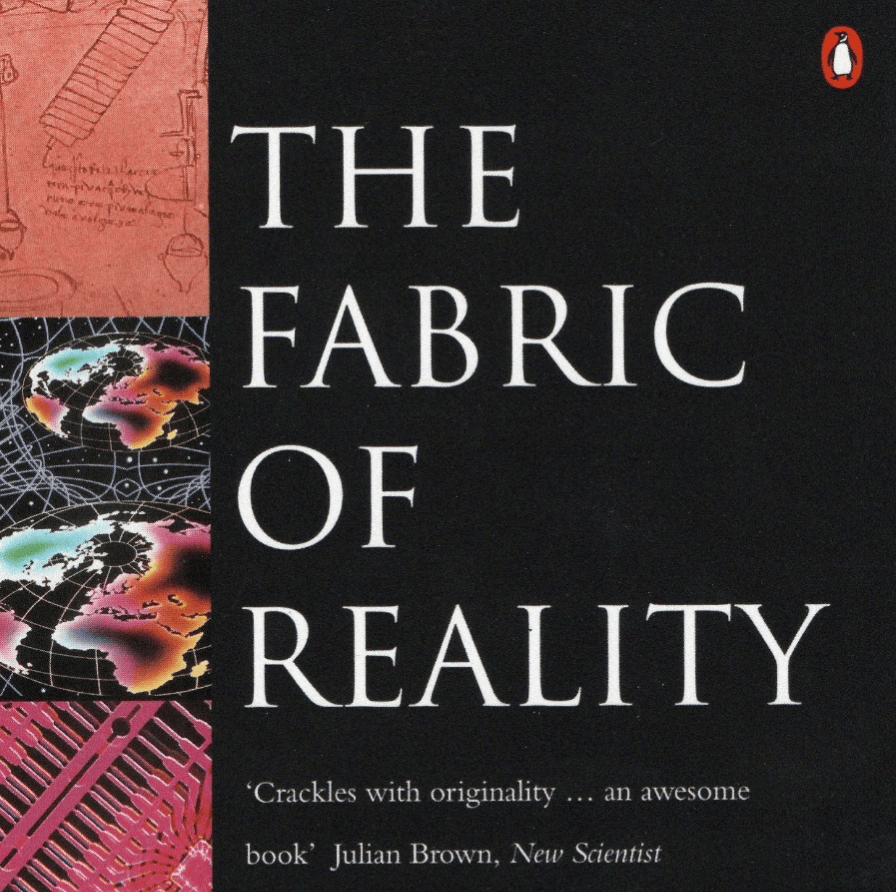
In 1985, more than a decade before he wrote The Fabric of Reality, David Deutsch published a paper in the Proceedings of the Royal Society describing a universal quantum computer.
There were no qubits then, no laboratories building them, and no obvious reason to think such a machine could ever exist. Today the trial-and-error engineering of that idea consumes billions of dollars at IBM, Google, and national laboratories on three continents. The paper is one of the founding documents of quantum computing.
This matters for reading the book, because it establishes something about its author. Deutsch is not a populariser assembling other people’s ideas into a grand synthesis. He is a working physicist who helped found a field, and The Fabric of Reality is his argument that four separate theories are really one explanation — made by someone whose own contribution came from taking exactly that view seriously.
In 1997, a physicist at Oxford published a book with a title most academics would have called recklessly ambitious. The Fabric of Reality claimed to outline a unified theory of everything — not just of physics, but of physics, biology, computation, and knowledge at once.
The author, David Deutsch, was already known for a specific and highly technical contribution: the first rigorous description of a quantum computer, published in 1985 in the Proceedings of the Royal Society. What he was now proposing was far larger.
His argument: the four deepest explanatory frameworks in late-twentieth-century science — quantum mechanics, evolution, computation, and the theory of knowledge — were not independent. They were interlocked so deeply that none could be fully understood without the other three.
Understood together, he argued, they formed not a collection of separate theories but something that deserved to be called, for the first time, a genuine theory of everything — a unified account of reality that was, in principle, complete.
Nearly three decades later, its ideas have aged in a way most science books do not — not by becoming obsolete, but by becoming more relevant, as the quantum computing revolution Deutsch anticipated has moved from speculation to physical hardware. In 2022 he shared the Breakthrough Prize in Fundamental Physics, one of science’s richest awards, with Charles Bennett, Gilles Brassard and Peter Shor for foundational work in quantum information. This is the full account.
Deutsch’s 1985 paper helped found a field; his interpretation of quantum mechanics did not, and the archive shows the split. By 1 September 2026 arXiv held 6,234 papers with “quantum computation” in the title and 102 with “many-worlds”. Re-run on 5 October 2026, the counts were 6,315 and 105.
About sixty papers on the machine for every one on the metaphysics he says the machine demonstrates. The engineering left the philosophy behind almost immediately, and has never gone back for it.
That gap is the most interesting thing about the book below. Its central argument is that these strands are one explanation; the literature built one of them into an industry and left the other as a minority position.
David Deutsch: The Physicist Who Founded Quantum Computing

David Deutsch was born in Haifa, Israel, in 1953, and studied at Cambridge and Oxford. He has worked at Oxford for most of his career, latterly as a visiting professor associated with the university’s Centre for Quantum Computation, and has never sought a conventional academic post. His foundational contribution preceded the book by more than a decade.
In 1985 he published a paper in the Proceedings of the Royal Society A titled “Quantum Theory, the Church-Turing Principle and the Universal Quantum Computer” — the first rigorous physical description of what a quantum computer would need to be and what it could in principle do.
The paper set out a universal quantum computer, a quantum version of Turing’s universal machine. In 1989 Deutsch followed it with “Quantum computational networks”, which introduced the quantum logic gates and circuits in which almost all quantum algorithms are now written. Together they framed the field within which IBM, Google, and every other organisation building quantum computers today is working. For where the field stands now, see our article on quantum computing in 2026.
He was not alone. In 1980 Paul Benioff of Argonne National Laboratory described a computer running according to quantum mechanics, and in 1982 Richard Feynman argued that simulating quantum physics would need a computer built on quantum principles. Deutsch’s step was to ask what such a machine could compute in general, and to show it could do things no ordinary computer could do as efficiently.
The first clear example came in 1992, when Deutsch and Richard Jozsa described a problem that a quantum computer could solve exponentially faster than any deterministic classical machine. It was artificial, but it pointed the way. In 1994 Peter Shor found a quantum algorithm for factorising large numbers, which threatens much of today’s encryption, and in 1996 Lov Grover found one for searching unsorted data. Those results turned a theoretical curiosity into a field.
The philosophical commitment driving the whole book is what Deutsch calls realism: the view that scientific theories describe a reality existing independently of our observations, and that the goal of science is to understand what is actually happening, not merely to organise our observations efficiently.
This sounds like a truism, but it is not. A major strand of thinking about quantum mechanics, from Bohr and the Copenhagen interpretation onward, resists it — treating the theory as being about what we can know rather than what exists. Deutsch regards this as an evasion, and rejecting it is the starting point for everything else.
The Paper Behind the Book
Books of grand synthesis are common, and most are written by people summarising fields they did not build. Deutsch’s standing rests on a specific, citable piece of work that predates The Fabric of Reality by twelve years.
His 1985 paper, Quantum theory, the Church-Turing principle and the universal quantum computer, did something more fundamental than proposing a faster machine. The Church-Turing thesis holds that anything computable can be computed by a Turing machine. Deutsch asked whether that claim, framed in the abstract mathematics of the 1930s, actually holds in a universe governed by quantum mechanics — and argued that a properly quantum computing device would be the correct universal model instead.
That framing is what connects the paper to the book. Deutsch was treating computation not as an engineering discipline but as a fact about physics — what a universe permits to be calculated is determined by the laws of that universe. The four strands the book weaves together (quantum physics, evolution, computation and epistemology) are presented as one structure for precisely this reason: on his account they are all theories about how information is created, copied and transformed.
The intervening decades have been kind to the computing half of that argument and left the rest contested. Quantum computing became a real discipline, as covered in our piece on where the field stands today. But Deutsch’s reliance on the many-worlds interpretation — which he treats as straightforwardly true rather than as one option among several — remains a minority position among physicists, and working quantum computers do not require it to function.
That is the honest way to approach the book. Its author has an unambiguous, checkable claim to having helped found a field. Within it, he makes a much larger argument that is philosophically ambitious, internally coherent, and not the consensus. Reading it well means keeping those two facts separate.
The First Strand: Quantum Physics and the Multiverse
The most radical strand of Deutsch’s theory is his interpretation of quantum mechanics. He is an uncompromising advocate of the Many-Worlds Interpretation, first proposed by Hugh Everett III in his 1957 Princeton dissertation and developed by Bryce DeWitt and others.
Many-Worlds begins with a simple observation. The Schrödinger equation, which governs quantum systems, is linear and deterministic. Left alone, it predicts systems evolving into superpositions of states. Yet when we measure, we observe a single definite outcome — not a superposition.
This is the measurement problem: the outcome is definite, but the mathematics predicts a superposition. How is the definite outcome selected? The Copenhagen interpretation answers with wave-function collapse — a non-linear, non-deterministic process converting the superposition into one outcome.
Everett’s response was: there is no collapse. The Schrödinger equation is always right. When a quantum system interacts with a measuring device, the device enters a superposition too — and when it interacts with the observer, so does the observer.
Each branch is a version of reality in which the outcome took a specific value. All exist; none is aware of the others. We find ourselves in one branch because there is a version of us in each — but from within any branch, only one outcome is observed.
One objection is that if every outcome happens, the probabilities quantum mechanics assigns to outcomes lose their meaning. In 1999 Deutsch proposed an answer from decision theory: a rational agent who knows the world will branch should weigh the branches exactly as the standard quantum rule prescribes. David Wallace and others have developed the argument since; critics still dispute whether it succeeds.
For Deutsch, the interference pattern in the double-slit experiment is direct evidence of other universes. The electron that went through one slit interfered with something invisible in any experiment — which he argues is a version of the electron travelling through the other slit in a parallel universe. The pattern is the fingerprint of multiversal interaction.
Critics answer that interference does not force that conclusion. In the pilot-wave theory of de Broglie and Bohm, a single real particle is guided by a wave that passes through both slits; in information-based readings, the wave function describes what can be known rather than what exists. Each explains the same pattern without parallel electrons. Deutsch’s reply is that these views either smuggle the extra worlds back in under another name or decline to explain at all; his critics regard that reply as a philosophical preference, not a result.
This is not fringe. Many-Worlds is taken seriously by a significant fraction of theoretical physicists, including Max Tegmark and Sean Carroll; in Nature’s 2025 survey of more than 1,100 researchers, 15% chose the Everett family of interpretations, against 36% for Copenhagen. It is controversial not for making wrong predictions — it makes the same predictions as Copenhagen — but for its enormous ontological commitment to a branching multiverse of parallel realities.
For a deeper look at the phenomenon at the heart of many-worlds thinking, see our article on quantum entanglement. And for what happens when quantum mechanics meets the most extreme objects in nature, see our article on black holes, event horizons, and the information paradox.
The Second Strand: Evolution and the Nature of Adaptation
The second strand is Darwinian evolution — specifically the understanding of adaptation developed by Darwin and extended by Richard Dawkins in The Selfish Gene and The Blind Watchmaker.
Why does evolution belong in a theory of everything? Because it reveals something profound about knowledge and physical reality. Before Darwin, the apparent design of living organisms seemed to require an intelligent designer. Darwin showed this appearance can arise from a mindless, mechanical process — natural selection on random variation.
In Deutsch’s framework, evolution is therefore a knowledge-generating process. Genomes encode knowledge about the environments ancestors inhabited — threats, food, mates, exploitable regularities. It is not consciously understood, but it is real, objective, mind-independent knowledge, tested against reality and retained because it conferred survival.
The link to quantum physics runs through the multiverse. Evolution explores a space of genetic variants; quantum mechanics explores a space of physical outcomes. Both, in a deep sense, are parallel-search processes — though the connection Deutsch draws is structural rather than mechanistic.
He is not claiming quantum effects drive mutation, though they may influence it. The chemist Per-Olov Löwdin suggested in 1963 that protons tunnelling between the two strands of DNA could create rare forms of the bases that pair wrongly, and a 2022 theoretical study by Louie Slocombe, Marco Sacchi and Jim Al-Khalili at the University of Surrey concluded that tunnelling makes such forms far more common than classical physics allows. Whether that matters for real mutation rates is still being tested. Deutsch’s claim is broader: both processes exemplify the same principle, the exploration of possibility space, with reality branching into parallel streams selected by their consistency with physical law.
The Third Strand: The Theory of Computation

The third strand is the theory of computation — the framework developed by Alan Turing in a paper written in 1936 describing what computation is and can achieve, extended by Deutsch himself into the quantum domain.
Turing’s central concept was the universal Turing machine: a device that, given the right programme, can simulate any other computing device and compute any computable function. The Church-Turing thesis proposes that this class of computable functions is exactly what any effective procedure, in any physical system, can compute.
Deutsch reframed this as a physical principle rather than a mathematical conjecture. He proposed the Turing principle: it is possible to build a universal quantum computer — a device that can simulate any finite physical system. This is stronger than the classical thesis, because it includes quantum systems a classical computer cannot efficiently simulate.
The implications are considerable. If the Turing principle holds, a sufficiently powerful quantum computer could simulate any physical process with arbitrary accuracy — quantum systems, protein folding, chemical reactions, ultimately the processes in a human brain.
This is not a claim that a quantum computer would be conscious — that is a separate, deep question computation theory cannot answer. It is a claim about computational power: that the universe is, at its deepest level, computable.
The book’s sharpest argument concerns Shor’s algorithm. Factorising a number with hundreds of digits by Shor’s method would, on Deutsch’s account, involve more intermediate calculations than there are atoms in the visible universe. So where, he asks, was the number factorised? His answer is: across the multiverse.
Many physicists who build quantum computers accept the machinery and decline the conclusion. The speed-up comes from interference among the amplitudes of an entangled state, and that mathematics is the same whichever interpretation is chosen. A working quantum computer is a demonstration of quantum mechanics; whether it is also a demonstration of parallel worlds depends on how one reads the theory, which is exactly the point in dispute.
This connects to an active frontier: the relationship between information and physical reality. John Archibald Wheeler’s slogan “it from bit” proposed that existence is fundamentally informational. Deutsch’s Turing principle is a version of that idea, grounded in quantum mechanics rather than Wheeler’s more speculative framework.
The Fourth Strand: The Theory of Knowledge
The fourth strand — epistemology — is the most unexpected. What does the philosophy of knowledge have to do with quantum physics, evolution, and computation? Deutsch’s answer: everything. It is the strand holding the others together.
Deutsch is a committed follower of Karl Popper, who argued in Logik der Forschung (1934), published in English in 1959 as The Logic of Scientific Discovery, that scientific theories are not verified by evidence but can be refuted by it. Science does not prove theories true; it eliminates those that make false predictions, retaining those that survive attempts to refute them.
The growth of knowledge, on this view, is not induction — not the accumulation of observations into general conclusions — but conjecture and criticism: bold guesses about reality, subjected to the most severe testing that can be devised.
This resolves the problem of induction — Hume’s observation that no amount of evidence can logically justify a universal generalisation — without giving up objective knowledge. We cannot prove the sun will rise tomorrow, but we have good explanatory theories about why it has, and those theories can be criticised, tested, and improved.
This matters for the multiverse. A standard objection to Many-Worlds is that it is unfalsifiable, since other universes cannot be observed directly. Deutsch’s Popperian response is that the criterion is not falsifiability but explanatory power — and Many-Worlds explains quantum interference without the mysterious collapse process Copenhagen requires but cannot explain.
Deutsch’s epistemology reaches its fullest development in his 2011 sequel, The Beginning of Infinity, which extends these ideas into culture, politics, aesthetics, and the nature of progress. Together the two books form a coherent philosophical system of unusual scope.
The central idea of that book is the “good explanation”: one that is hard to vary while still accounting for what it purports to account for. A myth about the seasons can be rewritten to fit any weather; the tilt of the Earth’s axis cannot be changed without destroying the explanation. On this view, the hallmark of science is not prediction alone but explanations whose details all do work.
After the Book: Constructor Theory
Deutsch has since tried to push the programme further. In 2013 he proposed what he calls constructor theory, which aims to express the laws of physics not as equations for how things change over time but as statements about which transformations are possible and which are impossible, and why.
With Chiara Marletto, he used it in 2015 to give a physical account of information itself: what it means for a system to carry information, in terms of tasks such as copying that the laws of physics permit. Supporters see it as a natural successor to the ambitions of The Fabric of Reality. It remains a small research programme, and so far its claims have been about reformulating known physics rather than predicting new results that experiments could check.
What Scientists Say
Deutsch himself has consistently maintained that he regards the quantum theory of parallel universes not as an optional add-on to quantum mechanics but as a direct consequence of taking the theory seriously as a description of physical reality — the only intellectually honest reading, in his view.
Why This Matters: The Book That Predicted the Quantum Revolution
When The Fabric of Reality was published in 1997, quantum computing was entirely theoretical. The best systems experimentalists could build had a handful of qubits and could barely demonstrate the simplest quantum operations. The experimental reality was still decades away.
Today, IBM and Google run processors with more than a hundred qubits. In 2019 Google reported that its 53-qubit Sycamore processor had performed a sampling task in about 200 seconds that, it estimated, would take a leading classical supercomputer about 10,000 years; IBM researchers replied that an improved classical method could do it in a matter of days. In December 2024 Google’s Willow processor showed that adding qubits to an error-correcting code made the logical qubit more reliable rather than less, a threshold the field had chased for decades. Quantum computers are now being tested on problems in chemistry and materials, but useful, error-corrected machines are still being built.
The 2025 Nobel Prize in Physics went to Clarke, Devoret, and Martinis for demonstrating quantum mechanical effects in macroscopic circuits — the foundational work that made this hardware possible. For the full story, see our article on the Nobel Prize in Physics 2025.
Deutsch’s prediction that quantum computation would be physically possible was not trivial. It required the Turing principle to be correct. Every quantum computer built and operated is, in effect, a test of quantum mechanics at ever larger scales, and so far quantum mechanics has passed. Whether that also confirms his multiverse is, as above, a question of interpretation rather than of experiment.
The broader claim — that quantum physics, evolution, computation, and epistemology form a unified fabric — has proved fruitful too, at least as a habit of mind. Evolutionary thinking applied to computation produced genetic algorithms, and computational thinking applied to biology produced bioinformatics and, in 2021, AlphaFold’s accurate prediction of protein structures, recognised with a share of the 2024 Chemistry Nobel. Neither depends on the many-worlds reading, but both exemplify the cross-strand fertilisation Deutsch argued was necessary.
The integration of AI and science now transforming biology, physics, and chemistry is, in a real sense, the practical realisation of that interdisciplinary vision. For how AI is decoding the genome’s regulatory layer, see our article on DeepMind’s AlphaGenome.
Deutsch’s epistemological distinction — between prediction and explanation, between knowing that something happens and understanding why — has grown more relevant in the era of large AI models that predict with extraordinary accuracy while explaining very little. It is one of the book’s most quietly prophetic threads.
Frequently Asked Questions
What is The Fabric of Reality about?
The Fabric of Reality (1997) by David Deutsch proposes that four deep explanatory frameworks — quantum physics, evolutionary biology, the theory of computation, and epistemology — are so interconnected that they form a single unified theory of everything. It argues that taking quantum mechanics seriously leads to the Many-Worlds Interpretation, which connects naturally to the other three strands into a coherent account of reality, knowledge, and computation.
Who is David Deutsch?
David Deutsch is a theoretical physicist at the University of Oxford, associated with its Centre for Quantum Computation, and one of the founders of quantum computing. His 1985 paper described a universal quantum computer and his 1989 paper introduced quantum logic circuits. He received the Paul Dirac Prize and Medal of the Institute of Physics, the Dirac Medal of the ICTP and, in 2022, a share of the Breakthrough Prize in Fundamental Physics.
What is the Many-Worlds Interpretation?
The Many-Worlds Interpretation, first proposed by Hugh Everett III in 1957 and championed by Deutsch, holds that the Schrödinger equation is always correct — there is no wave-function collapse. When a quantum system is measured, all outcomes occur, in branching parallel universes, each equally real. Quantum interference patterns are, in this view, caused by interactions between branches of the multiverse.
What is the Turing principle?
The Turing principle, proposed by Deutsch, states that it is possible to build a universal quantum computer capable of simulating any finite physical system with arbitrary accuracy. It is a physical principle about the structure of reality, not merely a mathematical conjecture — implying that physical reality is computable at the quantum level.
How does epistemology fit into a theory of everything?
Deutsch argues that the Popperian theory of knowledge — that science progresses through conjecture and refutation rather than inductive accumulation — is a constraint on any theory of reality. Good theories must be explanatory, not merely predictive. Explanatory power, not falsifiability alone, is what distinguishes science from pseudoscience and connects the four strands into a unified framework.
Is The Fabric of Reality still relevant today?
Yes, and increasingly so. The quantum computing revolution Deutsch anticipated in 1997 is now physically underway. The interdisciplinary integration he advocated has produced productive research programmes, and his emphasis on explanation over prediction has become more relevant as AI systems demonstrate the limits of prediction without understanding. His 2011 sequel, The Beginning of Infinity, extends these ideas further.
What is the Deutsch–Jozsa algorithm?
Published by David Deutsch and Richard Jozsa in 1992, it was the first example of a problem a quantum computer can solve exponentially faster than any deterministic classical computer. The problem, telling whether a hidden function is constant or balanced, has no practical use, but it showed that quantum speed-ups were real and inspired the algorithms of Peter Shor and Lov Grover.
Does a working quantum computer prove that parallel universes exist?
No, not on its own. Quantum computers work as quantum mechanics predicts, and every interpretation of quantum mechanics makes the same predictions. Deutsch argues that the best explanation of a quantum computation is that it happens across many universes; others explain the same speed-up through interference of amplitudes without invoking parallel worlds.
Did David Deutsch invent quantum computing?
He was one of its founders rather than its sole inventor. Paul Benioff described a quantum mechanical computer in 1980 and Richard Feynman proposed quantum simulation in 1982. Deutsch’s 1985 paper defined the universal quantum computer, and his later work with Richard Jozsa produced the first algorithm showing a quantum speed-up.
What is constructor theory?
Constructor theory is a framework Deutsch proposed in 2013 that tries to express physical laws as statements about which transformations are possible and which are impossible. With Chiara Marletto he has used it to describe information in physical terms. It is a small and still developing research programme.
Further Reading
Sources
- Deutsch, D. — Quantum Theory, the Church-Turing Principle and the Universal Quantum Computer, Proceedings of the Royal Society A (1985)
- David Deutsch Official Site — The Fabric of Reality
- Turing — On Computable Numbers, with an Application to the Entscheidungsproblem, Proceedings of the London Mathematical Society s2-42, 230 (1937)
- Deutsch — Quantum Theory of Probability and Decisions, Proceedings of the Royal Society A 455, 3129 (1999)
- Löwdin — Proton Tunneling in DNA and Its Biological Implications, Reviews of Modern Physics 35, 724 (1963)
- Slocombe, Sacchi & Al-Khalili — An Open Quantum Systems Approach to Proton Tunnelling in DNA, Communications Physics 5, 109 (2022)
- Jumper et al. — Highly Accurate Protein Structure Prediction with AlphaFold, Nature 596, 583 (2021)
- Benioff — The Computer as a Physical System, Journal of Statistical Physics 22, 563 (1980)
- Feynman — Simulating Physics with Computers, International Journal of Theoretical Physics 21, 467 (1982)
- Deutsch — Quantum Computational Networks, Proceedings of the Royal Society A 425, 73 (1989)
- Deutsch & Jozsa — Rapid Solution of Problems by Quantum Computation, Proceedings of the Royal Society A 439, 553 (1992)
- Arute et al. — Quantum Supremacy Using a Programmable Superconducting Processor, Nature 574, 505 (2019)
- Pednault et al. — Leveraging Secondary Storage to Simulate Deep 54-qubit Sycamore Circuits, arXiv:1910.09534 (2019)
- Google Quantum AI — Quantum Error Correction Below the Surface Code Threshold, Nature 638, 920 (2025)
- Deutsch — Constructor Theory, Synthese 190, 4331 (2013)
- Deutsch & Marletto — Constructor Theory of Information, Proceedings of the Royal Society A 471, 20140540 (2015)
- APS Physics — Breakthrough Prize for Quantum Information Pioneers, Physics 15, 148 (2022)
- Gibney — Physicists Disagree Wildly on What Quantum Mechanics Says About Reality, Nature 643, 1175 (2025)
Baryon. (2025, September 27). David Deutsch’s Fabric of Reality: Quantum Physics, Evolution, Computation, and Knowledge as One. Web News For Us. https://webnewsforus.com/fabric-of-reality-david-deutsch-theory/
Baryon. “David Deutsch’s Fabric of Reality: Quantum Physics, Evolution, Computation, and Knowledge as One.” Web News For Us, 27 September 2025, https://webnewsforus.com/fabric-of-reality-david-deutsch-theory/. Accessed 21 October 2026.

2 Responses