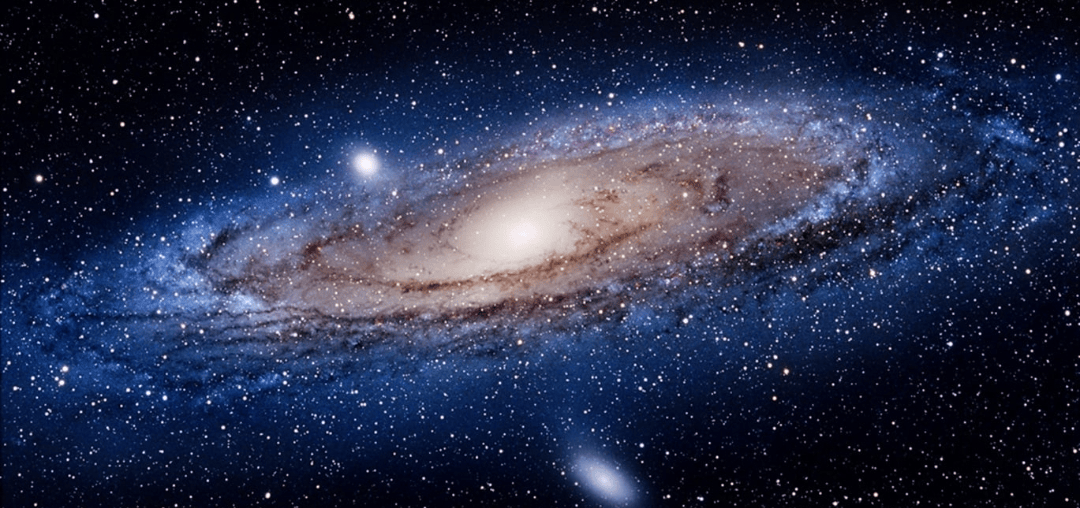
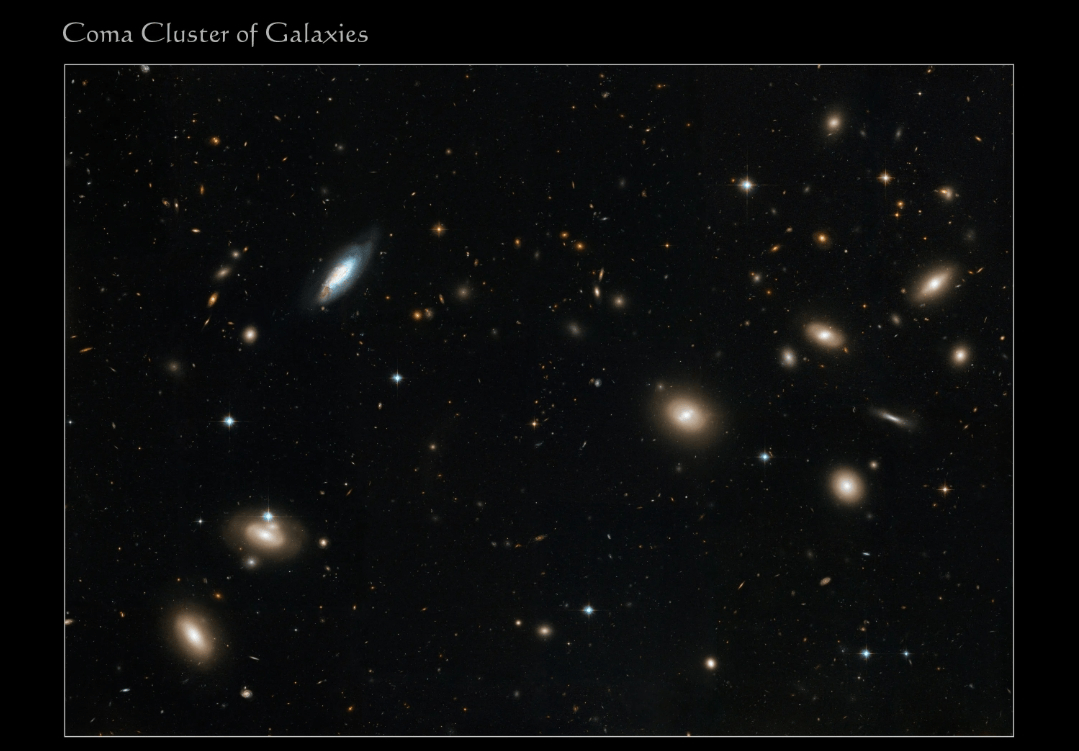
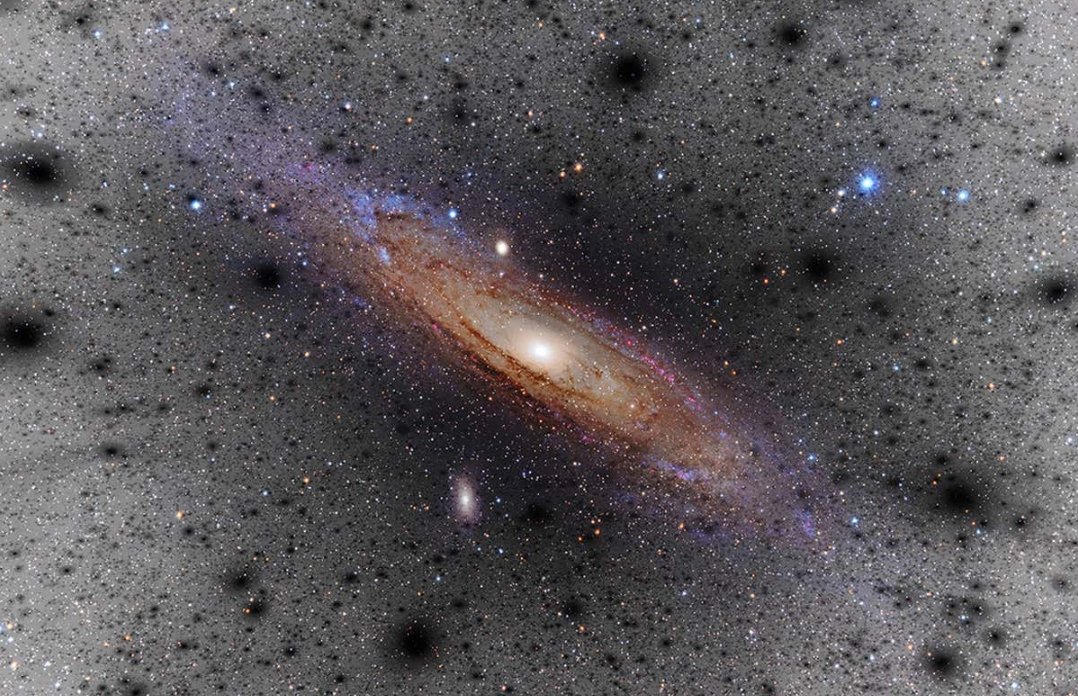
For most of human history, the idea of parallel worlds belonged to mythology and storytelling. Then quantum mechanics arrived, and physicists — very serious, very sober physicists — began arguing that parallel worlds might not just be possible. They might be unavoidable.
This is not science fiction. This is a genuine, ongoing debate at the frontier of theoretical physics.
The multiverse has gone from a fringe idea to a concept that appears, uninvited, in multiple independent branches of physics. The question is no longer whether we can imagine it — it is whether we can avoid it.
In popular accounts the multiverse is discussed as though it were a major research programme, so we counted it. A title search of arXiv on 1 September 2026 returned 330 papers with “multiverse” in the title, 212 on the interpretation of quantum mechanics and 102 on many-worlds specifically. Re-run on 5 October 2026, the counts were 334, 212 and 105.
For comparison, the same archive held 6,456 titled papers on dark energy and 20,649 on dark matter on 5 October. The idea that appears in every popular account of modern physics has a literature roughly one sixtieth the size of dark matter’s.
A title count measures activity, not validity. What it establishes is that the multiverse is a live but small theoretical conversation, not the frontier that popular coverage implies.
Where the Idea Actually Comes From
The multiverse is not one theory. It is several, arising from completely different directions in physics, all pointing toward the same uncomfortable conclusion.
What makes the idea so hard to dismiss is precisely that it was never anyone’s goal. No one set out to discover parallel universes. They kept appearing, unbidden, as the logical consequence of theories built for entirely different reasons.
Three independent roads lead there: quantum mechanics, cosmological inflation, and string theory. None was designed to produce a multiverse. Each does anyway.
It is worth clearing up a common confusion first. The multiverse of physics is not the multiverse of superhero films, where characters hop between worlds and meet alternate versions of themselves. The scientific versions are, without exception, impossible to visit.
What physicists are describing is stranger and more disciplined than fiction: not a network of accessible worlds, but a reality whose full extent may lie permanently beyond observation, deducible only through mathematics. That is exactly what makes it so hard to argue about — and so hard to dismiss.
The Quantum Multiverse: Many Worlds
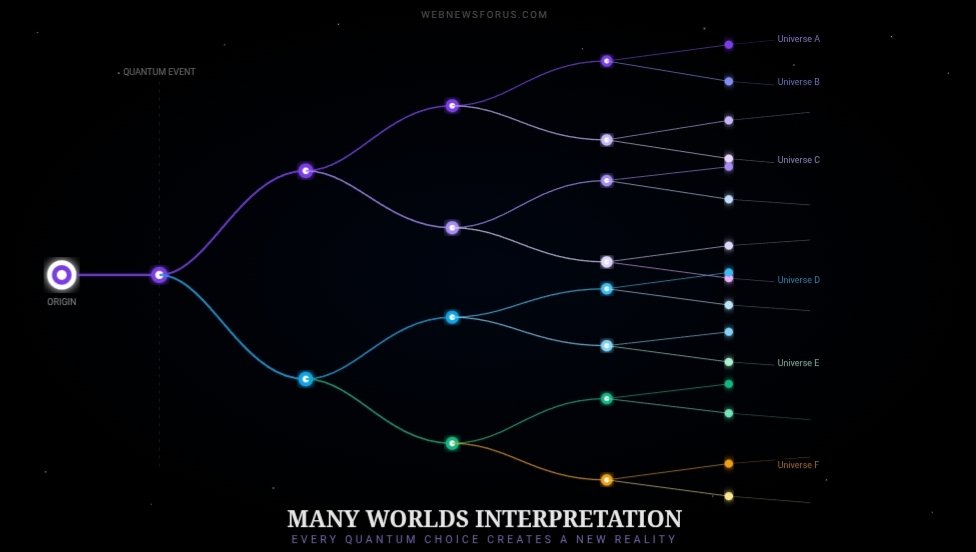
The first and most rigorous route comes directly from quantum mechanics. In 1957 Hugh Everett III, a graduate student at Princeton working under John Wheeler, proposed what he called the “relative state” formulation, now known as the Many Worlds Interpretation.
At the time it was largely ignored. Everett left physics for defence analysis at the Pentagon, and his idea drew attention only after Bryce DeWitt popularised it under the name “many worlds” in Physics Today in 1970. Everett died in 1982. Today it is one of the most discussed interpretations of quantum theory among working physicists.
Everett’s insight was deceptively simple. Standard quantum mechanics says that when a particle is measured, its wave function collapses — all possibilities reduce to one outcome. Everett asked: what if the wave function never collapses?
Under this interpretation, every quantum event that could go multiple ways does go multiple ways — in separate, parallel branches of the universe. The universe does not choose between possibilities. It realises all of them.
A natural objection follows: if reality is constantly branching, why do we never feel it? The answer is a process called decoherence, worked out from 1970 by the German physicist H. Dieter Zeh and developed by Wojciech Zurek and others. Once a quantum system interacts with its noisy environment, its branches lose the ability to interfere with one another and effectively become separate worlds.
This is why we experience a single, definite reality even if all outcomes occur. Each version of us is sealed inside its own branch, unaware of the rest, with no way to sense the others.
A long-standing challenge for Many Worlds has been probability. If every outcome happens, what does it mean to say one is 90 percent likely? In a 1999 paper David Deutsch argued that a rational agent facing a branching universe would weigh outcomes exactly as the familiar quantum rule says, and David Wallace later developed the argument. It remains an active and contested area of research.
Deutsch has been the interpretation’s most forceful champion. His unified case for taking the quantum multiverse literally is explored in our article on David Deutsch’s The Fabric of Reality. For the strange quantum behaviour underlying it all, see our piece on quantum entanglement.
One reason Many Worlds has gained ground is elegance. It requires no special collapse process, no mysterious role for the observer, and no line between the quantum and everyday worlds. It simply takes the core equation of quantum mechanics at face value and follows it to its conclusion.
The cost of that simplicity is ontological extravagance — an unimaginably vast, constantly branching tree of realities. Whether that trade is a bargain or an absurdity is exactly what physicists cannot agree on.
What Physicists Actually Think
How widely is it actually held? The largest survey yet gives an answer. To mark a century of quantum mechanics, Nature emailed more than 15,000 researchers whose recent papers involved the theory and published the answers in July 2025. Of the 1,101 who named a favourite interpretation, 36% chose the Copenhagen interpretation and 15% chose the Everett family, which the survey grouped with a related approach called consistent histories. About 17% preferred approaches in which the wave function represents information rather than reality, and under 7% chose the pilot-wave theory of de Broglie and Bohm.
The striking figure is confidence. Only 24% said they thought their favoured interpretation was actually correct; most called theirs adequate or merely useful. Among respondents who publish in cosmology and gravity, the fields that produce the other multiverses, 17% chose the Everett option.
So Many Worlds is a substantial minority view among physicists, not a consensus and not a fringe. The same is true of almost every other interpretation, which is perhaps the most honest summary of where quantum theory stands after a hundred years.
Tegmark’s Four Levels of Multiverse
The physicist Max Tegmark brought order to the confusion by proposing a taxonomy of four distinct kinds of multiverse — a framework now widely used to keep the debate precise.
Level I is the simplest. If space is infinite, then regions beyond our cosmic horizon are, in effect, other universes — governed by the same laws, but forever out of view. Given infinity, distant regions may even repeat arrangements of matter. In his 2003 survey Tegmark put the distance to an identical copy of you at about 10 to the power of 10 to the power of 29 metres: written out, a 1 followed by a hundred billion billion billion zeros.
Level II is the multiverse of eternal inflation — separate bubble universes that may have different physical constants and even different laws. This is the level cosmology points toward.
Level III is Everett’s quantum many-worlds — the branching of reality at every quantum event. Tegmark argued that Level III adds no new kinds of worlds beyond Levels I and II, only new ways of realising them.
Level IV is the most radical: the idea that every self-consistent mathematical structure corresponds to a real universe. On this view, mathematics does not merely describe reality — different mathematics are different realities. It remains highly speculative, even among multiverse proponents.
The Cosmic Inflation Argument
The second path to the multiverse comes from cosmology, not quantum mechanics, and is arguably even harder to dismiss.
The leading model of the early universe holds that in the first fraction of a second after the Big Bang, space underwent a period of extraordinarily rapid expansion called cosmic inflation. This resolves several puzzles about why the universe looks the way it does — why it is so flat, so uniform, so finely balanced.
But inflation has a consequence many physicists find unsettling. Once inflation starts, most models suggest it never fully stops. Different regions of space stop inflating at different times, each becoming a separate pocket universe with its own properties.
This process — called eternal inflation, developed by physicists including Andrei Linde, Alexander Vilenkin, and Alan Guth — produces an endless, ever-growing landscape of universes, each causally disconnected from the others.
Our observable universe, on this view, is one bubble in an infinite foam of realities. Alan Guth, one of the original architects of inflation theory, wrote in a 2007 review that inflation is “generically eternal into the future” in both of its main families of models, which is why so many cosmologists treat the multiverse as a consequence rather than an assumption.
Eternal inflation carries a deep unsolved difficulty known as the measure problem. In an infinite multiverse, working out what is “typical” — and therefore what the theory actually predicts — becomes mathematically ambiguous. Solving it is one of the field’s central open challenges.
The difficulty is not abstract. Guth’s review describes one way of counting that leads to a “youngness paradox”: because the inflating volume grows so fast, newer pocket universes vastly outnumber older ones, and a naive count predicts observers should almost always find themselves in a universe far younger than ours. Different ways of regulating the infinities give different answers, which is why the measure problem matters for any prediction at all.
The same review notes a limit in the other direction. Although inflation is generically eternal into the future, it cannot be eternal into the past: under reasonable assumptions, the inflating region must have had a beginning, so some physics other than inflation is needed to describe where it all started.
Not everyone accepts that the foam is infinite. In his last paper, published in 2018 with Thomas Hertog, Stephen Hawking argued from a different description of eternal inflation that the exit from it produces not an infinite, fractal multiverse but one that is “finite and reasonably smooth”. It was a conjecture built on simplified models, and it did not settle the question, but it showed that the multiverse’s size is itself a matter of live calculation.
This bubble-universe picture connects directly to how our own cosmos may have emerged from a quantum vacuum, explored in our article on how the universe emerged from nothing but vacuum and energy.
The String Theory Landscape
String theory — a leading candidate for a unified theory of physics — adds another layer. Its mathematics admits an almost incomprehensibly large number of possible solutions, each corresponding to a universe with different physical constants, particle masses, and laws of nature.
This collection of possible universes is called the string theory landscape, a term coined by the physicist Leonard Susskind in 2003. It is often said to number roughly 10 to the power of 500 — a number so large it makes the count of atoms in the observable universe, about 10 to the power of 80, look trivial.
Critics argue this makes string theory untestable and therefore unscientific. Proponents argue the landscape is not a failure but a feature — an explanation for why the constants of our universe appear so finely tuned for life.
The famous figure is an estimate, not a count, and estimates have moved. In 2015 Washington Taylor and Yi-Nan Wang applied the standard estimation method to one particular geometry in a version of string theory called F-theory and suggested it alone could give rise to around 10 to the power of 272,000 such solutions. Numbers of this size say less about how many universes exist than about how little the theory currently constrains.
There is a striking precedent for this reasoning. In 1987 Steven Weinberg used anthropic logic to argue that the cosmological constant — the energy of empty space — could not be much larger than the density of matter, or galaxies would never have formed, and so might be small but not zero. When dark energy was discovered in 1998, its value fell within the range his argument allowed, a rare case of anthropic reasoning anticipating a measurement.
The landscape remains fiercely debated within string theory itself. In 2005 Cumrun Vafa proposed that many apparently consistent theories in fact belong to a “swampland” that cannot be completed into quantum gravity, and a 2018 conjecture by Vafa and colleagues went further, questioning whether string theory allows stable universes with positive dark energy at all. If that holds, it would sharply shrink the landscape and, with it, the multiverse it implies.
The disagreement matters because it determines whether the string multiverse is a genuine prediction or an artefact of an incomplete theory. It is a reminder that all of this rests on physics still very much under construction.
Fine-Tuning and the Anthropic Principle
The multiverse is, for many physicists, an answer to one of the deepest puzzles in science: fine-tuning. Several constants of nature appear balanced on a knife’s edge. Adjust the strength of gravity, the mass of the electron, or the cosmological constant even slightly, and no stars, planets, or life could form.
Why should the universe be so precisely suited to us? One answer invokes design. Another invokes the multiverse.
The anthropic principle, articulated by the physicist Brandon Carter in 1973, observes that we can only ever find ourselves in a universe capable of supporting observers. If countless universes exist with different constants, then the ones with life-friendly settings are simply the only ones anyone is around to notice.
On this view, our universe’s apparent fine-tuning is not a miracle but a selection effect — no more mysterious than the fact that we live on a planet with liquid water. Critics counter that this reasoning risks explaining everything and therefore nothing.
Can Any of This Be Tested?
This is the question that divides physicists most sharply. The standard objection is that, by definition, other universes cannot be observed — so the multiverse is metaphysics, not physics.
But some researchers argue testing is not completely impossible. If our universe collided with a neighbouring bubble universe early in its history, it might have left detectable imprints in the cosmic microwave background — the faint afterglow of the Big Bang.
Specific circular patterns of temperature fluctuation could, in principle, serve as the bruise left by such a collision. In 2011 Stephen Feeney, Hiranya Peiris and colleagues carried out the first such search, in seven years of data from NASA’s WMAP satellite.
They found no reason to add bubble collisions to the standard model of the universe, and limited the average number of detectable collisions on the whole sky to fewer than 1.6. No confirmed collision signal has been reported since. The absence of evidence so far is not evidence of absence: the signal, if it exists, could be too faint or too rare to separate from noise.
Many Worlds faces a different problem: it makes the same predictions as standard quantum mechanics for every experiment anyone knows how to do. What can be tested are its rivals that change the physics. Spontaneous-collapse theories propose that superpositions break down by themselves once objects become large enough. In 2019 a Vienna team made molecules of up to 2,000 atoms, with masses above 25,000 atomic mass units, interfere with themselves, the heaviest objects shown to behave as waves. In 2020, an experiment deep under Italy’s Gran Sasso mountain ruled out the simplest, parameter-free version of the collapse model associated with Lajos Diósi and Roger Penrose.
Each such result leaves less room for quantum mechanics to stop being quantum at larger scales. That is the assumption Many Worlds starts from. But it does not single Many Worlds out: the Copenhagen, pilot-wave and information-based views survive those experiments just as well.
The Critics and the Limits of Science
Not all physicists are persuaded, and the objections are serious. The cosmologist George Ellis, a longtime critic, argues that a theory whose central entities can never be observed strains the definition of science itself. In 2014 he and Joseph Silk warned in Nature that some physicists were in effect proposing to weaken the requirement that theories be testable, and called for that line to be defended.
Others, including physicists who helped build inflationary cosmology, have grown uneasy that eternal inflation may predict everything and therefore nothing — because in an infinite multiverse, almost any observation can be accommodated somewhere. Paul Steinhardt, one of inflation’s early developers, made that case with Anna Ijjas and Avi Loeb in Scientific American in 2017.
The reply was unusual. Guth, Andrei Linde, David Kaiser and Yasunori Nomura wrote a letter, signed by 33 physicists including Stephen Hawking, Steven Weinberg, Edward Witten and Juan Maldacena, arguing that inflation had been tested repeatedly against observations of the cosmic microwave background and had passed. The exchange was about inflation itself, but the multiverse sat at the centre of it.
This is the heart of the dispute. Is the multiverse a bold extrapolation of well-tested physics, or an untestable story that dresses speculation in mathematics? Honest advocates admit the criticism has force.
Intriguingly, some theorists have argued the two main multiverses may be one. A 2011 proposal by Raphael Bousso and Leonard Susskind, published in 2012, suggested that the quantum many-worlds of Everett and the bubble universes of inflation are the same thing, and that the multiverse is needed to give quantum probabilities an exact meaning.
What the Multiverse Does to Our Sense of Meaning
Beyond the physics, the multiverse raises questions philosophy and science have never had to face together before. If every possible version of you exists in some branch of reality, what does it mean to make a choice? If every outcome occurs, does anything truly matter?
The idea of many worlds is far older than physics. The Greek philosopher Epicurus wrote, in a letter preserved by Diogenes Laertius, that there are infinitely many worlds, some like ours and some unlike it. In Hindu tradition the Bhagavata Purana describes unlimited universes passing through the pores of the divine body like particles of dust through a screened window. These are philosophical and religious visions rather than physical theories, and they make no testable predictions, but they show how naturally the human imagination reaches beyond a single cosmos.
Most physicists who take the multiverse seriously are not troubled by this in the way popular culture assumes. David Deutsch argues that the existence of parallel versions of ourselves does not diminish the significance of any one of them.
Each branch is fully real. Each version of you lives a complete life, makes genuine choices, and experiences real consequences. The you reading this is not a copy or a shadow — you are wholly here, in this branch, and it is entirely yours.
These questions of choice and awareness shade into the deepest puzzle of all — the nature of the observer doing the choosing, explored in our article on the hard problem of consciousness.
The multiverse does not make your life smaller. If anything, it suggests existence is far larger, stranger, and more generous than a single universe could ever be.
The Pattern Behind the Argument
What strikes the thoughtful observer about multiverse physics is not the vastness it implies but the humility it demands. Every previous expansion of the known universe — from Earth to solar system, from solar system to galaxy, from galaxy to observable cosmos — was met with resistance, then wonder, then acceptance.
The multiverse may simply be the next step in that long pattern of adjustment. Science has a habit of revealing that reality is larger than we assumed, though a larger reality is not, by that habit alone, a real one.
That is why so many careful physicists — Everett, Guth, Linde, Susskind, Tegmark, Deutsch — have followed the mathematics here despite the discomfort. Not because they wanted parallel worlds, but because their best theories kept producing them.
Frequently Asked Questions
Is the multiverse the same as alternate dimensions?
Not exactly. Popular culture often conflates parallel universes with alternate dimensions, but in physics these are distinct. Alternate dimensions usually refer to extra spatial dimensions in theories like string theory. Parallel universes in the multiverse sense are separate regions of spacetime or separate quantum branches — not additional dimensions of our own space.
Do physicists actually believe in the multiverse?
It depends on the physicist and the model. In Nature’s 2025 survey of more than 1,100 researchers, 15% favoured the Everett family of interpretations, against 36% for the Copenhagen interpretation, and only a quarter of all respondents were confident their favoured view was correct. The inflationary multiverse is accepted as a natural consequence of inflation by many cosmologists and disputed by others. It is a minority view overall but far from fringe science.
Could we ever travel to a parallel universe?
Under current physics, no. In the Many Worlds interpretation, different branches decohere almost instantly and cannot interact. In the inflationary multiverse, other bubble universes are separated by expanding space that cannot be crossed. The multiverse may be real and permanently inaccessible at the same time.
What is the anthropic principle and how does it relate to the multiverse?
The anthropic principle observes that the universe must have properties compatible with observers, since we are here to observe it. In a multiverse context this becomes a selection effect — we necessarily find ourselves in a life-friendly universe, regardless of how many hostile ones also exist. Critics argue this makes the multiverse unfalsifiable; proponents argue it is simply sound reasoning.
Is the multiverse compatible with religious or spiritual worldviews?
This is a matter of personal and theological interpretation. Some find the concept incompatible with traditional notions of a created, singular universe. Others find it compatible with, or even suggestive of, perspectives in which reality is infinite and unbounded. Physics does not answer this question — it only sharpens it.
What are Tegmark’s four levels of the multiverse?
Physicist Max Tegmark classified multiverses into four levels: Level I (regions beyond our cosmic horizon with the same laws), Level II (bubble universes from eternal inflation with different constants), Level III (the quantum many-worlds of Everett), and Level IV (the idea that every self-consistent mathematical structure is a real universe). The framework helps distinguish the very different claims often grouped under the single word “multiverse.”
Has anyone found evidence of another universe?
No. The most direct search looked for marks left on the cosmic microwave background by collisions with other bubble universes. A 2011 analysis of WMAP satellite data found no evidence for them, and no confirmed signal has been reported since. Every other kind of multiverse is, by its nature, out of reach of direct observation.
Can the Many Worlds interpretation be tested?
Not directly, because it predicts the same results as standard quantum mechanics. Experiments can test rival theories in which superpositions collapse on their own. Interference with molecules of up to 2,000 atoms and an underground test that ruled out the simplest gravity-related collapse model have narrowed those rivals, but they do not distinguish Many Worlds from other interpretations that leave quantum mechanics unchanged.
What is the measure problem?
In an eternally inflating multiverse, every possible kind of universe occurs infinitely many times, so asking which kind is most likely means comparing infinities. Different ways of doing that give different answers, and some give absurd ones, such as predicting that we should live in a much younger universe. Until it is solved, the inflationary multiverse cannot make firm statistical predictions.
Conclusion
The multiverse sits at one of the most fascinating and contested boundaries in all of science — the place where rigorous mathematics meets the limits of what can ever be observed. It is uncomfortable precisely because it is serious.
The physicists who work on it are not dreamers. They are following the equations wherever they lead, and the equations keep pointing outward, beyond our horizon, toward a reality that may be incomparably larger than the one we can see.
Whether or not the multiverse is real, the fact that physics has arrived here tells us something important: the universe we inhabit is stranger and more generous than any previous generation had the tools to imagine. That alone is worth sitting with.
Further Reading
Sources
- Max Tegmark — Parallel Universes (Scientific American / MIT)
- Tegmark — Parallel Universes, arXiv:astro-ph/0302131 (2003)
- Everett — “Relative State” Formulation of Quantum Mechanics, Reviews of Modern Physics 29, 454 (1957)
- Guth — Eternal Inflation and Its Implications, arXiv:hep-th/0702178 (2007)
- Susskind — The Anthropic Landscape of String Theory, arXiv:hep-th/0302219 (2003)
- Fine-Tuning — Stanford Encyclopedia of Philosophy
- Gibney — Physicists Disagree Wildly on What Quantum Mechanics Says About Reality, Nature 643, 1175 (2025), with full survey data
- Zeh — On the Interpretation of Measurement in Quantum Theory, Foundations of Physics 1, 69 (1970)
- DeWitt — Quantum Mechanics and Reality, Physics Today 23(9), 30 (1970)
- Deutsch — Quantum Theory of Probability and Decisions, Proceedings of the Royal Society A 455, 3129 (1999)
- Fein et al. — Quantum Superposition of Molecules Beyond 25 kDa, Nature Physics 15, 1242 (2019)
- Donadi et al. — Underground Test of Gravity-Related Wave Function Collapse, Nature Physics 17, 74 (2021)
- Feeney, Johnson, Mortlock & Peiris — First Observational Tests of Eternal Inflation, Physical Review Letters 107, 071301 (2011)
- Hawking & Hertog — A Smooth Exit from Eternal Inflation?, Journal of High Energy Physics 2018, 147
- Weinberg — Anthropic Bound on the Cosmological Constant, Physical Review Letters 59, 2607 (1987)
- Taylor & Wang — The F-theory Geometry with Most Flux Vacua, Journal of High Energy Physics 2015, 164
- Vafa — The String Landscape and the Swampland, arXiv:hep-th/0509212 (2005)
- Obied, Ooguri, Spodyneiko & Vafa — De Sitter Space and the Swampland, arXiv:1806.08362 (2018)
- Bousso & Susskind — Multiverse Interpretation of Quantum Mechanics, Physical Review D 85, 045007 (2012)
- Ellis & Silk — Scientific Method: Defend the Integrity of Physics, Nature 516, 321 (2014)
- Ijjas, Steinhardt & Loeb — Pop Goes the Universe, Scientific American 316, 32 (2017)
- Guth, Kaiser, Linde, Nomura and 29 colleagues — A Cosmic Controversy, Scientific American (10 May 2017)
- Śrīmad-Bhāgavatam 10.14.11 — text and translation (Vedabase)
Baryon. (2025, December 27). The Multiverse Is Not Science Fiction Anymore: What Physics Actually Says About Parallel Worlds. Web News For Us. https://webnewsforus.com/multiverse-parallel-worlds-physics/
Baryon. “The Multiverse Is Not Science Fiction Anymore: What Physics Actually Says About Parallel Worlds.” Web News For Us, 27 December 2025, https://webnewsforus.com/multiverse-parallel-worlds-physics/. Accessed 9 October 2026.