Science & A.I. · Quantum physics
In 1984 and 1985, in a laboratory at the University of California, Berkeley, three physicists watched an electrical circuit, on a chip about a centimetre across, do something only individual atoms were supposed to do. Forty years later, that experiment won the Nobel Prize in Physics.
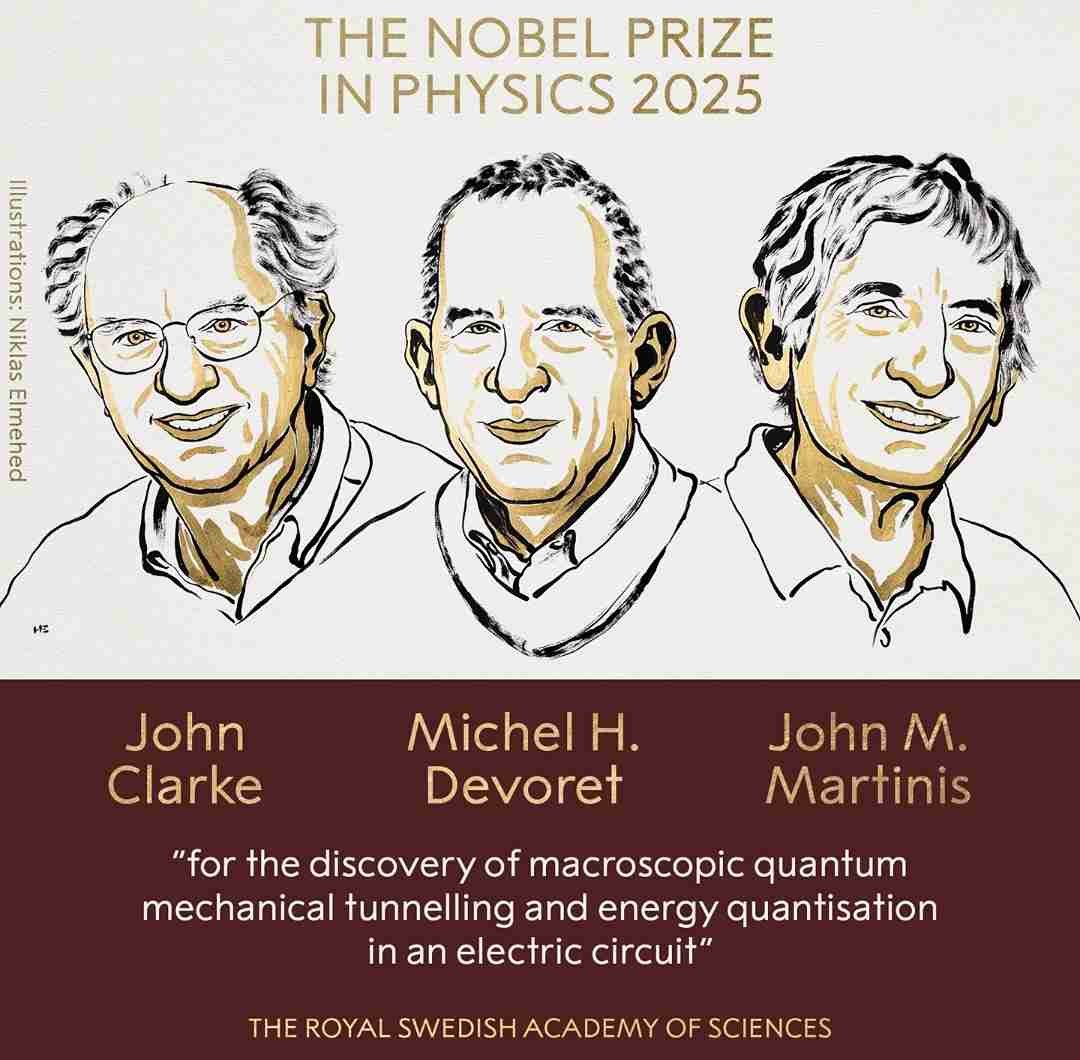
On 7 October 2025 the Royal Swedish Academy of Sciences awarded the prize to John Clarke, Michel H. Devoret and John M. Martinis. Their citation reads: “for the discovery of macroscopic quantum mechanical tunnelling and energy quantisation in an electric circuit”.
Stripped of jargon, they showed that the strange rules of quantum mechanics — usually confined to single particles — can govern an object large enough to hold in your hand. That demonstration is the foundation on which today’s quantum computers are built. This article explains what they found, why it took four decades to be honoured, and what it unlocked.
It is a story with an unusually clean shape. A deep question in fundamental physics, answered with a careful experiment in the mid-1980s, sat quietly for a generation — and then turned out to be the seed of one of the most closely watched technologies of our time.
The research literature helps explain the forty-year wait. Searching the arXiv preprint archive on 1 October 2026 turned up 88 papers with “macroscopic quantum tunneling” in the title — the phenomenon the prize was awarded for, and the same number as a month earlier.
Eighty-eight. Meanwhile the technology it seeded, quantum computation, has 6,310 titled papers, and quantum error correction alone has 998.
The prize was not given for a large field. It was given for a small, decisive result that a very large field was built on top of, which is a different kind of achievement and a harder one for a committee to time.
What the 2025 Nobel was awarded for
The prize recognises two related discoveries in a single device: macroscopic quantum tunnelling, and the quantisation of energy in an electric circuit. Both had been seen before in individual particles. The laureates showed them in a circuit built from superconductors — a system vastly larger than an atom, yet still obeying quantum rules.
At the heart of the experiment sat a Josephson junction: two superconductors separated by a wafer-thin barrier of non-conducting material. In a superconductor, electrons pair up and flow without resistance, and a Josephson junction lets that collective quantum state be probed and controlled electrically. It is the component that made everything else possible.
The importance is conceptual as much as technical. Quantum mechanics was long assumed to fade away at everyday scales, its effects averaged into ordinary classical behaviour. The Berkeley work proved that a carefully engineered object, large enough to be handled, could be coaxed into behaving as a single quantum entity — the essential precondition for a quantum bit.
Quantum on a human scale: tunnelling and quantised energy
Quantum tunnelling is the phenomenon by which a particle passes through an energy barrier it classically should not be able to cross. Picture a ball that lacks the energy to roll over a hill, yet somehow appears on the far side. For single particles this is routine physics; the surprise was seeing it in a whole circuit.
Energy quantisation is the second quantum signature. A classical system can hold any amount of energy along a smooth continuum. A quantum system can only occupy specific, discrete levels, like rungs on a ladder with nothing in between. The laureates demonstrated that their macroscopic circuit had exactly these discrete energy states.
Together, these two results were decisive. A device that tunnels and that has distinct energy levels can be prepared in a chosen state, nudged between levels, and read out — the full repertoire a computer needs from its most basic element. The circuit was, in effect, an artificial atom that engineers could design rather than merely find in nature.
Why superconductors, and why so cold?
The choice of superconductors was not incidental; it was the whole trick. In an ordinary wire, countless electrons jostle and scatter, and their individual quantum behaviour is washed out into the familiar classical flow of current. To see quantum effects in a macroscopic object, that disorder has to be tamed.
A superconductor tames it. Below a critical temperature, electrons bind into pairs and settle into a single, shared quantum state that flows without resistance. The many particles begin to act as one, and that collective state can behave quantum-mechanically on a scale far larger than a single atom — which is precisely what the laureates exploited.
This is also why quantum computers must be kept so cold. The superconducting qubits that descend from the Berkeley circuits operate at temperatures near absolute zero, colder than the depths of space, inside elaborate refrigerators. Warmth is noise, and noise destroys the fragile quantum state before it can be used.
The 1984–85 experiments that started it all
The experiments were carried out at the University of California, Berkeley, in 1984 and 1985. John Clarke led the laboratory; Michel Devoret and John Martinis were the younger researchers who built and measured the circuits. The work demanded extreme conditions: temperatures near absolute zero, and shielding against the faintest electrical noise that could destroy the delicate quantum state.
What made the results credible was their quantitative precision. The team did not merely observe suggestive behaviour; they measured it against the predictions of quantum theory and found agreement. That rigour turned an intriguing possibility into an established fact that others could build upon.
The measurements themselves were ingenious. To reveal tunnelling, the researchers biased the junction close to the point where its quantum state should escape, then timed how often it did so, comparing the statistics against theory. To reveal the discrete energy levels, they used microwaves to nudge the circuit between states, watching it respond only at specific, telltale frequencies.
The Nobel committee’s own account makes the logic easy to follow. The team fed a weak current into the Josephson junction and watched the voltage across it. At first the voltage was zero, because the circuit was trapped in a state that allowed none. Then, at a random moment, the circuit escaped that state and a voltage appeared. Because quantum events are governed by chance, a single escape tells you little, so the researchers repeated the measurement many times and plotted how long the zero-voltage state lasted, much as physicists measure the half-life of a radioactive nucleus from the statistics of many decays.
What escaped was not one electron. The circuit held billions of Cooper pairs, the bound pairs of electrons that carry current in a superconductor, and in tunnelling they moved together, behaving like a single giant particle. The second test confirmed it. When the team shone in microwaves, some were absorbed and lifted the circuit to a higher energy level, and from there it escaped sooner, exactly as quantum mechanics predicts for a particle trapped behind a barrier: the more energy it has, the more easily it tunnels.
At the time, the practical payoff was not obvious. The experiments answered a deep question in fundamental physics: how large can a quantum object be? The answer — larger than anyone had shown — would only reveal its full significance decades later, when the technology to exploit it matured.
The question the experiment was built to answer
The Berkeley experiments did not happen in a vacuum. They were designed to test a sharp theoretical question that had been posed in the early 1980s: does quantum mechanics still apply when a system contains a vast number of particles, or does some new physics take over at large scales?
Theorists had worked out how a large object coupled to its noisy environment should behave if quantum mechanics held all the way up. The prediction was specific and testable: a macroscopic circuit should still tunnel, and should still show discrete energy levels, provided the experiment was clean and cold enough to keep the environment from washing the effect away.
That is what makes the result so satisfying. It was not a lucky accident but a confirmation of a bold claim about the reach of quantum theory. The universe did not switch to a different rulebook for large objects; it kept the quantum one, and the laureates proved it in the laboratory.
The theorists behind that question were Amir Caldeira and Anthony Leggett. In a 1981 paper in Physical Review Letters, Influence of Dissipation on Quantum Tunneling in Macroscopic Systems, they worked out how friction with the surroundings, which every real circuit has, should affect the chance of a large system tunnelling. The Nobel committee’s own account credits Leggett’s theoretical work on macroscopic quantum tunnelling at a Josephson junction with inspiring new kinds of experiment. Leggett, who shared the 2003 Nobel Prize in Physics for other work, has also compared the laureates’ circuit with Schrödinger’s famous cat: a large object behaving by quantum rules.
Who the laureates are
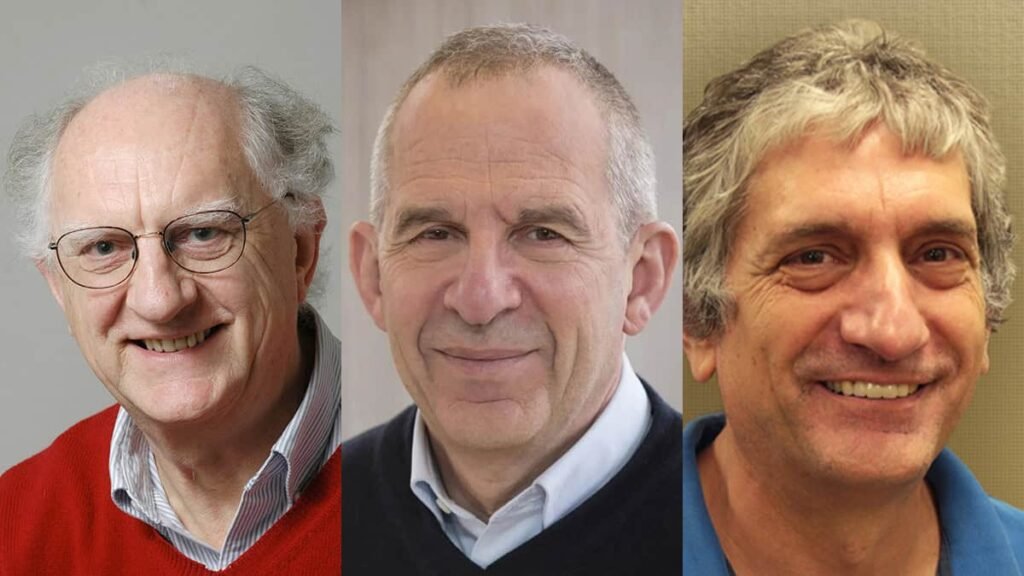
John Clarke was born in Cambridge, England, in 1942, completed his doctorate at the University of Cambridge in 1968 and moved to Berkeley, where he built up a research group exploring superconductors and the Josephson junction. He became a leading authority on superconducting devices and on the exquisitely sensitive magnetic detectors known as SQUIDs, and his laboratory made the discoveries possible.
Michel Devoret was born in Paris in 1953 and received his doctorate from Université Paris-Saclay in 1982. By the mid-1980s he had joined Clarke’s group as a postdoctoral researcher. He went on to become a central figure in quantum-circuit research, and his work helped turn the early circuits into controllable building blocks. At the time of the award he was a professor at Yale and at the University of California, Santa Barbara, and chief scientist for quantum hardware at Google Quantum AI, which places one of the 1985 experimenters inside one of the companies now racing to build a quantum computer.
John Martinis, born in 1958, was the doctoral student in the group, and received his PhD from Berkeley in 1987. He became one of the field’s most prominent experimentalists and led the Google team that reported a landmark quantum-computing milestone in 2019. At the time of the award he was a professor at the University of California, Santa Barbara, and chief technology officer at Qolab in Los Angeles. The arc of his career, from a Berkeley graduate student to the frontier of industrial quantum computing, mirrors the journey of the field itself.
From laboratory curiosity to the qubit
The straight line from the 1985 experiments to today runs through the superconducting qubit. A qubit is the quantum equivalent of a classical bit, but instead of being fixed at zero or one it can exist in a combination of both states at once, a property called superposition. The artificial atom the laureates built is exactly the kind of system that can hold such a state.
Most of the best-known quantum computers — including those built by IBM and Google — use superconducting qubits based on Josephson junctions, cooled to temperatures colder than deep space. Every one of them is a direct descendant of the circuits measured at Berkeley four decades ago.
The refinement from those first circuits to a modern qubit took decades of further work, much of it by the laureates and their students. Designs were made less sensitive to noise, easier to control and more reproducible, so that many could be built to behave alike. But the physical principle never changed: a Josephson junction, held cold and quiet, coaxed into acting as a single quantum object.
This is why the 2025 award was described as honouring both a past achievement and a present revolution. The committee recognised foundational physics, but the timing acknowledged that the technology it enabled had at last become real, moving from the laboratory bench toward genuine computational use.
From One Circuit to a Qubit, Step by Step
The line from Berkeley to a modern quantum processor can be traced through a handful of papers. In October 1985 the trio published two papers in Physical Review Letters, one measuring macroscopic quantum tunnelling and one showing that the circuit’s energy came in discrete levels. In 1988, with Andrew Cleland and Daniel Esteve, they set out the full picture in Science under the title Quantum Mechanics of a Macroscopic Variable. The Nobel committee describes the result as a form of artificial atom on a large scale, an atom with cables and sockets.
The next step was control. In 1999 Yasunobu Nakamura, Yuri Pashkin and Jaw-Shen Tsai reported in Nature that a small superconducting electrode called a single-Cooper-pair box behaved as an artificial two-level system. Despite involving a large number of electrons, it held a coherent superposition of two states, which they could steer with a short voltage pulse and then measure: in their words, a qubit in a solid-state electronic device. Its weakness was extreme sensitivity to stray electric charge.
The answer came in 2007, when a team whose authors included Devoret proposed the transmon, a variant of the Cooper-pair box built to be drastically less sensitive to charge noise while keeping enough control to address each qubit. By 2019 Google, with Martinis leading its hardware effort, was running 53 superconducting qubits in its contested supremacy experiment, and in 2024 Google’s Willow chip showed error correction improving as the code grew. Each step rests on the one before, and the first step was the 1985 circuit.
The state of quantum computing today
The superconducting qubit is not the only route to a quantum computer, but it is the most industrially developed. IBM and Google have built their machines around it, steadily increasing qubit counts and improving the quality of each one. Both have published multi-year roadmaps aimed at large, error-corrected systems.
In 2019 a Google team led by John Martinis reported that its superconducting processor had performed a specific, narrowly defined task faster than the best classical supercomputers of the day could match — an early, contested, but symbolically important demonstration that quantum hardware could do something classical hardware could not. It was a milestone on the road the Nobel work had opened.
That contest has a postscript. In 2022 three researchers generated a million samples from the same 53-qubit circuits on ordinary hardware, using 512 graphics processors for about 15 hours. The same back-and-forth continued after the prize. Google reported a verifiable speed-up on Willow in October 2025, IBM claimed a verified quantum advantage in July 2026, and within weeks classical researchers reproduced IBM’s first test case on graphics processors in 37.3 minutes, confirming along the way that the quantum hardware had worked as claimed. The full story is in our article on quantum computing in 2026, listed below.
Other approaches compete seriously. Trapped-ion machines encode qubits in individual charged atoms; photonic systems use particles of light; neutral-atom arrays hold atoms in place with lasers. Each has strengths and weaknesses, and it is not yet clear which will scale best. What they share is the same underlying goal the laureates made conceivable.
It is worth being honest about the state of play. Today’s machines are noisy and limited, useful for research and narrow demonstrations rather than everyday problems. The gap between a laboratory processor and a computer that reliably outperforms classical machines on commercially valuable tasks remains wide, and closing it is the work of the coming years.
What has changed is the seriousness of the effort. Governments and technology companies now invest heavily in quantum research, treating it as strategically important rather than speculative. That shift, more than any single processor, is what the 2025 prize implicitly acknowledged: a field that was once niche has become a global race.
Why the prize came now
Nobel Prizes often arrive decades after the work they honour, once the significance is beyond dispute. In this case the wait was instructive. For years, macroscopic quantum circuits were a specialist curiosity; only as quantum computing grew into a global research effort did the foundational nature of the Berkeley experiments become impossible to overlook.
By the mid-2020s, quantum processors had run a handful of carefully chosen calculations that classical machines struggled to match, each one contested and none yet commercially useful, and companies and governments were investing heavily in the technology. Against that backdrop, recognising the physicists who proved quantum behaviour could be engineered at scale was both overdue and pointed.
The lesson is a familiar one in science: fundamental research pursued for its own sake, with no application in view, can decades later become the bedrock of an entire industry. The 2025 physics prize is a case study in that long, unpredictable payoff.
What a quantum computer could actually do
The excitement around quantum computing rests on a handful of problems where it could offer a genuine advantage. The most famous is factoring very large numbers. A sufficiently powerful quantum computer running an algorithm devised by the mathematician Peter Shor could break the encryption that secures much of today’s internet traffic.
That prospect, though still distant, has already prompted a worldwide effort to develop new, quantum-resistant forms of cryptography before the threat becomes real. It is a rare case of a technology reshaping security policy years before it exists in usable form.
The more constructive promise lies in simulating nature itself. Molecules and materials are quantum systems, and a quantum computer is naturally suited to modelling them. That could accelerate the design of new drugs, catalysts, batteries and materials in ways classical machines find prohibitively expensive.
Optimisation is a third area, from logistics to finance, where quantum methods might one day find better solutions than classical ones. In every case the honest caveat is the same: the potential is real, the timeline is uncertain, and the hardware is not yet good enough. The foundations, however, are no longer in doubt.
What comes next for quantum technology
The central challenge now is not proving that quantum circuits work but making enough of them work together reliably. Qubits are fragile: the faintest disturbance can collapse their delicate states, a problem known as decoherence. Building useful machines means correcting these errors faster than they accumulate.
Quantum error correction spreads the information of one reliable logical qubit across many physical ones, so that errors can be detected and fixed without destroying the computation. Scaling from today’s processors to the large, fault-tolerant machines that could break cryptography or design new materials remains the field’s defining engineering problem.
Whatever route succeeds, its foundations were laid in that Berkeley laboratory. The laureates answered a question about the nature of reality — how far into our everyday world the quantum rules reach — and in doing so handed engineers the raw material for a new kind of computer.
There is a quiet lesson in the four decades between the experiment and the prize. None of the three physicists set out in 1984 to build a computer. They were chasing a fundamental question about how the world works, and the answer turned out to be worth an industry.
It is a pattern that recurs throughout the history of science, from electromagnetism to the laser: curiosity-driven research, undertaken with no product in mind, laying foundations that only later prove indispensable. The 2025 Nobel Prize in Physics is both a celebration of a specific discovery and a reminder of why such patient, open-ended inquiry deserves support.
Beyond computing: quantum sensing
Quantum circuits are not only about computation. The same extreme sensitivity that makes a qubit fragile also makes it an exquisite sensor. John Clarke built much of his career on superconducting quantum interference devices, or SQUIDs, which can detect magnetic fields of almost unimaginable faintness.
Such devices are already used to measure the tiny magnetic signals produced by the human brain and heart, to search for signatures of exotic physics, and to probe materials in the laboratory. Quantum sensing may reach practical, everyday use sooner than quantum computing does, because it demands fewer perfectly coordinated qubits.
This breadth is part of why the 2025 prize resonated. The physics it honoured did not open a single door but a whole corridor of them — computing, sensing, secure communication and precision measurement all trace back to the ability to control quantum states in engineered devices.
Frequently asked questions
Who won the 2025 Nobel Prize in Physics?
John Clarke, Michel H. Devoret and John M. Martinis, announced by the Royal Swedish Academy of Sciences on 7 October 2025. The prize was shared equally between the three.
What was the prize awarded for?
The official citation is “for the discovery of macroscopic quantum mechanical tunnelling and energy quantisation in an electric circuit” — showing that quantum effects usually seen in single particles can occur in a circuit large enough to hold in the hand.
What is a Josephson junction?
Two superconductors separated by a very thin barrier of non-conducting material. It allows the collective quantum state of a superconductor to be controlled electrically, and it is the core component of the circuits behind the prize — and of most superconducting quantum computers today.
Why did it take 40 years to win the Nobel?
Nobel Prizes are often awarded only once the long-term importance of a discovery is clear. The Berkeley experiments were foundational, but their significance became undeniable only as quantum computing matured into a major technology in the 2020s.
How does this relate to quantum computers?
Most leading quantum computers, including those from IBM and Google, use superconducting qubits built on Josephson junctions — the same class of device the laureates first demonstrated as a quantum object in the mid-1980s.
What is the biggest obstacle still ahead?
Decoherence — the tendency of fragile quantum states to collapse when disturbed. Overcoming it requires quantum error correction and scaling to far larger numbers of qubits, which remains the central engineering challenge of the field.
Could quantum computers break current encryption?
In principle, yes — a large, fault-tolerant quantum computer running Shor’s algorithm could break the public-key encryption that protects much of the internet. That machine does not yet exist, but the risk has already driven a global shift toward quantum-resistant cryptography.
Why do quantum computers need to be so cold?
Superconducting qubits rely on the resistance-free flow of paired electrons, which only occurs near absolute zero. Warmth introduces noise that destroys the delicate quantum state, so the processors sit inside refrigerators colder than outer space.
Is this the same as quantum entanglement?
No, though they are related quantum phenomena. The 2025 prize was for showing tunnelling and discrete energy levels in a macroscopic circuit. Entanglement — the strange correlation between separated particles — is a distinct effect that quantum computers also exploit, and it was central to earlier Nobel-recognised work.
What is a Cooper pair?
Two electrons bound together inside a superconductor. Below a critical temperature the electrons pair up and the pairs settle into one shared quantum state, which is why a superconductor carries current without resistance. In the laureates’ circuit, billions of Cooper pairs acted together like a single giant particle.
How much was the prize worth?
11 million Swedish kronor, shared equally between the three laureates, according to the Royal Swedish Academy of Sciences.
Where do the laureates work now?
At the time of the award John Clarke was at the University of California, Berkeley; Michel Devoret at Yale University, the University of California, Santa Barbara, and Google Quantum AI, where he is chief scientist for quantum hardware; and John Martinis at the University of California, Santa Barbara, and Qolab, where he is chief technology officer.
Further reading on Web News For Us
Sources
Primary peer-reviewed research (the laureates’ own work):
- Devoret, M. H., Martinis, J. M., & Clarke, J. (1985). Measurements of macroscopic quantum tunneling out of the zero-voltage state of a current-biased Josephson junction. Physical Review Letters, 55, 1908. doi.org/10.1103/PhysRevLett.55.1908
- Martinis, J. M., Devoret, M. H., & Clarke, J. (1985). Energy-level quantization in the zero-voltage state of a current-biased Josephson junction. Physical Review Letters, 55, 1543. doi.org/10.1103/PhysRevLett.55.1543
- Clarke, J., Cleland, A. N., Devoret, M. H., Esteve, D., & Martinis, J. M. (1988). Quantum mechanics of a macroscopic variable: the phase difference of a Josephson junction. Science, 239, 992. doi.org/10.1126/science.239.4843.992
- Arute, F., et al. (2019). Quantum supremacy using a programmable superconducting processor. Nature, 574, 505. doi.org/10.1038/s41586-019-1666-5
Nobel Prize documentation:
- The Nobel Prize in Physics 2025 — official press release (Royal Swedish Academy of Sciences)
- NobelPrize.org — Physics 2025 summary and citation
- NobelPrize.org — Popular science background: quantum properties on a human scale
Scientific background and journalism:
- Royal Swedish Academy of Sciences — Scientific background to the 2025 physics prize (PDF)
- NobelPrize.org — Laureate facts: Clarke, Devoret and Martinis
- Caldeira, A. O. & Leggett, A. J. (1981) — Influence of dissipation on quantum tunneling in macroscopic systems. Physical Review Letters 46:211-214.
- Nakamura, Y., Pashkin, Yu. A. & Tsai, J. S. (1999) — Coherent control of macroscopic quantum states in a single-Cooper-pair box. Nature 398:786-788.
- Koch, J. et al. (2007) — Charge-insensitive qubit design derived from the Cooper pair box. Physical Review A 76:042319.
- Pan, F., Chen, K. & Zhang, P. (2022) — Solving the sampling problem of the Sycamore quantum circuits. Physical Review Letters 129:090502.
- Google Quantum AI (2025) — Quantum error correction below the surface code threshold. Nature 638:920.
- Manabe, H., Gu, H. & Pan, F. (13 August 2026) — Classical simulation and design frontiers for IBM’s doped Clifford sampling experiment, arXiv:2608.13110.
Baryon. (2025, October 18). Nobel Prize in Physics 2025: The Quantum Circuit Behind the Computer Revolution. Web News For Us. https://webnewsforus.com/nobel-prize-in-physics-2025-the-quantum/
Baryon. “Nobel Prize in Physics 2025: The Quantum Circuit Behind the Computer Revolution.” Web News For Us, 18 October 2025, https://webnewsforus.com/nobel-prize-in-physics-2025-the-quantum/. Accessed 11 October 2026.
1 Response