In June 2026 El Capitan lost the title this article was originally written about. The 67th edition of the TOP500 list put a Chinese machine called LineShine at number one, ending El Capitan’s run and making it the first China-based system to lead the ranking since Sunway TaihuLight in 2017.
The margin was not narrow. LineShine debuted at 2.198 exaflops against El Capitan’s 1.809 — more than twenty per cent ahead. It also took first place on HPCG, the benchmark designed to be harder to game than raw floating-point speed.
The detail that should interest anyone who follows this field is how it did so. LineShine has no accelerators at all. It reached 2.198 exaflops using 13,789,440 CPU cores on a custom platform called LingKun, running Kylin OS over a proprietary interconnect. Every other exascale machine on the list, El Capitan included, depends on GPUs. That is not a small footnote — it is a challenge to the architectural assumption the entire Western exascale programme was built on.
Science & A.I. · Exascale computing
For nineteen months El Capitan was the fastest computer humanity had ever built. On 23 June 2026 it lost that title — and the people who run it were entirely unbothered, because the number-one ranking was never the point.
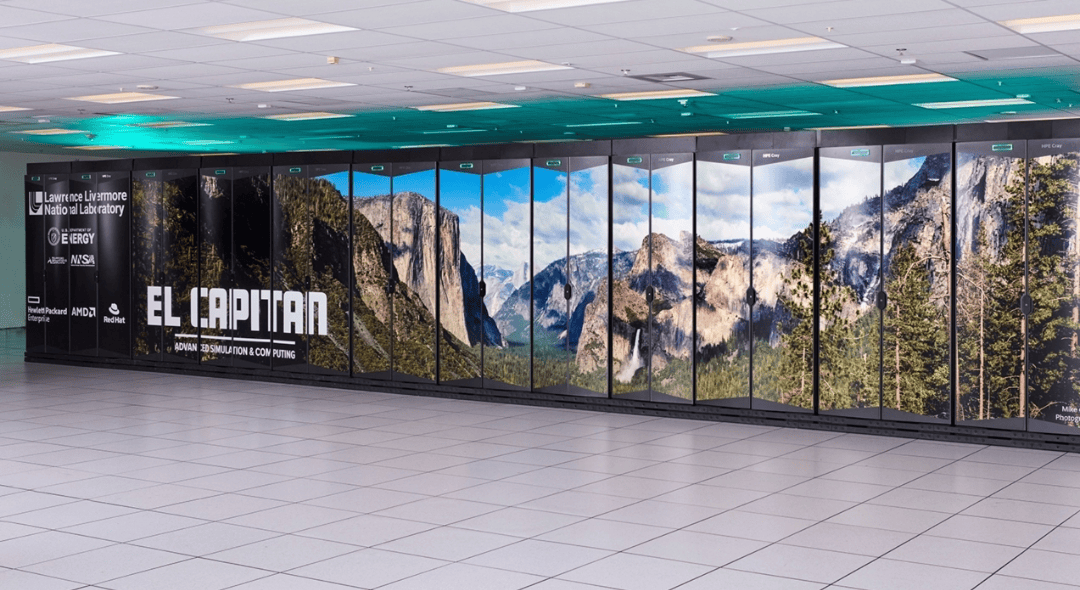
The machine lives in a windowless hall at Lawrence Livermore National Laboratory in California, drawing roughly the electricity of a small town. It was built not to win benchmarks but to answer one consequential question without setting off a nuclear explosion: are the weapons in the United States stockpile still safe, and do they still work?
El Capitan exists to simulate that answer. This is the story of what an exascale supercomputer actually is, why a weapons laboratory needed the most powerful one on Earth, and what it means that a Chinese system has just overtaken it.
What “exascale” actually means
An exaflop is a quintillion floating-point operations per second — a one followed by eighteen zeros. The scale defeats intuition, so try this. If every person alive completed one arithmetic sum every second, without pause, it would take more than four years of unbroken human effort to match what El Capitan does in one second.
The benchmark that certifies this is called High Performance Linpack, or HPL. It measures how fast a system solves a vast dense set of linear equations, and its result — a figure called Rmax — is what the twice-yearly TOP500 list ranks. When El Capitan debuted in November 2024 it posted 1.742 exaflops on HPL.
That made it the third machine ever to cross the exascale line, and at that moment the fastest of them all. Rmax is the measured speed; a second figure, Rpeak, is the theoretical ceiling the hardware could reach if nothing ever waited on anything else.
El Capitan’s Rpeak is 2.79 exaflops, so its real-world HPL result runs at roughly 62 per cent of the paper maximum. That ratio is respectable for a machine of this size, where the gap between peak and delivered performance is exactly where the hardest engineering hides.
The road to exascale: how we got here
El Capitan did not appear from nowhere. It is the product of a decade-long United States Department of Energy programme to reach exascale computing, and it stands on the shoulders of the machines that came before it.
The exascale era began in earnest with Frontier, which came online at Oak Ridge National Laboratory in 2022 as the first system to break the exaflop barrier on HPL. Frontier, another HPE Cray machine, proved that sustained exascale performance was achievable and set the template that El Capitan would follow and surpass.
Livermore had its own lineage. Its previous flagship, Sierra, delivered around a tenth of El Capitan’s speed and served the same stockpile mission for years. Each generation lets the weapons laboratories simulate more physics, in higher resolution, in less time — a steady climb that El Capitan advanced by a large step.
Crucially, El Capitan is described as the first exascale system dedicated to national security. Where Frontier and Argonne’s Aurora are open-science machines, El Capitan was designed from the outset around the classified needs of the National Nuclear Security Administration, which shaped everything from its architecture to the hall that houses it.
Inside the machine: eleven million cores and a clever chip
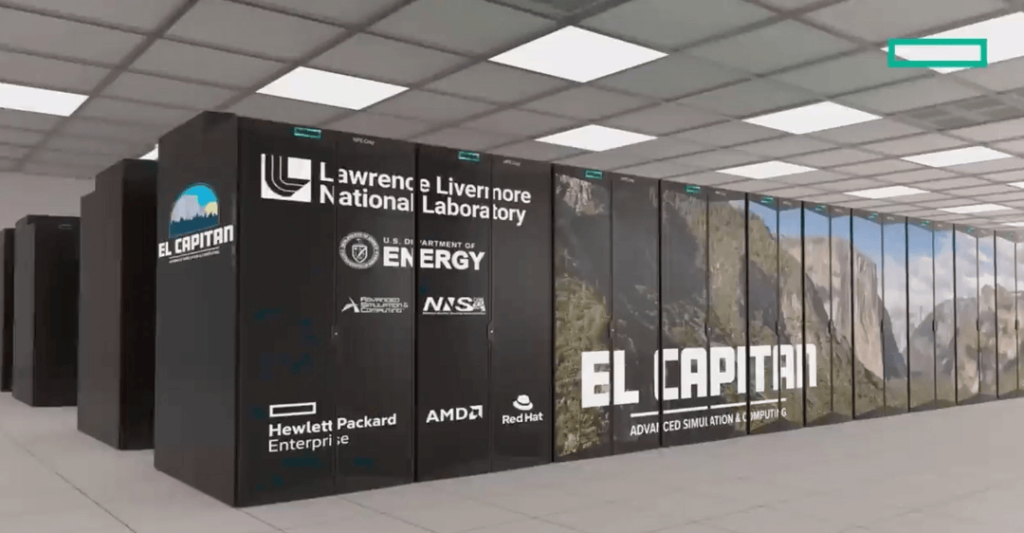
El Capitan is an HPE Cray Supercomputing EX system built around more than 11,000 compute nodes and 11,039,616 total cores. Its performance comes from a component that reflects the dominant idea in modern high-performance computing: stop treating the processor and the graphics accelerator as separate chips that must ship data back and forth.
The system is powered by AMD Instinct MI300A units, described as accelerated processing units, or APUs. Each MI300A fuses AMD fourth-generation EPYC CPU cores, GPU compute cores and high-bandwidth memory into a single shared package.
Because the CPU and GPU address the same pool of memory, the costly copying of data between separate CPU and GPU memories — a chronic tax on older designs — largely disappears. For the memory-hungry physics codes the weapons laboratories run, that unified design is not a minor convenience; it is much of the reason the machine performs as it does.
Those nodes are stitched together by the HPE Slingshot 11 interconnect, the nervous system that lets eleven million cores behave as one machine rather than eleven million isolated ones. In a calculation spread across the whole system, the speed at which nodes exchange partial results often matters as much as raw core count.
The whole assembly carries 5.4375 petabytes of memory and is kept alive by direct liquid cooling, water piped straight to the hot components rather than relying on chilled air. At full load the machine draws about 30 megawatts.
Efficiency, not just raw speed, is a deliberate goal. At its debut El Capitan delivered 58.89 gigaflops for every watt consumed, a figure that had improved to roughly 60.9 gigaflops per watt by late 2025 as its software and operation matured — placing it among the more efficient large systems in the world.
Why a weapons lab needed the world’s fastest computer
The United States has not conducted an explosive nuclear test since 1992. That moratorium created a scientific problem that has quietly shaped American supercomputing ever since: how do you know an ageing arsenal still works, and is still safe to handle, if you never detonate one to check?
The answer is the National Nuclear Security Administration’s Stockpile Stewardship Program, which replaces physical testing with physics-based simulation. El Capitan is its most powerful instrument, a shared resource for the three NNSA weapons laboratories — Lawrence Livermore, Sandia and Los Alamos.
The physics involved is genuinely hard. Certifying a warhead means modelling how materials behave under extreme pressure and temperature, how components age over decades, and how a vast number of coupled physical processes unfold in fractions of a second. Each added dimension of realism multiplies the computing required.
Jill Hruby, the NNSA Administrator and Department of Energy Under Secretary for Nuclear Security, framed El Capitan’s arrival as the continued advance in capability needed to sustain the stockpile without resuming explosive testing.
Rob Neely, who directs weapon simulation and computing at Livermore, has described the goal in similar terms: simulating entire weapons systems while incorporating the many real-world factors a simpler model is forced to leave out. Each of those factors adds computational cost, and the machine exists to absorb it.
Simulation does not stand alone. It is calibrated against the archive of data from the era of underground testing, against non-nuclear subcritical experiments, and against results from facilities such as the National Ignition Facility. The computer ties those threads together into a predictive model, which is why more computing power translates directly into more confidence.
This is why the leaderboard ranking is close to irrelevant to the laboratory. A weapon simulation that once had to run in coarse approximation, or in two dimensions to save time, can now run in full three-dimensional detail with more of the underlying physics included. The value is measured in the fidelity of the answer, not a position on a public list.
Beyond weapons: what else exascale unlocks
A machine built for weapons physics turns out to be extraordinarily useful for any problem that is too large, too dangerous or too slow to study by experiment alone. Livermore is also home to the National Ignition Facility, where researchers achieved fusion ignition in 2022, and the same laboratory culture of simulation-led science runs through both projects.
The ability to resolve fine detail across an enormous simulated volume applies far beyond the stockpile mission. Climate and weather models can be run at finer resolution, capturing smaller features of the atmosphere and ocean. Drug and materials discovery can screen enormous numbers of candidate molecules before anyone synthesises one in a laboratory.
Fusion-energy research, cardiac modelling and the simulation of new battery chemistries all draw on the same capacity to compute the consequences of physics at scale. Problems that were once reduced to rough approximations can be attacked in something closer to their full complexity.
Increasingly these machines also run artificial-intelligence workloads. The MI300A accelerators that give El Capitan its speed are the same class of hardware used to train large neural networks, so an exascale system can move between traditional physics simulation and modern machine learning — sometimes weaving the two together, using a trained model to approximate an expensive calculation and free the simulation to reach further.
What the benchmark measures — and what it misses
It is worth being precise about what a TOP500 ranking does and does not tell you. HPL solves one particular kind of mathematical problem extremely efficiently, and it rewards machines with enormous dense-matrix throughput. It is a fair, repeatable yardstick — but it is a single number standing in for a machine that does far more.
Many real scientific codes look nothing like HPL. They move irregular data, communicate constantly between nodes, and stress memory and network in ways the benchmark does not. This is why the supercomputing community also tracks alternative measures, and why a laboratory judges a machine by whether its own applications run well, not by a headline figure.
The rise of artificial intelligence has added another dimension. AI training leans on lower-precision arithmetic, where a machine can run far faster than its double-precision HPL score suggests. A system’s single TOP500 number, in other words, is the beginning of its story rather than the whole of it.
Dethroned: the June 2026 TOP500 upset
El Capitan held first place through three editions of the TOP500 list. In November 2025 it was still comfortably ahead, its HPL result having climbed to 1.809 exaflops as the system settled into full operation. Then, on 23 June 2026, at the ISC High Performance conference in Hamburg, the order changed.
A previously unlisted Chinese system called LineShine, installed at the National Supercomputing Centre in Shenzhen, debuted at number one with an HPL score of 2.198 exaflops against a theoretical peak of 2.736 exaflops. It became the first machine on the list to exceed two exaflops of sustained double-precision performance using CPUs alone, without GPU accelerators.
That CPU-only approach is a notable departure from the accelerator-heavy designs that dominate the rest of the top tier, and its appearance is significant for another reason: Chinese centres had for years declined to submit systems to the TOP500 at all. A debut straight at number one signals both renewed transparency and considerable capability.
El Capitan moved to second at its steady 1.809 exaflops. Behind it sat the other American exascale machines, Frontier at Oak Ridge with 1.353 exaflops and Aurora at Argonne with 1.012 exaflops, followed by Europe’s first exascale system, the JUPITER Booster at the Jülich Supercomputing Centre in Germany, at an even 1.000 exaflops.
The reshuffle is a reminder that a supercomputer ranking is a snapshot of a moving race, not a settled fact. El Capitan lost none of its capability on 23 June; a faster machine simply appeared. For the geopolitics of computing, though, it matters a great deal that the top of the list is now contested across three continents.
The Architecture Argument Nobody Expected
Read the June 2026 TOP500 entries side by side and a design disagreement emerges that matters more than the ranking itself.
El Capitan is built the way every recent Western exascale system has been built. It pairs AMD fourth-generation EPYC processors with AMD Instinct MI300A accelerators across 11,340,000 cores, connected by Cray Slingshot 11, and reaches 1.809 exaflops at an energy efficiency of 60.94 gigaflops per watt. The accelerators do the heavy arithmetic; the CPUs coordinate. Frontier, Aurora and JUPITER all follow variations of the same pattern.
LineShine does none of this. Installed at the National Supercomputing Centre in Shenzhen and built by the Shenzhen Cloud Computing Center, it runs 13,789,440 cores of 304-core LX2 processors at 1.55 GHz on a custom platform called LingKun, linked by a proprietary LingQi interconnect and running Kylin OS. There are no GPUs in the machine. It is CPU-only, and it is the fastest computer in the world.
The trade-off shows up on the mixed-precision benchmark. On HPL-MxP, which rewards the low-precision arithmetic that GPUs excel at, LineShine placed fourth at 7.92 exaflops with a speedup of only about 3.6 times over its standard score — a modest multiplier that is exactly what a design without accelerators would predict. On HPCG, which stresses memory access patterns closer to real scientific workloads and is notoriously unflattering to GPU machines, LineShine took first place at 22.00 petaflops, ahead of El Capitan’s 17.41.
Read together, those three results describe a machine optimised for a different kind of problem. Western exascale design has been shaped by the assumption that accelerators are the only affordable route to this performance — an assumption reinforced by the AI boom, which has poured investment into exactly that hardware. LineShine suggests there is more than one road, and that export controls on accelerator hardware may have pushed one programme down a path the other never seriously explored.
One caveat is worth stating plainly. TOP500 rankings rest on self-submitted benchmark runs, and a debut placement is a snapshot of one measurement rather than a full account of what a machine does in daily service. El Capitan’s classified weapons-simulation workload is not something a public benchmark captures, and neither is LineShine’s. The list ranks a race that nobody actually runs for a living.
The US–China computing race behind the numbers
LineShine’s debut is about more than one benchmark. For several years, leading Chinese centres had stopped submitting their fastest machines to the TOP500, even as researchers believed exascale systems were operating inside the country. A public return straight to number one is a deliberate statement.
The detail that it reached two exaflops using CPUs alone, without the GPU accelerators that power El Capitan, Frontier and Aurora, is strategically pointed. The United States has restricted exports of the most advanced accelerator chips to China, and a competitive CPU-only design is one answer to those controls.
For the United States, the response is that leadership was never resting on a single machine. The country now operates three exascale systems — El Capitan, Frontier and Aurora — spanning weapons science and open research, a depth of installed capability no other nation yet matches. Europe’s JUPITER has joined the exascale club, and the field is widening rather than narrowing.
The lesson of the June 2026 list is that exascale computing is no longer a two-horse race, and no single ranking will stay settled for long. National capability is better measured by how many frontier machines a country can build, run and use well — not by who happens to hold the top line in any given month.
What it takes to build and run an exascale machine
A system like El Capitan is not bought off a shelf. It is the product of years of co-design, in which the laboratory, the system builder Hewlett Packard Enterprise and the chip designer AMD shape the hardware and the scientific software together, so that the machine fits the problems it must solve rather than the other way round.
The hardest part is often invisible. Building a machine with eleven million cores is one challenge; writing software that keeps all of them usefully busy is a far greater one. A calculation must be broken into millions of pieces that run in parallel, exchange results constantly, and still arrive at a single coherent answer.
Decades-old physics codes had to be substantially rewritten to run efficiently on the MI300A architecture, a preparation effort that ran for years before the hardware was switched on. Much of the return on an exascale investment comes not from the metal but from that painstaking work of readying applications to exploit it.
Then there is the sheer physical reality of the thing. A machine drawing around 30 megawatts needs the power feeds, the water-cooling plant and the reinforced floor of a small industrial facility. Running it is a continuous engineering operation, and the energy appetite of frontier computing is now part of a wider debate about the sustainability of large-scale data centres.
Second on One Stopwatch, First on Two Others
There is a complication in the ranking above that the headline cannot carry, and it matters more than the headline does.
TOP500 orders machines by High Performance Linpack, which solves a large dense system of linear equations. HPL is regular, predictable work: the data sits in tidy blocks, every processor knows what it needs next, and a machine can be tuned to run it close to its theoretical peak. That is precisely why it has survived as a benchmark since 1993. It is comparable across decades and hard to game.
It is also, as the section above noted, not what most scientific code looks like. Real simulations tend to be sparse and irregular: the calculation jumps around memory, processors wait on each other, and performance is governed by how fast data moves rather than how fast arithmetic happens. The benchmark built to capture that is High Performance Conjugate Gradients, and machines routinely score a small fraction of their HPL figure on it. A third benchmark, HPL-MxP, measures mixed-precision work of the kind that dominates modern AI training, where lower-precision arithmetic is used wherever full precision is not needed.
On both of those, El Capitan still ranks first. It lost the headline while holding the two measures that arguably track useful work more closely than the one it lost. Depending on which stopwatch you hold, the machine is either the second fastest in the world or the fastest, and both statements are true simultaneously.
None of this is a consolation prize, and it is not a reason to dismiss the Chinese result either. LineShine won the benchmark it entered, decisively, with an architecture nobody expected. The point is narrower: “fastest supercomputer in the world” is a sentence that sounds like a fact and behaves like a definition. Which machine it names depends on a choice about what computing is for — and that choice is made by whoever selects the benchmark, not by the hardware.
It is worth asking who the ranking is for, because that explains why the choice is contested. A TOP500 position is not a trophy sitting on a shelf in a machine room. It is evidence in budget negotiations, a recruiting argument for laboratories competing for a small pool of people who can write code at this scale, and a line in the diplomatic ledger between states that treat computing capacity as strategic. A single ordered list, however imperfect, is useful to all three audiences in a way that a nuanced multi-benchmark picture is not.
That creates a quiet pressure worth naming. A benchmark that is easy to explain and easy to rank will outlive a benchmark that is more informative but produces no clean ordering. HPL endures partly because it is a good measurement and partly because it yields a single number that fits in a headline and a funding request. The machines, meanwhile, are bought to do science, and the science looks much more like the benchmark El Capitan still leads than the one it lost. None of which makes the ranking worthless. It makes it a measurement with a stated scope, which is the most any benchmark can honestly claim, and rather more than the phrase “world’s fastest” tends to suggest when it reaches a news headline.
Where the List Stands Now
TOP500 publishes twice a year, in June at the ISC conference and in November at SC, so the June 2026 ranking is still the current one and the next is not due until November. Checked again on 22 September 2026, nothing in the paragraphs above has moved: LineShine remains first at 2.198 exaflops, El Capitan second at 1.809.
The rest of the table is worth seeing, because the top of it has quietly become crowded. Frontier, at Oak Ridge, is third at 1.353 exaflops. Aurora, at Argonne, is fourth at 1.012. Fifth is JUPITER Booster in Germany at almost exactly one exaflop, the first European machine over the line. Five systems now sit above a threshold that nothing in the world had reached before 2022. Exascale has stopped being a single achievement and become a category.
One further detail gives the Chinese debut its weight: LineShine is the first China-based system to lead the TOP500 since Sunway TaihuLight in 2017. Whatever the architecture argument above finally settles, a nine-year absence from the top of the list has ended.
The real measure of a machine like this
It is tempting to treat these systems as trophies, and press coverage tends to reward that framing. But the engineers at Livermore will tell you the ranking is the least interesting thing about El Capitan. What matters is that a class of scientific question that was previously out of reach can now be answered in full.
The deeper significance of exascale is that it changes what counts as a knowable problem. A machine that can simulate an ageing warhead in three dimensions can also model a beating heart, a warming ocean or a fusion plasma with the same unprecedented fidelity.
El Capitan may no longer be the fastest computer on Earth. But the era it helped open — where simulation stands in for experiments we cannot, or must not, perform — is only beginning. The leaderboard will keep changing hands; the deeper shift, in what science can now compute, is the part that lasts.
Frequently asked questions
Is El Capitan still the world’s fastest supercomputer?
No. El Capitan was the fastest from November 2024 until June 2026. On the TOP500 list of 23 June 2026 a Chinese system called LineShine debuted at number one with 2.198 exaflops, pushing El Capitan to second place at 1.809 exaflops.
What is El Capitan used for?
Its primary mission is nuclear stockpile stewardship for the National Nuclear Security Administration — simulating the safety and reliability of the United States nuclear arsenal without explosive testing, which the US halted in 1992. It also supports climate, materials, fusion and biomedical research.
What does “exaflop” mean?
One exaflop is a quintillion — a billion billion, or 10¹⁸ — floating-point calculations per second. El Capitan achieved 1.742 exaflops on the High Performance Linpack benchmark at its debut, against a theoretical peak of 2.79 exaflops.
What hardware is El Capitan built from?
It is an HPE Cray Supercomputing EX system with more than 11,000 nodes and over 11 million cores, powered by AMD Instinct MI300A APUs that combine CPU cores, GPU cores and high-bandwidth memory in one package. Nodes are linked by the HPE Slingshot 11 interconnect and cooled by direct liquid cooling.
How much power does El Capitan use?
About 30 megawatts at full load, comparable to a small town. Despite that appetite it is highly efficient, delivering roughly 60 gigaflops of computing for every watt — a ratio that places it among the more efficient large systems in the world.
Where is El Capitan located?
At Lawrence Livermore National Laboratory in California. It is a shared resource for the three National Nuclear Security Administration weapons laboratories: Lawrence Livermore, Sandia and Los Alamos.
Who built El Capitan?
It was built by Hewlett Packard Enterprise, using its Cray Supercomputing EX architecture, around AMD Instinct MI300A processors. The system was delivered to Lawrence Livermore National Laboratory and verified as the world’s fastest supercomputer in November 2024, the result of years of co-design between the laboratory, HPE and AMD.
How is El Capitan different from Frontier?
Frontier, at Oak Ridge National Laboratory, was the first exascale supercomputer and is an open-science machine. El Capitan is faster and was purpose-built for classified national-security work — nuclear stockpile stewardship for the NNSA. Both are HPE Cray systems using AMD hardware, and as of June 2026 they rank second and third in the world.
Further reading on Web News For Us
- TOP500 — the 67th list, June 2026, confirmed still current on 22 September 2026.
- Quantum computing in 2026: how it works and what has been achieved
- Neural networks explained: from the human brain to modern AI
- How large language models actually work
- What is artificial general intelligence, and how close are we?
Sources
Primary institutional sources:
- Lawrence Livermore National Laboratory — El Capitan verified as world’s fastest supercomputer (2024)
- LLNL Advanced Simulation and Computing — El Capitan: NNSA’s first exascale machine
Rankings and science journalism:
- TOP500 — El Capitan system entry (DOE/NNSA/LLNL)
- TOP500 — LineShine debuts at No. 1 (June 2026 list)
- TOP500 — El Capitan retains No. 1 as JUPITER becomes Europe’s first exascale system (Nov 2025)
- Oak Ridge Leadership Computing Facility — Frontier and the dawn of the exascale era
- TOP500 — 67th edition, June 2026 (LineShine debuts at No. 1)
Baryon. (2025, February 9). El Capitan: Inside America’s Most Powerful Supercomputer. Web News For Us. https://webnewsforus.com/el-capitan-the-worlds-fastest-supercomputer/
Baryon. “El Capitan: Inside America’s Most Powerful Supercomputer.” Web News For Us, 9 February 2025, https://webnewsforus.com/el-capitan-the-worlds-fastest-supercomputer/. Accessed 11 October 2026.