Imagine two particles, separated by billions of miles of empty space, so deeply connected that measuring one instantly determines the state of the other. No signal passes between them. No time elapses. The connection is simply there.
This is quantum entanglement — one of the most experimentally confirmed, most philosophically unsettling, and most practically important phenomena in all of physics.
Einstein called it “spooky action at a distance”, in a 1947 letter to Max Born, and spent years arguing that quantum mechanics must be incomplete. Erwin Schrödinger, who gave the phenomenon its name in 1935, called it not one but the characteristic trait of quantum mechanics. Experiments have since sided with the theory. The universe is stranger than Einstein was willing to accept.
This article explains what entanglement is, why it does not violate the speed of light, what it reveals about reality, and why it sits at the centre of the most exciting technological revolution of the twenty-first century.
Somewhere along the way, entanglement stopped being a philosophical puzzle and became an engineering material, and the literature records the shift. The arXiv archive held 21,225 papers with “entanglement” in the title on 1 September 2026, against 875 on Bell inequalities. Re-run on 6 October 2026, the counts were 21,481 and 883.
Twenty-four papers on using entanglement for every one on testing whether it is real. The question Einstein raised was settled decisively enough that the field stopped asking it and started building with it.
That ratio is the clearest available measure of what the Bell tests achieved, and it is why the 2022 Nobel citation reads as history rather than news.
What Is Quantum Entanglement?
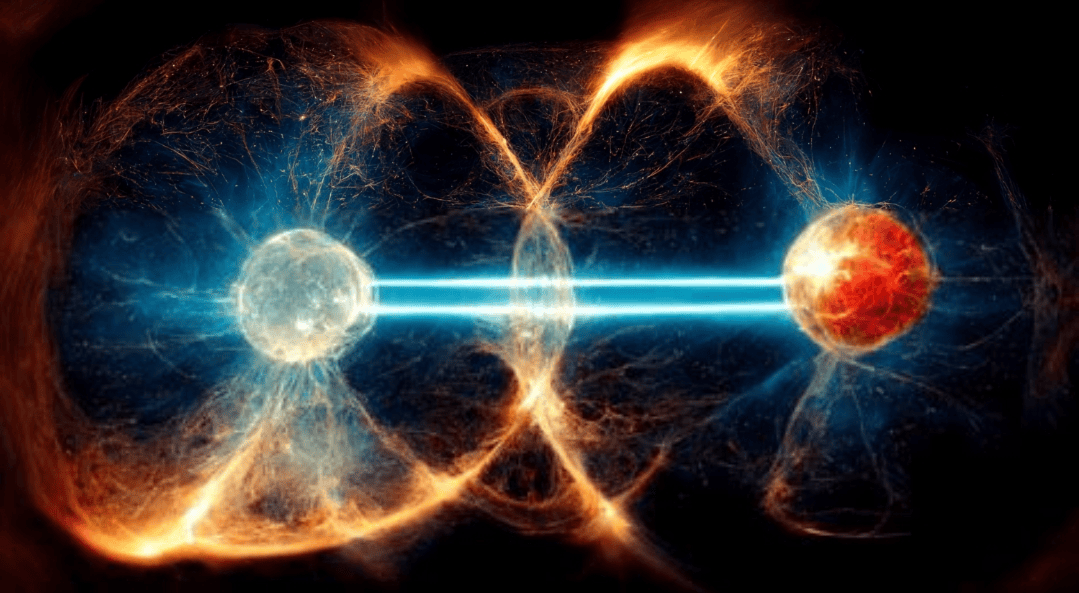
Quantum entanglement is a phenomenon in which two or more particles become correlated so that the quantum state of each cannot be described independently of the others — no matter how far apart they are.
To see why this is strange, start with a basic feature of quantum mechanics: before measurement, particles do not have definite properties. An electron does not have a fixed spin — it exists in a superposition of possibilities at once.
Only when you measure it does it settle on a definite value. Until then, the spin is genuinely undetermined, not merely unknown.
This distinction is subtle but crucial. On the standard reading, the particle is not hiding a value from us; it does not possess one yet. Measurement does not reveal a pre-existing answer — it brings one into being.
Now take two entangled electrons prepared in what physicists call a singlet state. Measure one along any direction and find its spin is “up”, and the other — wherever it is in the universe — will be found “down” along that same direction. Every single time, without exception.
This is not because the particles carried hidden instructions fixed when they parted. Experiments have ruled out every theory of that local kind. The outcomes are perfectly linked in a way no pair of separately carried instructions can reproduce. That is entanglement — and it is real.
Superposition: The Foundation Beneath It
Entanglement rests on an even more basic quantum idea: superposition. A quantum particle can exist in a blend of possibilities until it is observed.
A spinning coin offers a rough analogy. While it spins, it is neither heads nor tails but somehow poised between them. Only when it lands does it commit to one outcome.
The quantum version is stranger. The particle is not secretly one value we happen not to know — it genuinely holds all possibilities at once, and measurement forces a single result into being.
Entanglement is what happens when two particles share a single superposition. Their possibilities are locked together, so that resolving one instantly resolves the other. Superposition is the raw material; entanglement is the link.
From Thought Experiment to Experimental Fact
The story begins in 1935, when Albert Einstein, Boris Podolsky, and Nathan Rosen published a paper — now known as the EPR paper — arguing that quantum mechanics must be incomplete.
Their reasoning was simple. If measuring one particle instantly affects another far away, then either information travels faster than light, which relativity forbids, or the particles carried hidden values all along.
Since faster-than-light signalling seemed absurd, they concluded quantum mechanics was missing something — a hidden variable that fixed each particle’s properties in advance.
For nearly three decades this stayed a philosophical debate with no way to settle it. Then in 1964, the Irish physicist John Bell found a way to turn the question into an experiment.
Bell’s theorem showed that any theory in which each particle carries its own local instructions predicts correlations that cannot exceed a certain limit, while quantum mechanics predicts correlations that exceed it. Nature itself would have to choose between them.
The most widely used version came in 1969 from John Clauser, Michael Horne, Abner Shimony and Richard Holt. It combines four measurements into a single number, S. Any local theory must give an S of at most 2. Quantum mechanics allows up to about 2.83, twice the square root of two. A Bell test is, at heart, a careful measurement of S.
How We Know: The Bell Tests
Nature chose quantum mechanics. In 1972 Stuart Freedman and John Clauser at Berkeley ran the first test, with pairs of photons from calcium atoms, and found the quantum prediction holding. Alain Aspect’s experiments in Paris in the early 1980s went further, switching the measurement settings while the photons were in flight, and again found correlations beyond Bell’s limit.
Sceptics pointed to “loopholes” — subtle ways a clever hidden-variable theory might still slip through. Closing them became a decades-long experimental quest.
The decisive step came in 2015, when three teams in Delft, Vienna, and at the US National Institute of Standards and Technology performed loophole-free Bell tests. The Delft group entangled electron spins in two laboratories 1.3 kilometres apart and, over 245 trials, measured S = 2.42 ± 0.20. All three closed the two main gaps at once: the detectors caught enough of the particles, and the measurement choices were made too far apart for any signal at light speed to connect them.
One assumption remained: that the measurement settings were truly independent of whatever had prepared the particles. Experimenters have pushed that back as far as they can. In 2017 a Vienna-led team chose its settings using light from Milky Way stars emitted hundreds of years earlier, and in 2018 using light from quasars billions of light-years away. The same year the BIG Bell Test recruited about 100,000 volunteers worldwide to supply unpredictable choices by playing an online game. Every version found the quantum result.
The verdict was decisive: entanglement is real, and no theory respecting the independence of distant regions can explain it.
In 2022, the Nobel Prize in Physics went to Alain Aspect, John Clauser, and Anton Zeilinger “for experiments with entangled photons, establishing the violation of Bell inequalities and pioneering quantum information science”. Zeilinger’s group, then at the University of Innsbruck, had reported the first quantum teleportation of a photon’s state in 1997, and his Vienna team ran one of the 2015 loophole-free tests, so the prize joined the answer to Einstein’s question to the technology built on it.
It is worth pausing on how remarkable this is. A philosophical dispute about the nature of reality, once thought untestable, was converted into a precise laboratory question — and nature answered unambiguously.
Few debates in the history of thought have been settled so cleanly. Einstein’s intuition was reasonable, even beautiful, but the universe simply does not work the way he expected.
The Paradox of Instantaneous Communication
The most natural question about entanglement is also the most pressing: if measuring one particle instantly affects the other, does information travel faster than light?
The answer is no — and understanding why reveals something deep about quantum mechanics.
When you measure an entangled particle, you get a random result. Spin up or spin down — you cannot control which. The distant particle takes the correlated state, but its observer also sees a random result.
Neither observer alone sees anything unusual. The correlation only appears when they compare notes — and comparing notes requires an ordinary channel limited by the speed of light.
Because you cannot control your outcome, you cannot encode a message in it. This is the no-communication theorem: entanglement is a genuine connection, but it cannot transmit information faster than light. Relativity is safe.
What Entanglement Tells Us About Reality

If entanglement cannot send messages, what is it actually telling us about the nature of reality? The answer is profound and still debated.
Bell’s theorem and its confirmation tell us that the universe is not “locally realistic”. The correlations between entangled particles cannot be explained by any mechanism in which each particle carries its own definite properties and responds only to influences arriving no faster than light.
In other words, reality is not built from independently existing objects with pre-set properties waiting to be read. The state of entangled particles is genuinely shared — a single quantum state spread across space.
Different interpretations handle this differently. The Copenhagen view says asking what is “really” happening before measurement is meaningless. The many-worlds view says every outcome occurs in a branching universe.
Pilot-wave theory keeps definite particle positions, and so keeps hidden variables, but only by making them explicitly non-local: what happens to one particle depends instantly on the other. Relational quantum mechanics says states are relative to observers, not absolute. Bell’s theorem rules out local hidden variables, not every hidden-variable theory.
What all of them share is a break with the classical picture of the world as a collection of separate things with their own properties. Entanglement forces us to see the universe as more unified than that.
None of these changes the predictions — all agree on what happens. They disagree only on what it means. This remains one of the deepest open questions in the foundations of physics. A related worldview is explored in our article on David Deutsch’s Fabric of Reality.
Entanglement and Quantum Computing
Entanglement is not merely a philosophical curiosity. It is the engine of the quantum computing revolution now underway.
Classical computers process information as bits, each either 0 or 1. Quantum computers use qubits, which can exist in superpositions of 0 and 1 at once.
The real power comes from entanglement. A collection of entangled qubits is described by a single quantum state whose size doubles with every qubit added; 300 qubits would need more numbers to write down than there are atoms in the observable universe.
For some problems that structure gives an enormous advantage. Factorising very large numbers, which would take the best classical computers longer than the age of the universe, could in principle take hours on a large error-corrected quantum computer, and simulating molecules is a natural fit. For many other tasks, including most optimisation problems, no such dramatic speed-up has been proved.
This is not raw speed, and a quantum computer does not simply try every answer at once. If it did, reading the output would give a random answer. The art of a quantum algorithm is to choreograph interference so that the paths leading to wrong answers cancel out and those leading to the right answer reinforce. For where the field stands today, see our article on quantum computing in 2026.
Building such machines is fiendishly hard, precisely because entanglement is delicate. Keeping qubits entangled long enough to compute, while shielding them from the environment, is the central engineering challenge of the field.
Quantum Cryptography: Secure by Physics
Entanglement also makes possible a form of cryptography that is not merely hard to break but secure by the laws of physics themselves.
In one version of quantum key distribution, proposed by Artur Ekert in 1991, two parties share entangled particles and use the correlations between their measurements to generate a secret key. Most systems in use today follow an earlier scheme, BB84, that sends single prepared photons instead, but both rest on the same principle.
Any eavesdropper must measure the particles to intercept them — and measurement disturbs quantum states. So any interception leaves a detectable trace the legitimate parties can spot.
This differs fundamentally from classical cryptography, where a signal can in principle be copied without disturbance. Quantum cryptography makes interception physically detectable, not merely difficult.
China’s Micius satellite, launched in 2016, has made the largest demonstrations. In 2017 it sent entangled photons to two ground stations 1,203 kilometres apart. In 2020 the same team used entanglement itself to generate a secure key between stations 1,120 kilometres apart. A 2018 link between China and Austria, 7,600 kilometres apart, used single photons and relied on the satellite as a trusted relay rather than on entanglement. Europe and the United States are building quantum communication networks too.
The stakes are considerable. As classical encryption faces the eventual threat of quantum computers, entanglement-based security offers a defence rooted not in mathematical difficulty but in the laws of nature themselves.
Quantum Teleportation: Not Science Fiction
Quantum teleportation is one of the most misunderstood ideas in physics. The name does not help, but it is a real, experimentally demonstrated phenomenon.
It uses entanglement to transfer the exact quantum state of one particle to another at a distant location, without moving the original particle. The state is destroyed at the source and rebuilt at the destination.
No matter is teleported — only quantum information. And the process still needs a classical channel to complete, so it cannot beat the speed of light.
The name causes endless confusion. Nothing like a Star Trek transporter is involved; no object vanishes and reappears. What moves is the precise quantum description of a state, reconstructed elsewhere on a waiting particle.
What it can transmit is quantum states — exactly what is needed to build quantum networks and the repeaters that will one day link them.
In 2017 the Micius team teleported the quantum states of single photons from a ground station in Tibet to the satellite, over distances of up to 1,400 kilometres, with an average fidelity of 0.80, well above what any classical method could achieve. The quantum internet — a global network of entangled nodes — is now a serious engineering goal, not mere speculation.
Beyond Pairs: Many-Particle Entanglement
Entanglement is not limited to pairs. Three or more particles can share a single quantum state, producing correlations even richer and stranger than two-particle entanglement.
The best-known examples are GHZ states, named after Greenberger, Horne, and Zeilinger. In these states, three particles are so tightly linked that measuring any one immediately fixes the others.
Such multi-particle states reveal the conflict with classical physics even more sharply than pairs, and they are essential building blocks for quantum computers and error correction.
There is also a surprising rule called the monogamy of entanglement, made precise in 2000 by Valerie Coffman, Joydip Kundu and William Wootters. If two particles are maximally entangled with each other, neither can be entangled at all with a third — the connection cannot be freely shared.
This restriction is not a limitation but a resource. Monogamy is precisely what makes quantum cryptography secure, since an eavesdropper cannot secretly entangle with a private quantum channel.
Entanglement Swapping and the Quantum Internet
One of the most remarkable tricks in quantum physics is entanglement swapping — the ability to entangle two particles that have never interacted.
Take two separate entangled pairs. By performing a joint measurement on one particle from each pair, you can transfer the entanglement so that the two untouched particles become entangled with each other.
This is the key to quantum repeaters. Because entanglement is fragile over long distances, a quantum internet would chain many short links together, swapping entanglement along the way to span continents.
Without swapping, long-distance quantum networks would be impossible. With it, a future internet of entangled nodes — offering perfectly secure communication — becomes a realistic engineering target.
Entanglement in Nature: It Was There All Along
For decades, entanglement was thought to be a fragile laboratory phenomenon needing extreme isolation. Recent research has overturned that assumption in striking ways.
Photosynthesis, the process by which plants and bacteria turn sunlight into chemical energy, was the first big test case. In 2007 a team reported long-lived wave-like oscillations in a bacterial light-harvesting complex and suggested that quantum coherence helped energy find its way efficiently.
That interpretation has not held up well. In 2017 a group led from the Max Planck Institute in Hamburg concluded that the electronic coherence in such complexes dies away far too quickly to matter, and that the long-lived oscillations come mostly from molecular vibrations. Coherence is also not the same thing as entanglement. The question of how much quantum effects help photosynthesis is still argued.
Bird navigation is a stronger case. Many migratory birds are thought to use a “quantum compass” based on radical pairs — molecules whose paired electron spins respond to Earth’s magnetic field. In 2021 researchers showed that cryptochrome 4, a protein from the eye of the European robin, is magnetically sensitive in the laboratory in the way the theory requires. Whether that is how birds actually steer is still being tested.
These findings suggest life may have exploited quantum mechanics in places, long before physicists worked out the theory. The young field of quantum biology is real, but its claims are best treated case by case rather than as a general rule.
If confirmed broadly, it would blur a line we once thought firm: that quantum weirdness belongs to the laboratory while biology runs on ordinary chemistry. Nature may be quietly quantum in ways we are only starting to appreciate.
Entanglement and the Baryons That Build the Universe
Entanglement does not only operate among photons and electrons. It plays a role in the physics of baryons — the protons and neutrons that make up every atomic nucleus.
Inside a proton, three quarks are bound by the strong nuclear force in a shared quantum state that is itself a form of entanglement. The quarks’ properties cannot be described independently of one another.
In 2024 the ATLAS experiment at CERN’s Large Hadron Collider reported entanglement between the spins of top quarks and their antimatter partners, produced in proton collisions at the highest energies ever used for such a test. The result was more than five standard deviations from what would be expected without entanglement: the first observation of entanglement between quarks, and at energies vastly beyond any laboratory optics experiment.
Understanding how entanglement works at the level of quarks and gluons is a frontier of nuclear physics, with implications for matter at its most fundamental. For more, see our article on baryons, the building blocks of all matter.
The Arrow of Time and Entanglement
One of the deepest connections in modern physics is between entanglement and the arrow of time — why the past is fixed and the future open.
Recent work suggests that entanglement between a system and its environment is what makes quantum superpositions appear to “collapse,” a process called decoherence.
As a system entangles with more and more particles around it, its quantum behaviour becomes effectively classical. This may be why the everyday world looks nothing like the quantum realm.
Some physicists go further, proposing that the arrow of time itself may emerge from the growth of entanglement in an initially low-entropy universe. For a full exploration, see our article on the arrow of time.
Why This Matters
Quantum entanglement began as a philosophical objection, matured into a decisive experiment, and has now become a working technology. Few ideas in science have travelled so far.
It tells us the universe is woven together more tightly than our intuitions allow, and yet in a way that never lets us cheat the speed of light. Both facts are astonishing.
Whatever entanglement ultimately means, it has already reshaped physics, computing, and cryptography — and its deepest lessons about reality may still be ahead of us.
A century ago, entanglement was a reason to doubt quantum mechanics. Today it is one of its crown jewels, powering technologies Einstein could never have imagined and pointing toward a science we are only beginning to write.
Frequently Asked Questions
Does quantum entanglement allow faster-than-light communication?
No. While the correlation between entangled particles is instantaneous, no information can be transmitted using entanglement alone. Measurement outcomes are random, and the correlations only become apparent when results are compared through conventional communication limited by the speed of light. This is guaranteed by the no-communication theorem.
How are entangled particles created?
The most common method is spontaneous parametric down-conversion, where a photon passing through a special crystal splits into two entangled photons with correlated polarisations. Entanglement can also arise by letting particles interact and then separating them, or through certain atomic decay processes.
Can entanglement be maintained over long distances?
Yes, though it is technically challenging. Entanglement is fragile and easily disrupted by interaction with the environment, a process called decoherence. Using the Micius satellite, researchers have shared entangled photons between ground stations 1,203 kilometres apart and teleported quantum states over up to 1,400 kilometres. Quantum repeaters under development aim to extend this range for practical networks.
What is the difference between entanglement and superposition?
Superposition refers to a single particle existing in multiple states at once. Entanglement refers to a correlation between two or more particles such that their states cannot be described independently. Entanglement requires superposition, but superposition does not require entanglement.
Was Einstein wrong about entanglement?
Yes. Einstein believed entanglement implied either faster-than-light signalling or hidden variables that fixed particle properties in advance. Bell’s theorem and decades of experiments have ruled out local hidden-variable theories. The universe is genuinely non-local in the sense Einstein found unacceptable — though this non-locality cannot transmit information.
What practical technologies use entanglement today?
Quantum key distribution is already in use in China and being built in Europe and the United States, although most deployed systems send single prepared photons rather than entangled pairs. Entanglement-based key distribution has been demonstrated over 1,120 kilometres by satellite. Quantum computers at IBM, Google, and other firms use entanglement as a computational resource, and quantum teleportation forms the basis for future quantum-network design.
Who coined the term entanglement?
Erwin Schrödinger, in 1935, months after the Einstein–Podolsky–Rosen paper. He used the German word Verschränkung and the English “entanglement”, and described it as the characteristic trait of quantum mechanics, the one that forces its entire departure from classical lines of thought.
What does a Bell test actually measure?
It measures how strongly the results on two separated particles agree when the measurement settings are chosen independently. In the common CHSH form, the result is combined into a number S. Any theory based on local, pre-set properties must give S of 2 or less; quantum mechanics allows up to about 2.83. Loophole-free experiments in 2015 found values above 2.
Has entanglement been seen at particle colliders?
Yes. In 2024 the ATLAS collaboration at CERN reported entanglement between top quarks and antiquarks produced in proton collisions, at more than five standard deviations. It was the first observation of entanglement between quarks and the highest-energy observation of entanglement so far.
Further Reading
Sources
- Einstein, A., Podolsky, B. & Rosen, N. (1935). “Can Quantum-Mechanical Description of Physical Reality Be Considered Complete?” Physical Review, 47, 777 (DOI: 10.1103/PhysRev.47.777).
- Bell, J. S. (1964). “On the Einstein Podolsky Rosen Paradox.” Physics Physique Fizika, 1, 195 (DOI: 10.1103/PhysicsPhysiqueFizika.1.195).
- Aspect, A., Dalibard, J. & Roger, G. (1982). “Experimental Test of Bell’s Inequalities Using Time-Varying Analyzers.” Physical Review Letters, 49, 1804 (DOI: 10.1103/PhysRevLett.49.1804).
- Hensen, B., et al. (2015). “Loophole-free Bell inequality violation using electron spins separated by 1.3 kilometres.” Nature, 526, 682 (DOI: 10.1038/nature15759).
- Yin, J., et al. (2017). “Satellite-based entanglement distribution over 1200 kilometers.” Science, 356, 1140 (DOI: 10.1126/science.aan3211).
- Engel, G. S., et al. (2007). “Evidence for wavelike energy transfer through quantum coherence in photosynthetic systems.” Nature, 446, 782 (DOI: 10.1038/nature05678).
- The Nobel Prize in Physics 2022 — Aspect, Clauser & Zeilinger (official summary).
- Stanford Encyclopedia of Philosophy — Quantum Entanglement and Information.
- Schrödinger, E. (1935). “Discussion of Probability Relations between Separated Systems.” Mathematical Proceedings of the Cambridge Philosophical Society, 31, 555 (DOI: 10.1017/S0305004100013554).
- Clauser, J. F., Horne, M. A., Shimony, A. & Holt, R. A. (1969). “Proposed Experiment to Test Local Hidden-Variable Theories.” Physical Review Letters, 23, 880 (DOI: 10.1103/PhysRevLett.23.880).
- Freedman, S. J. & Clauser, J. F. (1972). “Experimental Test of Local Hidden-Variable Theories.” Physical Review Letters, 28, 938 (DOI: 10.1103/PhysRevLett.28.938).
- Giustina, M., et al. (2015). “Significant-Loophole-Free Test of Bell’s Theorem with Entangled Photons.” Physical Review Letters, 115, 250401 (DOI: 10.1103/PhysRevLett.115.250401).
- Shalm, L. K., et al. (2015). “Strong Loophole-Free Test of Local Realism.” Physical Review Letters, 115, 250402 (DOI: 10.1103/PhysRevLett.115.250402).
- Handsteiner, J., et al. (2017). “Cosmic Bell Test: Measurement Settings from Milky Way Stars.” Physical Review Letters, 118, 060401 (DOI: 10.1103/PhysRevLett.118.060401).
- Rauch, D., et al. (2018). “Cosmic Bell Test Using Random Measurement Settings from High-Redshift Quasars.” Physical Review Letters, 121, 080403 (DOI: 10.1103/PhysRevLett.121.080403).
- The BIG Bell Test Collaboration (2018). “Challenging Local Realism with Human Choices.” Nature, 557, 212 (DOI: 10.1038/s41586-018-0085-3).
- Bouwmeester, D., Pan, J.-W., Mattle, K., Eibl, M., Weinfurter, H. & Zeilinger, A. (1997). “Experimental Quantum Teleportation.” Nature, 390, 575 (DOI: 10.1038/37539).
- Coffman, V., Kundu, J. & Wootters, W. K. (2000). “Distributed Entanglement.” Physical Review A, 61, 052306 (DOI: 10.1103/PhysRevA.61.052306).
- Ren, J.-G., et al. (2017). “Ground-to-Satellite Quantum Teleportation.” Nature, 549, 70 (DOI: 10.1038/nature23675).
- Liao, S.-K., et al. (2018). “Satellite-Relayed Intercontinental Quantum Network.” Physical Review Letters, 120, 030501 (DOI: 10.1103/PhysRevLett.120.030501).
- Yin, J., et al. (2020). “Entanglement-Based Secure Quantum Cryptography over 1,120 Kilometres.” Nature, 582, 501 (DOI: 10.1038/s41586-020-2401-y).
- Duan, H.-G., et al. (2017). “Nature Does Not Rely on Long-Lived Electronic Quantum Coherence for Photosynthetic Energy Transfer.” PNAS, 114, 8493 (DOI: 10.1073/pnas.1702261114).
- Xu, J., et al. (2021). “Magnetic Sensitivity of Cryptochrome 4 from a Migratory Songbird.” Nature, 594, 535 (DOI: 10.1038/s41586-021-03618-9).
- ATLAS Collaboration (2024). “Observation of Quantum Entanglement with Top Quarks at the ATLAS Detector.” Nature, 633, 542 (DOI: 10.1038/s41586-024-07824-z).
Baryon. (2025, January 18). Quantum Entanglement: The Mystery at the Heart of Quantum Mechanics. Web News For Us. https://webnewsforus.com/quantum-entanglement-the-mystery/
Baryon. “Quantum Entanglement: The Mystery at the Heart of Quantum Mechanics.” Web News For Us, 18 January 2025, https://webnewsforus.com/quantum-entanglement-the-mystery/. Accessed 8 October 2026.


2 Responses