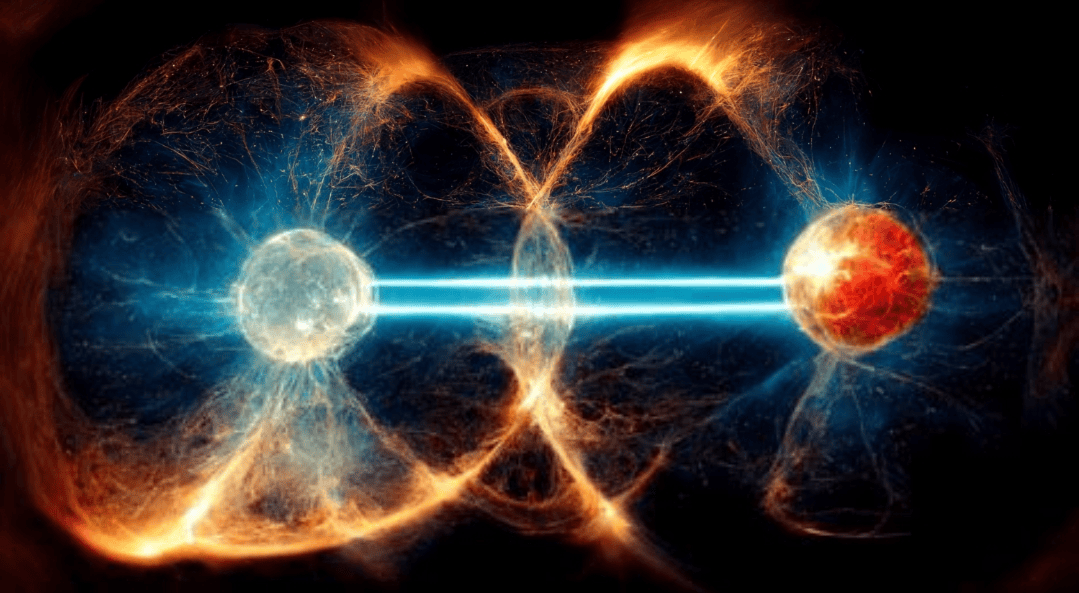
Baryons are the reason matter exists. Every atom in your body, every planet in the solar system, every star in the observable universe is built from them. Yet most people have never heard the word.
Each baryon is made of three quarks bound together by the strongest force in nature. They form the backbone of atomic nuclei and govern the properties of everything we can touch, see, or measure.
Understanding baryons means understanding why matter exists at all — and confronting one of the deepest unsolved mysteries in physics.
This article explains what baryons are, what holds them together, where a proton’s mass really comes from, and why the imbalance between matter and antimatter remains unexplained.
That imbalance is the reason every atom you are made of exists, and nobody can explain it. To see how hard physics is trying, we counted titles in the arXiv archive: by 1 September 2026 there were 253 papers with “baryon asymmetry” in the title, and 339 on proton decay — the prediction that would test the leading explanations. On 6 October 2026 the counts were 254 and 341.
Those are small numbers for the question of why there is matter at all. They are small because the experiments are brutal: proton decay has never been observed, and the searches consume decades and tens of thousands of tonnes of detector.
The physics below is settled and beautifully confirmed. The one thing it does not explain is the reason any of it survived.
What Is a Baryon?
A baryon is a subatomic particle made up of exactly three quarks. Quarks are the fundamental building blocks of matter — point-like particles that cannot be broken down further, as far as physicists currently know.
The word “baryon” comes from the Greek barys, meaning heavy, reflecting the fact that these particles are among the most massive in the subatomic world.
The two baryons you meet in everyday life are the proton and the neutron — the particles in the nucleus of every atom. A proton is two up quarks and one down quark; a neutron is two down quarks and one up quark.
Together, protons and neutrons account for more than 99.9% of the mass of ordinary matter. Everything solid around you is, at heart, a vast assembly of baryons.
Baryons belong to a broader family called hadrons — particles made of quarks. Hadrons split into two groups: baryons, made of three quarks, and mesons, made of one quark and one antiquark.
Antibaryons exist too — mirror-image particles built from three antiquarks. When a baryon meets its antibaryon, the two annihilate in a flash of energy, a fact that lies at the heart of the universe’s greatest puzzle, which we will return to below.
The Quarks Inside
Quarks come in six types, whimsically called flavours: up, down, charm, strange, top, and bottom. Only the lightest two — up and down — make up ordinary, stable matter.
Quarks carry fractional electric charge, unlike any freely observed particle. An up quark carries +2/3, a down quark −1/3. Add two ups and a down and you get a proton’s charge of exactly +1.
The heavier quarks — charm, strange, top, bottom — appear only in high-energy collisions and decay almost instantly. They let physicists build exotic, short-lived baryons to test their theories.
The top quark is the heaviest of all, so massive it decays before it can even combine into a baryon. Studying these rare, fleeting particles pushes the Standard Model to its limits.
The quark model was proposed independently by Murray Gell-Mann and George Zweig in 1964. It brought order to a bewildering “zoo” of particles that had baffled physicists for years.
Before the quark model, Gell-Mann had already spotted patterns among the particles, arranging them into neat geometric families he called the Eightfold Way — a nod to Buddhist philosophy.
The quark model revealed why those patterns existed: the families were simply the different ways three quarks could be combined. What had looked like chaos was underlying order.
The Strong Nuclear Force: What Holds Baryons Together
The three quarks inside a baryon do not stay together by accident. They are bound by one of the four fundamental forces of nature: the strong nuclear force, the most powerful force known to physics.
The strong force acts through particles called gluons, which carry the force between quarks much as photons carry electromagnetism between charged particles.
Its defining feature is colour confinement: quarks can never exist alone. Try to pull two apart and the energy needed grows so large that it spawns a new quark-antiquark pair, keeping quarks locked inside composite particles.
This is why free quarks have never been seen in nature, despite decades of searching at facilities like CERN’s Large Hadron Collider.
The theory describing all this is quantum chromodynamics, or QCD — one of the pillars of the Standard Model of particle physics.
Colour Charge: Why Exactly Three?
Why do baryons contain three quarks, rather than two or five? The answer lies in a property called colour charge — the source of the strong force, named by analogy with colour rather than anything visible.
Each quark carries one of three colour charges, labelled red, green, and blue. The rule of nature is that only “colourless” combinations can exist as free particles.
Just as red, green, and blue light combine to make white, one quark of each colour makes a colourless baryon. This is precisely why three quarks bind together so naturally.
A meson achieves colourlessness differently, pairing a colour with its anticolour. Both are valid solutions to the same underlying rule, which is why baryons and mesons are the two common kinds of hadron.
Confinement and Asymptotic Freedom
The strong force behaves in a way that defies everyday intuition. For most forces, pulling two objects apart weakens their attraction. The strong force does the opposite.
As quarks are pulled apart, the force between them grows stronger, like an unbreakable elastic band. This is why they are permanently confined.
Yet at very short distances — when quarks are close together — the force becomes surprisingly weak, letting them move almost freely. This is called asymptotic freedom.
The discovery of asymptotic freedom by David Gross, Frank Wilczek, and David Politzer in 1973 explained how QCD works and earned them the 2004 Nobel Prize in Physics.
Where Does a Proton’s Mass Come From?
Here is one of the most surprising facts in all of physics. The three quarks inside a proton account for only about one percent of its mass.
If you simply added up the masses of two up quarks and one down quark, you would fall drastically short of the proton’s actual mass. So where does the other 99% come from?
The answer is energy. The furious motion of the quarks and the intense energy of the gluon field binding them together carry enormous energy — and through Einstein’s E = mc², that energy is mass.
In other words, almost all the mass of ordinary matter — and therefore almost all of your own body weight — is not “stuff” at all. It is bound energy, frozen into the structure of baryons.
Understanding this mass in detail, directly from the equations of QCD, is one of the hardest calculations in physics. Supercomputer simulations called lattice QCD now make it possible. A 2018 study split the proton’s mass into pieces: about a third from the energy of the quarks’ motion, a little over a third from the energy of the gluon field, about a quarter from a quantum effect called the trace anomaly, and roughly a tenth from the quark masses themselves.
It also reframes what we mean by “solid.” The atoms in a table feel firm, but their mass is overwhelmingly locked-up energy, and their volume is mostly empty space. Solidity is an illusion built from fields and forces.
How Big Is a Proton, and Why Does It Spin?
Even the proton’s size turned out to be a puzzle. In 2010 a team led by Randolf Pohl measured it using muonic hydrogen, in which a heavier cousin of the electron, the muon, orbits the proton much more closely. They found a radius of about 0.84 femtometres, some 4 per cent smaller than the accepted value from ordinary hydrogen and electron scattering, a gap far too large to be chance.
For nearly a decade the “proton radius puzzle” prompted talk of new physics. Then new measurements began to agree with the smaller value. In 2019 the PRad experiment at Jefferson Laboratory in Virginia, built after the discrepancy appeared, scattered electrons off hydrogen gas and found 0.831 femtometres. Most physicists now think the older measurements were slightly off, not that nature treats electrons and muons differently.
Spin produced a deeper surprise. In 1988 the European Muon Collaboration at CERN found that the spins of the quarks account for only a small part of the proton’s total spin, far less than the simple quark model implied. The rest must come from the gluons and from the orbital motion of quarks and gluons inside the proton. Pinning down that budget is one of the main jobs of the Electron-Ion Collider.
Baryon Number: The Quantum Fingerprint
Every baryon carries a quantum property called baryon number, assigned a value of +1. Antibaryons — the antimatter counterparts made of three antiquarks — carry −1. All other particles carry 0.
Baryon number is a conserved quantity: in any known physical process, the total baryon number of a system stays constant.
Baryons cannot simply appear or vanish. They can only be created or destroyed in baryon-antibaryon pairs, keeping the total unchanged.
This conservation law has profound implications for the origin of matter — and, as we will see, may not be perfectly exact after all. The quantum rules governing particles are introduced in our article on quantum entanglement.
Types of Baryons: Protons, Neutrons, and Beyond
While protons and neutrons are the most familiar baryons, physicists have catalogued dozens of species, most highly unstable and lasting only tiny fractions of a second.
The neutron is stable inside nuclei, but on its own it decays in about a quarter of an hour into a proton, an electron and an antineutrino, and exactly how long it lives is itself unsettled. Experiments that trap ultracold neutrons and count the survivors find a lifetime of about 878 seconds; the most precise, at Los Alamos in 2021, gave 877.75 seconds. Experiments that count the protons emerging from a neutron beam find about 888 seconds. The ten-second gap has resisted explanation for years.
Lambda (Λ) baryons contain one strange quark alongside up and down quarks. Among the first “strange” particles found in the 1940s and 1950s, they led to the concept of strangeness as a quantum number.
Omega (Ω) baryons contain three strange quarks. Famously, the Ω⁻ was predicted in 1962 from Gell-Mann’s Eightfold Way, which had a gap in one of its patterns, before it was found at Brookhaven in 1964 — a triumph that helped persuade physicists the patterns were real and led directly to the quark model.
Charmed and bottom baryons, containing heavier quarks, have been produced at accelerators and provide precise tests of QCD. The LHCb experiment continues to discover new excited baryon states with remarkable precision.
Do Protons Ever Decay?
As far as anyone has measured, the proton is stable. It is the only baryon that never decays — which is fortunate, since if protons fell apart, all matter would eventually dissolve.
Yet some theories that go beyond the Standard Model, known as grand unified theories, predict that the proton should decay extremely rarely, over timescales vastly longer than the age of the universe.
If protons could decay, baryon number would not be perfectly conserved — which would be a crucial ingredient in explaining why matter exists at all.
Enormous detectors such as Japan’s Super-Kamiokande, a tank of 50,000 tonnes of ultra-pure water a kilometre underground, watch for a single proton decay. None has ever been seen. Its 2020 analysis of data from 1996 to 2018 set the lifetime for the favourite decay, into a positron and a neutral pion, at more than 2.4 × 10³⁴ years — about a million billion billion times the age of the universe. Hyper-Kamiokande, several times larger, is under construction to push further.
Baryons in the Early Universe
Baryons are central to the story of how the universe began. In the first fractions of a second after the Big Bang, space was a searing plasma of free quarks and gluons.
As the universe expanded and cooled, quarks combined for the first time to form baryons. Lattice calculations published in 2006 showed that this was not a sharp transition, like water freezing, but a rapid smooth change known as a crossover.
Everything that followed — atomic nuclei, atoms, stars, galaxies, and eventually life — depended on the outcome of that transition, a few millionths of a second into cosmic history.
Physicists recreate droplets of that primordial quark-gluon plasma today by smashing heavy nuclei together at CERN and Brookhaven, studying matter as it existed at the dawn of time.
Those experiments have revealed that the early plasma behaved not like a gas but like a nearly perfect liquid, flowing with almost no viscosity — a discovery that surprised physicists and reshaped models of the young universe.
The Baryon Asymmetry Problem
Here is a question that should trouble you: if the laws of physics treat matter and antimatter symmetrically, why does anything exist at all?
When the universe began, baryons and antibaryons should have been produced in exactly equal numbers. Matter and antimatter would then have annihilated completely, leaving a universe of pure radiation.
Obviously that did not happen. Today there is almost no antimatter in the observable universe, and the cosmic microwave background lets physicists measure what survived: about six baryons for every ten billion photons. That corresponds to an imbalance in the early universe of roughly one extra baryon for every billion baryon-antibaryon pairs, a tiny surplus that left behind everything we see.
In 1967, the physicist Andrei Sakharov set out three conditions any theory must meet to explain this imbalance: baryon number must sometimes be violated, matter and antimatter must behave slightly differently, and the universe must pass through a state out of equilibrium.
The Standard Model meets these conditions only weakly — far too weakly to account for the observed imbalance. Explaining baryon asymmetry therefore points to physics beyond the Standard Model, and remains one of the deepest unsolved problems in science.
Even the surviving matter is mostly hidden. The cosmic microwave background and the abundances of light elements made in the first minutes both say that baryons make up about 4.9 per cent of the universe’s contents. For decades astronomers could find only part of that in stars, galaxies and known gas. In 2020 a team used fast radio bursts, brief flashes from distant galaxies whose signals are smeared by the thin gas they pass through, to weigh the diffuse matter between galaxies, and found the missing baryons there in the amount the Big Bang requires.
The scale of the puzzle is humbling. That one-in-a-billion surplus of matter is the reason galaxies, stars, planets, and people exist. Had the balance been perfect, the cosmos would be nothing but light.
Finding what tipped that balance is among the great goals of modern physics, driving experiments from the LHC to studies of neutrinos, which may hold a related clue.
Real-World Applications of Baryon Research
Baryon physics is not purely abstract. It has produced practical technologies that affect everyday life and save lives.
Proton therapy for cancer is the most direct medical application. The physicist Robert Wilson, later the first director of Fermilab, proposed it in 1946. Because protons deposit most of their energy at a precise depth — the Bragg peak — they can target tumours with far greater precision than conventional X-rays.
This spares surrounding healthy tissue. Proton therapy centres now operate in dozens of countries and treat many thousands of patients each year.
The proton beams are produced in compact accelerators and steered magnetically to millimetre precision, a direct practical payoff of understanding how these baryons behave.
Nuclear energy depends on understanding neutron behaviour within atomic nuclei. Reactor design, fuel efficiency, and safety all rest on precise knowledge built from baryon physics.
Nuclear medicine draws on the same physics. Accelerators like those used to study baryons produce many of the short-lived isotopes used in hospital imaging, and PET scanners detect the gamma rays from positrons, the electron’s antiparticle, annihilating in the body — antimatter put to work in diagnosis.
There is a broader lesson here. Research into baryons was pursued purely to understand nature, with no application in mind — yet it produced cancer treatments and diagnostic tools that save lives every day.
It is a reminder that curiosity-driven physics, however abstract it seems, has a long history of transforming medicine and technology in ways no one could have predicted.
Baryons and the Large Hadron Collider
The Large Hadron Collider at CERN is, among many other things, a baryon factory. When protons collide at near-light speed, the energy released can create exotic baryons that do not exist naturally today.
The LHCb experiment is designed to study baryons and mesons containing heavy quarks, probing the slight differences between matter and antimatter that may help explain the asymmetry.
In 2015, LHCb reported the first clear pentaquarks — exotic states of four quarks and an antiquark, long predicted but never before seen. With more data in 2019 the collaboration found that one of the signals was really several narrow states, a pattern suggesting a proton-like baryon loosely bound to a meson rather than five quarks packed tightly together. It was a landmark in hadron physics.
The experiment has since gone further. In 2017 it reported evidence that a beauty baryon called the Λb⁰ and its antimatter partner decay at slightly different rates. In 2025, studying a different decay of the same particle, LHCb announced the first observation of this matter-antimatter difference, known as CP violation, in baryons. It had been seen in mesons since 1964, but never before in the kind of particle that makes up the visible universe. The size observed fits the Standard Model, which still falls far short of explaining why matter survived.
The Future of Baryon Research
The Electron-Ion Collider, being built at Brookhaven National Laboratory, is designed to reveal how quarks and gluons combine to give protons and neutrons their mass and spin.
These questions remain only partly answered despite decades of research, and the new collider should provide the sharpest picture yet of the interior of a baryon.
Neutron stars offer another natural laboratory. So dense that a teaspoon of their material would weigh billions of tonnes, they probe baryon matter at extremes no accelerator can reach. Their physics is explored in our article on neutron stars.
Gravitational-wave observatories now detect neutron-star mergers, constraining our models of dense baryonic matter with each new signal.
The framework behind all of this traces back to quantum electrodynamics, the theory that inspired QCD — the life’s work of physicists like Richard Feynman, whose story we tell in our article on Richard Feynman.
Why Baryons Matter
Baryons are the most abundant form of matter in the observable universe. Every atom, every molecule, every visible structure is built from them.
To study baryons is to probe the deepest structure of nature — how mass arises, why matter exists, and how the universe grew from a plasma into a cosmos of stars and planets.
They connect the largest questions to the smallest scales, linking the fate of galaxies to the behaviour of three tiny quarks. The same fundamental physics threads through our article on the arrow of time.
Most people have never heard the word “baryon.” Yet everything they have ever touched, and everything they are, is built from these three-quark particles — the quiet, essential architecture of reality.
There is something fitting in that. The particles that make up the visible universe hide in plain sight, unnamed and unnoticed, holding everything together while asking nothing of our attention.
Frequently Asked Questions
What is the difference between a baryon and a meson?
Both baryons and mesons are hadrons — particles made of quarks. Baryons are made of three quarks, while mesons are made of one quark and one antiquark. Baryons are generally heavier and more stable; the proton has never been observed to decay.
Are protons and neutrons baryons?
Yes. The proton and neutron are the two most familiar and most stable baryons. A proton is made of two up quarks and one down quark; a neutron is made of two down quarks and one up quark. Together they form the nuclei of all atoms.
What is the baryon asymmetry problem?
It asks why the universe contains vastly more matter than antimatter. The laws of physics predict baryons and antibaryons should have formed in equal numbers in the early universe, leading to total annihilation. The survival of matter-dominated structures is one of the deepest unsolved problems in physics.
Where does most of a proton’s mass come from?
Surprisingly, only about 1% of a proton’s mass comes from the masses of its three quarks. The other 99% comes from the energy of the quarks’ motion and the gluon field binding them together, converted into mass via Einstein’s E = mc². Most of ordinary matter’s mass is, in effect, bound energy.
What is quantum chromodynamics (QCD)?
QCD is the theory describing the strong nuclear force — the force that binds quarks together inside baryons via gluons. It is a central component of the Standard Model and explains both colour confinement and asymptotic freedom.
Why can’t quarks exist freely outside baryons?
Because of colour confinement. The energy needed to separate quarks increases the further apart they are pulled. When enough energy is applied, it spontaneously creates new quark-antiquark pairs, ensuring quarks always remain confined inside composite particles like baryons.
Why does the neutron lifetime matter?
It sets how many neutrons survived the first minutes after the Big Bang to be locked into helium, so it feeds directly into predictions of the universe’s chemical make-up. It is also a test of the weak force. Two kinds of experiment disagree by about ten seconds, 878 against 888, and finding out why could reveal a mistake or new physics.
What fraction of the universe is made of baryons?
About 4.9 per cent, according to measurements of the cosmic microwave background and the abundances of light elements formed after the Big Bang. Dark matter makes up about 27 per cent and dark energy about 68 per cent. Most baryons are not in stars but in thin gas between galaxies, which was finally weighed in 2020 using fast radio bursts.
How big is a proton?
Its charge radius is about 0.84 femtometres, less than a millionth of a billionth of a metre. A 2010 measurement with muonic hydrogen gave a smaller value than older methods, creating the “proton radius puzzle”; newer measurements, including the PRad experiment in 2019 at 0.831 femtometres, now largely agree with the smaller figure.
Has matter-antimatter asymmetry been seen in baryons?
Yes. In 2025 the LHCb experiment at CERN reported the first observation of CP violation in baryon decays, in a particle called the Λb⁰. The effect is real but small, in line with the Standard Model, and far too small on its own to explain why the universe is made of matter.
Further Reading
Sources
- Gell-Mann, M. (1964). “A schematic model of baryons and mesons.” Physics Letters, 8, 214 (DOI: 10.1016/S0031-9163(64)92001-3).
- Barnes, V. E., et al. (1964). “Observation of a Hyperon with Strangeness Minus Three (the Ω⁻).” Physical Review Letters, 12, 204 (DOI: 10.1103/PhysRevLett.12.204).
- Gross, D. J. & Wilczek, F. (1973). “Ultraviolet Behavior of Non-Abelian Gauge Theories (asymptotic freedom).” Physical Review Letters, 30, 1343 (DOI: 10.1103/PhysRevLett.30.1343).
- Sakharov, A. D. (1967). “Violation of CP invariance, C asymmetry, and baryon asymmetry of the universe.” JETP Letters, 5, 24 (DOI: 10.1070/PU1991v034n05ABEH002497).
- LHCb Collaboration (2015). “Observation of J/ψp resonances consistent with pentaquark states.” Physical Review Letters, 115, 072001 (DOI: 10.1103/PhysRevLett.115.072001).
- CERN — The LHCb Experiment.
- Particle Data Group — Review of Particle Physics, Phys. Rev. D 110, 030001 (2024).
- Brookhaven National Laboratory — Electron-Ion Collider.
- Yang, Y.-B., et al. (2018). “Proton Mass Decomposition from the QCD Energy Momentum Tensor.” Physical Review Letters, 121, 212001 (DOI: 10.1103/PhysRevLett.121.212001).
- Pohl, R., et al. (2010). “The Size of the Proton.” Nature, 466, 213 (DOI: 10.1038/nature09250).
- Xiong, W., et al. (2019). “A Small Proton Charge Radius from an Electron–Proton Scattering Experiment.” Nature, 575, 147 (DOI: 10.1038/s41586-019-1721-2).
- Ashman, J., et al. (European Muon Collaboration) (1988). “A Measurement of the Spin Asymmetry and Determination of the Structure Function g1 in Deep Inelastic Muon–Proton Scattering.” Physics Letters B, 206, 364 (DOI: 10.1016/0370-2693(88)91523-7).
- Yue, A. T., et al. (2013). “Improved Determination of the Neutron Lifetime.” Physical Review Letters, 111, 222501 (DOI: 10.1103/PhysRevLett.111.222501).
- Gonzalez, F. M., et al. (2021). “Improved Neutron Lifetime Measurement with UCNτ.” Physical Review Letters, 127, 162501 (DOI: 10.1103/PhysRevLett.127.162501).
- Takenaka, A., et al. (Super-Kamiokande) (2020). “Search for Proton Decay via p → e⁺π⁰ and p → μ⁺π⁰ with an Enlarged Fiducial Volume in Super-Kamiokande I–IV.” Physical Review D, 102, 112011 (DOI: 10.1103/PhysRevD.102.112011).
- Aoki, Y., et al. (2006). “The Order of the Quantum Chromodynamics Transition Predicted by the Standard Model of Particle Physics.” Nature, 443, 675 (DOI: 10.1038/nature05120).
- Macquart, J.-P., et al. (2020). “A Census of Baryons in the Universe from Localized Fast Radio Bursts.” Nature, 581, 391 (DOI: 10.1038/s41586-020-2300-2).
- LHCb Collaboration (2017). “Measurement of Matter–Antimatter Differences in Beauty Baryon Decays.” Nature Physics, 13, 391 (DOI: 10.1038/nphys4021).
- LHCb Collaboration (2025). “Observation of Charge–Parity Symmetry Breaking in Baryon Decays.” Nature, 643, 1223 (DOI: 10.1038/s41586-025-09119-3).
- Wilson, R. R. (1946). “Radiological Use of Fast Protons.” Radiology, 47, 487 (DOI: 10.1148/47.5.487).
- LHCb Collaboration (2019). “Observation of a Narrow Pentaquark State, Pc(4312)+, and of the Two-Peak Structure of the Pc(4450)+.” Physical Review Letters, 122, 222001 (DOI: 10.1103/PhysRevLett.122.222001).
- Planck Collaboration (2020). “Planck 2018 Results. VI. Cosmological Parameters.” Astronomy & Astrophysics, 641, A6 (DOI: 10.1051/0004-6361/201833910).
Baryon. (2025, January 9). Baryons: The Building Blocks of All Matter — What They Are and Why They Matter. Web News For Us. https://webnewsforus.com/baryons-building-blocks-of-all-matter/
Baryon. “Baryons: The Building Blocks of All Matter — What They Are and Why They Matter.” Web News For Us, 9 January 2025, https://webnewsforus.com/baryons-building-blocks-of-all-matter/. Accessed 8 October 2026.