Astronomers estimate the Milky Way contains somewhere in the region of a hundred million neutron stars — the collapsed cores left behind by every massive star that has ever died here.
We have catalogued 3,983 of them: on 9 October 2026, a query of SIMBAD returned that many objects classified as pulsars. Only 243 of those have a measured parallax, the geometric method that gives a distance without leaning on models.
That is a detection rate of roughly one in twenty-five thousand. Everything in this article — the physics of matter at nuclear density, the magnetars, the collision that let us watch gold being made — is built on a sample so small that it would be a rounding error in almost any other science. Understanding why we see so few, and what that hides, is where this begins.
Somewhere in our galaxy right now, a dead star the size of a city is spinning several hundred times a second, its surface racing at a fraction of the speed of light, sweeping out a beam of energy so regular that when astronomers first caught it in 1967, they briefly wondered if it was a message from another civilisation. They labelled it LGM-1 — Little Green Men 1. They were half-joking. Only half.
It turned out to be a pulsar: a rotating neutron star, one of the most extreme objects in the known universe. Not built by anyone, not signalling anything — just a collapsed star, crushed into a sphere about 20 kilometres across, holding more mass than the Sun, turning in the dark like a lighthouse nobody switched on.
A neutron star is what happens when physics is pushed to its absolute limit. It is denser than anything we can make on Earth by a factor of roughly a hundred trillion. A single teaspoon of its material would weigh about a billion tonnes. Its gravity bends light; its magnetic field is typically about a trillion times Earth’s, and in the strongest examples a thousand times more than that; the fastest spin so quickly that their equators move at around a fifth of the speed of light.
And yet these impossible objects are among our best teachers. They test Einstein’s gravity where no laboratory can. They forged the gold in your jewellery. They send ripples across spacetime that our detectors are only beginning to hear. And at their hidden cores, matter may be doing something no human has ever witnessed — dissolving into its most fundamental parts.
What Is a Neutron Star?
A neutron star is the collapsed core left behind when a massive star — between roughly eight and twenty times the Sun’s mass — burns through its fuel and explodes as a supernova. The outer layers are blasted into space; the core implodes in a fraction of a second. If that core stays below the threshold for forming a black hole, what remains is a neutron star.
The name tells the story. In the crushing density of the collapse, electrons and protons are forced together into neutrons, releasing a flood of neutrinos that escape into space. What is left is an object made almost entirely of neutrons, about 20 kilometres wide, packing between 1.2 and roughly 2.3 times the mass of the Sun into that tiny sphere.
The numbers defy intuition. The Sun is 1.4 million kilometres across; a neutron star squeezes a comparable mass into a city. Compress the entire Earth to this density and it would be a ball about 300 metres wide, smaller than many sports stadiums. Squeeze every person alive today to the same density, roughly eight billion people, and all of humanity would fit inside a sugar cube. This is not a figure of speech — it is a description of real objects in our galaxy that have been observed, measured, and, in August 2017, heard as a tremor in spacetime.
A Spoonful of the Impossible
To stand near a neutron star, if you somehow could, is to meet gravity at its most brutal. The pull at the surface is roughly two hundred billion times stronger than Earth’s. An object dropped from a single metre up would strike the surface in microseconds, moving at millions of kilometres per hour.
The consequences are almost cartoonish in their violence. A marshmallow falling onto a neutron star would arrive with roughly the energy of the bomb dropped on Hiroshima, simply from the depth of the gravitational well it falls into. Anything with substance would be smeared into an atom-thin film the instant it arrived. And because the escape velocity is a large fraction of the speed of light, the star’s gravity visibly bends the light around it — you would see part of its far side curving into view, an object warping the very geometry of space around itself.
This is what makes neutron stars so valuable: they are the only place in nature where such extremes can be studied at all, a permanent experiment in physics we could never run on Earth.
How Neutron Stars Form: The Violence of a Supernova
The birth of a neutron star begins, fittingly, with one of the most violent events in the universe. Over its life, a massive star fuses hydrogen into helium, then heavier and heavier elements, building an onion-like structure that ends at an iron core. Iron is the dead end: fusing it consumes energy rather than releasing it.
When that iron core reaches about 1.4 times the Sun’s mass, nothing can hold it up. It collapses in under a second, releasing more energy in that instant than the Sun will emit across its entire ten-billion-year life. Infalling matter rebounds off the newborn core, and a shockwave — driven by a torrent of neutrinos — tears the star apart in a supernova.
What is left behind is a neutron star, glowing in X-rays and, thanks to the conservation of angular momentum, spinning ferociously fast. A star that once turned once a month can, compressed to this size, spin hundreds of times a second. That is where pulsars come from. You can trace the whole arc in our guide to stellar evolution, the complete life cycle of stars.
Pulsars: Cosmic Lighthouses
In 1967, Jocelyn Bell Burnell, a graduate student at Cambridge working with her supervisor Antony Hewish, spotted a strange, perfectly regular pulse of radio waves arriving every 1.337 seconds. It was too precise for natural noise, and after ruling out interference, the team half-seriously wondered if it was artificial — LGM-1.
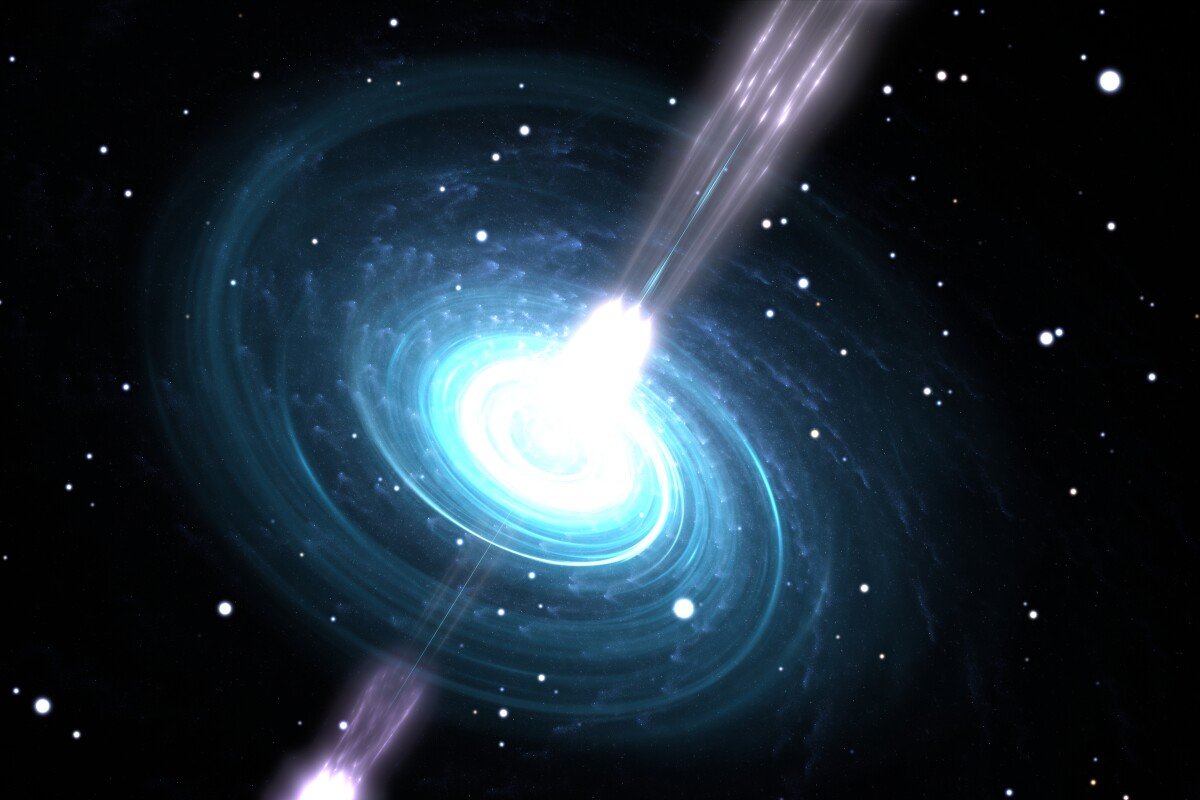
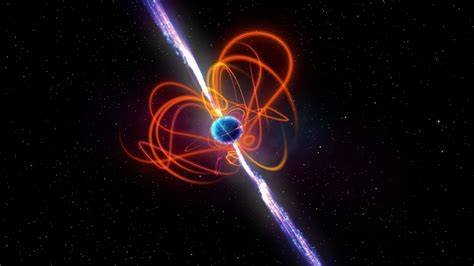
It was not aliens. It was the first pulsar — a spinning neutron star whose magnetic field funnels radiation into two narrow beams. As the star rotates, the beams sweep round like a lighthouse, and each time one crosses Earth we catch a pulse. Some pulsars, the millisecond variety, whirl hundreds of times a second, their surfaces moving at a serious fraction of light speed.
The discovery earned a Nobel Prize in Physics in 1974, but it went to Hewish and Martin Ryle, not to the student who had first noticed the signal. In 2018 she received a Special Breakthrough Prize in Fundamental Physics worth three million dollars, and gave all of it to the Institute of Physics to fund doctoral students from groups under-represented in physics.
These are among the most precise natural clocks in existence — the best rival atomic clocks for stability. Networks of them, called pulsar timing arrays, are now used as a galaxy-sized gravitational-wave detector. In 2023, several such collaborations announced evidence for a faint hum of gravitational waves pervading the cosmos, possibly from pairs of supermassive black holes circling each other in distant galaxies.
The record for speed belongs to a pulsar found with the Green Bank Telescope in the dense star cluster Terzan 5 and reported in 2006. It spins 716 times a second, beating a record of 642 rotations per second that had stood for 24 years, and it is hidden behind its companion star for about 40 per cent of every orbit. Its spin alone is revealing: if it weighs less than twice the Sun, it must be less than 16 kilometres across, or it would fly apart.
Their clocklike reliability has an almost poetic use as well. When NASA sent the Pioneer and Voyager probes out of the solar system, it engraved a map of nearby pulsars onto them — a starburst of lines fixing Earth’s position relative to these beacons, so any finder could trace the senders. In November 2017 NASA went further: an experiment called SEXTANT, riding on an X-ray telescope aboard the International Space Station, worked out the station’s orbit by itself, in real time, purely by timing X-ray pulses from millisecond pulsars. The objects once mistaken for aliens may one day guide our own machines between the stars.
Why We See Almost None of Them
The catalogue of known pulsars stands at 3,983 objects. Set against an estimated galactic population of order a hundred million neutron stars, that is a detected fraction of roughly one in twenty-five thousand. The reason is not that our telescopes are weak. It is that most neutron stars are, from where we sit, invisible in principle.
A pulsar is not a special kind of neutron star. It is a neutron star whose radio beam happens to sweep across Earth. The beam emerges along the magnetic axis, which is tilted from the rotation axis, so it traces a cone as the star spins. If our line of sight falls inside that cone we see pulses; if it does not, the same object is silent to us no matter how bright it actually is. Geometry alone eliminates the large majority.
Age removes most of the rest. Pulsars radiate away rotational energy and slow down, and once the spin falls below a threshold the emission mechanism shuts off. A neutron star is typically an active pulsar for something like ten million years — a brief window against a galaxy more than ten billion years old. The overwhelming majority of neutron stars in the Milky Way are cold, slow, dark objects that stopped broadcasting long ago.
Even among the ones we do detect, precision is scarce. Only 243 pulsars in the catalogue have a parallax measurement, meaning their distance has been determined geometrically rather than inferred from how radio waves disperse through interstellar gas. For everything else, distance — and therefore true brightness, size and energy output — carries a model-dependent uncertainty.
This shapes what we can honestly claim. Our sample is biased towards neutron stars that are young, spinning fast, favourably oriented and relatively nearby. Statements about the population as a whole — how many there are, how massive they get, how they are distributed — are extrapolations from an unrepresentative slice. That is not a flaw in the science so much as its central difficulty, and it is worth remembering whenever a number in this field is quoted without an error bar.
Inside a Neutron Star: Layers of the Extreme
A neutron star is not a uniform ball. It has a layered interior, each stratum governed by physics stranger than the one above, and the deepest layer remains one of science’s great unknowns.
Beneath a wafer-thin atmosphere lies a solid outer crust — a lattice of atomic nuclei in a sea of electrons, like an impossibly dense metal. Deeper still, in the inner crust, neutrons begin to leak out of nuclei and flow as a frictionless superfluid, threaded with quantum vortices that store the star’s spin. When a young pulsar abruptly speeds up in a “glitch,” it is thought to be these vortices suddenly releasing their grip on the crust.
In December 2016 radio astronomers in Tasmania caught one of these glitches as it happened, in the Vela pulsar, which turns 11.2 times a second. Recording every single pulse, they saw the pulses themselves change during the event, evidence that the sudden spin-up disturbed the star’s magnetic surroundings as well as its crust.
That crust is remarkable in its own right. In 2018, computer simulations of the “nuclear pasta” deep in the crust, where nuclei are squeezed into sheets and tubes, suggested it may be the strongest material in the known universe, by one estimate some ten billion times stronger than steel. Yet even this crust can support only the tiniest irregularities. A 2022 calculation put the largest possible deformation at about seven parts in a million, which on a star twelve kilometres in radius means a “mountain” of roughly ten centimetres. A spinning star with even such a minuscule bump would radiate a faint, continuous gravitational-wave signal — a whisper detectors are still straining to hear.
The outer core is a dense fluid of neutrons, protons and other particles at densities beyond any atomic nucleus. And the inner core — if the star is heavy enough — is the deepest mystery in astrophysics. There, neutrons themselves may dissolve, their constituent quarks and gluons breaking free into a state called quark matter, the same primordial soup that filled the universe microseconds after the Big Bang. For how quarks, baryons and the strong force fit together, see our guide to baryons, the building blocks of all matter.
Whether neutron star cores really contain quark matter is one of physics’ biggest open questions. In January 2025, physicists led from the Massachusetts Institute of Technology used lattice quantum chromodynamics, a way of solving the theory of the strong force on a supercomputer, to set the first rigorous bounds calculated from that theory itself on how pressure rises with density in nuclear matter. It does not settle the quark-matter question, but it narrows the range of answers the real stars are allowed to give.
Magnetars: The Universe’s Strongest Magnets
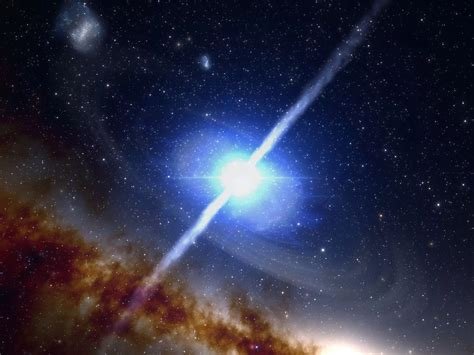
Some neutron stars are extreme even by neutron star standards. A magnetar carries a magnetic field around a thousand times stronger than an ordinary pulsar’s, up to about a quadrillion times Earth’s. At that strength the vacuum of space itself becomes polarised, atoms are stretched into needles, and the star’s crust is strained until it cracks in violent starquakes.
The energy of these quakes is staggering. On 27 December 2004, a magnetar called SGR 1806-20 loosed a burst of gamma and X-rays that measurably disturbed Earth’s upper atmosphere from tens of thousands of light-years away. By NASA’s estimate at the time, it released more energy in two-tenths of a second than the Sun does in 250,000 years, all from a crack in an object 20 kilometres wide.
That flare had a second surprise, recognised only twenty years later. In 2025 a team led by Anirudh Patel and Brian Metzger of Columbia University showed that a faint glow of high-energy gamma rays, which peaked about ten minutes after the burst and had never been explained, matches the radioactive decay of freshly made heavy elements. The giant flare had blasted crust material into space fast enough to forge about a millionth of a solar mass of elements such as gold and platinum. If that is typical, magnetar flares supply at least one to ten per cent of the galaxy’s heaviest elements, a role once credited almost entirely to collisions.
Magnetars are also now linked to fast radio bursts — brilliant millisecond flashes from across the cosmos that baffled astronomers for years. In April 2020, a magnetar in our own galaxy fired off a burst seen simultaneously in radio and X-rays, tying at least some of these enigmatic flashes firmly to magnetars.
GW170817: The Day a Collision Rewrote Astronomy
On 17 August 2017, the two LIGO detectors in the United States, joined by Virgo in Italy, recorded a gravitational-wave signal. Just 1.7 seconds later, a space telescope caught a short gamma-ray burst from the same patch of sky. Within hours, telescopes worldwide were trained on a galaxy 130 million light-years away, where a new point of light was brightening in a way nothing had before.
They were watching two neutron stars collide — a kilonova, and the most thoroughly observed event in the history of astronomy. Over the following weeks it was seen across the entire electromagnetic spectrum by some 70 observatories. It was the first cosmic event ever witnessed in both gravitational waves and light, and it gave birth to what we now call multi-messenger astronomy.
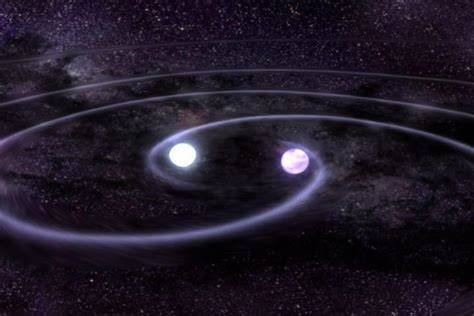
There is something haunting about the signal itself. As the two neutron stars spiralled together in their final seconds, they orbited faster and faster, and the gravitational waves rose in pitch. Translated into sound, the last moments of the collision become an audible “chirp” — a rising note, climbing toward the instant of merger. For the first time, humanity did not just see a cosmic cataclysm. It heard one.
The harvest was extraordinary. The glowing debris faded and reddened exactly as models of rapid neutron capture, the r-process, predicted for a cloud rich in very heavy elements. In 2019 a re-analysis of its spectra identified one of them by name, strontium, the first freshly made heavy element ever pinned to a specific cosmic event. Gold and platinum were not seen directly, but the evidence that neutron star mergers forge them is now strong. The gold in your ring, the platinum in a catalytic converter, the uranium in a reactor: much of it was cooked in collisions like this one, long before the Sun existed.
The flash of gamma rays that arrived 1.7 seconds after the merger settled an older debate too: at least some short gamma-ray bursts, the flashes lasting less than two seconds that satellites had recorded for decades, are made by colliding neutron stars. And because the gravitational waves told astronomers how far away the merger was, the event gave an independent measure of the universe’s expansion rate, about 70 kilometres per second per megaparsec, with error bars wide enough to sit between the two values that disagree in the so-called Hubble tension.
The event also delivered a fresh measure of the universe’s expansion rate a “standard siren” complementing the supernovae used in dark energy research — and confirmed that gravitational waves travel at the speed of light to within one part in a thousand trillion, sweeping away many rival theories of gravity in a single stroke.
What We Have Heard Since
GW170817 was a beginning, not an end. The LIGO-Virgo-KAGRA network has kept listening, and in 2026 its fifth catalogue brought the total of confident gravitational-wave events to 390, counting observations up to January 2025. Most are black hole pairs. A handful involve neutron stars, including a 2023 signal, GW230529, in which a neutron star merged with an object of between 2.5 and 4.5 solar masses, squarely in the “mass gap” between the heaviest neutron stars and the lightest black holes.
Each detection feeds the great open problem: the neutron star equation of state, the relationship between density and pressure that reveals what the interior is truly made of. Today’s detectors are not yet sensitive enough to pin it down. Next-generation observatories — the proposed Einstein Telescope in Europe and Cosmic Explorer in the United States — would be ten times more sensitive, able to read the interior structure of a neutron star from the gravitational shudder of its final moments.
Neutron Star or Black Hole? Testing Einstein at the Limit
Sitting at the edge of the possible, neutron stars are nature’s finest laboratories for gravity. A neutron star forms when the collapsing core is light enough for tightly packed neutrons to resist further crushing; if it is heavier, nothing can stop the fall, and a black hole forms instead. The dividing line sits somewhere around two to three solar masses, and exactly where depends on the still-unknown equation of state.
Because pulsars keep such perfect time, binary pulsars offer razor-sharp tests of general relativity. The Hulse-Taylor binary, discovered by Russell Hulse and Joseph Taylor in 1974, gave the first evidence for gravitational waves: its orbit was decaying at exactly the rate Einstein predicted for a system radiating them, work that won the 1993 Nobel Prize. The Double Pulsar, found in 2003 and timed for sixteen years, now matches Einstein’s prediction for gravitational-wave energy loss to within 0.013 per cent — the most precise test of its kind.
Neutron stars also probe the strong nuclear force at densities no particle accelerator can reach, linking the physics of the very smallest scales to the gravity of the very largest. In them, quantum chromodynamics and Einstein’s gravity meet in the same object — which is exactly why they are so precious.
What We Still Do Not Know
For all we have learned, the biggest questions stay open. We still do not know the equation of state of dense matter, nor whether neutron star cores hold quark matter, hyperons, or some stranger phase entirely. NICER, an X-ray instrument on the International Space Station, is measuring neutron star sizes by tracking hot spots on their spinning surfaces. In 2024 its team reported that PSR J0740+6620, despite weighing about 2.07 solar masses, is roughly 12.5 kilometres in radius, which rules out the softest, most squeezable models of dense matter. The interior, though, remains uncertain.
Nor do we know the exact maximum mass a neutron star can reach before becoming a black hole. The most precisely weighed heavyweight, PSR J0740+6620, comes in at about 2.08 solar masses. A rapidly spinning pulsar called PSR J0952-0607 has been estimated at 2.35 solar masses, refined in December 2025, which would push the limit higher still. A 2019 gravitational-wave event involved a mysterious 2.6-solar-mass object that has never been classified as either. And the origin of most fast radio bursts, though partly tied to magnetars, is still not fully explained.
Perhaps most profound is the link between neutron star cores and the infant cosmos. The transition from quark-gluon plasma to ordinary matter that happened microseconds after the Big Bang may still be playing out, quietly, inside these dead stars. They may be the only places left where a shard of the newborn universe survives. For that primordial state, see our piece on how the universe emerged from nothing.
There is something humbling in it. The next time you glance at anything gold, remember it was born in the collision of two of these city-sized corpses, somewhere in the deep past of the galaxy. The most extreme objects in the universe are not remote abstractions. A little piece of them is probably on your hand.
Frequently Asked Questions
What is a neutron star in simple terms?
It is the collapsed core of a massive star that exploded as a supernova — roughly the Sun’s mass squeezed into a sphere about 20 kilometres across, the size of a city. Made almost entirely of neutrons packed beyond nuclear density, it is the densest stable object in the universe; a teaspoon would weigh about a billion tonnes.
What is the difference between a neutron star and a black hole?
Both form from collapsing massive stars, but a neutron star survives when tightly packed neutrons resist further crushing. If the core is too heavy, nothing stops the collapse and a black hole forms. Neutron stars shine across the electromagnetic spectrum; black holes do not. The boundary is roughly two to three solar masses.
What is a pulsar?
A pulsar is a rapidly spinning neutron star whose magnetic field beams radiation from its poles. As it rotates, the beams sweep past Earth like a lighthouse, producing regular pulses. The first was found by Jocelyn Bell Burnell in 1967. Millisecond pulsars rank among the most precise natural clocks in the universe.
What is a kilonova?
A kilonova is the explosion produced when two neutron stars merge. It releases gravitational waves, a short gamma-ray burst, and a cloud of heavy elements — gold, platinum, uranium — forged by rapid neutron capture. The 2017 kilonova GW170817 was the first event seen in both gravitational waves and light.
How do neutron stars produce gold?
When neutron stars collide, the intensely neutron-rich debris lets atomic nuclei rapidly capture neutrons and build up into very heavy elements — gold, platinum, uranium, and more. In the debris of GW170817, 130 million light-years away, astronomers identified strontium directly and inferred heavier elements from how the glow faded. In 2025, researchers showed that giant flares from magnetars forge such elements too.
Further Reading
Sources
- LIGO/Virgo — GW170817: Observation of Gravitational Waves from a Binary Neutron Star Inspiral, Phys. Rev. Lett. (2017)
- LIGO Scientific Collaboration — GW170817 detection summary
- Salmi et al. — The Radius of the High-Mass Pulsar PSR J0740+6620 with 3.6 yr of NICER Data, The Astrophysical Journal 974, 294 (2024)
- SIMBAD Astronomical Database, CDS Strasbourg — catalogued pulsars and parallax measurements (queried 9 October 2026)
- Bombaci & Logoteta — Equation of State of Dense Nuclear Matter and Neutron Star Structure from Nuclear Chiral Interactions, Astronomy & Astrophysics 609, A128 (2018)
- LIGO-Virgo-KAGRA — GWTC-5.0: observations from the second part of the fourth observing run, arXiv:2605.27225 (2026)
- LIGO-Virgo-KAGRA — GWTC-4.0: updating the gravitational-wave transient catalog, The Astrophysical Journal Letters (2025)
- Kramer et al. — Strong-field gravity tests with the Double Pulsar, Physical Review X 11, 041050 (2021)
- Fonseca et al. — Refined mass and geometric measurements of the high-mass PSR J0740+6620, The Astrophysical Journal Letters (2021)
- Romani et al. — PSR J0952-0607: tightening a record-high neutron star mass, The Astrophysical Journal 996, 101 (2025)
- Watson et al. — Identification of strontium in the merger of two neutron stars, Nature (2019)
- Patel et al. — Direct evidence for r-process nucleosynthesis in delayed MeV emission from the SGR 1806-20 magnetar giant flare, The Astrophysical Journal Letters 984, L29 (2025)
- Abbott et al. — QCD constraints on isospin-dense matter and the nuclear equation of state, Physical Review Letters 134, 011903 (2025)
- Caplan, Schneider & Horowitz — The elasticity of nuclear pasta, Physical Review Letters 121, 132701 (2018)
- Morales & Horowitz — Neutron star crust can support a large ellipticity, Monthly Notices of the Royal Astronomical Society 517, 5610 (2022)
- NASA — NASA team first to demonstrate X-ray navigation in space (SEXTANT)
- LIGO Scientific Collaboration and Virgo Collaboration et al. — A gravitational-wave standard siren measurement of the Hubble constant, Nature 551, 85 (2017)
- Hessels et al. — A radio pulsar spinning at 716 Hz, Science 311, 1901 (2006)
- Palfreyman et al. — Alteration of the magnetosphere of the Vela pulsar during a glitch, Nature 556, 219 (2018)
- Physics World — Jocelyn Bell Burnell to support diversity in physics with $3m winnings from major prize (2018)
Baryon. (2026, August 9). What Is a Neutron Star? The Complete Guide to the Universe’s Most Extreme Objects. Web News For Us. https://webnewsforus.com/neutron-stars-explained-pulsars-kilonovae/
Baryon. “What Is a Neutron Star? The Complete Guide to the Universe’s Most Extreme Objects.” Web News For Us, 9 August 2026, https://webnewsforus.com/neutron-stars-explained-pulsars-kilonovae/. Accessed 12 October 2026.