For most of the twentieth century, physicists were confident they knew how the story of the universe would end. The Big Bang had flung everything outward; gravity, patient and relentless, would slowly haul it back. The only question was whether the cosmos would fall together again or merely coast to a stop. Either way, expansion was supposed to be losing.
Through the 1990s, two rival teams of astronomers set out to measure exactly how fast the slowdown was happening. One was led by Saul Perlmutter, the other by Brian Schmidt and Adam Riess. They tracked exploding stars across billions of light-years, expecting to clock the universe gently applying its brakes.
In 1998 they reported that the accelerator was pressed to the floor. The most distant exploding stars looked fainter than they should, as if they were 10 to 15 per cent farther away than a slowing universe allowed. The universe was not slowing down. It was speeding up. Both teams checked, re-checked, and tried to explain the result away. They could not. Something was pushing space apart.
We call that something dark energy, and it accounts for roughly 68% of everything in the observable universe. It is the largest component of reality, and one of the things we understand least. This is what we know about it — and, just as fascinating, what we do not.
For something so large, its research literature is strikingly small. The arXiv archive, searched on 1 September 2026, held 6,396 papers with “dark energy” in the title, against 20,400 for dark matter. Run again on 6 October 2026, the counts were 6,457 and 20,661.
The thing that makes up roughly 68 per cent of the universe has been titled in under a third as many papers as the thing that makes up about 27 per cent. The imbalance is not neglect. It is that dark matter offers particles to hunt and detectors to build, while dark energy offers a single number to measure ever more precisely.
That asymmetry explains the shape of this field better than any individual result, and it is why the DESI hint that the number may not be constant matters so much.
What Is Dark Energy? The Simple Explanation
Dark energy is the name physicists give to whatever is driving the accelerated expansion of the universe. It is not dark in the sense of being black; it is dark in the sense of being utterly invisible. It interacts with matter and light so faintly that no experiment on Earth has ever felt its touch. We know it exists only because the universe behaves as though it does.
Picture space itself as a fabric. The Big Bang stretched it outward; gravity, matter pulling on matter, tries to draw it back in. For the first several billion years gravity was winning, and the expansion was slowing. Then, about six billion years ago, the balance tipped, and the expansion began to accelerate. Dark energy became the largest single ingredient of the universe more recently still, around three and a half billion years ago.
The strangest thing about dark energy is its refusal to thin out. Matter and radiation grow more dilute as space expands, spread ever thinner through a growing volume. Dark energy does not. Every new cubic metre of space seems to arrive with its own fresh supply. More space means more dark energy — so as the universe grows, its push only strengthens relative to gravity’s pull. That property, negative pressure, is the engine of the acceleration.
It is a genuinely strange idea, and worth sitting with. We are used to energy running down and spreading thin. Dark energy does the opposite: the more the expanding universe dilutes everything else, the more this single ingredient asserts itself, until it comes to dominate the cosmic story entirely. The deep future belongs to it.
Dark Energy vs Dark Matter: What Is the Difference?
Dark energy and dark matter are constantly confused, because they share the word “dark.” They have almost nothing else in common — except that we are ignorant of both.
| Property | Dark Matter | Dark Energy |
|---|---|---|
| What it does | Pulls matter together (extra gravity) | Pushes space apart (acceleration) |
| Share of universe | ~27% | ~68% |
| Where it sits | Halos around galaxies | Uniform through all space |
| Effect on structure | Helps galaxies form | Slows the growth of new structures |
| Discovered | 1933 / confirmed 1970s | 1998 |
Dark matter is the cosmic glue; dark energy is the cosmic solvent. One builds galaxies up, the other slowly prises the universe apart. For the full story of its opposite number, see our guide to dark matter, the invisible substance holding the universe together.
How Do We Know Dark Energy Exists?
Dark energy is not one team’s lucky result. It is the meeting point of several completely different measurements, each arriving at the same answer from a different direction. That convergence is why cosmologists trust it despite never having seen it.
Type Ia supernovae. These exploding white dwarfs reach similar peak brightnesses, and the differences can be corrected, making them cosmic mile-markers. In 1998, the distant ones came in fainter — and therefore farther away — than a decelerating universe allowed. The expansion was accelerating. That single, stubborn discrepancy earned the 2011 Nobel Prize in Physics.
The trick works a little like judging distance by candlelight. If you know how brightly a candle truly burns, its apparent dimness tells you how far away it stands. Type Ia supernovae are not quite identical candles, but in 1993 the astronomer Mark Phillips showed that the brighter ones fade more slowly. Measuring how quickly a supernova fades reveals its true brightness, and they blaze brightly enough to be seen halfway across the cosmos. When the distant ones came in too faint, they were quietly reporting that an accelerating expansion had carried them farther than anyone expected.
The cosmic microwave background. The afterglow of the Big Bang, mapped exquisitely by the Planck satellite, fixes the total energy budget of the cosmos and shows space to be geometrically flat. Ordinary matter and dark matter together supply only about 32% of what flatness demands. The missing 68% is dark energy.
Baryon acoustic oscillations. Frozen into the distribution of galaxies is a preferred distance — a fossil of sound waves from the infant universe. Used as a cosmic ruler across different epochs, it traces an expansion history that only dark energy explains.
The growth of structure. Dark energy quietly starves cosmic construction, slowing the rate at which new galaxy clusters assemble. Counts of clusters across cosmic time match the same dark-energy density the other methods find. Four independent clues, one culprit.
A Result Nobody Wanted to Believe
It is worth lingering on how unwelcome the 1998 discovery was. The two teams were rivals, and both had fully expected to measure a universe applying its brakes. When the numbers instead pointed to acceleration, the first reaction was not triumph but dread.
For months, researchers on both sides hunted for the error — dust dimming the supernovae, some quirk in the exploding stars, a slip in the analysis. Every check only made the result more solid. What finally settled it was that two independent groups, using different supernovae and different methods, had walked into the same impossible answer.
The samples were tiny by today’s standards. The paper from Riess and Schmidt’s team rested on 16 distant supernovae and 34 nearby ones; Perlmutter’s team analysed 42 distant ones. The recalibrated catalogues used in 2026 each hold around 1,500 to 2,000 supernovae, and the acceleration has survived every one of them. What is argued about now is not whether the universe is speeding up, but exactly how its push has changed over time.
Science trusts a strange result far more when rivals stumble onto it separately. Slowly, reluctantly, the community accepted that the universe was doing something no one had predicted — and that most of it was made of something no one could name.
Einstein’s “Greatest Blunder” — That Wasn’t
The neatest description of dark energy is also the oldest, and it comes with one of the best stories in physics. In 1917, Einstein added a term to his equations of gravity — the cosmological constant, written as the Greek letter Lambda — to keep the universe still, because a static cosmos seemed obviously correct.
Then the evidence moved. In 1927 the Belgian priest and physicist Georges Lemaître argued that the universe was expanding, and in 1929 Edwin Hubble showed that more distant galaxies are receding faster. The universe was not static after all. By 1931 Einstein had dropped the term.
The famous line, that he called it the biggest blunder of his life, comes from the physicist George Gamow’s memoir, and for years historians doubted it. A 2018 study of Einstein’s later writings concluded that he clearly came to regard the term as a serious error and that it is very likely he used the phrase on at least one occasion.
Seven decades later, in 1998, the blunder rose from the dead. The acceleration the supernova hunters found is precisely what a positive cosmological constant would produce — a fixed, uniform energy woven into empty space itself. Today’s standard model of cosmology, Lambda-CDM, is built around it. Einstein’s discarded fudge factor turned out to be, quite possibly, the most abundant thing in existence.
There is a catch, and it is enormous. Quantum theory says empty space should seethe with vacuum energy — and when physicists calculate how much, they get a number about 10 to the power of 120 times larger than what the universe actually shows. That is a one followed by 120 zeros: the single worst mismatch between prediction and reality in the history of science. It is called the cosmological constant problem, and no one has solved it.
Is Dark Energy Changing? What New Data Suggests
For years, treating dark energy as a fixed constant worked beautifully. Recently, that comfortable picture has begun to wobble.
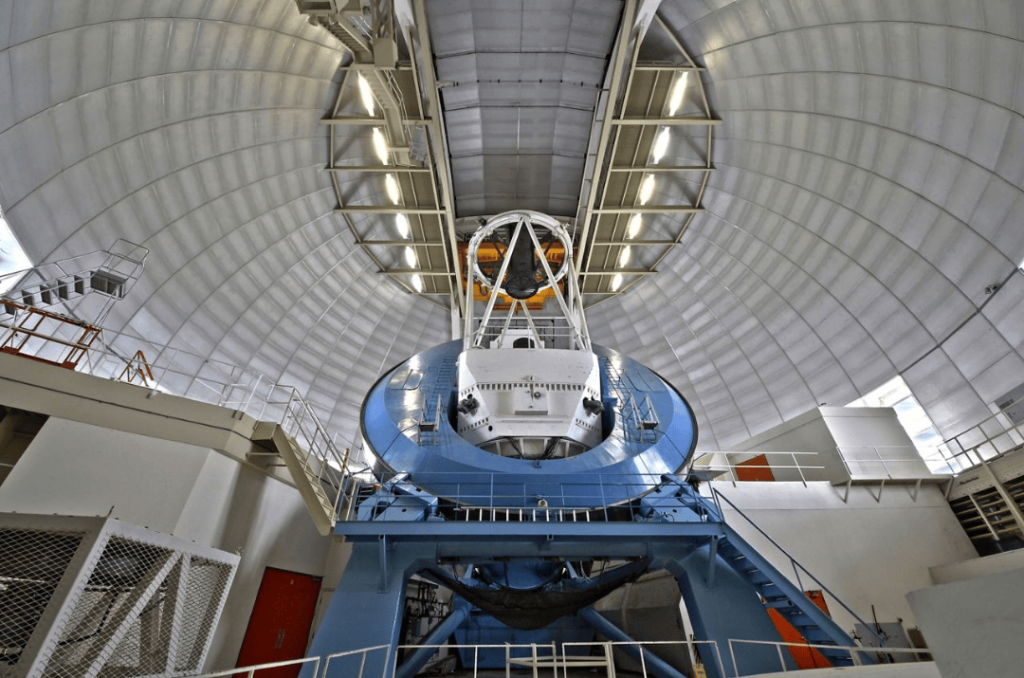
The Dark Energy Spectroscopic Instrument (DESI), mounted on a telescope at Kitt Peak in Arizona, is charting the three-dimensional positions of tens of millions of galaxies. Its first results, released in 2024, carried a faint but tantalising hint: dark energy may have been stronger in the past and may be weakening now — behaviour a simple cosmological constant forbids.
DESI’s second release, in March 2025, drew on more than 14 million galaxies and quasars from its first three years. Combined with the cosmic microwave background, it preferred a changing dark energy over a constant one at 3.1 sigma. Adding supernova data gave between 2.8 and 4.2 sigma, depending on which supernova catalogue was used. That is strong enough to make the field sit up, though still short of the five-sigma gold standard for a discovery.
A word on those numbers. In physics, “sigma” measures how unlikely a result would be if nothing new were going on. At three sigma, a fluke that large would turn up by chance about once in 740 tries; at five sigma, the discovery threshold, about once in 3.5 million. Three-sigma hints have come and gone before, which is why physicists stay cautious until five.
Then the supernova catalogues themselves were checked. In late 2025 the Dark Energy Survey team recalibrated its five-year sample, and the significance from that combination fell from 4.2 to 3.2 sigma. The team described what remained as only a weak preference for evolving dark energy. In January 2026 the Union team corrected how host galaxies had been measured in its catalogue and found 3.4 sigma. The three supernova samples now agree far better with each other, at around 3.2 to 3.4 sigma.
If the signal holds, the implication is staggering: dark energy would not be a fixed feature of empty space but something dynamic, evolving across cosmic time. In April 2026 DESI finished its planned five-year survey, having mapped more than 47 million galaxies and quasars rather than the 34 million it set out to collect, and it will keep observing into 2028. The analysis of that full dataset is the test everyone is waiting for.
What Dark Energy Might Actually Be
If dark energy is not merely the energy of the vacuum, what else could it be? Several genuine contenders are on the table.
Quintessence imagines dark energy as a dynamic field filling all of space — a cousin of the Higgs field — whose strength can drift over cosmic history. Unlike a fixed constant, it could rise and fall, which is exactly the kind of behaviour the DESI hints would require. So far, no experiment has detected it directly.
Modified gravity takes a bolder line: perhaps there is no new substance at all, and instead Einstein’s general relativity simply breaks down at the largest scales. If gravity behaves differently across billions of light-years, the acceleration might be a mirage produced by using the wrong theory. Ongoing surveys are actively testing that idea.
Microscopic wormholes are a more exotic proposal, published in 2024: that the constant creation and annihilation of quantum-scale tunnels in the vacuum could produce an effective energy that behaves like dark energy and changes over time. By its authors’ own account it has not yet been tested against observations such as DESI’s. We explore the idea in full in the wormhole solution.
Phantom energy is the nightmare option — a dark energy that grows ever stronger, ending in a “Big Rip.” Current data does not favour it, but nor has it been ruled out entirely.
The Hubble Tension: A Crack in Cosmology
There is a second mystery entangled with the first. Two trusted ways of measuring how fast the universe expands today give stubbornly different answers. The Planck satellite’s map of the cosmic microwave background, read through the standard model, gives 67.4 kilometres per second per megaparsec. The SH0ES team, using pulsating stars and supernovae, measured 73.04, with an uncertainty of about 1. The gap is far too large to be a fluke, and it has become known as the Hubble tension.
Not every local measurement agrees with SH0ES. In 2025 a team led by Wendy Freedman, using a different kind of star calibrated with the James Webb Space Telescope, found 70.4, between the two camps and consistent with the standard model. Whether the tension reflects new physics or hidden errors in the distance ladder is still argued.
One proposed escape route runs through a different kind of dark energy. If an extra burst of it acted in the first few hundred thousand years, before the cosmic microwave background was released, it could shift the early-universe reading without disturbing the local one. This idea, called early dark energy, is separate from the DESI hint, which concerns the last few billion years. On its own, DESI’s evolving dark energy does not close the Hubble gap. Finding one mechanism that solved both puzzles would be one of the great scientific coups of the century; so far nobody has.
The Fate of the Universe
Dark energy is not merely shaping the universe’s past. It is writing its ending, and which ending we get depends on what dark energy turns out to be.
It is a rare thing in science to hold, in a single unsolved question, the origin of nearly everything and the fate of absolutely everything. Dark energy is that question. The choices below are not idle speculation — they are the genuine, competing destinies our measurements are still trying to choose between.
If it is a fixed cosmological constant, the cosmos expands forever, faster and faster. Distant galaxies will slip past our horizon and vanish, one by one, until the Milky Way and its neighbours float alone in an ocean of black. Stars will gutter out, black holes will slowly evaporate, and the universe will drift toward a cold, silent heat death.
If it is phantom energy, the ending is violent: a Big Rip, in which the expansion tears apart clusters, then galaxies, then solar systems, then atoms themselves. And if the DESI hints are real and dark energy is fading, the future depends on how far it fades. If it weakens but stays positive, the expansion simply accelerates less. Only if it kept falling until it turned negative could the expansion one day stall and reverse into a Big Crunch, and some theorists, including a Princeton team in 2022, have built models that do just that. The data cannot yet distinguish these possibilities.
We do not yet know which future is ours. The most profound question about how everything ends turns entirely on a substance we have never touched.
The Race to Catch Dark Energy
A fleet of instruments is now closing in, and the next decade should decide whether dark energy is constant or evolving.
DESI has mapped more than 47 million galaxies and quasars to pin down the expansion history with unmatched precision; its full dataset should confirm or kill the evolving-dark-energy signal. Euclid, launched by the European Space Agency in 2023, is surveying the shapes of billions of galaxies through weak gravitational lensing to weigh the dark universe across cosmic time. Its first large data release comes in two stages, in November 2026 and mid-2027.
The Vera C. Rubin Observatory in Chile began its decade-long Legacy Survey of Space and Time on 30 June 2026. It will photograph the entire southern sky every few nights, harvesting supernovae and lensing signals on an unprecedented scale. And NASA’s Nancy Grace Roman Space Telescope, launched on 30 August 2026 aboard a SpaceX Falcon Heavy, is purpose-built to measure dark energy several independent ways at once. Between them, these machines will either crown the cosmological constant as nature’s final answer — or blow the field wide open.
Why We Are Lucky to See This at All
Here is the thought that ought to give anyone pause. Because dark energy is carrying the galaxies away from one another, the universe is slowly emptying itself of visible landmarks. Give it enough time and every galaxy beyond our own local group will have raced past the horizon, gone forever.
Astronomers living in that far future — trillions of years from now — will look out and see only a single island of stars in an otherwise black sky. The evidence of the Big Bang, the expansion, the whole grand history of the cosmos, will have slipped beyond reach. They will have no way to know any of it happened.
We, by contrast, live at a privileged moment — early enough that the universe still wears its history on its sleeve, late enough to have built the instruments to read it. Dark energy is the very thing that will one day draw the curtain, and also the reason this brief, luminous window of cosmic clarity is worth savouring.
The Deepest Question of All
Beneath every survey and theory sits a puzzle physics cannot yet touch: why does the universe hold exactly the amount of dark energy it does? The value is not zero, and it is nowhere near the catastrophic number quantum theory predicts. It is a tiny positive quantity. Had it been much larger, space would have flown apart before gravity could gather matter into galaxies; a large negative value would have pulled everything back together long before stars could form.
In 1987 the physicist Steven Weinberg turned that observation into a prediction. If many regions of a larger cosmos have different values, observers can only arise in the rare ones where the value is small enough for galaxies to form, so we should expect to measure a small but non-zero number. Eleven years later, the supernova teams found one. Whether that counts as an explanation or a way of giving up on one is fiercely debated.
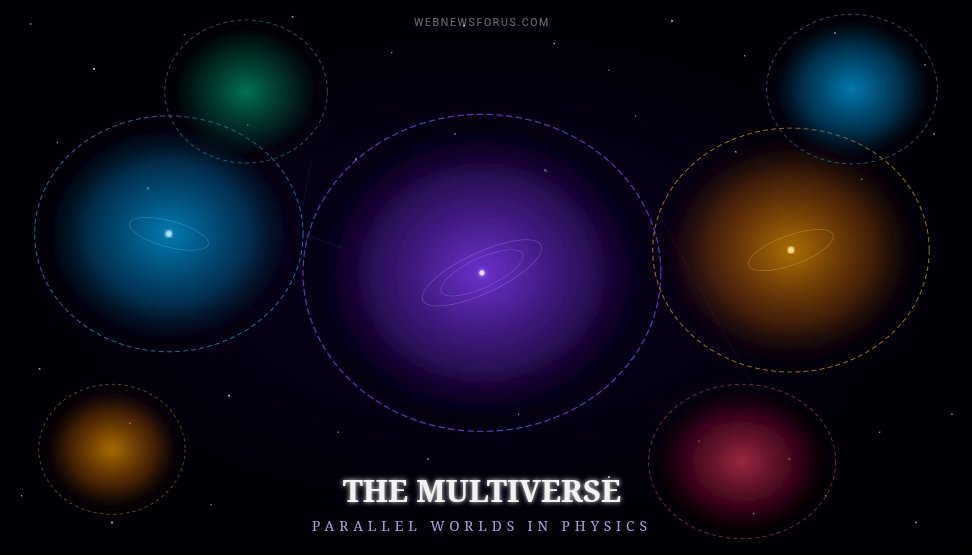
That puzzle is one of the great enigmas of modern science. Some read Weinberg’s argument as a sign of a multiverse of countless universes, each with a different value, in which we necessarily find ourselves in one hospitable to life — an idea as controversial as it is hard to test. Others hunt for a deeper law that fixes the number from first principles. No one has found it.
Dark energy, in the end, is nature telling us that our two greatest theories — quantum mechanics and general relativity — are missing something fundamental. Cracking it may take a revolution as profound as relativity itself. For the quantum vacuum that may lie at its heart, see our piece on how the universe emerged from nothing; and for the ordinary matter dark energy is prising apart, see baryons, the building blocks of all matter.
Frequently Asked Questions
What is dark energy in simple terms?
Dark energy is the name for whatever is making the universe’s expansion speed up. It is invisible, fills all of space evenly, and — unlike matter — does not thin out as the universe grows. It makes up about 68% of the total energy of the observable universe, yet we do not know what it fundamentally is.
Is dark energy the same as dark matter?
No. Dark matter exerts gravitational attraction and helps hold galaxies together. Dark energy has a repulsive effect and drives the accelerating expansion of the universe, working against gravity on the largest scales. They share only the word “dark.”
How was dark energy discovered?
In 1998, two teams measuring distant Type Ia supernovae found them fainter, and so farther away, than a slowing universe would allow. The expansion was accelerating. The 2011 Nobel Prize in Physics went half to Saul Perlmutter, who led the Supernova Cosmology Project, and half jointly to Brian Schmidt and Adam Riess of the High-Z Supernova Search Team.
Could dark energy be Einstein’s cosmological constant?
The cosmological constant — a fixed energy of empty space Einstein introduced in 1917 — is the simplest description, and the standard model uses it. DESI results combined with other data prefer a dark energy that changes over time, at about 3.2 to 3.4 sigma after the 2025–2026 supernova recalibrations. That is suggestive but short of the five-sigma standard for a discovery.
What is the cosmological constant problem?
Quantum theory predicts a vacuum energy about 10 to the power of 120 times larger than the dark energy we actually observe — the biggest mismatch between theory and observation in the history of science. It signals that something fundamental is missing from our understanding of quantum physics or gravity.
Will dark energy eventually destroy the universe?
Possibly. If it is a constant, the universe expands into a cold, isolated heat death. If it grows stronger, it could tear everything apart in a Big Rip. If it is weakening, the expansion will slow its acceleration, and only if it eventually turned negative could the universe recollapse in a Big Crunch. Current data cannot yet tell these futures apart.
When did the universe start speeding up?
In the standard model, using Planck satellite values, the expansion stopped slowing and began to accelerate about six billion years ago. Dark energy became the largest component of the universe about three and a half billion years ago, and its share keeps growing as matter thins out.
How strong is the evidence that dark energy is changing?
DESI’s 2025 results, combined with the cosmic microwave background and supernovae, preferred a changing dark energy at 2.8 to 4.2 sigma. After the supernova catalogues were recalibrated in 2025 and 2026, the combinations sit at about 3.2 to 3.4 sigma. Physicists normally require five sigma before calling something a discovery.
Did Einstein really call the cosmological constant his biggest blunder?
The quotation comes from the physicist George Gamow, and for years historians questioned it. A 2018 study concluded that Einstein clearly came to see the term as a serious mistake and that he very likely used the phrase at least once.
Further Reading
Sources
- Nobel Prize in Physics 2011 — the discovery of accelerating expansion
- DESI Collaboration — DESI DR2 Results II: Measurements of Baryon Acoustic Oscillations and Cosmological Constraints, arXiv:2503.14738 (2025)
- ESA — Euclid Mission
- Riess et al. — Observational Evidence from Supernovae for an Accelerating Universe, The Astronomical Journal 116, 1009 (1998)
- Weinberg — The Cosmological Constant Problem, Reviews of Modern Physics 61, 1 (1989)
- Perlmutter, S., et al. (1999). “Measurements of Ω and Λ from 42 High-Redshift Supernovae.” The Astrophysical Journal, 517, 565 (DOI: 10.1086/307221).
- Phillips, M. M. (1993). “The Absolute Magnitudes of Type Ia Supernovae.” The Astrophysical Journal, 413, L105 (DOI: 10.1086/186970).
- Planck Collaboration (2020). “Planck 2018 Results. VI. Cosmological Parameters.” Astronomy & Astrophysics, 641, A6 (DOI: 10.1051/0004-6361/201833910).
- Popovic, B., et al. (2025). “The Dark Energy Survey Supernova Program: A Reanalysis of Cosmology Results and Evidence for Evolving Dark Energy with an Updated Type Ia Supernova Calibration.” arXiv:2511.07517.
- Hoyt, T. J., et al. (2026). “Union3.1: Reducing Systematics in Supernova Cosmology with Self-Consistent Measurements of Host Galaxy Properties for 2000 Type Ia Supernovae.” arXiv:2601.19424.
- Fermilab / Berkeley Lab (17 April 2026). “DESI Completes Planned 3D Map of the Universe and Continues Exploring.” news.fnal.gov.
- Riess, A. G., et al. (2022). “A Comprehensive Measurement of the Local Value of the Hubble Constant with 1 km/s/Mpc Uncertainty from the Hubble Space Telescope and the SH0ES Team.” The Astrophysical Journal Letters, 934, L7 (DOI: 10.3847/2041-8213/ac5c5b).
- Freedman, W. L., et al. (2025). “Status Report on the Chicago-Carnegie Hubble Program (CCHP): Measurement of the Hubble Constant Using the Hubble and James Webb Space Telescopes.” The Astrophysical Journal, 985, 203 (DOI: 10.3847/1538-4357/adce78).
- O’Raifeartaigh, C. & Mitton, S. (2018). “Interrogating the Legend of Einstein’s ‘Biggest Blunder’.” Physics in Perspective, 20, 318 (DOI: 10.1007/s00016-018-0228-9).
- Weinberg, S. (1987). “Anthropic Bound on the Cosmological Constant.” Physical Review Letters, 59, 2607 (DOI: 10.1103/PhysRevLett.59.2607).
- Tsilioukas, S. A., Saridakis, E. N. & Tzerefos, C. (2024). “Dark Energy from Topology Change Induced by Microscopic Gauss-Bonnet Wormholes.” Physical Review D, 109, 084010 (DOI: 10.1103/PhysRevD.109.084010).
- Andrei, C., Ijjas, A. & Steinhardt, P. J. (2022). “Rapidly Descending Dark Energy and the End of Cosmic Expansion.” Proceedings of the National Academy of Sciences, 119, e2200539119 (DOI: 10.1073/pnas.2200539119).
- NASA. “Roman Launch.” science.nasa.gov.
- NSF–DOE Vera C. Rubin Observatory (30 June 2026). “Action! Rubin Observatory Begins Capturing the Greatest Cosmic Movie Ever Made.” rubinobservatory.org.
- European Space Agency. “Euclid DR1 Timeline.” cosmos.esa.int.
Baryon. (2026, January 18). Dark Energy Explained: The Invisible Force Pushing the Universe Apart. Web News For Us. https://webnewsforus.com/dark-energy-explained-the-invisible-force/
Baryon. “Dark Energy Explained: The Invisible Force Pushing the Universe Apart.” Web News For Us, 18 January 2026, https://webnewsforus.com/dark-energy-explained-the-invisible-force/. Accessed 8 October 2026.
3 Responses