Lensing is described as ubiquitous, and in one sense it is. We asked SIMBAD, the astronomical database run from Strasbourg, what has actually been catalogued. Sorted by object type on 6 October 2026: 11,549 gravitationally lensed images of galaxies, 2,524 lensed images of all kinds, 1,260 complete lens systems, 511 objects classified as gravitational lenses — and 188 lensed images of quasars.
That last number is the one that matters most for cosmology. A lensed quasar is the workhorse for timing a variable source and turning the delay into a measurement of how fast the universe expands; lensed supernovae can do the same, but only a handful have been found. There are 188 catalogued quasar images, and because a lens produces two or four images of the same quasar, the number of usable systems is smaller still.
So the independent lensing route to the Hubble constant, described below as a referee between two disagreeing methods, rests on a catalogue you could read through in an afternoon. That is worth knowing before treating it as a tiebreaker.
Light travels in straight lines — or so everyday experience suggests. Shine a torch across a room and the beam runs true from source to wall. But that intuition is only an approximation of a deeper reality.
Light is bent by gravity. When it passes a massive object, the curvature of spacetime bends its path — producing one of the most beautiful and scientifically productive phenomena in all of astronomy.
Gravitational lensing turns galaxies, clusters, and even single stars into natural telescopes. It magnifies objects too faint to see any other way, and it maps invisible dark matter through its gravity alone.
It also gives an independent measurement of how fast the universe is expanding. And it produces images of haunting beauty — rings, arcs, and mirrored quasars — that astronomers still find striking after decades.
This article explains the physics of gravitational lensing, its three distinct types, and the observations that made it one of the most powerful tools in modern cosmology.
The Physics: Why Gravity Bends Light
The bending of light by gravity is a direct prediction of Einstein’s general theory of relativity, published in 1915. In that theory, gravity is not a force pulling between masses.
Instead, gravity is the curvature of spacetime caused by mass and energy. Objects follow the straightest available paths through that curved geometry, and to an outside observer those paths look bent.
Light follows these same paths. Although a photon has no mass, it travels along the geometry of spacetime itself — so where spacetime curves, light curves with it.
Einstein calculated that a ray grazing the Sun would be deflected by 1.75 arcseconds. Crucially, that is exactly twice the value a naive Newtonian calculation predicts — a value the German astronomer Johann von Soldner had worked out in 1801, and that Einstein himself first obtained in 1911, before general relativity was complete.
That factor of two is not a detail. It is a clean, testable fingerprint that distinguishes Einstein’s curved-spacetime gravity from Newton’s, and it turned light-bending into a decisive experiment.
The 1919 Eclipse That Made Einstein Famous
To measure starlight bending past the Sun, astronomers needed the Sun’s glare blocked. A total solar eclipse provided exactly that opportunity.
On 29 May 1919, two British expeditions organised by the Astronomer Royal, Frank Dyson, photographed stars near the eclipsed Sun’s edge: Arthur Eddington’s team on the island of Príncipe, off West Africa, and a second team at Sobral in Brazil.
They compared the stars’ apparent positions with their true positions measured months earlier. The shift matched Einstein’s prediction, not Newton’s.
The result, announced at a joint meeting of the Royal Society and the Royal Astronomical Society in November 1919 and published in 1920, made headlines around the world and turned Einstein into a global figure almost overnight. The measurements were rough, and their precision has been debated since, but modern radio methods leave no doubt: a 2004 analysis of radio waves passing the Sun, measured with networks of telescopes thousands of kilometres apart, matched Einstein’s prediction to better than one part in a thousand.
Every gravitational lens observed since is, in a sense, a grander repeat of that 1919 experiment — the same physics, scaled up from a single star to entire galaxies.
How Astronomers Read a Lens
A gravitational lens is not just a pretty picture. It is a precise measuring device, and its geometry can be read like an instrument dial.
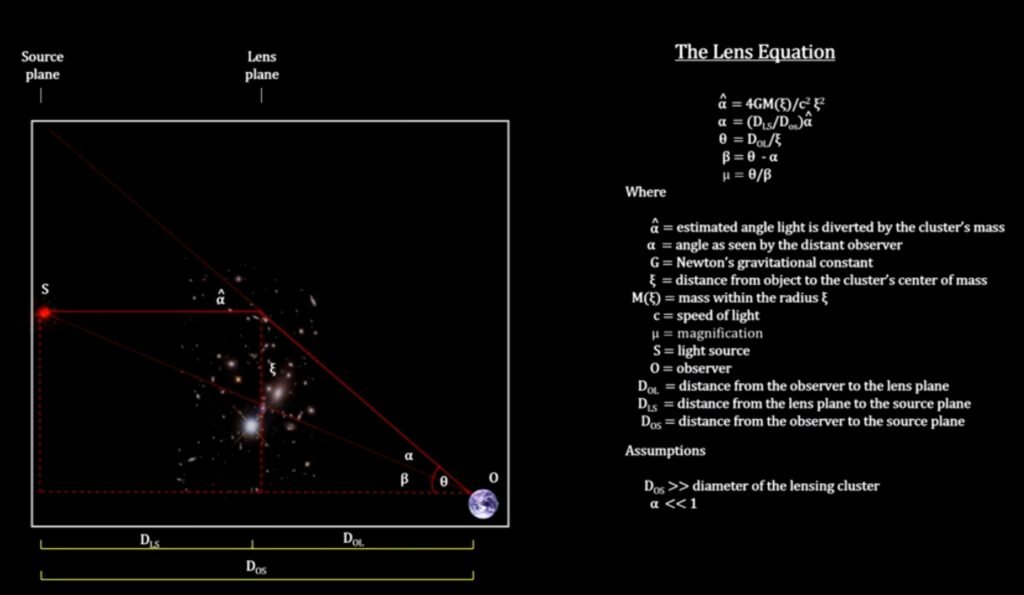
The key quantity is the deflection angle — how sharply light is bent. It depends on the lens’s mass and on how closely the light ray passes.
The size of an Einstein ring, called the Einstein radius, then follows from that deflection combined with the distances between source, lens, and observer.
Measure the ring, know the distances, and the lens’s total mass drops out of the equation directly — including every gram of dark matter within it.
This is why lensing is so prized. Most methods weigh only what shines; lensing weighs everything that has mass, seen or unseen.
From Prediction to Discovery: The Twin Quasar
Einstein himself doubted lensing would ever be observed. In a 1936 paper in Science, written at the urging of a persistent Czech engineer, Rudi Mandl, he described the ring-shaped image a perfectly aligned star could produce, but thought the alignment too rare to ever see. Historians later found that he had worked through the same calculation in a notebook around 1912 and set it aside.
A year later, the astronomer Fritz Zwicky went further. He argued that entire galaxies, being far more massive, would act as lenses — and could reveal unseen mass. He was decades ahead of his time.
Confirmation finally arrived in 1979. Dennis Walsh, Robert Carswell, and Ray Weymann found two quasars sitting suspiciously close together with identical spectra.
They were not twins. They were a single quasar, its light split into two images by an intervening galaxy — the first gravitational lens ever confirmed, known as the Twin Quasar.
Nine years later, in 1988, Jacqueline Hewitt and colleagues reported the first Einstein ring, a radio source called MG1131+0456 imaged with the Very Large Array in New Mexico. Lensing had moved from theory to a working branch of astronomy.
Strong Lensing: Arcs, Rings, and Einstein Crosses
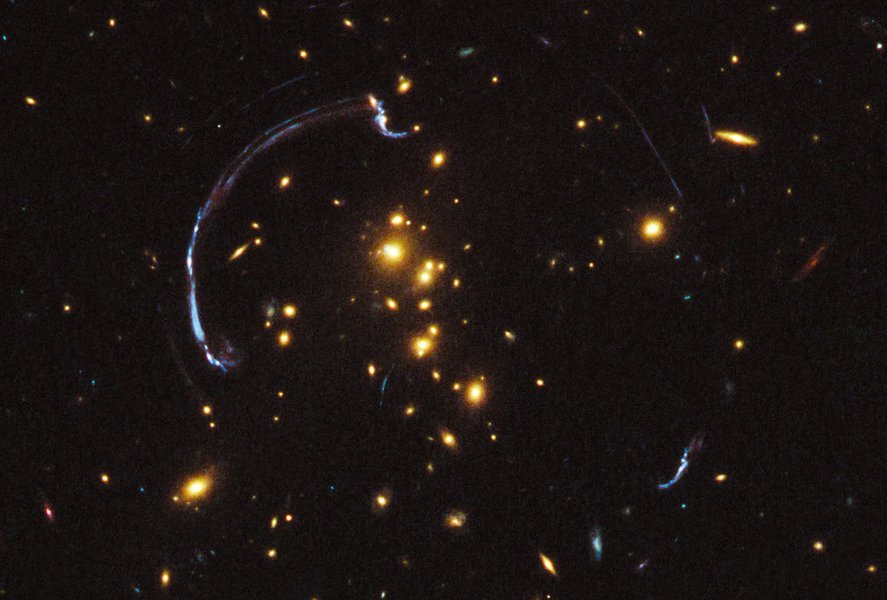
Strong lensing occurs when the alignment is close enough, and the lens massive enough, to produce dramatic distortions. The results are among the most striking images in all of astronomy.
When the alignment is nearly perfect, the background source is bent into a complete or partial ring around the foreground lens — an Einstein ring.
Each ring is a precise scale. Its radius directly measures the mass of the lensing object contained within it — including any dark matter that emits no light at all.
When alignment is slightly off, the ring breaks into arcs — curved streaks that are stretched images of the source. Galaxy clusters, the most massive bound structures in the universe, produce the grandest examples.
The cluster Abell 2218, imaged by Hubble, shows dozens of arcs — a visual map of the cluster’s mass that no other technique could produce.
When the source is a point-like quasar, lensing can produce two or four separate images in a cross pattern — an Einstein Cross.
The most famous example is the Einstein Cross, discovered in 1985. A distant quasar appears as four points around a foreground galaxy some 400 million light-years away.
All four points are the same object, seen four times over. It remains one of the most instantly recognisable demonstrations of Einstein’s theory in the sky.
Because those images travel different paths, their light arrives at slightly different times. Those time delays, remarkably, can be used to measure the expansion rate of the whole universe.
Weak Lensing: Mapping the Invisible
Weak lensing happens when the effect is too subtle to make visible arcs. Each background galaxy is only slightly stretched, by a small fraction of its size.
No single galaxy can be identified as lensed, because galaxies have their own varied shapes. The signal only emerges statistically, across huge numbers of them.
By measuring the shapes of millions of galaxies and finding coherent alignments in their orientations, astronomers reconstruct the mass causing the distortion.
This is the most powerful method we have for mapping dark matter — the invisible mass that dominates galaxies and clusters but gives off no light.
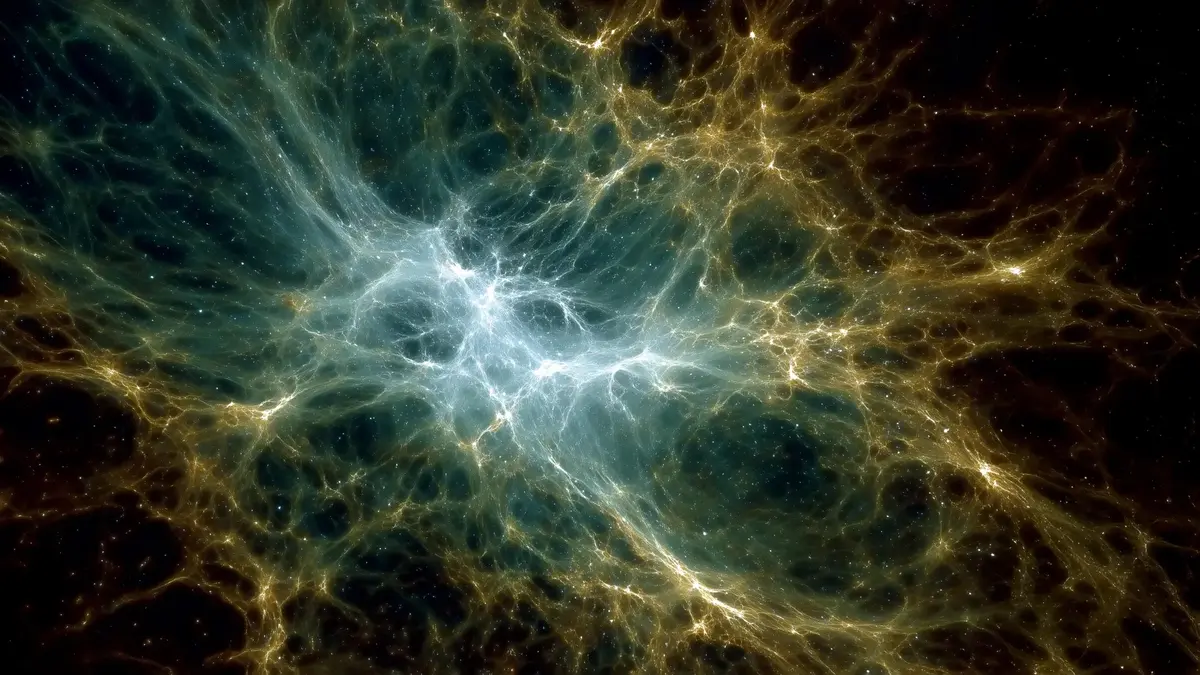
Weak-lensing surveys have mapped dark matter across large fractions of the sky, tracing the cosmic web of filaments, walls, and voids that frames the universe.
The Dark Energy Survey observed about an eighth of the sky from Chile between 2013 and 2019. Its final analysis, published in January 2026, used the shapes of about 140 million galaxies. It found matter slightly less clumpy than the cosmic microwave background predicts — a difference of 2.6 standard deviations, suggestive but not yet decisive.
Not every survey agrees. The completed Kilo-Degree Survey, a European project covering about 1,350 square degrees, reported in 2025 a clumpiness consistent with the cosmic microwave background. Whether there is a real “S8 tension” between lensing and the early universe is still open.
The European Space Agency’s Euclid telescope, launched in July 2023, is now extending this to about a third of the sky — measuring how dark energy has shaped cosmic structure over billions of years. This connects closely to dark energy, the invisible force pushing the universe apart.
Euclid’s First Harvest
Euclid has already shown how many lenses are waiting to be found. In February 2025 its team reported a complete Einstein ring around the centre of NGC 6505, a galaxy only about 590 million light-years away whose ring had gone unnoticed: the light of a galaxy 4.42 billion light-years behind it, bent into a circle.
A month later, the mission’s first quick data release, covering 63 square degrees, about 0.45 per cent of its planned survey, produced a catalogue of 497 galaxy-scale strong lenses, found by machine learning, checked by citizen scientists and vetted by experts. That alone doubled the number of lens candidates known from space-based imaging. On the same rate, the full survey would yield on the order of a hundred thousand.
The Bullet Cluster: Seeing Dark Matter Directly
The single most persuasive piece of evidence for dark matter came from lensing. It is a cosmic collision known as the Bullet Cluster.
Two galaxy clusters smashed through each other. Their hot gas — most of the ordinary, visible matter — slowed and piled up in the middle, glowing in X-rays.
But weak lensing revealed where the mass actually was. Most of it had sailed straight through the collision, sitting far from the glowing gas.
That separation is exactly what dark matter predicts. Dark matter barely interacts, so it passed through untouched while the gas clouds collided and stalled.
Published by Douglas Clowe and colleagues in 2006, the lensing map showed the mass offset from the hot gas at a statistical significance of 8 sigma. The Bullet Cluster is widely regarded as direct empirical evidence that dark matter is real, not merely a flaw in our theory of gravity.
Microlensing: Detecting Hidden Worlds
Microlensing is a third regime, where the lens is a small object — a star, planet, or black hole — drifting in front of a background star.
The effect is too tiny to make arcs. Instead, the background star simply brightens temporarily as the lens crosses in front of it, then fades again.
That brightening lasts hours to months, depending on the lens’s mass and speed. Its precise shape encodes the properties of an otherwise invisible object.
The OGLE survey, running since 1992, has monitored hundreds of millions of stars toward the galactic centre and caught thousands of microlensing events.
Among its finds are free-floating planets — worlds bound to no star, drifting through the galaxy — detectable by no other method.
In 2005, microlensing revealed OGLE-2005-BLG-390Lb, a planet of about 5.5 Earth masses orbiting a faint star, then one of the coldest and most Earth-like exoplanets ever found — a super-Earth thousands of light-years away.
Microlensing keeps setting records. In 2020 the OGLE and KMTNet teams reported the shortest microlensing event ever seen, OGLE-2016-BLG-1928, which lasted about 42 minutes. The lens appears to be a free-floating planet somewhere between the mass of Mars and that of Earth, with no star detected nearby.
In 2022 a team using eight years of Hubble images reported the first isolated stellar-mass black hole, found because its gravity both brightened a background star and shifted its apparent position. They estimated a mass of about 7 Suns and a distance of about 5,000 light-years; a rival analysis of the same event preferred a lower mass, which shows how hard such invisible objects are to weigh.
NASA’s Nancy Grace Roman Space Telescope, launched on 30 August 2026, will run a microlensing survey of the galactic bulge expected to find thousands of planets, including free-floating ones, and to map stellar remnants across the galaxy.
Cosmic Telescopes: Lensing the Earliest Galaxies
The James Webb Space Telescope, operational since 2022, has transformed lensing science in ways still being fully appreciated.
Webb’s infrared vision resolves the fine structure of lensed arcs far better than Hubble could, and reaches galaxies from the first few hundred million years of the universe.
Massive clusters like SMACS 0723 and Abell 2744 are now used routinely as natural telescopes. They magnify background galaxies by factors of ten to a hundred.
This lets Webb see objects otherwise far beyond its reach. Behind Abell 2744, the UNCOVER programme confirmed galaxies seen about 330 million years after the Big Bang. The current record holders, at redshifts around 14 and seen less than 300 million years after the Big Bang, were found in unlensed deep fields, a reminder that lensing is one route among several.
Lensing can even magnify single stars. In 2022, Hubble detected Earendel, the most distant individual star ever seen, visible only because a cluster bent and amplified its light.
Webb’s lensing observations now resolve individual star-forming regions in galaxies billions of light-years away — reshaping how we think early galaxies built their stars. The same observatory’s wider impact is covered in our article on the James Webb Space Telescope.
Lensing and the Hubble Tension
One of lensing’s most important current uses is tackling the Hubble tension — a stubborn disagreement over how fast the universe is expanding.
Measurements from the early universe, via the cosmic microwave background, give one value. Measurements from the nearby universe, via supernovae, give a value about eight percent higher.
That gap is far larger than the errors can explain. It may signal genuinely new physics — and lensing offers a way to break the deadlock.
Time-delay cosmography measures the expansion rate from the delays between multiple images of a lensed quasar. It is fully independent of the other two methods.
In 2020 the H0LiCOW collaboration used six lensed quasars to measure the expansion rate to 2.4 per cent precision, matching the higher, nearby-universe value. Its successor, TDCOSMO, then relaxed some of the assumptions about how mass is spread inside the lens galaxies, which widened the uncertainties considerably.
Its 2025 analysis of eight lensed quasars, using new measurements from the James Webb Space Telescope and large ground-based telescopes of how fast stars move in the lens galaxies, found 71.6 kilometres per second per megaparsec, with a precision of about 5 per cent. That sits between the two disputed values and leans towards the nearby one, without settling the argument. The full puzzle is explored in our article on the Hubble tension and the crisis in cosmology.
Lensed Supernovae and Cosmic Timekeeping
Lensing can also multiply a single exploding star. The clearest example is Supernova Refsdal, spotted behind a galaxy cluster in 2015.
The cluster split its light into four images arranged in a cross. Astronomers then made a bold prediction: a fifth image would appear about a year later, along a longer path.
It did, right on schedule. It was the first time a supernova’s reappearance had been forecast and then confirmed — a stunning validation of our lensing models.
Lensed supernovae offer yet another independent route to the expansion rate, because their images flare and fade at different times. In 2023 the Refsdal team used the delays to measure 64.8 to 66.6 kilometres per second per megaparsec, depending on the lens models used, closer to the early-universe value. SN H0pe, a triply imaged supernova discovered by Webb, gave 75.4 with larger uncertainties. Two supernovae pointing in different directions show how much depends on modelling the lens.
Lensing as a Test of Einstein’s Gravity
Every lens is also an experiment. General relativity predicts precisely how much light should bend for a given mass, so lensing puts Einstein’s theory on trial across cosmic scales.
So far, it passes every test. From the 1919 eclipse to the sharpest cluster arcs today, observations match general relativity’s predictions with remarkable consistency.
The most extreme lens of all is a black hole. The Event Horizon Telescope’s images of M87* in 2019 and Sagittarius A* in 2022 show rings of light bent around each black hole, enclosing a dark shadow about two and a half times the size of the event horizon itself, as general relativity predicts.
This matters for a live debate. Some physicists have proposed modifying gravity itself — theories like MOND — to explain galaxy motions without invoking dark matter.
Lensing is one of the hardest tests such alternatives face. The Bullet Cluster, where mass and visible matter clearly part ways, is very difficult for modified-gravity models to explain.
By weighing mass independently of light, lensing keeps both Einstein’s gravity and the dark-matter hypothesis honest — and so far, both continue to survive the scrutiny.
The Coming Survey Era
Lensing is about to enter a golden age. A new generation of instruments will map the sky on a scale that dwarfs everything before them.
The Vera C. Rubin Observatory in Chile began its ten-year Legacy Survey of Space and Time on 30 June 2026, repeatedly imaging the southern sky and measuring the shapes of billions of galaxies for weak-lensing analysis.
Euclid, already operating, is charting dark matter and dark energy across a third of the sky with space-based precision no ground telescope can match.
The Roman Space Telescope, now in space, will add a deep microlensing survey of the galactic bulge, expected to reshape our census of planets and stellar remnants.
Together, these surveys will turn gravitational lensing from a source of individual discoveries into a systematic map of the universe’s hidden mass.
Why Gravitational Lensing Matters
Gravitational lensing is unique among astronomical tools because it responds to mass alone — visible or not. That makes it the closest thing we have to a way of weighing the invisible universe.
It maps dark matter, magnifies the first galaxies, tests general relativity across cosmic distances, and measures the expansion of space through three independent methods.
Few techniques touch so many of the biggest open questions at once — the nature of dark matter, the identity of dark energy, and the true expansion rate of the cosmos.
The ordinary matter it helps weigh against the dark is itself built from deeper components, explored in our article on baryons, the building blocks of all matter. And the largest structures lensing reveals connect to the discovery of vast new cosmic structures.
There is a quiet elegance to it all. The same effect that once needed a total eclipse and a world war’s aftermath to detect now runs silently in every deep image of the sky.
A century after Eddington’s eclipse photographs, the bending of light has grown from a single dramatic test into one of astronomy’s most versatile instruments — a magnifying glass built from gravity itself.
Frequently Asked Questions
What is gravitational lensing?
Gravitational lensing is the bending of light by the curvature of spacetime caused by mass, as described by Einstein’s general theory of relativity. When light from a distant source passes near a massive object, its path bends — producing magnification, distortion, multiple images, or rings of light depending on the alignment.
What is an Einstein ring?
An Einstein ring forms when a background source, a massive foreground lens, and the observer are almost perfectly aligned, bending the source’s light into a complete ring around the lens. Each ring gives a precise measurement of the lensing object’s mass, including invisible dark matter, and they are among the most striking sights in astronomy.
How does gravitational lensing reveal dark matter?
Weak lensing measures the slight, statistical distortion in the shapes of millions of background galaxies caused by intervening mass. Because it responds to all mass regardless of whether it emits light, it maps dark matter across large regions of sky. The Bullet Cluster, where lensing showed mass separated from visible gas, is considered direct proof that dark matter exists.
What is microlensing?
Microlensing is gravitational lensing by a small object — a star, planet, or black hole — that briefly brightens a background star as it passes across the line of sight. It is used to detect free-floating planets, stellar remnants, and exoplanets that emit no detectable light of their own.
Can lensing measure how fast the universe is expanding?
Yes. Time-delay cosmography uses the different travel times of light arriving via multiple paths in a strongly lensed quasar or supernova to measure the Hubble constant, independently of supernova distance ladders or the cosmic microwave background. The latest quasar analysis, TDCOSMO 2025, found 71.6 kilometres per second per megaparsec, between the two disputed values.
Which telescope has advanced lensing science the most?
The Hubble Space Telescope produced many of the field’s landmark discoveries over three decades. The James Webb Space Telescope has since surpassed it in sensitivity and resolution, routinely using galaxy clusters as natural telescopes to observe the earliest galaxies in the universe.
Can gravitational lensing find planets?
Yes. When a star with a planet passes in front of a more distant star, the planet can add a brief extra spike to the brightening. Microlensing is especially good at finding cold planets far from their stars and free-floating planets with no star at all, which other methods miss. NASA’s Roman Space Telescope is expected to find thousands this way.
Was the 1919 eclipse result reliable?
It was rough by modern standards, and historians have debated how Eddington and his colleagues weighed their different plates. But the effect is beyond doubt: radio measurements of quasars passing behind the Sun, using telescopes spread across continents, have since confirmed Einstein’s prediction to better than one part in a thousand.
What is the most distant star seen through lensing?
Earendel, reported in 2022, is a star whose light left it less than a billion years after the Big Bang. It is visible only because a galaxy cluster happens to sit in front of it and magnifies it thousands of times. Without lensing, no telescope could pick out a single star at that distance.
Further Reading
Sources
- Dyson, F. W., Eddington, A. S. & Davidson, C. (1920). “A Determination of the Deflection of Light by the Sun’s Gravitational Field.” Philosophical Transactions of the Royal Society A, 220, 291 (DOI: 10.1098/rsta.1920.0009).
- Einstein, A. (1936). “Lens-Like Action of a Star by the Deviation of Light in the Gravitational Field.” Science, 84, 506 (DOI: 10.1126/science.84.2188.506).
- Zwicky, F. (1937). “Nebulae as Gravitational Lenses.” Physical Review, 51, 290 (DOI: 10.1103/PhysRev.51.290).
- Walsh, D., Carswell, R. F. & Weymann, R. J. (1979). “0957 + 561 A, B: twin quasistellar objects or gravitational lens?” Nature, 279, 381 (DOI: 10.1038/279381a0).
- Clowe, D., et al. (2006). “A Direct Empirical Proof of the Existence of Dark Matter.” The Astrophysical Journal Letters, 648, L109 (DOI: 10.1086/508162).
- Kelly, P. L., et al. (2015). “Multiple images of a highly magnified supernova (SN Refsdal).” Science, 347, 1123 (DOI: 10.1126/science.aaa3350).
- Wong, K. C., et al. / H0LiCOW (2020). “H0LiCOW XIII — a 2.4% measurement of H0.” Monthly Notices of the Royal Astronomical Society, 498, 1420 (DOI: 10.1093/mnras/stz3094).
- European Space Agency — Euclid Mission (weak-lensing dark-energy survey).
- NASA — Nancy Grace Roman Space Telescope (microlensing survey).
- Hewitt, J. N., et al. (1988). “Unusual Radio Source MG1131+0456: A Possible Einstein Ring.” Nature, 333, 537 (DOI: 10.1038/333537a0).
- Shapiro, S. S., et al. (2004). “Measurement of the Solar Gravitational Deflection of Radio Waves Using Geodetic Very-Long-Baseline Interferometry Data, 1979–1999.” Physical Review Letters, 92, 121101 (DOI: 10.1103/PhysRevLett.92.121101).
- Beaulieu, J.-P., et al. (2006). “Discovery of a Cool Planet of 5.5 Earth Masses through Gravitational Microlensing.” Nature, 439, 437 (DOI: 10.1038/nature04441).
- Kelly, P. L., et al. (2016). “Déjà Vu All Over Again: The Reappearance of Supernova Refsdal.” The Astrophysical Journal Letters, 819, L8 (DOI: 10.3847/2041-8205/819/1/L8).
- Kelly, P. L., et al. (2023). “Constraints on the Hubble Constant from Supernova Refsdal’s Reappearance.” Science, 380, eabh1322 (DOI: 10.1126/science.abh1322).
- TDCOSMO Collaboration (2025). “TDCOSMO 2025: Cosmological Constraints from Strong Lensing Time Delays.” Astronomy & Astrophysics, 704, A63 (DOI: 10.1051/0004-6361/202555801).
- Pierel, J. D. R., et al. / Pascale, M., et al. — SN H0pe measurements, summarised in “Testing Lens Models of PLCK G165.7+67.0 Using Lensed SN H0pe.” arXiv:2510.07637.
- DES Collaboration (2026). “Dark Energy Survey Year 6 Results: Cosmological Constraints from Galaxy Clustering and Weak Lensing.” arXiv:2601.14559.
- Wang, B., et al. (2023). “UNCOVER: Illuminating the Early Universe — JWST/NIRSpec Confirmation of z > 12 Galaxies.” The Astrophysical Journal Letters, 957, L34 (DOI: 10.3847/2041-8213/acfe07).
- Carniani, S., et al. (2024). “Spectroscopic Confirmation of Two Luminous Galaxies at a Redshift of 14.” Nature, 633, 318 (DOI: 10.1038/s41586-024-07860-9).
- Welch, B., et al. (2022). “A Highly Magnified Star at Redshift 6.2.” Nature, 603, 815 (DOI: 10.1038/s41586-022-04449-y).
- Renn, J., Sauer, T. & Stachel, J. (1997). “The Origin of Gravitational Lensing: A Postscript to Einstein’s 1936 Science Paper.” Science, 275, 184 (DOI: 10.1126/science.275.5297.184).
- Mróz, P., et al. (2020). “A Terrestrial-mass Rogue Planet Candidate Detected in the Shortest-timescale Microlensing Event.” The Astrophysical Journal Letters, 903, L11 (DOI: 10.3847/2041-8213/abbfad).
- Sahu, K. C., et al. (2022). “An Isolated Stellar-mass Black Hole Detected through Astrometric Microlensing.” The Astrophysical Journal, 933, 83 (DOI: 10.3847/1538-4357/ac739e).
- Walmsley, M., et al. (2025). “Euclid Quick Data Release (Q1): The Strong Lensing Discovery Engine A — System Overview and Lens Catalogue.” arXiv:2503.15324.
- Max Planck Institute for Astrophysics (10 February 2025). Euclid discovers rare Einstein ring (NGC 6505).
- Wright, A. H., et al. (2025). “KiDS-Legacy: Cosmological Constraints from Cosmic Shear with the Complete Kilo-Degree Survey.” Astronomy & Astrophysics, 703, A158 (DOI: 10.1051/0004-6361/202554908).
- NASA (30 August 2026). Nancy Grace Roman Space Telescope launches.
Baryon. (2025, August 9). The Wonders of Gravitational Lensing: How Gravity Bends Light Across the Cosmos. Web News For Us. https://webnewsforus.com/gravitational-lensing-cosmos-magnifying-glass/
Baryon. “The Wonders of Gravitational Lensing: How Gravity Bends Light Across the Cosmos.” Web News For Us, 9 August 2025, https://webnewsforus.com/gravitational-lensing-cosmos-magnifying-glass/. Accessed 17 October 2026.
2 Responses