Point a telescope at a circle of sky one degree across — about twice the width of the full Moon — centred on the middle star of Orion’s sword, and you are looking at one of the most heavily catalogued regions in astronomy. On 9 October 2026, a query of SIMBAD returned 10,625 catalogued objects inside that circle, 6,684 of them in the central patch no wider than the Moon.
There is a second reason this region matters, and it only becomes clear when you compare it with our own neighbourhood. At the heart of the nebula sits θ1 Orionis C, a star of spectral class O7. Within 32.6 light years of Earth there is not a single O-type or B-type star — not one object massive enough to end its life as a supernova.
To see a star like that you have to look roughly 1,300 light years to Orion. The nebula is not simply a pretty object. It is the nearest place where the violent, short-lived, galaxy-shaping kind of star can actually be studied.
Look toward the constellation Orion on a clear winter night and, hanging below the three stars of the Hunter’s Belt, you will find a faint smudge of light in his “sword.” To the naked eye it looks like a slightly fuzzy star. It is not a star at all.
It is the Orion Nebula — a vast cloud of gas and dust where new stars are being born right now. Catalogued as Messier 42, or M42, it is the nearest major stellar nursery to Earth.
That closeness makes it one of the most important objects in all of astronomy. It is our clearest window into how stars — and the planets around them — actually form.
This article explains what the Orion Nebula is, how far away it lies, what powers its glow, and why the James Webb Space Telescope has made it a frontier of discovery once again.
What Is the Orion Nebula?
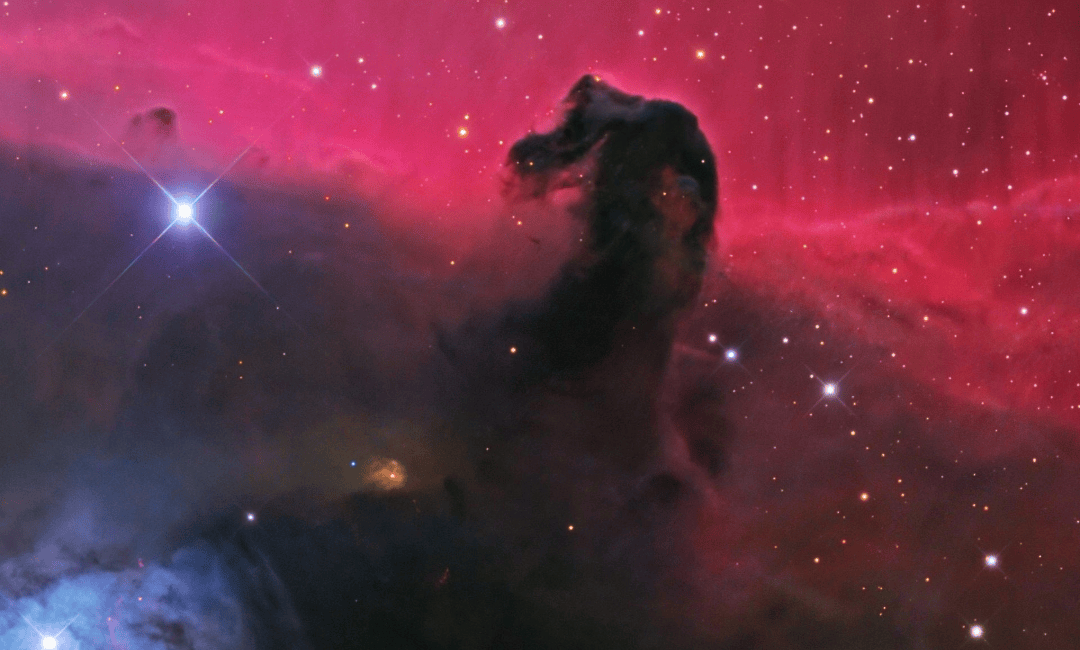
The Orion Nebula is a diffuse emission nebula — a glowing cloud of ionised gas and dust in the constellation Orion. It shines at about magnitude 4, bright enough to see with the unaided eye from a dark site, and NASA describes it as the closest large star-forming region to Earth.
It sits in the “sword” of Orion, just below the three bright stars of the Hunter’s Belt. Under dark skies it appears as a soft grey patch; through a telescope it blooms into swirling structure.
The light reaching us tonight left the nebula about 1,300 years ago. The gas and dust it shows are the raw stock from which new stars are made, and the stars already born there are among the youngest in our part of the galaxy.
Its glowing colours come from ionised elements. Hydrogen produces the characteristic pink-red light, while oxygen and other elements add greens and blues, all lit by intense ultraviolet radiation from young, hot stars at its heart.
A small companion nebula sits just to the north, catalogued as M43 or De Mairan’s Nebula. It is part of the same complex, separated from the main nebula by a lane of foreground dust.
The constellation that hosts it has been recognised for millennia. Orion the Hunter is one of the most universally identified star patterns on Earth, known across ancient Greek, Egyptian, Babylonian, and many other cultures. According to NASA, the Maya of Mesoamerica are believed to have seen the nebula itself as the cosmic fire of creation, a description modern astronomy would struggle to improve on.
Yet for most of that history, the nebula itself went unremarked in the records — a faint glow that only revealed its true nature once the telescope arrived. What ancient sky-watchers took for a single point of light was, all along, a factory of stars.
How Far Away Is the Orion Nebula?
For a long time the nebula’s distance was uncertain, with estimates scattered across hundreds of light-years. Pinning it down mattered, because nearly everything else — the size, the mass, the ages of its stars — depends on it.
The first breakthrough came in 2007. Using radio telescopes to measure the parallax of young stars in the region directly, a team led by Karl Menten found a distance of about 414 parsecs, roughly 1,350 light-years.
Radio astronomers kept refining it. In February 2026 a survey with the Very Long Baseline Array, a network of radio dishes spanning the United States, measured the parallaxes of 58 young stars across the Orion complex and put the Orion Nebula Cluster at 388.5 parsecs, give or take 1.7, or about 1,267 light-years. The European Space Agency’s Gaia satellite, which measures visible starlight, agrees with the radio results to within a fraction of their uncertainty.
The same survey shows that the Orion complex has real depth: its star-forming clouds lie anywhere between about 380 and 440 parsecs away, with the Orion Nebula on the near side.
In galactic terms, 1,270 light-years is close — the nebula sits in the same spiral arm as the Sun. That proximity is exactly why it is so valuable to study.
Part of a Giant Molecular Cloud
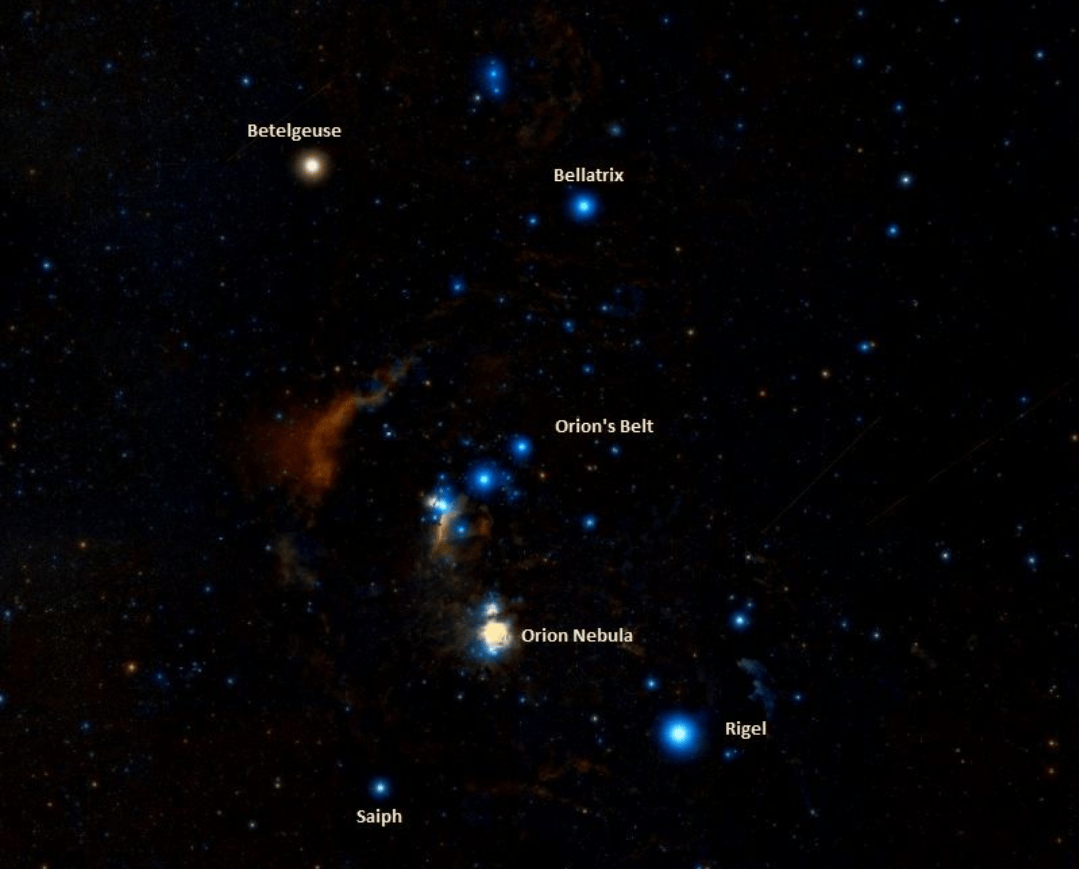
The visible nebula is only a small, glowing part of something far larger. It sits on the near side of the Orion Molecular Cloud Complex — an enormous region of cold gas hundreds of light-years across.
This complex includes several famous landmarks, among them the Horsehead Nebula and the Flame Nebula. The Orion Nebula is the brightest and most active pocket of star formation within it.
The part we see glowing is essentially a cavity — a bubble carved into the front face of a much denser molecular cloud by the radiation of newborn stars.
Astronomers sometimes describe M42 as a “blister” on the surface of that cloud. We are looking into the hollow it has blown, with the dark, dense cloud stretching away behind it.
Deep inside that dense cloud, hidden from visible light, star formation continues in regions we can only see in infrared and radio wavelengths.
The Trapezium: The Engine of the Nebula
At the heart of the Orion Nebula lies a tight knot of brilliant young stars called the Trapezium Cluster. Through a small telescope it resolves into four stars arranged in a trapezoid shape.
These are among the youngest and most massive stars in our part of the galaxy, only a few hundred thousand to a million years old. In stellar terms, they are newborns.
The dominant member, Theta-1 Orionis C, is a scorching O-type star many thousands of times more luminous than the Sun. It floods the surrounding gas with ultraviolet radiation.
That radiation is what makes the nebula glow. It strips electrons from hydrogen atoms; when the electrons recombine, they release the light we see as the nebula’s characteristic colour.
The Trapezium is the visible tip of a much larger group, the Orion Nebula Cluster, which contains thousands of young stars packed into a few light-years. It is one of the densest young clusters known.
Seen through a small telescope, the four Trapezium stars look alike. Spectra show they are not: three are hot B-type stars, and only Theta-1 Orionis C is of type O, the class massive and short-lived enough to dominate everything around it.
What the Colours of the Nebula Mean
The Orion Nebula’s colours are not decorative — each one is a fingerprint of a specific element and physical process. Astronomers read them like a chemical map.
The dominant red and pink comes from hydrogen, the most abundant element in the nebula. When ionised hydrogen recombines with electrons, it emits a strong red line known as hydrogen-alpha.
The greenish tints come mainly from doubly-ionised oxygen. For decades their source was a mystery; some astronomers even proposed a new element, “nebulium”, to explain them. In 1927 the physicist Ira Bowen showed in Nature that the lines come from ordinary oxygen and nitrogen undergoing rare “forbidden” transitions, which only survive in the near-vacuum of space, where atoms almost never collide.
Darker lanes and patches are not empty. They are dense concentrations of dust that block the light behind them, tracing the cold material where the next generation of stars will form.
By separating these colours, astronomers can measure the temperature, density, and composition of the gas — turning a beautiful image into precise physical data.
Why This Particular Patch of Sky
Astronomers return to the Orion Nebula more than to almost any other target, and the catalogue shows why. Within half a degree of its centre, SIMBAD lists 10,625 objects — young stars, protoplanetary discs, jets, shocked gas knots and infrared sources, packed into an area about four times that of the full Moon.
The catalogue also records what the four Trapezium stars actually are, and they are not alike. θ1 Ori A is a B0 star, B is B1, D is B1.5 — and θ1 Ori C is O7, the only O-type star among them and the one doing most of the work. Its ultraviolet output is what ionises the surrounding hydrogen and makes the nebula glow at all. Their measured parallaxes cluster around 2.5 milliarcseconds, which places the group at roughly 1,300 light years.
That spectral class is the point. As set out in our piece on the life cycle of stars, our own neighbourhood is quiet. SIMBAD lists 586 objects whose parallaxes place them within 32.6 light years of Earth, and not one is of type O or B. Our corner of the galaxy contains nothing that will ever explode. The dramatic end of the stellar life cycle — supernova, neutron star, black hole — has no local examples at all.
Orion is the nearest place where that kind of star can be watched. θ1 Ori C will live only a few million years, blaze through its fuel, and end in a supernova — a complete stellar lifetime compressed into less time than humans have existed as a species. Almost everything astronomers know about how massive stars form, behave and shape the gas around them has been learned from this nebula and a handful like it.
There is a caution buried in that dependence. A single region observed intensively is a rich dataset and a narrow one. Orion is relatively nearby, relatively unobscured and forming stars vigorously right now — which is precisely why we can see into it, and precisely why it may not be typical of star formation across the galaxy as a whole. Much of our textbook account of how stars are born rests on one exceptionally cooperative example.
Proplyds: Solar Systems Being Born
One of the Orion Nebula’s most profound gifts to science is the proplyd — short for protoplanetary disk. These are disks of gas and dust around newborn stars, the very structures from which planets form.
In the 1990s, the Hubble Space Telescope imaged the nebula’s core and revealed these disks directly. Work by C. Robert O’Dell and colleagues showed the nebula was full of them.
A 2008 atlas built from Hubble’s Advanced Camera for Surveys listed 178 of them, along with 28 further discs seen only as dark silhouettes against the glowing gas. About two-thirds of the objects have counterparts in X-rays, the signature of young, active stars. Each proplyd is, in effect, a solar system caught in the act of being built.
Many appear as bright teardrop shapes with glowing tails. That shape is carved by the fierce ultraviolet light of the Trapezium, which is slowly evaporating the disks from the outside.
This creates a cosmic race. A disk must form planets before the radiation strips away its material — a process that shapes how, and whether, planetary systems survive in crowded stellar nurseries.
In 2024 that race was clocked for the first time. Using Webb together with the ALMA radio observatory, Olivier Berné and colleagues measured how fast ultraviolet light from the Trapezium is boiling gas off one disc in the nebula. The rate was high enough to strip the disc of its gas in less than a million years, quick enough to stop giant planets like Jupiter from forming there at all.
Because our own Sun likely formed in a cluster much like this one, the proplyds of Orion offer a direct glimpse of our own origins some 4.6 billion years ago.
Stellar Jets and Herbig-Haro Objects
Star birth is not gentle. As a young star gathers mass, it also flings twin jets of gas outward from its poles at hundreds of kilometres per second.
Where these jets slam into surrounding gas, they create glowing shock fronts called Herbig-Haro objects. Some of the first ever identified were found in the Orion region.
These jets carry away angular momentum, helping a forming star shed the excess spin that would otherwise prevent it from collapsing. They are a crucial part of how stars are made.
The Orion Nebula is threaded with these outflows, making it a living textbook of the violent, dynamic reality of stellar birth — the opening chapter of the story told in our article on the complete life cycle of stars.
The Hidden Region Behind the Glow
Behind the bright, visible nebula lies a region invisible to ordinary telescopes. Deep in the dense cloud sits the Becklin-Neugebauer object and the Kleinmann-Low nebula, glowing only in infrared.
This is one of the nearest sites of massive star formation, buried under so much dust that its light cannot escape at visible wavelengths.
Around 500 years ago, as seen from the region’s own frame, a dramatic event took place there. Two of the nearest massive stars still forming, known as the BN object and Source I, were flung apart at about 29 and 13 kilometres per second, apparently by a close gravitational encounter between young stars.
The encounter blew the surrounding gas apart. The ALMA radio observatory has mapped more than a hundred streamers of gas flying outwards in every direction at up to about 150 kilometres per second, the fastest furthest from the centre, like a miniature version of the expanding universe. The energy released, about 10 to the power of 48 ergs, may have come from two young stars forming a tight pair or merging, and the researchers suggest Orion may be the prototype of a new class of stellar explosion. It is a reminder that star nurseries can be violent places.
What the James Webb Space Telescope Has Revealed
Since 2022, the James Webb Space Telescope has turned its infrared eye on the Orion Nebula, and the results have been extraordinary.
Infrared light pierces the dust that hides so much of the nebula’s activity. Webb sees young stars, disks, and delicate structures that visible-light telescopes simply cannot reach.
A prime target has been the Orion Bar — a wall of dense gas being eroded by Trapezium radiation. It is a textbook example of a photodissociation region, where starlight reshapes the chemistry of a cloud.
The PDRs4All team, an international collaboration of more than a hundred astronomers, called its 2023 Webb images the most detailed and sharpest infrared views ever taken of the inner Orion Nebula. They show the edges of the cloud sculpted into ridges, waves and globules on scales of just 40 to 400 times the Earth–Sun distance, and the folded surface where starlight breaks molecules apart.
In 2023, a team led by Olivier Berné used Webb to detect the methyl cation — a simple carbon molecule — in a protoplanetary disc within the nebula. It was the first time this molecule had been observed outside the Solar System.
The find matters because astronomers proposed some forty years ago that the methyl cation kick-starts the gas-phase carbon chemistry that builds organic molecules, the building blocks of life as we know it. Webb showed that, in this disc, the ultraviolet light of nearby massive stars is what switches that chemistry on.
Webb has also produced a puzzle. In 2023 Samuel Pearson and Mark McCaughrean reported 540 candidate free-floating objects of planetary mass in the nebula, some as light as six-tenths of Jupiter, and found that about 9 per cent seemed to be in wide pairs, dubbed Jupiter-mass binary objects. No theory predicted them. In 2024 the astronomer Kevin Luhman re-examined the same images and concluded that most of the pairs have the colours of reddened background sources rather than young planetary-mass objects, and a 2025 study in Nature Astronomy argued that such wide pairs could not form in the way first proposed. They need spectra to confirm what they are. The telescope’s wider impact is covered in our article on the James Webb Space Telescope.
The same re-analysis turned up more than 200 candidate brown dwarfs, failed stars too small to shine by fusion, the faintest perhaps only one or two times the mass of Jupiter. Spectra will decide which are real members of the cluster, and how low the masses of newborn objects can go.
A Nursery That Shapes the Galaxy
The Orion Nebula does more than make stars. The massive stars it produces will end their lives as supernovae, seeding the surrounding cloud with heavy elements.
Those elements — carbon, oxygen, iron — are the raw material of future planets and living things. Nurseries like Orion are where the galaxy manufactures the ingredients of worlds.
The most massive of these stars will eventually collapse, some into neutron stars and some into black holes — the extreme endpoints explored in our articles on neutron stars and black holes and event horizons.
The Trapezium has already ejected several “runaway” stars, flung out of the cluster at high speed by gravitational encounters. Tracing the paths of two of them, AE Aurigae and Mu Columbae, back through space shows that they and the binary star Iota Orionis were in the same place about 2.5 million years ago, in the young Trapezium cluster, where an encounter between two pairs of stars sent them flying. They now streak across the sky far from where they were born.
In this way the nebula both creates and disperses. It builds stars, enriches the galaxy, and scatters its offspring — a single link in a cycle of birth and death billions of years old.
How to See the Orion Nebula
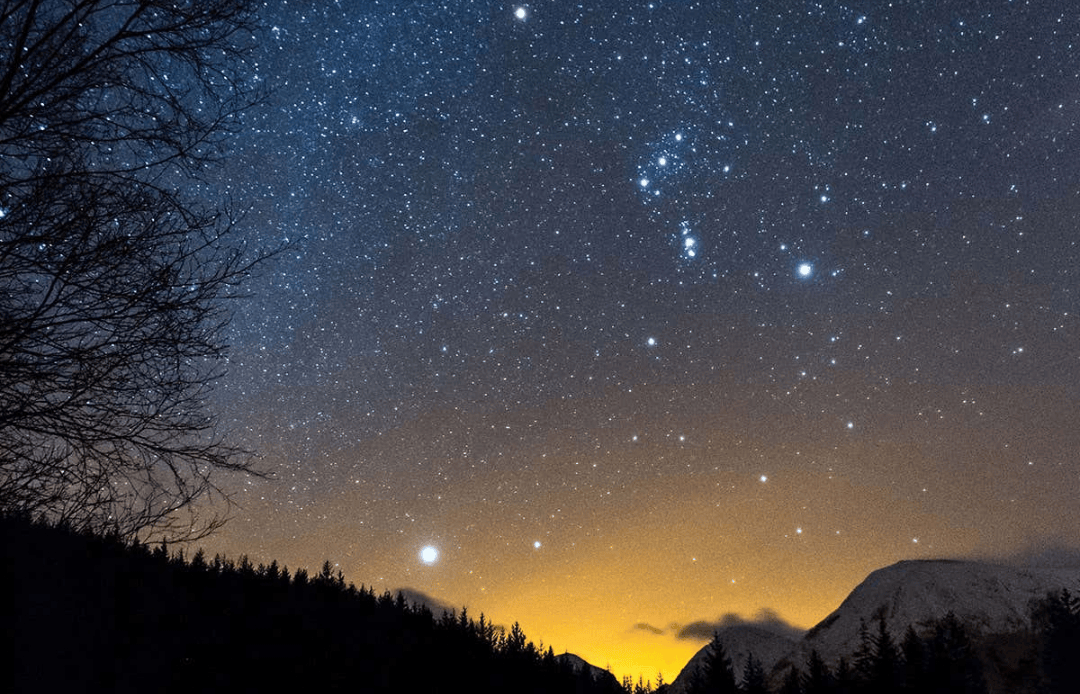
The Orion Nebula is one of the easiest deep-sky objects for beginners to find, and no expensive equipment is required to enjoy it.
When to look. In the Northern Hemisphere, the best months are December through February, when Orion rides high in the evening sky. Southern-Hemisphere observers see it in their summer.
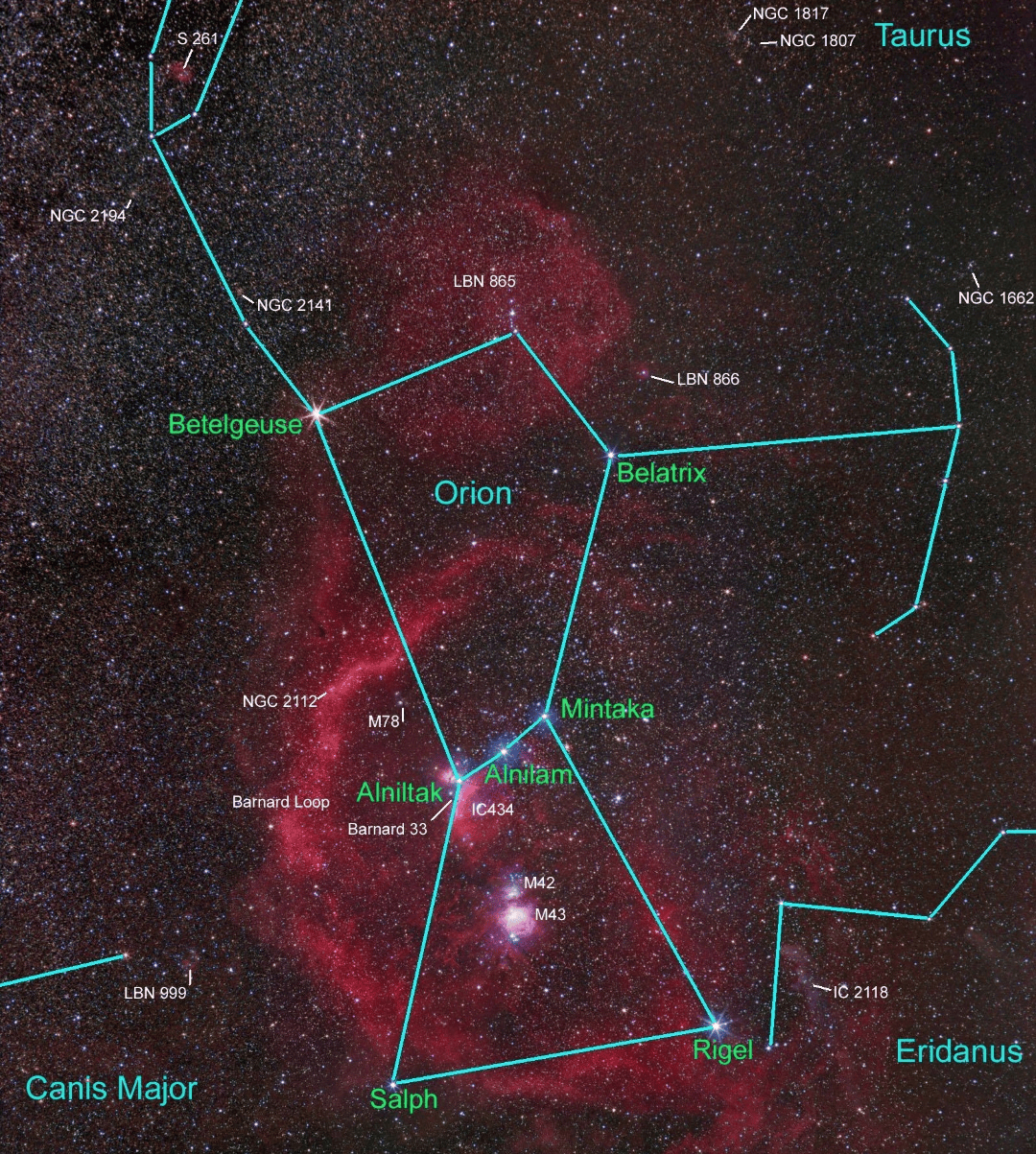
Where to look. Find the three stars of Orion’s Belt, then look to the shorter line of stars hanging below — the sword. The middle “star” of the sword is the nebula.
What to use. The naked eye shows a fuzzy patch under dark skies. Binoculars reveal a glowing cloud, and even a small 60-to-80mm telescope shows the Trapezium stars and wisps of nebulosity.
Observing tips. Choose a dark site, let your eyes adjust for 15 to 20 minutes, and use averted vision — looking slightly to the side — to catch the faintest detail.
Discovery and Observational History
Curiously, the ancient astronomers who catalogued the stars of Orion did not record the nebula as anything unusual. The first clear telescopic observation came in 1610, by the French scholar Nicolas-Claude Fabri de Peiresc.
In 1656 the Dutch astronomer Christiaan Huygens made detailed drawings of the nebula and its central stars, bringing it to wider attention among astronomers.
In 1769 Charles Messier added it to his famous catalogue as object number 42 — the designation M42 that it still carries today.
The nebula became a favourite target as photography and spectroscopy matured. In 1880 it was the first nebula ever photographed, by Henry Draper, opening a new era of astronomical imaging.
Since then it has been observed across every wavelength — optical, infrared, radio, ultraviolet, and X-ray — making it one of the most thoroughly studied objects in the entire sky.
The Nebula’s Future
The Orion Nebula as we see it is a temporary phase, not a permanent fixture. On cosmic timescales, it is a fleeting flash of light.
The same radiation and stellar winds that make it glow are also blowing its gas away. Over the next few hundred thousand years, the nebula will gradually disperse.
As the gas clears, the newborn stars it hid will be revealed as an open cluster — a loose family of sibling stars drifting slowly apart, much like the Pleiades today.
Star formation will not stop, though. It will simply migrate deeper into the surrounding molecular cloud, where fresh material waits to collapse into the next generation of suns.
What we are witnessing, in other words, is a single frame of a process that has repeated across the galaxy for billions of years and will continue long after this nebula is gone.
Why the Orion Nebula Matters
The Orion Nebula is, above all, our closest and clearest laboratory for the single most important process in the visible universe: the birth of stars.
Almost everything we understand about how stars and planetary systems form has been tested and refined against what we see in Orion. It is the benchmark against which more distant nurseries are measured.
Orion is even helping to check the instruments themselves. Because radio waves pass through dust that blocks visible light, the 2026 radio parallaxes of its young stars provide an independent test of the Gaia satellite’s measurements in exactly the kind of obscured region where Gaia struggles most.
Its proplyds show planets assembling. Its jets show stars shedding spin. Its chemistry, now probed by Webb, hints at where the molecules of life first appear.
And it does all this close enough to see in fine detail — even, in its brightest parts, with the naked eye from your own back garden. The same deep-imaging techniques that study it also power discoveries through gravitational lensing.
So the next time you find that faint patch of light in Orion’s sword, remember what you are looking at: a place where stars, and perhaps the seeds of future worlds, are being born right now.
Frequently Asked Questions
What is the Orion Nebula (M42)?
The Orion Nebula, catalogued as Messier 42, is a bright emission nebula in the constellation Orion — a vast cloud of gas and dust where new stars are actively forming. It is the nearest major stellar nursery to Earth and the only nebula easily visible to the naked eye, appearing as a fuzzy patch in the “sword” below Orion’s Belt.
How far away is the Orion Nebula?
The Orion Nebula lies about 1,270 light-years (roughly 389 parsecs) from Earth. Radio telescopes first measured its parallax precisely in 2007, and a 2026 survey with the Very Long Baseline Array refined the distance to 388.5 parsecs, in agreement with the Gaia satellite. It sits within the same spiral arm of the Milky Way as the Sun, making it one of the closest large star-forming regions to us.
What makes the Orion Nebula glow?
The nebula glows because of intense ultraviolet radiation from the young, hot stars of the central Trapezium Cluster, especially the O-type star Theta-1 Orionis C. This radiation ionises the surrounding hydrogen gas; when the electrons recombine with atoms, they emit the characteristic reddish-pink light, with other elements adding greens and blues.
What are proplyds in the Orion Nebula?
Proplyds are protoplanetary disks — flattened rings of gas and dust around newborn stars from which planets form. A 2008 Hubble atlas catalogued 178 of them in the Orion Nebula, each a solar system in the making. Their glowing teardrop shapes are sculpted by ultraviolet radiation from the Trapezium, which slowly erodes the disks.
What has the James Webb Space Telescope discovered in Orion?
Webb’s infrared observations have imaged the Orion Bar in unprecedented detail and, in 2023, detected the methyl cation — a key carbon molecule never before seen outside the Solar System — inside a protoplanetary disk. It also revealed hundreds of candidate free-floating planetary-mass objects, including apparent pairs whose reality is now disputed.
Can I see the Orion Nebula without a telescope?
Yes. Under reasonably dark skies the Orion Nebula is visible to the naked eye as a faint fuzzy patch in the sword of Orion, below the three belt stars. Binoculars show it as a glowing cloud, and a small telescope reveals the four Trapezium stars and delicate wisps of nebulosity. It is best seen on winter evenings in the Northern Hemisphere.
Further Reading
Sources
- Menten, K. M., Reid, M. J., Forbrich, J. & Brunthaler, A. (2007). “The distance to the Orion Nebula.” Astronomy & Astrophysics, 474, 515 (DOI: 10.1051/0004-6361:20078247).
- O’Dell, C. R. & Wen, Z. (1994). “Hubble Space Telescope Mapping of the Orion Nebula. I. Proplyds and Herbig-Haro Objects.” The Astrophysical Journal, 436, 194 (DOI: 10.1086/174892).
- Berné, O., et al. (2023). “Formation of the methyl cation by photochemistry in a protoplanetary disk.” Nature, 621, 56 (DOI: 10.1038/s41586-023-06307-x).
- Bally, J., et al. (2017). “The ALMA View of the OMC-1 Explosion in Orion.” The Astrophysical Journal, 837, 60 (DOI: 10.3847/1538-4357/aa5c8b).
- NASA / Hubble — Messier 42 (The Orion Nebula).
- ESA/Webb — James Webb Space Telescope images of the Orion Nebula and Orion Bar.
- ESO — VISTA infrared view of the Orion Nebula.
- SIMBAD Astronomical Database, CDS Strasbourg — object counts and Trapezium spectral types (queried 9 October 2026)
- Dzib et al. — DYNAMO-VLBA: trigonometric parallaxes and proper motions of young stellar objects in Orion, Astronomy & Astrophysics 708, A299 (2026).
- Ricci, Robberto & Soderblom — The HST/ACS atlas of protoplanetary disks in the Great Orion Nebula, The Astronomical Journal 136, 2136 (2008).
- Pearson & McCaughrean — Jupiter Mass Binary Objects in the Trapezium Cluster, arXiv:2310.01231 (2023).
- Luhman — Candidates for substellar members of the Orion Nebula Cluster from JWST/NIRCam, The Astronomical Journal 168, 230 (2024).
- Berné et al. — A far-ultraviolet-driven photoevaporation flow observed in a protoplanetary disk, Science 383, 988 (2024).
- Habart et al. — PDRs4All II: JWST’s NIR and MIR imaging view of the Orion Nebula, Astronomy & Astrophysics 685, A73 (2024).
- Hoogerwerf, de Bruijne & de Zeeuw — The origin of runaway stars, The Astrophysical Journal Letters 544, L133 (2000).
- Bowen — The origin of the nebulium spectrum, Nature 120, 473 (1927).
- Portegies Zwart & Hochart — Why wide Jupiter-mass binary objects cannot form, Nature Astronomy (2025).
Baryon. (2025, June 18). The Orion Nebula (M42): Inside the Stellar Nursery Visible with the Naked Eye. Web News For Us. https://webnewsforus.com/orion-m42-a-cosmic-wonder/
Baryon. “The Orion Nebula (M42): Inside the Stellar Nursery Visible with the Naked Eye.” Web News For Us, 18 June 2025, https://webnewsforus.com/orion-m42-a-cosmic-wonder/. Accessed 11 October 2026.
Thank you for your sharing. I am worried that I lack creative ideas. It is your article that makes me full of hope. Thank you.