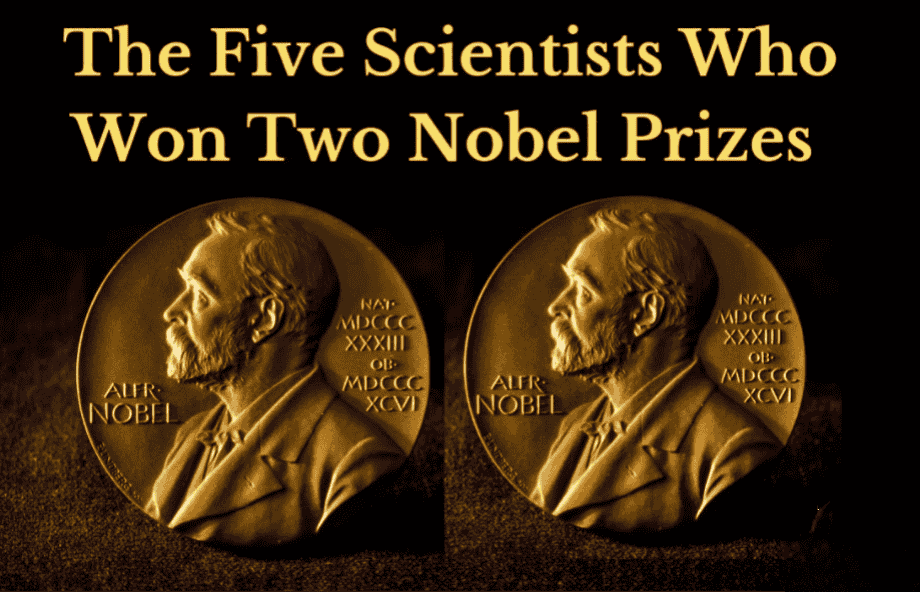
The Nobel Foundation’s own records, updated after this year’s prizes were announced between 5 and 12 October 2026, count 1,000 individuals and 28 organisations honoured since 1901. Five of those individuals won twice.
That is roughly one in two hundred — and the rarity is more extreme than the fraction suggests, because a second prize requires not merely a second great idea but a second one judged, decades later, to have changed a field. One of these five did something rarer still: Linus Pauling remains the only person in history to hold two unshared Nobel Prizes.
What follows is not a list of clever people. It is five careers examined for what actually produced a second breakthrough, and the answer is more consistent — and more useful — than genius.
The Nobel Prize is the highest honour in science. Each of the three science prizes can be shared by at most three people, so no more than nine scientists can win in a year, chosen from a global pool by committees that deliberate for months. Winning once places a person among the most celebrated figures in the history of human knowledge.
Winning twice is something else entirely. Since the first prizes in 1901, only five individuals have done it.
These five did not simply repeat themselves. Each won in domains that required fundamentally different kinds of thinking — or pressed so far into a single field that they transformed it twice from the inside.
Their stories are not just records of achievement. They are case studies in what sustained scientific ambition looks like across a lifetime — the costs it exacts, the obstacles it meets, and the mark it leaves. This is the full story of each, and what their lives reveal about scientific greatness.
Marie Curie (Physics 1903, Chemistry 1911)
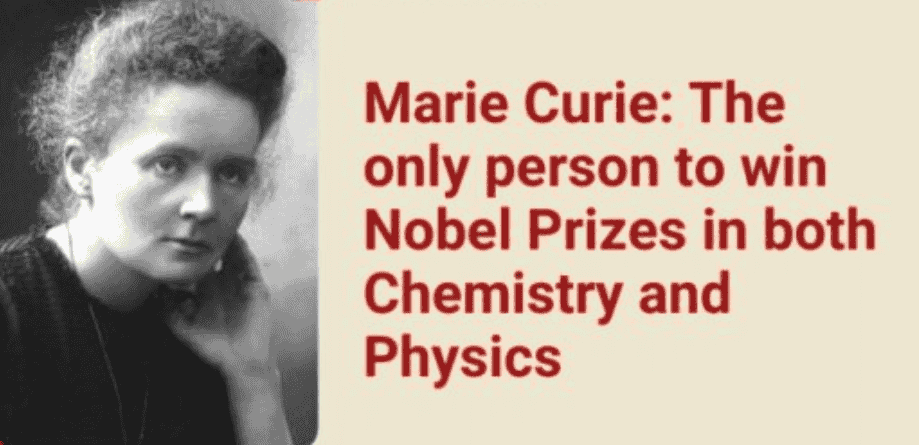
Marie Curie was not only the first person to win two Nobel Prizes. She was the first woman to win one, the first person to win in two different scientific disciplines, and the only person whose prizes span physics and chemistry.
Maria Skłodowska was born in Warsaw in 1867, under Russian imperial rule, where women were barred from university. She studied in secret at the underground “Flying University,” taught in private apartments at real risk to everyone involved.
In 1891 she moved to Paris and enrolled at the Sorbonne, one of very few women there. She lived in poverty, studying in an unheated garret sometimes too cold to write, and finished first in physics and second in mathematics.
She met Pierre Curie in 1894. Their partnership became a marriage, and their marriage one of the most productive scientific collaborations in history. Working in a leaking shed through brutal winters, they processed tonnes of pitchblende to isolate two unknown elements — polonium, named for her occupied homeland, and radium.
The 1903 Physics Nobel went to Becquerel and the Curies for radioactivity, but Marie was almost left out. The French Academy of Sciences had nominated only Henri Becquerel and Pierre. The Swedish mathematician Gösta Mittag-Leffler, an advocate for women in science, alerted Pierre, who replied that he wished to be considered together with Madame Curie. The nomination was amended, and Marie became the first woman to receive a Nobel Prize.
Pierre died in 1906, struck by a horse-drawn wagon in a Paris street. Marie took over his Sorbonne professorship — the first woman to hold one there — and continued alone. In 1910 she produced radium as a pure metal. In 1911 she won the Chemistry Nobel, unshared, for the discovery of radium and polonium, the isolation of radium and the study of its compounds.
That same year she stood for a vacant seat in the French Academy of Sciences. After a campaign in parts of the press that attacked her as a foreigner, she lost to the physicist Édouard Branly on 23 January 1911 by two votes.
The radioactive materials were slowly killing her. She carried test tubes of radioactive material in her coat pockets. Her notebooks remain radioactive today and are kept in lead-lined boxes. She died on 4 July 1934 at a sanatorium near Sallanches in the French Alps, of aplastic anaemia, her bone marrow destroyed by decades of exposure.
Before then she found another use for physics. When the First World War began, she persuaded the French government to let her set up the country’s first military radiology centres, became director of the Red Cross radiology service, and talked wealthy acquaintances into donating cars that body shops turned into X-ray vans. By late October 1914 the first was ready; she equipped 20 in all, and soldiers called them petites Curies, little Curies.
Her daughter Irène Joliot-Curie shared the 1935 Chemistry Nobel with her husband, Frédéric Joliot. Parents and children have both won before and since — the Braggs, father and son, even shared the 1915 Physics prize — but the Curies remain the most decorated Nobel family, with five prizes across two generations.
John Bardeen (Physics 1956, Physics 1972)
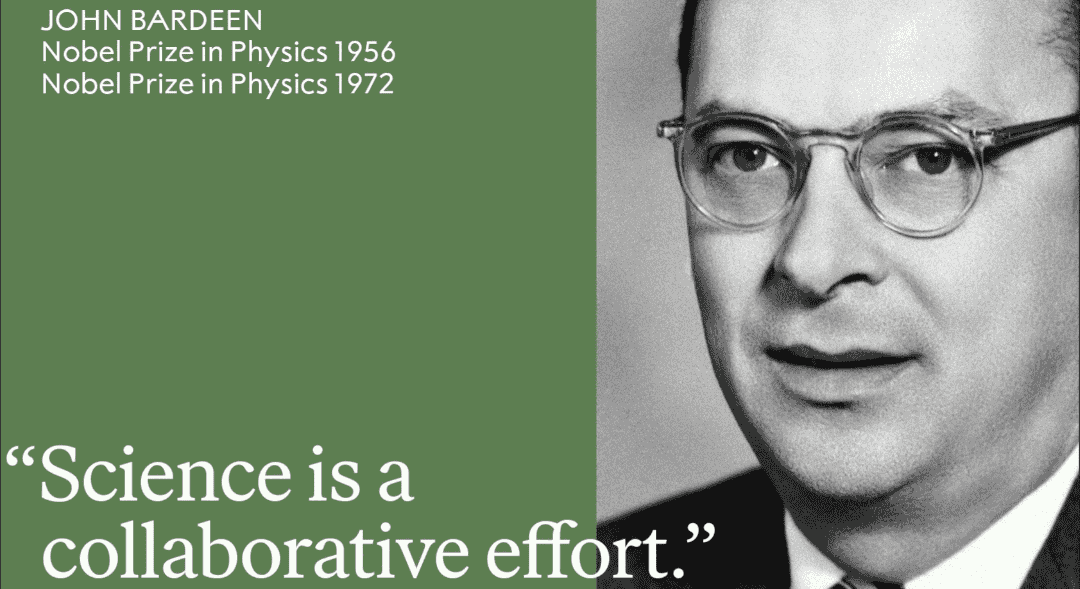
John Bardeen is the only person to have won the Nobel Prize in Physics twice, and the only one to have led two entirely separate research programmes that each produced a physics Nobel. He may be the most consequential physicist of the twentieth century whose name is not Einstein or Feynman.
Born in Madison, Wisconsin in 1908, Bardeen was quietly brilliant — an engineering degree, several years as a geophysicist, then a PhD at Princeton under Eugene Wigner. He was modest, methodical, and deeply collaborative, unusual among the dramatic individualists of his era.
At Bell Laboratories in the late 1940s, Bardeen worked in William Shockley’s group on semiconductor amplification. In December 1947 he and Walter Brattain demonstrated the first transistor, a point-contact device built on a sliver of germanium that could amplify electrical signals. Shockley followed within weeks with the junction transistor, the design that went on to dominate.
The transistor replaced the bulky, fragile vacuum tube. Everything in modern electronics is built on it — the chip in your phone holds tens of billions of transistors. The 1956 Physics Nobel was shared equally by Bardeen, Shockley and Brattain “for their researches on semiconductors and their discovery of the transistor effect”.
Bardeen left Bell Labs in 1951, partly over friction with Shockley, for the University of Illinois. There he attacked a problem that had resisted solution since the Dutch physicist Heike Kamerlingh Onnes discovered it in mercury in 1911: superconductivity, in which certain materials cooled near absolute zero conduct electricity with exactly zero resistance.
Working with Leon Cooper, a young postdoctoral researcher, and John Robert Schrieffer, his graduate student, he developed BCS theory — the first complete microscopic theory of superconductivity. Cooper showed in 1956 that electrons in a metal can bind into pairs; the full theory followed in a long paper in Physical Review in December 1957. At low temperatures these Cooper pairs condense into a single quantum state that flows without resistance. The 1972 Physics Nobel was shared equally by all three.
Bardeen thus won for two of the most consequential contributions to physics of the century — the transistor, which made the information age possible, and BCS theory, which explains the superconducting circuits at the heart of many quantum computers. The 2025 Physics prize went to John Clarke, Michel Devoret and John Martinis for showing that such circuits can behave as single quantum objects; that story is told in our article on the Nobel Prize in Physics 2025.
He kept working into his seventies, publishing on high-temperature superconductivity shortly before his death in 1991, aged 82.
Frederick Sanger (Chemistry 1958, Chemistry 1980)
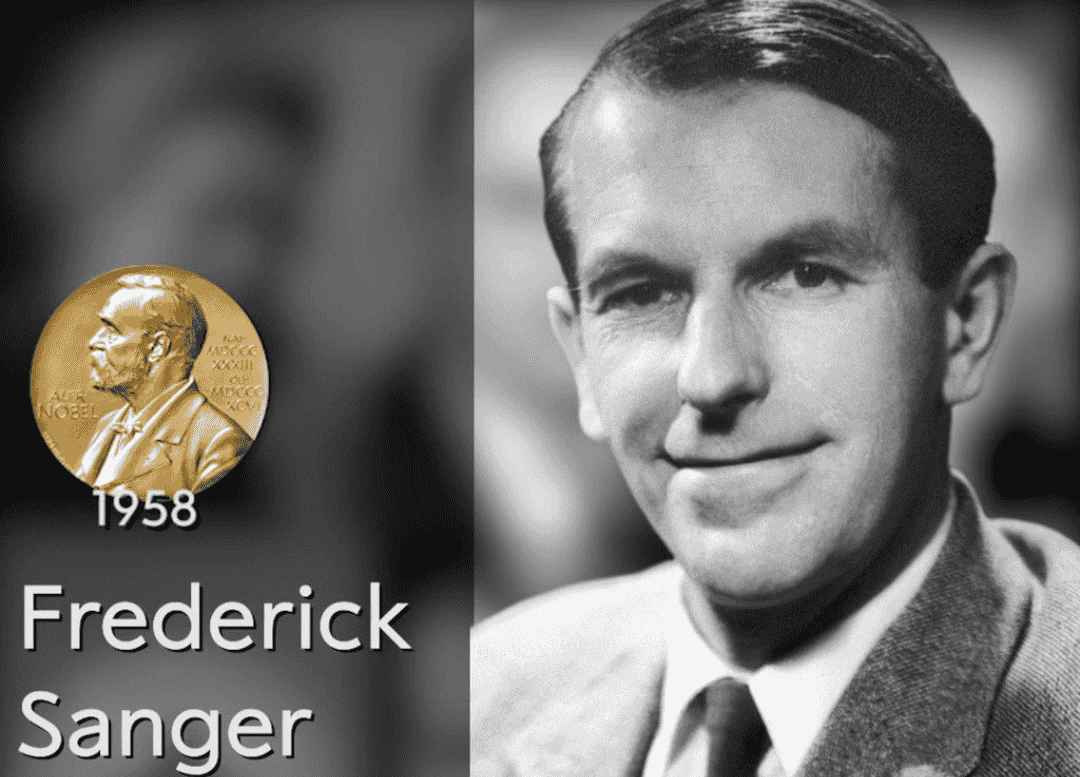
Frederick Sanger is the only person to win two Nobel Prizes in Chemistry, and among the most technically inventive scientists in the history of biology. Where Curie and Bardeen made conceptual breakthroughs, Sanger’s genius was methodological — he invented two techniques that transformed what biology could do.
Born in the Gloucestershire village of Rendcomb in 1918, the son of a doctor who had become a Quaker, Sanger was quiet and almost aggressively modest. He described himself as not academically brilliant and credited persistence and a willingness to try things that might fail. He spent his whole career in Cambridge: in the university’s biochemistry department from 1940 and, from 1962, at the Medical Research Council’s new Laboratory of Molecular Biology.
His first prize solved a problem that had defeated biochemists for decades: reading the amino-acid sequence of a protein. He spent ten years developing methods to break insulin into identifiable fragments and work out their order.
He published the order of insulin’s two chains in the early 1950s and, in 1955, the way they are cross-linked by sulphur bridges — the first complete structure of a protein’s sequence. It proved that every protein has a precise, inherited order of amino acids, an idea at the root of molecular biology. The 1958 Chemistry Nobel was awarded to him alone.
He then turned to an even harder target: DNA. Through the 1960s and 70s he developed ever more powerful methods, first the “plus and minus” method of 1975 and then, in 1977, the chain-termination method now known as Sanger sequencing — using modified nucleotides that halt DNA copying at specific points, producing readable fragments of known length.
His team had already used an earlier method to read the first complete DNA genome, that of the virus φX174, published in Nature in February 1977. The 1980 Chemistry Nobel was divided: half to Paul Berg for work on recombinant DNA, and a quarter each to Sanger and Walter Gilbert “for their contributions concerning the determination of base sequences in nucleic acids”. Gilbert, at Harvard, had developed a rival chemical method at the same time; Sanger’s proved easier to automate and became the standard.
Sanger sequencing remained the dominant DNA technology for three decades. The Human Genome Project, completed in 2003, used it to read all three billion base pairs. For the molecule at the centre of that work, see our article on what DNA is and how it works.
He retired in 1983, returned to his Cambridge garden, and declined all further honours — including a knighthood, which he refused because he did not want to be called “Sir.” He died in 2013, aged 95, apparently unbothered by his extraordinary legacy.
Linus Pauling (Chemistry 1954, Peace 1962)
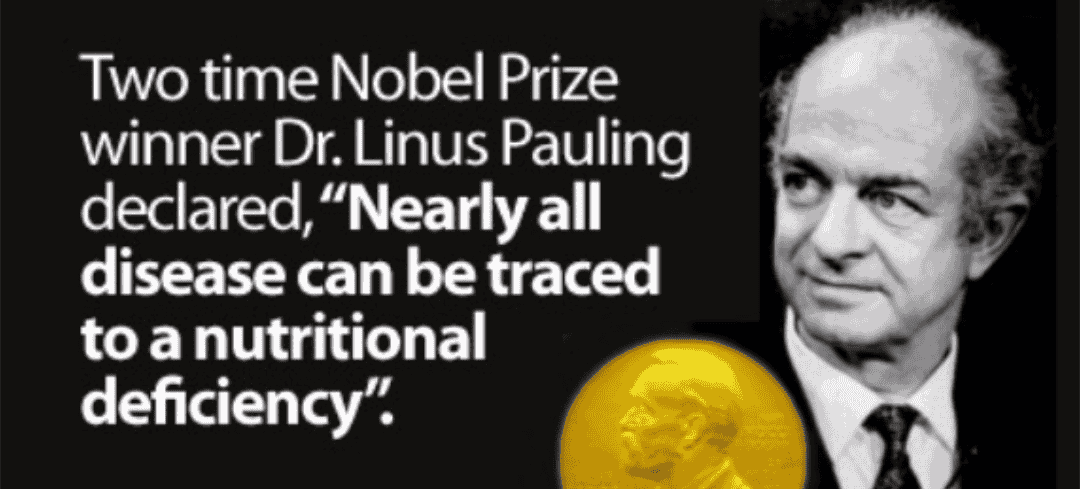
Linus Pauling is the only person to win two unshared Nobel Prizes — both awarded to him alone — and the only one to win in two completely different fields: chemistry and peace. He may be the closest the twentieth century came to a universal scientific genius in the old polymath tradition.
Born in Portland, Oregon in 1901, Pauling was voraciously curious, a self-taught reader who studied chemistry at Oregon Agricultural College before a PhD at Caltech. There he encountered the new quantum mechanics from Europe and immediately grasped its implications for chemistry — implications almost no chemist had yet worked out.
His central insight was that chemistry could be understood quantum mechanically — that bond properties, molecular shapes, and structural stability all followed from quantum mechanics. His concepts of electronegativity, resonance, and hybridisation are taught in every introductory chemistry course today.
His 1939 book The Nature of the Chemical Bond is one of the most cited scientific texts of the century. He applied the same structural thinking to biology, proposing the alpha helix and beta sheet — two fundamental protein structures — with Robert Corey in 1951.
In the same period, Watson and Crick were racing to solve DNA, and Pauling was their most feared rival. In February 1953 he and Robert Corey published a proposed triple-helix structure in the Proceedings of the National Academy of Sciences that turned out to be wrong — a rare stumble. Watson and Crick published the correct double helix two months later.
Pauling received the 1954 Chemistry Nobel, unshared, “for his research into the nature of the chemical bond and its application to the elucidation of the structure of complex substances”. But his second prize marked a different kind of life. He had grown politically active, campaigning against nuclear weapons testing and the dangers of radioactive fallout.
The US State Department refused him a passport in 1952 — meaning he missed a London meeting where he might have seen the X-ray images that could have helped him solve DNA. He was given one in 1954, in time to collect his chemistry prize in Stockholm.
He circulated a petition eventually signed by more than 11,000 scientists calling for a nuclear test ban. The Partial Nuclear Test Ban Treaty was signed in August 1963 and came into force on 10 October 1963. That same day the Norwegian Nobel Committee announced that Pauling had won the Peace Prize for 1962, which it had held over, “for his fight against the nuclear arms race between East and West”.
His later career carried a warning as well as a lesson. From 1970 Pauling argued that very large doses of vitamin C could prevent colds and help treat cancer. When doctors at the Mayo Clinic tested high-dose vitamin C against placebo in patients with advanced cancer, in trials published in 1979 and 1985, they found no benefit. A towering scientist could still be wrong outside the evidence, and the trials, not his reputation, settled it.
Karl Barry Sharpless (Chemistry 2001, Chemistry 2022)
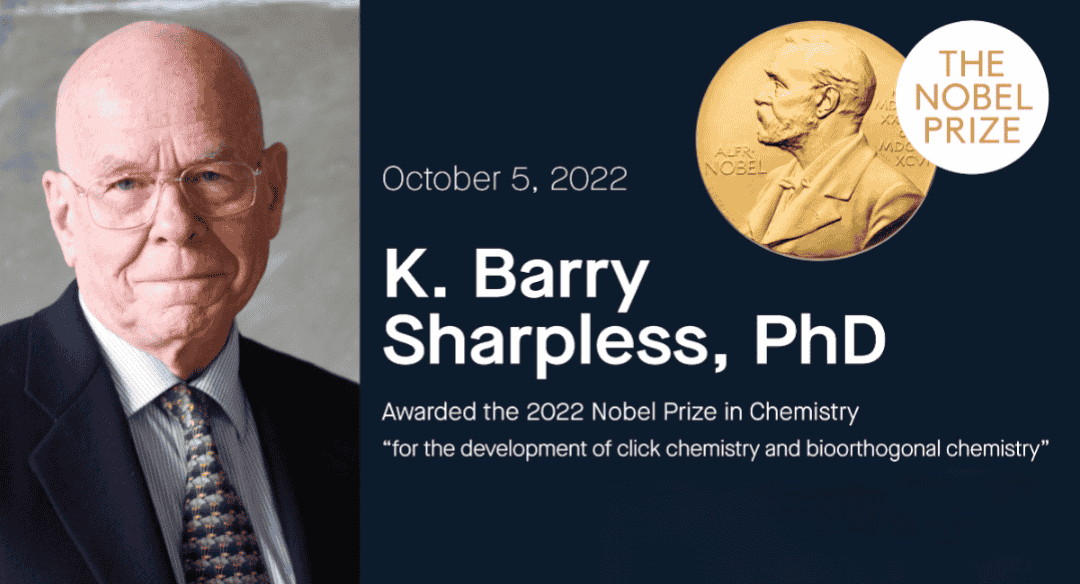
Barry Sharpless is the most recent double laureate and the second, after Sanger, to win two Chemistry Nobels. His prizes came 21 years apart, second only to Sanger’s 22, for two distinct contributions to synthetic chemistry.
Born in Philadelphia in 1941, Sharpless studied at Dartmouth and Stanford and spent most of his career at MIT and Scripps Research. He is known as one of the most creative and unconventional thinkers in organic chemistry — a field that tends toward the systematic, and in which he was neither.
His first Nobel, shared with William Knowles and Ryoji Noyori in 2001, recognised asymmetric catalytic oxidation — methods that add oxygen to molecules to produce a specific mirror-image form of the product. The landmark was a 1980 paper with Tsutomu Katsuki describing the first practical method for asymmetric epoxidation, a reaction that turns a simple carbon-carbon double bond into a three-membered ring with oxygen, in one mirror form.
This matters because mirror-image molecules can behave completely differently in the body — one form may be a medicine, the other useless or toxic. Sharpless’s methods made producing the right form reliable, which is essential to modern pharmaceutical manufacturing.
His second Nobel, shared with Carolyn Bertozzi and Morten Meldal in 2022, recognised click chemistry — a concept he proposed in 2001. The idea is to build molecules from reactions that are fast, reliable and produce no troublesome byproducts, snapping together like Lego pieces. Its best-known example, a copper-catalysed reaction joining azides and alkynes, was reported independently in 2002 by Sharpless’s group with Valery Fokin and by Meldal’s group in Denmark.
Click chemistry transformed how chemists build complex molecules in pharmaceuticals, materials science, and biology, where it lets molecules be labelled and tracked inside living cells. Copper is toxic to cells, so in 2004 Bertozzi’s group published a version that needs no copper, driven instead by the strain in a ring-shaped molecule. That was the basis of bioorthogonal chemistry — reactions that run inside living organisms without disrupting their biochemistry.
Sharpless lost the sight of one eye in 1970, shortly after he arrived at MIT as an assistant professor. Late one night he picked up a sealed NMR tube a first-year student had prepared in liquid nitrogen; condensed oxygen trapped inside made it explode. Writing about it in 1992, he concluded that there is “simply never an adequate excuse for not wearing safety glasses in the laboratory at all times.” He continued researching for more than five decades, receiving his second Nobel at 81.
How Rare This Actually Is
Numbers make the achievement legible in a way adjectives do not. Between 1901 and 2025 the Physics prize was awarded 119 times, to 229 different people, and the Chemistry prize 117 times, to 198 different people; the gaps are years when no prize was given, most of them during the two world wars. Across all categories, the Nobel Foundation counts 1,000 individuals and 28 organisations after this year’s prizes.
Five individuals appear on that list twice — about half of one per cent. But the raw fraction understates it, because winning once already places someone among perhaps a few hundred people per century judged to have transformed a discipline. A second prize requires that the same person do it again, in work distinct enough to be recognised separately, and live long enough for the committee’s characteristic delay of one to three decades to run twice.
The five also divide into different kinds of achievement, which is worth separating. Bardeen, Sanger and Sharpless each won twice within a single discipline — Physics for Bardeen, Chemistry for the other two — meaning the same field decided twice that their work was foundational. Marie Curie crossed disciplines, taking Physics and then Chemistry. Pauling crossed further still, from Chemistry to Peace.
The waits differ too. Curie’s two prizes came 8 years apart and Pauling’s 8, counting by prize year. Bardeen waited 16 years, Sharpless 21 and Sanger 22. Their ages at the second prize show the same pattern: Curie was 44, Pauling and Sanger 62, Bardeen 64 and Sharpless 81. Except for Curie, a second Nobel has been a prize for staying productive into one’s sixties or beyond.
Two organisations have also won more than once: the International Committee of the Red Cross three times, in 1917, 1944 and 1963, and the UN refugee agency, UNHCR, twice, in 1954 and 1981.
Pauling’s case is the singular one. Most Nobel Prizes are shared between two or three people. Both of his were awarded to him alone, and no one else in the history of the prize holds two unshared awards. Curie’s 1903 Physics prize was divided: half to Henri Becquerel and a quarter each to Marie and Pierre Curie, “in recognition of the extraordinary services they have rendered by their joint researches on the radiation phenomena discovered by Professor Henri Becquerel”. Her 1911 Chemistry prize was hers alone.
One caveat about reading too much into any of this. The prize has well-documented blind spots — the limit of three recipients, the exclusion of posthumous awards, historical under-recognition of women and of researchers outside Europe and North America. The list of double laureates records what the committee rewarded, which is related to, but not identical with, who did the most important work.
The list did not change this year. The 2026 prizes were announced between 5 and 12 October: medicine to Karl Deisseroth, Peter Hegemann and Georg Nagel for optogenetics, the use of light to switch nerve cells on and off; physics to Francis Halzen for the IceCube Neutrino Observatory; chemistry to Henri Kagan and Kenso Soai for non-linear effects and autocatalysis in asymmetric synthesis; literature to Anne Carson; peace to Navi Pillay; and economics to Robert Hall and Michael Woodford. None of the ten had won before, so the count of double laureates still stands at five.
What These Five Lives Have in Common
Looked at together, the five do not fit a single archetype. Curie worked in a field actively hostile to her presence. Bardeen collaborated in an era of scientific individualism. Sanger was a methodologist who distrusted grand theories. Pauling was a theorist who believed chemistry could be unified under quantum mechanics. Sharpless was an iconoclast who wanted to redesign his field’s foundations.
What they share is not a personality type. It is a willingness to keep working at the frontier after recognition — to resist consolidating a safe position and instead move into new territory where failure was again possible. Each, after their first Nobel, chose a harder problem rather than an easier one.
They also share an unusual relationship with failure. Curie’s later work was built partly on grief and endurance. Sanger’s DNA sequencing took years of false starts to work reliably. Pauling was wrong about DNA in a very public way, and later about vitamin C. Sharpless lost the sight of an eye and kept going. Bardeen walked away from one of physics’ most competitive environments and started over.
The Nobel Prize is awarded for success. But the stories of those who won it twice are largely stories of what happened in between — of work that did not immediately succeed, of persistence through difficulty, and of the choice to keep going when stopping would have been entirely reasonable.
For a scientist who shaped the foundations several of these laureates built on, see our article on Paul Dirac, the physicist who predicted antimatter. And for a scientist who turned curiosity itself into a method, see Richard Feynman.
Frequently Asked Questions
How many people have won the Nobel Prize twice?
Five individuals: Marie Curie (Physics 1903, Chemistry 1911), John Bardeen (Physics 1956, 1972), Frederick Sanger (Chemistry 1958, 1980), Linus Pauling (Chemistry 1954, Peace 1962), and Karl Barry Sharpless (Chemistry 2001, 2022). Two organisations — the International Committee of the Red Cross and the UNHCR — have also won multiple times.
Who was the first person to win two Nobel Prizes?
Marie Curie — Physics in 1903 and Chemistry in 1911. She was also the first woman to win a Nobel Prize and the first person to win in two different scientific disciplines.
Has anyone won three Nobel Prizes?
No individual has won three. The International Committee of the Red Cross has received three Nobel Peace Prizes (1917, 1944, 1963), but no individual has won more than two.
Who is the only person to win two Nobel Prizes in Physics?
John Bardeen — in 1956 for the invention of the transistor, and in 1972 for the BCS theory of superconductivity. These represent two completely separate and equally foundational contributions to physics.
How long was the gap between Sharpless’s two prizes?
Twenty-one years — his first Chemistry Nobel came in 2001 and his second in 2022. That is the second-longest interval for any double laureate; Frederick Sanger waited 22 years, from 1958 to 1980.
Did any double laureates refuse their Nobel Prize?
None of the five refused their prizes, though Frederick Sanger did refuse a knighthood. Jean-Paul Sartre refused the 1964 Literature Prize and Le Duc Tho refused the 1973 Peace Prize — but neither was a multiple laureate.
Has any woman won two Nobel Prizes?
Only Marie Curie, who won the Physics prize in 1903 and the Chemistry prize in 1911. She remains the only person to have won in two different sciences.
Who was the oldest double laureate at the second prize?
Barry Sharpless, who was 81 when he shared the 2022 Chemistry prize. Bardeen was 64 at his second, Sanger and Pauling 62, and Marie Curie 44.
Have any organisations won the Nobel Prize more than once?
Yes. The International Committee of the Red Cross has won the Peace Prize three times, in 1917, 1944 and 1963, and the office of the UN High Commissioner for Refugees twice, in 1954 and 1981. No organisation has won in any category other than peace.
Can a Nobel Prize be awarded after death?
Not since 1974. The Nobel Foundation’s statutes now say a prize cannot be awarded posthumously unless the laureate dies after the announcement. Before that rule, only two posthumous awards were made: to Dag Hammarskjöld for peace in 1961 and Erik Axel Karlfeldt for literature in 1931.
Did anyone win a second Nobel Prize in 2026?
No. All six of this year’s prizes went to first-time laureates: Karl Deisseroth, Peter Hegemann and Georg Nagel in medicine, Francis Halzen in physics, Henri Kagan and Kenso Soai in chemistry, Anne Carson in literature, Navi Pillay for peace, and Robert Hall and Michael Woodford in economics. The count of people with two Nobel Prizes remains five.
Have parents and children both won Nobel Prizes?
Yes, several times. Marie and Pierre Curie’s daughter Irène won in 1935; William Henry Bragg and his son Lawrence shared the 1915 Physics prize; and Niels Bohr and J. J. Thomson each had a son who later won physics prizes too. The Curies remain the family with the most prizes, five in all.
Further Reading
Sources
- Nobel Prize — Marie Curie
- Nobel Prize — John Bardeen
- Nobel Prize — Frederick Sanger
- Nobel Prize — Linus Pauling
- Nobel Prize — Barry Sharpless
- The Nobel Foundation — official laureate records and prize statistics (retrieved 22 August 2026)
- Bardeen, Cooper & Schrieffer — Theory of Superconductivity, Physical Review 108, 1175 (1957)
- Sanger, Nicklen & Coulson — DNA Sequencing with Chain-Terminating Inhibitors, PNAS 74, 5463 (1977)
- Pauling — The Nature of the Chemical Bond, Journal of the American Chemical Society 53, 1367 (1931)
- Bardeen — Semiconductor Research Leading to the Point Contact Transistor, Nobel Lecture (1956)
- Nobel Prize — Nobel Prize facts (counts to 12 October 2026)
- Nobel Prize — Facts on the Nobel Prize in Physics
- Nobel Prize — Facts on the Nobel Prize in Chemistry
- Nobel Prize — Linus Pauling, Nobel Peace Prize 1962: facts
- Nobel Prize — The Nobel Prize in Physiology or Medicine 2026
- Nobel Prize — All Nobel Prizes 2026
- American Institute of Physics — Marie Curie: Recognition and Disappointment (1903–1905)
- American Institute of Physics — Marie Curie: Scandal and Recovery (1910–1913)
- American Institute of Physics — Marie Curie: War Duty (1914–1919)
- Sharpless — Safety essay, MIT Tech Talk 36(23) (11 March 1992)
- Ryle, Sanger, Smith & Kitai — The Disulphide Bonds of Insulin, Biochemical Journal 60, 541 (1955)
- Sanger & Coulson — A Rapid Method for Determining Sequences in DNA by Primed Synthesis with DNA Polymerase, Journal of Molecular Biology 94, 441 (1975)
- Cooper — Bound Electron Pairs in a Degenerate Fermi Gas, Physical Review 104, 1189 (1956)
- Katsuki & Sharpless — The First Practical Method for Asymmetric Epoxidation, JACS 102, 5974 (1980)
- Agard, Prescher & Bertozzi — A Strain-Promoted [3 + 2] Azide–Alkyne Cycloaddition for Covalent Modification of Biomolecules in Living Systems, JACS 126, 15046 (2004)
- Nobel Prize — The Nobel Prize in Physics 2025
- Pauling & Corey — A Proposed Structure for the Nucleic Acids, PNAS 39, 84 (1953)
- Sanger et al. — Nucleotide Sequence of Bacteriophage φX174 DNA, Nature 265, 687 (1977)
- Rostovtsev, Green, Fokin & Sharpless — A Stepwise Huisgen Cycloaddition Process, Angewandte Chemie 41, 2596 (2002)
- Tornøe, Christensen & Meldal — Peptidotriazoles on Solid Phase, Journal of Organic Chemistry 67, 3057 (2002)
- Creagan et al. — Failure of High-Dose Vitamin C Therapy to Benefit Patients with Advanced Cancer, NEJM 301, 687 (1979)
- Moertel et al. — High-Dose Vitamin C versus Placebo in the Treatment of Patients with Advanced Cancer, NEJM 312, 137 (1985)
Baryon. (2025, June 27). Five Scientists Who Won the Nobel Prize Twice — and What Their Lives Tell Us About Curiosity. Web News For Us. https://webnewsforus.com/5-scientists-who-won-nobel-prize-twice/
Baryon. “Five Scientists Who Won the Nobel Prize Twice — and What Their Lives Tell Us About Curiosity.” Web News For Us, 27 June 2025, https://webnewsforus.com/5-scientists-who-won-nobel-prize-twice/. Accessed 17 October 2026.