Wardenclyffe was meant to send power through the air to anyone with a receiver. We tracked what became of that idea by counting arXiv papers with “wireless power transfer” in the title: none in 2010, 12 in 2015, 30 in 2020, 34 in 2025.
Two things follow. The subject did not exist as a research literature until roughly a century after he proposed it. And having arrived, it stopped growing — it has sat near thirty papers a year for half a decade.
That is the shape of an idea that found a niche rather than a revolution. Wireless power is real, and it charges phones, implants and toothbrushes. It does not run cities, which is the part Tesla was actually promising.
On the morning of 8 January 1943, a maid let herself into Room 3327 of the Hotel New Yorker. She had been told not to disturb the elderly man who lived there, but no one had seen him in two days. She found Nikola Tesla dead in his bed — 86 years old, nearly penniless, alone with his notebooks and the pigeons he fed at the window.
The man who had given the world its electrical nervous system had died in a rented room. Within hours, agents from the United States Office of Alien Property seized every document, notebook, and scientific paper he had left behind — decades of work, some of it restricted to this day.
A nation that ran on his inventions treated the life’s work of Nikola Tesla as a possible state secret rather than a gift to civilisation. It was a strangely fitting end for a man whose victories kept turning into other people’s credit.
This is the paradox at the centre of his story. The ideas of Nikola Tesla did not fail. They won so completely that they vanished into the walls — the alternating current in every socket, the principles behind every radio signal, the dream of wireless power we are only now rebuilding.
The more total his victory, the more invisible the man became. Born on 10 July 1856 in Smiljan, in what is now Croatia, he held over 300 patents and shaped the modern world more than almost anyone — and for most of a century, history could barely remember his name. This is that story, and an honest reckoning with how it happened.
Who Was Nikola Tesla? The Spark of a Genius
Nikola Tesla was born to a Serbian family in the village of Smiljan, then part of the Austrian Empire. As the story is often told, he arrived at the stroke of midnight during a fierce lightning storm — an omen the family midwife is said to have feared, and that Tesla himself later wore with pride.
His father was an Orthodox priest; his mother, though unschooled, had a prodigious memory and a gift for building small household devices. Tesla credited her for his own visual imagination — the quality that would define everything he did.
He studied at the Polytechnic in Graz and later in Prague, showing an early, almost frightening aptitude for mathematics and physics. He could perform integral calculus in his head so quickly that teachers suspected him of cheating. But he was restless, intense, and prone to burning himself out completely.
The pivotal moment in the early life of Nikola Tesla came in 1882, in a park in Budapest. Walking at sunset with a friend and reciting a passage from Goethe’s Faust, he saw — whole and complete, in his mind’s eye — the principle of the rotating magnetic field, the idea that would make alternating current practical. He reportedly sketched the design in the dust with a stick. He was 26, and he had just imagined the machine that would electrify the planet.
Nikola Tesla Comes to America
After working for the Continental Edison Company in Paris, Tesla sailed for New York in 1884, aged 28, with almost nothing but a letter of introduction to Thomas Edison. He worked for Edison’s company for nearly a year, reportedly redesigning its direct-current dynamos and improving their efficiency substantially.
According to History.com, Tesla said Edison had promised him fifty thousand dollars if he succeeded, then denied the promise when Tesla delivered. Tesla resigned. It was the start of a rivalry that would last decades — and the beginning of the long campaign that would push Nikola Tesla to the edges of history.
What Did Nikola Tesla Actually Invent?
The most consequential invention of Nikola Tesla — arguably the most consequential of the nineteenth century — was the alternating current electrical system. Before Tesla, power was generated and distributed as direct current, championed by Edison.
Direct current works over short distances, but it cannot be efficiently changed in voltage, so it cannot be sent far without enormous loss. Every neighbourhood would have needed its own power station.
Built around the rotating magnetic field and the AC induction motor he devised in 1887 and 1888, the system of Nikola Tesla solved this definitively. AC can be stepped up to high voltages for long-distance transmission, then stepped down to safe levels for the home. It made the electrification of whole continents possible. Every time you plug something into a wall, you are using a system Tesla built.
| Invention | What it did | Where it lives now |
|---|---|---|
| AC power system | Made long-distance electricity possible | Every wall socket on Earth |
| AC induction motor | Turned electricity into reliable motion | Industrial and household motors |
| Tesla coil | Produced high-frequency, high-voltage current | Radio and television technology |
| Radio transmission | Established core principles before Marconi | All wireless communication |
| Remote control | Demonstrated a radio-controlled boat (1898) | Drones, robotics, every remote |
In radio his claim is equally strong, and more contested. Tesla filed US Patent 645,576, System of Transmission of Electrical Energy on 2 September 1897, and it was granted on 20 March 1900, alongside US Patent 649,621. Guglielmo Marconi, conventionally credited with inventing radio, received his patent in 1904.
His other documented work includes fluorescent and neon lighting, early X-ray experiments conducted independently of Röntgen, and foundational principles behind radar. In 1898, at Madison Square Garden, Nikola Tesla guided a small radio-controlled boat across a pool of water — a demonstration so far ahead of its time that much of the audience assumed it was a trick or a trained animal.
The Battle of Currents: Nikola Tesla vs. Edison
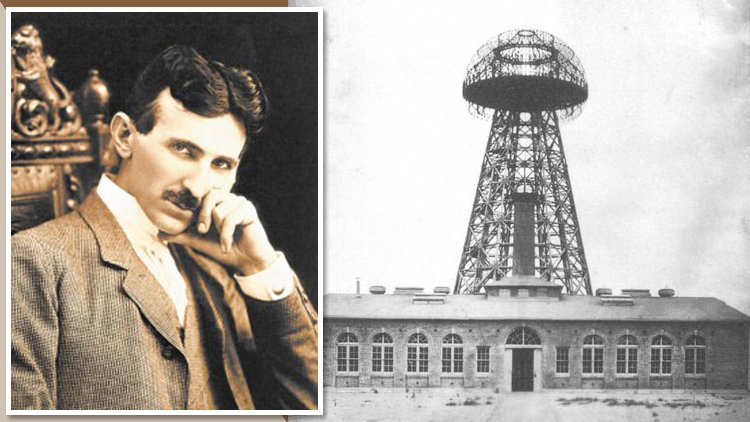
The most dramatic episode of Tesla’s life was his conflict with Edison over which system would power the United States. Having left Edison, Tesla partnered with the industrialist George Westinghouse, who recognised the potential of AC and licensed his patents.
What followed became known as the War of Currents — Edison’s campaign to brand AC as deadly. His team publicly electrocuted animals using AC, and he lobbied for AC to be used in the electric chair, hoping to bind the technology to death in the public mind.
The campaign failed. In 1893, Tesla and Westinghouse lit the entire World’s Columbian Exposition in Chicago with AC — a spectacle seen by some 27 million visitors that proved the technology safe and practical at scale.
Two years later, in 1895, the AC generators of Nikola Tesla at Niagara Falls became the first large-scale modern power station; by 1896 they were sending electricity 26 miles to Buffalo, New York. Edison’s DC could never have done this. The War of Currents was over.
The irony was profound. Tesla had won the technical battle completely — yet Edison’s name became synonymous with American invention, and Tesla’s became, for most of the twentieth century, a footnote.
Colorado Springs: Nikola Tesla and Artificial Lightning
In 1899, Tesla set up an experimental station at Colorado Springs to study high-voltage, high-frequency electricity and the possibility of transmitting power through the earth itself.
There he built an enormous magnifying transmitter — a scaled-up Tesla coil — and generated bolts of artificial lightning many metres long, accompanied by thunder reportedly heard miles away. On at least one occasion he overloaded and burned out the local power company’s generator.
It was at Colorado Springs that Nikola Tesla recorded strange, rhythmic signals he could not explain, and wondered aloud whether he might be detecting intelligence from another world. Whatever they were, the experiments convinced him that wireless power transmission across great distances was achievable. That conviction would lead directly to his greatest gamble.
Wardenclyffe and the Dream of Wireless Power
If AC was Tesla’s greatest achievement, the Wardenclyffe Tower was his most audacious vision — and his most devastating failure. From 1901 he built a tower on Long Island intended to transmit electrical power wirelessly across the Atlantic and, eventually, around the globe.
Tesla imagined a world where electricity was as free as the air, drawn from a wireless grid without cables, meters, or cost. According to the Tesla Science Center at Wardenclyffe, the tower was also meant to carry information worldwide — strikingly close to what we now call the internet.
The financier J. P. Morgan funded it — but Morgan wanted a profitable communications system, not free global electricity that could never be metered. When Tesla revealed the full scope of his vision, Morgan withdrew, and no other investor stepped in.
The tower was demolished in 1917 to pay Tesla’s debts, its metal sold for scrap. Nikola Tesla never recovered — financially, professionally, or psychologically. The eccentricity that had always been part of him hardened into obsession.
Why Was Nikola Tesla Erased from History?
The erasure of Nikola Tesla was not accidental. It was the sum of several forces: his failure to commercialise his inventions, his conflicts with better-connected rivals, a temperament visionary but impractical in business, and a patent system that rewarded whoever filed first over whoever conceived first.
Edison was a brilliant organiser and self-promoter who understood that in the industrial age, credit went to whoever controlled the narrative. Marconi had the Nobel Prize. Tesla had the truth and the courts — but too late, and too quietly.
There is something more uncomfortable here too. Tesla was an immigrant, Serbian by birth, a foreigner in a country that wanted the rewards of his genius without fully honouring the man. He had no heirs and no institution bearing his name in his lifetime; he died a ward of the state, his bill paid by the Yugoslav government.
The rehabilitation of Nikola Tesla began slowly in the later twentieth century, accelerated by the internet, and reached a popular peak when the electric-car company that carries his name — founded in 2003 by Martin Eberhard and Marc Tarpenning, and soon led by Elon Musk — introduced the inventor to a new generation. Whether Tesla would have approved of his name on a luxury product is a question worth sitting with.
Nikola Tesla’s Mind: Genius and Obsession
Nikola Tesla possessed one of the most remarkable — and unusual — minds on record. He had an eidetic memory, reportedly able to memorise entire books, and spoke several languages fluently.
He could visualise complex three-dimensional machinery entirely in his head — rotating it, examining it, running it through cycles of operation without ever making a drawing. He claimed to build each invention mentally first, run it in his imagination until he found the flaws, and only then commit it to construction.
He also experienced involuntary flashes of light that accompanied moments of sudden inspiration and troubled him all his life. He had obsessive rituals around numbers, a fixation on the number three, and an aversion to physical contact.
By modern understanding he would likely be described as neurodivergent — his extraordinary gifts and his difficulties with the social and commercial world of his era seem to have been two faces of the same neurological reality. Like Ettore Majorana, who solved problems of staggering complexity while retreating from the world that should have celebrated him, the genius of Nikola Tesla sat beside a fragility his era’s institutions were not built to hold.
And like Richard Feynman, he grasped nature intuitively — in the body and the mind’s eye — before he formalised it in mathematics.
The Final Years of Nikola Tesla
In his last decades, Nikola Tesla grew increasingly reclusive. He moved between New York hotels, often leaving unpaid bills behind, and formed an intense attachment to the pigeons he fed daily in the city’s parks — one white pigeon in particular, which he spoke of with startling tenderness.
He continued to announce bold ideas, including a directed-energy weapon the press called a “death ray,” which he described as a system of teleforce capable of ending war. No working device was ever produced, and the line between visionary and isolated dreamer blurred in the public eye.
When Tesla died in Room 3327, his papers were seized and later examined for the government by the electrical engineer John G. Trump, who concluded they contained nothing of military significance. Many documents were eventually returned to Yugoslavia, where the Nikola Tesla Museum in Belgrade holds them today.
Nikola Tesla’s Legacy in the Wireless Age
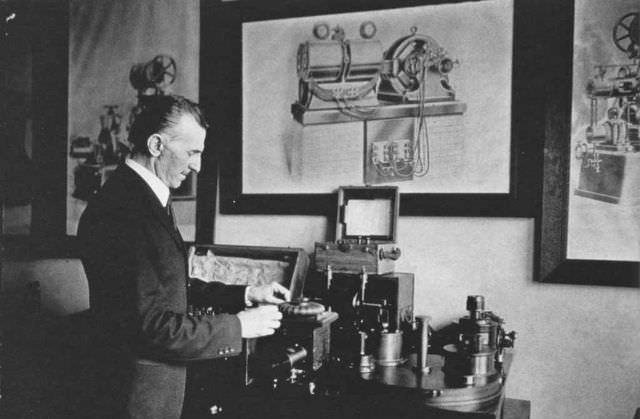
Every wireless device operating today relies on sending electromagnetic energy through space without wires, an idea Tesla pursued alongside Marconi, Braun and others. Wardenclyffe itself never transmitted power, and broadcasting usable energy in every direction, as he proposed, sends most of it where nobody wants it. The ambition was real; the global scheme was not workable.
In 1960, the world paid Nikola Tesla a permanent honour: the international body that governs scientific measurement named the unit of magnetic flux density the tesla. Every MRI scanner rated in teslas now carries his name into hospitals around the world.
His work on resonant circuits and high-frequency phenomena also fed into radar, MRI machines, and aspects of quantum-computing hardware that depends on precise electromagnetic control at the quantum scale. The inventor who was ahead of his time is, in some respects, still ahead of ours.
According to the IEEE — the world’s largest professional body for electrical engineers — the AC power system, the induction motor, the Tesla coil, and his foundational radio work are not peripheral contributions. They are the infrastructure of the modern world.
Separating the Record From the Legend
Tesla is unusual among scientists in that the popular account of him has drifted a long way from the documented one, and almost always in the same direction. Sorting the two is not an attack on his reputation. It is the only way to see what he actually did, which is impressive enough without assistance.
Historians of technology are broadly agreed on the core. Tesla’s induction motor and his polyphase system for generating and distributing alternating current, developed and commercialised with George Westinghouse, were genuine advances of the first rank. They made alternating current practical at scale, and the electricity reaching the room you are sitting in still arrives by a system recognisably descended from them. That is a career’s worth of achievement by any measure.
It is worth saying plainly what the polyphase idea solved, because the achievement is technical rather than theatrical. Alternating current could already be pushed long distances at high voltage and stepped down near the customer, which is what made it beat direct current over distance. What it could not do well was turn a motor. Tesla’s arrangement used several alternating currents offset in time, producing a magnetic field that rotates of its own accord, so a rotor follows it without brushes, commutators or any conversion step. That single idea is why industrial machinery could be plugged into the same grid that lit the lamps, and it is the reason factories stopped being built around belts and driveshafts.
The claims that do not survive checking are the ones that have travelled furthest. Tesla did not invent alternating current; single-phase AC was already in commercial use before his partnership with Westinghouse, with systems operating in Europe from the late 1870s onward. He did not invent radio outright, a field in which Karl Ferdinand Braun, Henry Dunwoody and Greenleaf Whittier Pickard all hold substantial credit alongside Marconi. He did not invent the crystal radio, and he did not invent the vacuum tube, where the line runs through Edison, John Ambrose Fleming and Lee de Forest.
Reviewing the historical literature for IEEE Technology and Society, A. David Wunsch, professor emeritus of electrical and computer engineering at the University of Massachusetts Lowell, makes a point that applies well beyond Tesla: most breakthroughs are overdetermined. Several people are usually working the same problem with the same available materials, and the question of who got there first is often a question about patent filing dates rather than about insight. The lone-genius story is satisfying precisely because it removes that mess.
Was He Actually Forgotten?
This article is titled around a forgotten genius, and the framing is worth testing, because it is the premise underneath most modern writing about Tesla and it does not entirely hold.
The strongest evidence against it is sitting in every physics textbook. The tesla, symbol T, is the SI unit of magnetic flux density. It was adopted by the General Conference on Weights and Measures in 1960 and named in his honour. Scientific communities do not attach a person’s name to a base-level unit of measurement by accident, and they do not do it for people they have erased. It places him in the company of Newton, Volta, Hertz and Kelvin, which is a fair estimate of the regard in which the profession holds him.
Nor was he ignored in his own lifetime. He received the Edison Medal, the highest honour of the American Institute of Electrical Engineers — an award named, with some irony, after the man he is popularly said to have been destroyed by. He was a widely covered public figure for decades. Long after his death, Time included him among the hundred most significant figures in history.
So what is the grain of truth? It is narrower than the legend but it is real. Tesla died in 1943 in a New York hotel, in reduced circumstances and heavily in debt, having spent his final decades making announcements that could not be substantiated. His name faded from popular awareness for much of the twentieth century even as it stayed firmly fixed in the technical literature. And the specific historical injustice usually cited — the question of his priority in radio — is genuinely complicated rather than simply settled against him.
The precise claim that survives scrutiny is therefore something like this: Tesla was never forgotten by engineers, but he was forgotten by the public for two or three generations, and the popular revival since the 1990s has overcorrected so enthusiastically that it now credits him with work he did not do. Both the neglect and the overcorrection are real, and they happened in that order.
That distinction is worth holding on to while reading anything about him, including this article. The case for Tesla does not require the suppression story. It requires the induction motor and the polyphase system, which are in the record, in the patents, and in the wiring of every building you have ever been inside.
Why the Myth Grew, and What It Costs Him
The inflation of Tesla’s record is not random, and understanding where it came from is more interesting than simply listing the errors.
Several ingredients combined. He was a genuinely strange and compelling figure, and he died poor and comparatively forgotten, which makes an irresistible narrative shape: the visionary cheated of his due. He made large public claims late in life — about transmitting power without wires, about a directed-energy weapon — that were never demonstrated and are now quoted as suppressed achievements rather than as unfulfilled proposals. And he stood opposite Edison, a man whose own reputation has been revised downward, so that elevating one became a way of criticising the other.
The Wardenclyffe tower sits at the centre of this. It was real, it was built on Long Island from 1901, and the ambition behind it was serious. What it was not is a working system for free electricity withheld from the public. Broadcasting usable power through the Earth and atmosphere, in the manner Tesla proposed, runs into the difficulty that energy radiated in all directions mostly goes where nobody wants it, and there is no mechanism by which it could be free. The project ran out of money and was never completed, which is an ordinary reason for an ambitious engineering venture to fail.
The cost of the myth falls on Tesla. An induction motor that reorganised industrial power is a concrete, checkable, permanent contribution. A suppressed free-energy device is not checkable at all, and because it cannot be verified it cannot be credited either. Inflating the claims moves him out of the history of engineering and into a category where belief substitutes for evidence. He does not need it. The polyphase system is the stronger case, and it has the advantage of being true.
There is a wider lesson here that outlasts Tesla, and it is the reason this section exists at all. Invention stories are told as biography because biography is memorable, and the shape they take — one mind, one flash, one thwarted visionary — is almost always wrong about how technology actually develops. Several groups work the same problem because the same materials, the same theory and the same commercial pressure have arrived at once. Priority disputes are common precisely because simultaneous invention is common.
Reading Tesla this way costs nothing and explains more. It accounts for why he and others converged on similar ideas, why patent litigation dominated his era, and why the question “who invented radio?” has never had a clean answer in any country. It also protects a reader against the next such story, which will arrive with the same structure and the same emotional pull. When a claim depends on the idea that one person saw everything and the world conspired to ignore it, the claim is usually doing work that the evidence cannot do on its own.
What Historians Say About Nikola Tesla
The measure of his standing is not a quotation but a unit: the SI unit of magnetic flux density is the tesla. It appears in every paper that measures a magnetic field, and almost nobody writing it down pauses over whose name it is.
The Tesla Science Center at Wardenclyffe, which runs the site of his most ambitious project as a museum, describes his inventions as having fundamentally reshaped the modern world by transforming how we generate, transmit, and use electricity — a description that reads less as praise than as plain engineering history.
Historians have noted that the story of Nikola Tesla is partly about the relationship between genius and institutions. The twentieth century was not kind to visionaries who could not commercialise their ideas. That the record has been substantially corrected is a tribute to the persistence of the truth — which, in the end, tends to emerge.
Frequently Asked Questions
What did Nikola Tesla invent that we still use today?
His most enduring invention is the alternating current electrical system — the AC power in every outlet in the world. Nikola Tesla also invented the AC induction motor that drives most electric motors today, the Tesla coil used in radio and television technology, and conducted foundational radio research that predated Marconi’s patents.
Why was Nikola Tesla forgotten by history?
Several factors: his failure to commercialise his inventions compared with rivals like Edison and Marconi; the collapse of funding for Wardenclyffe; his reclusive later years; the absence of heirs or institutions to preserve his legacy; and an industrial era in which credit went to whoever controlled the narrative. His reputation has been substantially restored since the mid-twentieth century.
Did Nikola Tesla really invent radio before Marconi?
By the historical and legal record, his priority is strong. Tesla filed key radio patents in 1897, granted in 1900; Marconi’s key patents came in 1904. In 1943 the US Supreme Court ruled Marconi’s foundational patents invalid because Tesla’s prior work had established the principles. But Marconi had already received the 1909 Nobel Prize and the public credit.
What did Nikola Tesla do at Colorado Springs?
In 1899 he built an experimental station there to study high-voltage electricity and wireless power. Using a giant magnifying transmitter, he generated bolts of artificial lightning many metres long and recorded mysterious signals he could not explain. The work convinced him that transmitting power without wires was possible — the idea behind Wardenclyffe.
What was the Wardenclyffe Tower and why was it demolished?
A wireless transmission facility built on Long Island from 1901, intended to send electricity and information worldwide. Funded by J. P. Morgan, it lost its backing when Morgan realised Tesla’s goal was free global electricity rather than a commercial service. It was demolished in 1917, its metal sold to pay Tesla’s debts. The site is now a museum run by the Tesla Science Center.
Further Reading
Sources
- History.com — Nikola Tesla: Inventions, Facts and Death
- Tesla — System of Electrical Power Transmission, US Patent 511,560 (1894)
- Tesla Science Center at Wardenclyffe — Tesla’s Inventions
- Tesla — Electro-Magnetic Motor, US Patent 381,968 (1888)
- The War of the Currents: AC vs DC Power — US Department of Energy
- Tesla — Apparatus for Transmitting Electrical Energy, US Patent 1,119,732 (1914)
Baryon. (2025, July 18). Nikola Tesla: The Forgotten Genius Who Powered the Modern World. Web News For Us. https://webnewsforus.com/nikola-tesla-genius-inventor-modern-world/
Baryon. “Nikola Tesla: The Forgotten Genius Who Powered the Modern World.” Web News For Us, 18 July 2025, https://webnewsforus.com/nikola-tesla-genius-inventor-modern-world/. Accessed 11 October 2026.