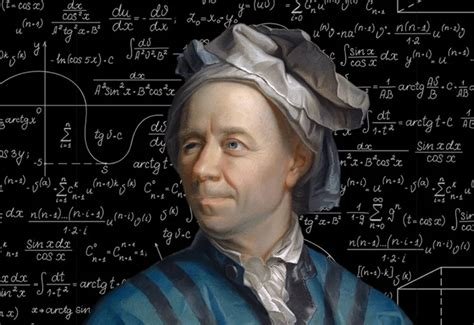
Leonhard Euler died in 1783. The first volume of his collected works appeared in 1911. The last printed volume was presented in 2022 — and the editors said even that did not finish the job.
That is not a figure of speech. In 1907, the bicentenary of his birth, the Swiss Society of Natural Sciences, today the Swiss Academy of Sciences, set up a committee to collect everything Euler wrote and issue it as Leonhardi Euleri Opera Omnia. The first volume appeared in 1911. The printed works alone fill 72 volumes in three series, and a fourth series of letters and manuscripts was begun in 1967. The final printed volume, on celestial mechanics, was celebrated in Basel in October 2022 — 111 years after the first, a publishing effort far longer than Euler’s own working life.
The Euler Archive, which catalogues his output work by work, has a page for each of the 866 items in the standard index of his writings, about 850 of them works by Euler himself. Few mathematicians, if any, have had collected works that took longer to print than they took to write.
On 18 September 1783, a 76-year-old man in St Petersburg spent his day as usual. He gave a mathematics lesson to one of his grandchildren, worked on the motion of hot-air balloons — the Montgolfier brothers had flown their first that summer — and discussed the newly discovered planet Uranus with two colleagues. At about five in the afternoon he suffered a brain haemorrhage, said “I am dying,” and lost consciousness. He died that night.
His name was Leonhard Euler. The sight of his right eye had begun to fail in the late 1730s, and soon after he returned to Russia in 1766, aged fifty-nine, an illness left him almost entirely blind; a cataract operation in 1771 restored his sight for a few days before he lost it for good. In those last years, working by dictation and by the extraordinary precision of his memory, he produced almost half of everything he ever wrote.
Euler is the most prolific mathematician in history. The standard index of his writings lists 866 items — so many that the St Petersburg Academy, which published him, kept releasing new Euler papers for decades after his death. He gave us the symbols e, i, f(x), and Σ. He founded graph theory with a single recreational puzzle about bridges. He wrote down the formula behind the equation that mathematicians have called, across three centuries, the most beautiful in all of mathematics.
And yet most people who know the names Einstein or Newton have never heard of him. This is one of history’s stranger oversights, because Euler’s mathematics is not a historical curiosity — it is the foundation on which GPS, electrical engineering, quantum mechanics, network science, and modern cryptography are built. You encounter Euler’s mathematics every day of your life, and you almost certainly have no idea.
A Basel Childhood and the Education That Shaped a Century
Leonhard Euler was born on 15 April 1707 in Basel, Switzerland, the eldest child of Paul Euler, a Protestant minister with a strong interest in mathematics, and Marguerite Brucker. The family moved to the village of Riehen when Leonhard was one, and it was there he grew up, in a household where intellectual seriousness was normal and mathematical thinking encouraged.
Paul Euler had studied under Jacob Bernoulli at the University of Basel and was friends with Jacob’s brother Johann Bernoulli, then one of Europe’s most eminent mathematicians. He gave his son a solid grounding before sending him to the University of Basel at thirteen. There, Euler took Saturday-afternoon tutorials from Johann Bernoulli himself — an arrangement Bernoulli offered once he saw that his young student was asking questions ordinary lectures could not answer. Bernoulli’s assessment was blunt and prescient: he reportedly told Paul Euler that his son would become the greatest mathematician in Europe. Coming from a competitive and famously difficult man, it was not flattery but a factual prediction.
Euler completed a Master’s degree in philosophy in 1723, aged sixteen, with a dissertation comparing the systems of Descartes and Newton. He then began theology at his father’s wish, intending to enter the ministry — but mathematics kept pulling him back, and Johann Bernoulli intervened to persuade Paul Euler that his son’s destiny lay elsewhere. By nineteen, Euler had submitted his first paper to the Paris Academy of Sciences, a competition entry on the optimal placement of masts on a ship. He came second, behind an experienced naval mathematician — a remarkable result for a nineteen-year-old who had never been to sea.
St. Petersburg: Where the Real Work Began
In 1727, Euler joined the newly founded St. Petersburg Academy of Sciences. Two of Johann Bernoulli’s sons, Nicolaus and Daniel, had gone there first; when Nicolaus died of appendicitis within months, a grief-stricken Daniel wrote to Euler asking him to fill the vacancy. Euler arrived at twenty and would spend the most creative decades of his life there. Russia in those years was politically turbulent, but Euler kept his head down and his pen moving — he is said to have joked that the turmoil helped, since the silence of people afraid to speak in public let him concentrate.
In January 1734 he married Katharina Gsell, the daughter of a Swiss painter in St Petersburg. They had thirteen children, of whom only five survived infancy. Euler claimed that some of his greatest discoveries came while he held a baby in his arms with other children playing round his feet.
Within a few years he had cracked the Basel Problem — a question that had defeated Europe’s best for nearly a century: what is the sum of the reciprocals of all the perfect squares, 1 + 1/4 + 1/9 + 1/16 + …? Euler showed it equals π²/6. The answer was not just a solved puzzle but a startling new bridge between the whole numbers, the primes, and the constant π — a connection that opened a whole branch of mathematics and led, eventually, to the Riemann hypothesis, still unsolved and now one of the Clay Mathematics Institute’s seven Millennium Prize Problems, each carrying a $1 million reward.
He did not stop there. In 1737 he showed that the same kind of infinite sum can be rewritten as a product over all the prime numbers, the identity now called the Euler product. It was the first time anyone had tied the primes to the smooth machinery of calculus, and it is the doorway through which Bernhard Riemann walked more than a century later.
Around the same time he defined the number now called Euler’s constant, written γ and roughly 0.5772, which measures the gap between a simple sum of fractions and the natural logarithm. Nearly three centuries later, nobody knows whether it can be written as a fraction. It is one of the oldest open questions in mathematics that a schoolchild can understand.
His eyesight began to fail in the late 1730s. In his own account the trouble started in 1738 with the strain of map-making for the Russian state, and by 1740 he had, he wrote, lost an eye and feared for the other. The historian Ronald Calinger argues that the problem began earlier, with a near-fatal fever in 1735. Euler was not much troubled, reportedly remarking that he would now have fewer distractions. He kept working.
His reputation was growing all the while. He won the Grand Prize of the Paris Academy of Sciences in 1738 and again in 1740, sharing it on both occasions, and offers began to arrive from abroad.
The Seven Bridges of Königsberg

In 1736, Euler turned to a puzzle circulating in the city of Königsberg (now Kaliningrad). The city was split by the Pregel River into four land areas, linked by seven bridges. The question: could you walk through the city crossing each bridge exactly once? It sounds like a weekend diversion. It founded graph theory and topology.
Euler’s insight was to abstract the problem entirely. The streets, the river, the buildings — all irrelevant. What mattered was the relationship between the land areas and the bridges. He represented the land areas as points (vertices) and the bridges as lines connecting them (edges), and asked whether a path exists that traverses every edge exactly once. He proved such a path is possible only if the network has exactly zero or two vertices with an odd number of connections. Königsberg had four — so no such walk was possible.
Every network analysis since — the structure of the internet, social-network analysis, the routing algorithms that steer data packets across the globe — traces its lineage to that 1736 paper. When Larry Page and Sergey Brin built Google’s PageRank algorithm at Stanford in 1998, they built it on directed graphs: pages linked to pages, analysed with precisely the graph-theoretic thinking Euler began in Königsberg. The founders of Google were, in a real sense, implementing Euler.
Berlin: Productivity at Scale
In 1741, Euler moved to Berlin at the invitation of Frederick the Great, and spent twenty-five years producing mathematics at a rate that defies easy description. He wrote textbooks that defined the field for a generation and worked on optics, music theory, lunar motion, shipbuilding, map-making, and the mathematics of lotteries. He even advised the Prussian government on pension design, using probability in ways that anticipated modern actuarial science.
His relationship with Frederick was productive but strained. The king prized scientific prestige more than science, and Euler’s quiet, devout, family-centred temperament did not suit the philosophical banter Frederick liked in his courtiers. Frederick reportedly called him a “mathematical Cyclops” — a jab at his missing right eye that nonetheless caught something true: Euler’s mathematical vision was so singular that the ordinary limits of what one person could accomplish simply did not apply.
In Berlin he developed his theory of the motion of the Moon — of enormous practical value for navigation, since accurate lunar tables let sailors find their longitude at sea. The German astronomer Tobias Mayer built his tables of the Moon on Euler’s theory; in 1765 Britain paid Mayer’s widow £3,000 for the tables’ contribution to finding longitude, and paid Euler £300 for the theory behind them. He also wrote the Introductio in Analysin Infinitorum (1748), a foundational text that introduced the modern concept of a function and established the notation f(x) that every mathematics student now learns. The historian of mathematics Carl Boyer, in a 1951 lecture, called it “the foremost textbook of modern times”.
Euler’s Identity: The Equation That Connects Everything

Of all Euler’s contributions, the one most often called his greatest is the equation now known as Euler’s identity:
eiπ + 1 = 0
Five numbers. One equation. Zero redundancy. e, Euler’s number (~2.71828), is the base of the natural logarithm, appearing wherever growth and decay occur — compound interest, radioactive decay, population dynamics. i, the imaginary unit, the square root of −1, is the number that “should not exist” yet opens an entire new dimension of mathematics indispensable to electrical engineering and quantum mechanics. π (~3.14159) is the ratio of a circle’s circumference to its diameter, appearing wherever circles, waves, and oscillations arise. And 1 and 0 are the multiplicative and additive identities, the building blocks of counting itself.
These five numbers come from completely different areas of mathematics. They were not discovered together and were not expected to be related. Euler showed they are joined by a single, simple, exact equation. In a 1988 poll by The Mathematical Intelligencer, his identity was voted the most beautiful theorem in mathematics; in a 2004 Physics World poll it tied with Maxwell’s equations as the greatest equation ever. And the beauty is not merely metaphorical: a 2014 study at University College London, led by the neuroaesthetics researcher Semir Zeki and published in Frontiers in Human Neuroscience, found that viewing Euler’s identity activated the same brain regions in trained mathematicians that respond to beautiful music and art.
One honest footnote: there is no record of Euler writing the identity in that form. What he published, in the Introductio of 1748, was the more general formula that e raised to the power ix equals cos x + i sin x, valid for any angle x. Set x equal to π and the identity falls out. The famous five-number version is his formula, tidied up by those who came after.
Richard Feynman called the underlying formula “our jewel” and the most remarkable formula in mathematics in his famous lectures at Caltech. For the full story of Feynman and his approach to physics, see our article on Richard Feynman, the Nobel physicist who called curiosity his greatest instrument.
Going Blind and Working Faster
In 1766, Euler returned to St. Petersburg — Frederick had proved too frustrating, and Catherine the Great offered far better conditions. Soon after, a cataract clouded his remaining left eye, and within a few years he was effectively blind. His output increased.
Misfortune did not stop there. In 1771 fire swept through his house in St Petersburg; he escaped with his life and, crucially, his mathematical manuscripts.
This is not a misprint. Freed from the physical effort of writing, working entirely by dictation to a rotating team of secretaries and students, Euler produced mathematics at a pace that staggered his contemporaries. He had always had a phenomenal memory — he could recite the Aeneid from beginning to end and recall the page number of any passage in any book he had read — and blindness seemed only to concentrate that power. He could hold long calculations entirely in his head and dictate the results with the same accuracy others achieved with pen and paper before them.
He would lie in bed in the morning, work through problems in his head, then dictate; by afternoon the calculations were checked and the papers drafted. After his return to St Petersburg he produced almost half of his total output, including fundamental work on celestial mechanics, optics, algebra, and the motion of the Moon. His sons, above all Johann Albrecht Euler, and assistants such as Nicolas Fuss took down and checked the work. His Letters to a German Princess, written in Berlin in the early 1760s to a teenage princess and published in three volumes between 1768 and 1772, became one of the bestselling science books of the eighteenth century. It is, in retrospect, one of the first great works of popular science writing.
What Scientists Say

“Read Euler, read Euler, he is the master of us all.”
— attributed to Pierre-Simon Laplace by the mathematician and historian Guglielmo Libri, about 1846
The admiration has never really faded. Professor David Percy of the Institute of Mathematics and its Applications, speaking to the BBC, called Euler’s identity a real classic — simple to look at yet incredibly profound, drawing the five most important mathematical constants into a single statement. The Stanford mathematician Keith Devlin has written that the equation reaches down into the very depths of existence, comparing it to a Shakespearean sonnet that captures the essence of love. And Richard Feynman, as noted, singled out the formula behind it as the most remarkable in all of mathematics. Across two and a half centuries, the people best equipped to judge have kept reaching for the same superlatives.
The Edition That Has Outlived Its Editors
Most accounts of Euler reach for the same statistic: he produced more mathematics than anyone before or since. It is true, but as a number it stays abstract. The concrete version is the publishing history of his collected works, and it is stranger than the statistic.
Nineteenth-century attempts to gather Euler’s output all failed — there was simply too much of it. In 1907, the bicentenary of his birth, the Swiss Society of Natural Sciences established a dedicated Euler Committee and tried again. The first volume of Leonhardi Euleri Opera Omnia was published in 1911.
The edition was organised into three series: mathematics, running to 29 volumes; mechanics and astronomy, 31 volumes; and physics and miscellaneous writings, 12 volumes. That printed-works edition alone comes to 72 volumes. A fourth series, covering manuscripts and correspondence, began in 1967 as a joint Swiss and Soviet undertaking. By 2016, 75 volumes had appeared across all four series.
The printed edition closed with volume II/27, on celestial mechanics, presented at a jubilee in Basel in October 2022. The Euler Committee was then wound up. But its final report, signed in May 2022, was frank: the great task of a complete edition of Euler’s works, letters and notebooks had not been fulfilled, and a great deal of unprocessed material still existed. The work passed to a new Bernoulli-Euler Commission, which is continuing it digitally, together with the papers of the Bernoulli family. Editors were born, trained, spent entire careers on this edition, and died. Euler worked for roughly sixty years. Printing him took 111.
The scale becomes stranger still when you recall the circumstances. Euler lost the use of one eye in his thirties and was almost entirely blind from soon after 1766 — and his rate of production rose. He dictated to assistants and to his sons, holding constructions in his head that most mathematicians need paper to manage. A substantial fraction of the edition was composed by a man who could not read it back.
Individual works are indexed by Eneström number, the cataloguing system that runs from E1 to E866 and is still used by scholars today. If you want to see the raw evidence rather than take anyone’s word for the scale of it, the Euler Archive lists them one by one, most with scans of the original publication attached.
Euler’s Mathematics in the Modern World
Euler’s contributions are not museum pieces. They are active infrastructure. Here is where you meet his mathematics in daily life, whether you know it or not.
Your phone’s signal processing. Every phone call, streamed song, and video is manipulated using the Fourier transform, which decomposes complex signals into their component frequencies — and the Fourier transform is formulated using Euler’s formula connecting exponentials and trigonometric functions. Without it, there is no digital audio, video, or wireless communication as we know it.
Online security. In 1763 Euler proved a theorem about remainders: raise a whole number to a certain power, fixed by what is now called Euler’s totient function, and divide, and the remainder is always 1, provided the number and the divisor share no common factor. In 1977 Ron Rivest, Adi Shamir and Leonard Adleman built the RSA encryption system on exactly that theorem. Every time a browser shows a padlock, eighteenth-century number theory is doing some of the work.
The internet’s structure. How information flows through a network, how to find the shortest path between two points, how to spot the most influential nodes — the routing protocols directing internet traffic and the algorithms powering social networks all draw on graph theory, which Euler founded in Königsberg in 1736.
Electrical engineering. The analysis of alternating-current circuits — power distribution, radio, electronics — uses complex numbers exactly as Euler developed them. The phasor representation of signals, the impedance of capacitors and inductors, the analysis of filters and resonance all use eiωt, Euler’s exponential, as their fundamental representation.
Quantum mechanics. The Schrödinger equation, governing the evolution of quantum states, is a complex differential equation whose solutions carry Euler’s imaginary unit i throughout; the wave functions describing electrons and photons are complex-valued. Without Euler’s development of complex analysis, quantum mechanics could not be written in its modern form — the same framework the physicist Paul Dirac used to predict antimatter from pure equations. For how the quantum world underlies everyday reality, see our article on the quantum tapestry beneath the everyday world.
Structural engineering. Euler’s formula for the critical load at which a slender column buckles under compression — derived in 1744 — is still used by engineers designing bridges, buildings, and aircraft, and taught in every undergraduate engineering programme in the world.
Physics and fluids. With Joseph-Louis Lagrange, Euler developed the calculus of variations, whose central equation — the Euler–Lagrange equation — expresses the principle that nature takes the path of least action, from a thrown ball to the orbits of planets. His 1757 equations for the motion of an ideal fluid are still the starting point for describing air over a wing and water in a pipe.
Topology. Euler’s formula for polyhedra — that vertices minus edges plus faces always equals 2 for any convex solid (V − E + F = 2) — founded the field of topology. The Euler characteristic generalised from it is a fundamental invariant appearing throughout modern mathematics and physics, from the classification of surfaces to the compactification of extra dimensions in string theory.
Why This Matters: Euler and the Language of the Universe
Euler’s significance is not merely a matter of giving a dead mathematician his due. It is a question about how the world works at a fundamental level. Mathematics is often described as the language of the universe — the claim that nature’s deepest patterns are mathematical in character. If that is even partly true, then the question of who built that language, and how, is not a minor historical footnote. It is a question about the structure of knowledge itself.
Euler built more of that language than anyone else in history. The notation every mathematician and physicist uses; the tools underlying electricity, quantum mechanics, network science, and structural engineering; the connections between distant areas of mathematics — between complex exponentials and trigonometry, between prime numbers and infinite series, between geometry and combinatorics — were established by Euler. When mathematicians work today on the Riemann hypothesis, they work in territory he opened. When physicists write quantum wave functions in complex numbers, they use his framework. When network scientists map the internet, they use the vocabulary he created with a puzzle about seven bridges.
The comparison with Ramanujan is instructive. Both possessed extraordinary intuition and saw patterns invisible to their peers. But where Ramanujan worked alone, in poverty, producing results he could not always prove, Euler worked systematically across an entire civilisation’s worth of mathematics, building and connecting and clarifying with a rigour and productivity never matched. For the other great self-taught visionary, see our article on Srinivasa Ramanujan, the man who knew infinity.
Euler’s death, that evening in September 1783, was described by the philosopher Nicolas de Condorcet — permanent secretary of the French Academy of Sciences — with a phrase that has become famous: “He ceased to calculate and to live.” It was meant as a tribute. It was also, as those who knew him understood, a precise description of how he had always lived. For Euler, calculation and life were the same thing.
Frequently Asked Questions
Who was Leonhard Euler and why is he important?
Leonhard Euler (1707–1783) was a Swiss mathematician and physicist, widely regarded as the greatest mathematician of the eighteenth century and the most prolific in history. The standard index of his writings lists 866 items. He founded graph theory, transformed the analysis of functions, standardised much of the mathematical notation used worldwide today, and developed tools underlying modern electrical engineering, quantum mechanics, network science, cryptography and structural engineering. The identity e to the power iπ plus 1 equals 0, which follows from his formula, is regularly called the most beautiful equation in mathematics.
What is Euler’s identity and why is it called beautiful?
Euler’s identity is eiπ + 1 = 0. It connects five of the most fundamental constants in mathematics — e, i, π, 1, and 0 — in a single exact equation. Each comes from a completely different area of mathematics, and their connection was not anticipated. A 1988 poll by The Mathematical Intelligencer voted it the most beautiful theorem in mathematics, and a 2014 study at University College London found it activates the same brain regions as beautiful art and music in trained mathematicians.
What did Euler invent that we use today?
Euler’s most widely used contributions include the notation f(x) for functions, the symbol e for the base of natural logarithms, i for the imaginary unit, and Σ for summation; graph theory, the foundation of network analysis and internet routing; the formula for complex exponentials used in signal processing and electrical engineering; Euler’s buckling formula in structural engineering; and the number-theory foundations underlying modern cryptography.
How did Euler keep working after going blind?
His right eye began to fail in the late 1730s, and soon after his return to St Petersburg in 1766 an illness left him almost entirely blind; a cataract operation in 1771 restored his sight only for a few days. He continued by dictating to his sons, especially Johann Albrecht, and to assistants such as Nicolas Fuss, relying on an extraordinary memory that let him hold long calculations entirely in his head. After returning to St Petersburg he produced almost half of his total output.
What is the connection between Euler and modern computing?
It is direct and multiple. Graph theory, which Euler founded, underlies internet routing, search algorithms, and social-network analysis. His formula for complex exponentials is the mathematical basis of the Fourier transform used in all digital signal processing. The analysis of networks, optimisation, and much of the discrete mathematics used in computer science all trace to his work.
How does Euler compare to Newton or Gauss?
Newton and Gauss made revolutionary contributions in specific areas — Newton in calculus, mechanics, and optics; Gauss in number theory, statistics, and differential geometry. Euler’s distinction is breadth combined with depth: he made foundational contributions to more areas of mathematics and physics than either, while producing more published work than any mathematician before or since. Gauss himself described the study of Euler’s works as the best school for mathematics — still the consensus among historians.
Sources
- MacTutor History of Mathematics — Leonhard Euler (University of St Andrews)
- Euler — Solutio problematis ad geometriam situs pertinentis (E53, 1736), the Königsberg bridges paper — Euler Archive
- Frontiers in Human Neuroscience — Zeki et al., The Experience of Mathematical Beauty (2014)
- Euler — Introductio in analysin infinitorum, Volume 1 (E101, 1748) — Euler Archive
- The Euler Archive — catalogue of Euler’s 850+ works by Eneström number, University of the Pacific
- Bernoulli-Euler Society — the Opera Omnia editorial project
- Euler Commission of the Swiss Academy of Sciences — Final report 2021/22 (Schlussbericht), Bernoulli-Euler-Zentrum, University of Basel
- Swiss National Science Foundation, Horizons — The Mozart of mathematics (June 2016)
- Boyer — The foremost textbook of modern times, The American Mathematical Monthly 58, 223 (1951)
Baryon. (2026, April 27). Who Was Leonhard Euler? Man Behind the Most Beautiful Equation in Mathematics. Web News For Us. https://webnewsforus.com/leonhard-euler-mathematician-genius/
Baryon. “Who Was Leonhard Euler? Man Behind the Most Beautiful Equation in Mathematics.” Web News For Us, 27 April 2026, https://webnewsforus.com/leonhard-euler-mathematician-genius/. Accessed 17 October 2026.