Science & A.I. · Quantum physics
Quantum mechanics is famous for being weird, remote and irrelevant to daily life. That reputation is almost exactly backwards. The quantum world is not somewhere else — it is the ground you are standing on.
Particles in two places at once, cats both alive and dead, measurements that change what they measure: the popular image of quantum physics is a carnival of strangeness with no bearing on ordinary reality. It makes the theory sound like a curiosity for physicists, safely sealed off from the solid, predictable world you live in.
This impression is completely wrong. Quantum mechanics is the foundation of all chemistry, all materials science and all modern electronics. The reason the sun shines is quantum mechanical. The reason the floor holds you up, the reason your phone works, the reason atoms exist at all — every one of these is a quantum story.
This article unpicks the quantum tapestry: the handful of strange rules that, woven together, produce the entire familiar world. No equations, just the ideas — and a new way of seeing the reality you already inhabit.
The aim is not to make the quantum world sound magical, but to show that the familiar one has been quantum all along. Once you see the threads, the ordinary stops looking ordinary — a table, a sunbeam, a phone screen each become quiet demonstrations of the deepest physics we know.
And the theory is still under active repair, 125 years on. Count the titles in the arXiv preprint archive and the picture is clear: by 1 September 2026 it held 5,869 papers with “quantum mechanics” in the title and 3,293 on decoherence — the mechanism that explains why the everyday world looks classical.
Only 212 concern the interpretation of the theory. The overwhelming majority of the work is not about what quantum mechanics means; it is about what it does, and about the process that hides it from you.
That balance is worth carrying into the article below. The strangeness is real, it is thoroughly tested, and the reason you never see it is itself a well-studied piece of physics rather than a philosophical escape hatch.
The everyday things only quantum can explain
Before diving into the strange rules, it helps to see the size of the debt the ordinary world owes to quantum physics. These are not exotic laboratory effects; they are the plainest facts of existence, and classical physics cannot account for any of them.
Classical physics predicts that atoms should not exist. An electron orbiting a nucleus should, by the older theory, spiral inward and crash in a fraction of a second, radiating away its energy. That every atom in your body is stable, and has been for billions of years, is a purely quantum fact.
Classical physics also cannot explain why matter is solid, why the sun burns steadily rather than exploding or fizzling, why some materials conduct electricity and others do not, or why a hot object glows the particular colours it does. Each of these was a crisis for nineteenth-century physics, and each was resolved only by the quantum revolution.
How the theory was forced into being
Quantum mechanics was not invented for fun; it was dragged out of a series of experimental crises that classical physics simply could not survive. The story begins in 1900, when Max Planck found he could only explain the colours of light from a hot object by assuming energy came in discrete lumps, or quanta. He considered it a mathematical trick.
In 1905 Albert Einstein took the idea seriously, showing that light itself behaves as discrete packets to explain how it knocks electrons out of metal. In 1913 Niels Bohr used quantisation to explain the structure of the atom. Piece by piece, a picture was forced upon physicists that none of them found comfortable.
By the mid-1920s the full theory arrived, in the work of Heisenberg, Schrödinger, Dirac and others. It was mathematically precise, wildly successful at prediction, and deeply unsettling in what it implied about reality. A century later, its predictions have never failed a test, even as arguments about its meaning continue.
Wave or particle? Both, and neither
The first thread of the tapestry is wave–particle duality. Light, long thought to be a wave, also arrives in discrete packets called photons. Electrons, long thought to be particles, also behave like waves, spreading out and interfering with themselves. Every quantum object is, in some sense, both at once.
The famous double-slit experiment makes this vivid. Fire particles one at a time at a barrier with two slits, and over time they build up the striped interference pattern of overlapping waves — even though each particle arrived alone. Each one somehow travelled as a wave through both slits, then landed as a single point.
This is not a failure of our instruments or our imagination. It is how nature actually behaves at small scales. A quantum object is not really a tiny ball, nor really a wave, but a third kind of thing for which our everyday words are simply inadequate. The wave describes where the particle is likely to be found.
Superposition and the wavefunction
Because a quantum object behaves like a wave, it does not have a single definite position until it is measured. Instead it exists in a superposition — a blend of many possibilities at once, described by a mathematical object called the wavefunction. The wavefunction encodes the probability of every outcome a measurement could produce.
This is the origin of the “particle in two places at once” headline. It is not that the particle is secretly in one place and we are ignorant of which; the mathematics insists it is genuinely spread across possibilities, and this spread has measurable consequences, such as the interference pattern.
When a measurement is made, only one outcome is observed, and the superposition appears to collapse to that single result. Why measurement does this — and what counts as a measurement — is among the deepest unresolved questions in physics, and we will return to it. For now, hold onto the picture: possibilities, then one outcome.
The uncertainty principle
One of the most famous, and most misunderstood, quantum rules is Heisenberg’s uncertainty principle. It states that certain pairs of properties — most notably a particle’s position and its momentum — cannot both be known with perfect precision at the same time. The more sharply you pin down one, the fuzzier the other becomes.
This is often misread as a limitation of our measuring instruments, as if better tools could beat it. They cannot. The uncertainty is built into nature itself: a quantum object simply does not possess a perfectly definite position and momentum at once. It is a feature of what the object is, not of how clumsily we observe it.
Far from being an inconvenience, the principle has real consequences that make the universe work. It is part of why atoms have a definite size, and it underlies the restless jitter of the quantum vacuum. Uncertainty is not ignorance; it is one of the load-bearing threads of the tapestry.
Why atoms exist at all
Return to the puzzle of the collapsing atom. The quantum resolution is that an electron bound to a nucleus cannot have just any energy; it is restricted to specific, discrete levels, like rungs on a ladder. There is a lowest rung, a ground state, below which the electron cannot fall.
Because it cannot lose energy continuously, the electron cannot spiral into the nucleus. It settles into its lowest allowed state and stays there, stable indefinitely. This quantisation of energy — the fact that the atomic world comes in discrete steps rather than a smooth continuum — is why matter is possible.
The same discrete energy levels explain why each chemical element emits and absorbs its own signature colours of light, the basis of how astronomers read the composition of distant stars. The rainbow of a neon sign and the spectral fingerprint of a galaxy are the same quantum phenomenon.
Why the floor holds you up
An atom is almost entirely empty space; the nucleus is a tiny speck and the electrons a faint cloud around it. If atoms are mostly nothing, why does matter feel solid, and why can you not push your hand through a table?
The answer is a quantum rule called the Pauli exclusion principle, which forbids certain identical particles, including electrons, from occupying the same quantum state. Electrons cannot simply be squeezed together into the same place; the principle makes them resist crowding, giving matter its stiffness and volume.
So the solidity of the everyday world is not the touching of tiny solid balls. It is the refusal of electron clouds to overlap, enforced by a quantum principle. When you rest your coffee cup on a table, you are witnessing the exclusion principle at work, holding two clouds of near-empty space apart.
Why the sun shines
The sun is powered by nuclear fusion: hydrogen nuclei merging into helium, releasing energy. But there is a problem. Nuclei are positively charged and fiercely repel one another, and even at the sun’s enormous core temperature they should not, by classical physics, collide often enough to keep it burning.
Quantum tunnelling bridges the gap. Because each nucleus behaves like a spread-out wave, there is a small probability it can pass through the repulsive barrier it could not classically surmount. Tunnelling lets fusion proceed at temperatures where it otherwise could not, and it is why the sun burns at a steady, life-sustaining rate.
Pause on that. The warmth on your skin from sunlight, the energy underpinning nearly all life on Earth, reaches you because of a subtle quantum effect in the heart of a star. There is no more everyday phenomenon than sunshine, and it is quantum to its core.
Quantum mechanics in your pocket
If the sun feels remote, consider the device in your hand. Modern electronics is applied quantum mechanics from end to end. The transistor, the switch at the heart of every computer chip, works because of the quantum behaviour of electrons in semiconductors — materials whose usefulness comes from the discrete energy bands quantum theory describes.
The same physics gives us the laser, a beam of light produced by coaxing many atoms to release identical photons in step. Lasers read your data from discs and fibres, scan barcodes and perform surgery. Light-emitting diodes, the LEDs lighting your screen and your home, are quantum devices too.
Medical imaging joins the list. The MRI scanner that can look inside your body without a single cut relies on the quantum property of atomic nuclei called spin. Whole industries, and a substantial share of the modern economy, rest on technologies that could not have been invented without quantum theory.
Entanglement: the deepest strangeness
Perhaps the strangest thread of all is entanglement. Two quantum objects can become linked so that their properties are correlated no matter how far apart they travel. Measure one, and you instantly know something about the other, whether it is across the room or across the galaxy.
Einstein found this so troubling he called it “spooky action at a distance” and suspected the theory was incomplete. But careful experiments over the following decades confirmed that entanglement is real, and that nature genuinely behaves this way. It does not allow faster-than-light messaging, but it does defy our everyday sense of separate, independent objects.
Entanglement is no longer merely philosophical. It is the resource that powers quantum computing and quantum cryptography, technologies now under intense development. The strangest feature of the quantum world is becoming one of its most practically important.
Quantum effects in living things
For a long time biology was assumed to be too warm, wet and chaotic for delicate quantum effects to survive. That assumption is now being questioned in an emerging field sometimes called quantum biology, which explores where quantum behaviour may play a functional role in living systems.
The leading example is photosynthesis. Evidence suggests that the way plants and some bacteria channel captured sunlight toward where it is used may exploit quantum effects to do so with remarkable efficiency. Similar ideas are being investigated in how certain enzymes speed up reactions, possibly aided by quantum tunnelling.
Another striking proposal concerns how some migratory birds may sense the Earth’s magnetic field, potentially through a quantum effect in proteins in their eyes. These ideas remain areas of active research rather than settled fact, and claims should be treated with due caution. But they hint that the quantum tapestry may reach even into the machinery of life.
So why does the world look classical?
If everything is built from quantum pieces that blur across possibilities, why does the large-scale world look so solid and definite? Why do you never see a chair in a superposition of two places, or a football behaving like a wave?
The key idea is decoherence. A quantum system holds its delicate superposition only as long as it stays isolated. The moment it interacts with its surroundings — countless air molecules, photons, vibrations — the fragile wave-like behaviour leaks away into the environment and the system starts to behave classically.
Large objects are impossible to isolate; they are constantly interacting with everything around them, so their quantum character vanishes almost instantly. This is why quantum effects seem to belong only to the tiny and the very cold: those are the conditions under which a system can stay isolated long enough for its quantum nature to show.
Decoherence explains the appearance of a classical world without abolishing the quantum one beneath it. The definite, everyday reality you experience is not a different kind of physics; it is quantum physics, viewed at a scale where the strangeness has been washed out by contact with the environment.
What quantum mechanics does not say
Quantum physics attracts more nonsense than almost any other science, so it is worth being clear about its limits. It does not say that consciousness creates reality, that you can reshape the world with your thoughts, or that “everything is connected” in a mystical sense. These are misreadings, not implications.
The measurement problem — why observation yields one definite outcome — is a genuine puzzle, and physicists hold several competing interpretations of what it means. But these are serious, constrained debates about a precise mathematical theory, not a licence to believe anything. The equations make astonishingly accurate predictions, whichever interpretation one favours.
The honest wonder of quantum mechanics needs no embellishment. That the ordinary world — solid, warm, luminous — emerges from a substrate of waves and probabilities is stranger, and more beautiful, than any pseudoscience draped over it. The real theory is the marvel.
Decoherence, and Why It Is So Hard to Fight
The reason the world looks classical, set out above, is also the central engineering obstacle of the past three decades, and it is worth seeing the two as one problem rather than two.
A quantum state is not destroyed by being observed in any mystical sense. It is destroyed by becoming entangled with its surroundings. A stray photon, a vibration in the mounting, a slightly warm wall — each of these carries away a fragment of information about the system, and once that information exists in the environment, the delicate relationship between the parts of a superposition stops producing interference and starts behaving like ordinary probability. Nothing collapses in a puff of smoke. The information simply leaks somewhere it cannot be gathered back from.
This is why large objects never show quantum behaviour. A dust grain is in contact with so many air molecules and photons that its superpositions decohere in times far shorter than any measurement could resolve. The transition from quantum to classical is not a change in the laws. It is a change in how quickly the environment finds out.
It also explains why building a quantum computer is so much harder than the popular account suggests. The difficulty is not making qubits. It is keeping them isolated enough to stay coherent while simultaneously connecting them well enough to compute, which are opposing requirements. And the usual engineering answer — add redundancy — ran into a wall peculiar to quantum mechanics. You cannot copy an unknown quantum state, so the classical trick of storing three copies and taking a majority vote is unavailable. Worse, every extra qubit added to a system is one more thing that can go wrong, so for a long time adding hardware made the error rate worse rather than better.
What Decoherence Does Not Explain
It is worth marking the limit of the explanation just given, because it is routinely overstated and the overstatement is the most common error in popular accounts of quantum mechanics.
Decoherence explains, in full and with equations that work, why we never observe a large object in a superposition. Once the environment has entangled with a system, the interference between its possible states becomes undetectable in practice and the system behaves, for every purpose available to us, like a classical object with a definite but unknown property. That is a real achievement and it dissolved a great deal of confusion.
What it does not explain is why you see one particular outcome. The equations describe the system and its environment evolving together into a state containing all the possible results, each attached to a corresponding version of the apparatus and, eventually, of the observer. Decoherence tells you why the branches stop interfering with one another. It does not tell you why you find yourself in one of them rather than another, and it does not, on its own, remove the other branches from the mathematics.
That gap is the measurement problem, and it remains open. The available responses are genuinely different pictures of reality rather than variations on a theme. One holds that the other branches simply exist and that the question of why you are in this one is confused. Another adds something to the mathematics so that a single outcome is physically selected. A third treats the wavefunction as a bookkeeping device for an observer’s information rather than as a description of the world. Each is held by serious physicists; none has been distinguished from the others by experiment.
The honest summary is that quantum mechanics is the most precisely confirmed theory ever constructed, and that what it says about reality remains disputed a century after it was written down. Those two facts sit together uncomfortably and they are both true. Anyone who tells you decoherence settled the interpretive question has described the first half of the argument and stopped.
Crossing the Threshold
Theorists worked out in the 1990s that there was a way through. Errors can be detected without ever reading the data, by measuring relationships between qubits rather than the qubits themselves — asking whether two qubits agree without asking what either one is. A logical qubit built from many physical ones can then have its errors caught and corrected faster than they accumulate. The theory came with a hard condition attached, called the threshold: if the physical error rate is below a certain value, making the code larger makes the logical error rate fall exponentially. If it is above that value, making the code larger makes everything worse. For roughly thirty years this remained a theorem without a demonstration.
In a paper published in Nature in 2025, Google Quantum AI reported crossing it. The result is worth stating precisely, because the precision is the achievement. Using a surface code of distance seven built from 101 qubits, the logical error rate was 0.143 per cent per cycle of error correction. Increasing the code distance by two suppressed that rate by a factor of 2.14, and doing so repeatedly produced the exponential improvement the theory predicted. The resulting logical qubit outlived the best individual physical qubit in the machine by a factor of about 2.4.
That last number is the one that matters, and it is easy to undersell. It means the assembled, error-corrected thing was better than its best single component — the point at which error correction stops being overhead and starts being useful. Adding more hardware now improves the machine rather than degrading it.
What this is not is a working quantum computer. One logical qubit that remembers a value is a very long way from thousands of them performing operations on each other, and the resource costs remain daunting. But the obstacle described at the start of this section — that decoherence gets worse faster than redundancy can fix it — is no longer a matter of faith in either direction. It has been measured, and it fell on the favourable side of the line. The quantum weirdness that makes this article’s subject strange is the same weirdness being slowly domesticated into a technology.
The honest way to hold this is to keep two timescales apart. The physics question — can error correction outrun decoherence at all? — now has an experimental answer, and it is yes. The engineering question of how many physical qubits are needed per useful logical one, and whether machines of that size can be built and kept cold and calibrated, has answers currently measured in the thousands to millions and is not settled by this result at all. Announcements tend to blur the two, and the blur is where most of the overclaiming in this field comes from.
The second quantum revolution
The first quantum revolution, a century ago, gave us the transistor and the laser by understanding quantum rules. A second is now under way, based not just on understanding those rules but on actively controlling individual quantum systems — single atoms, photons and electrons — one at a time.
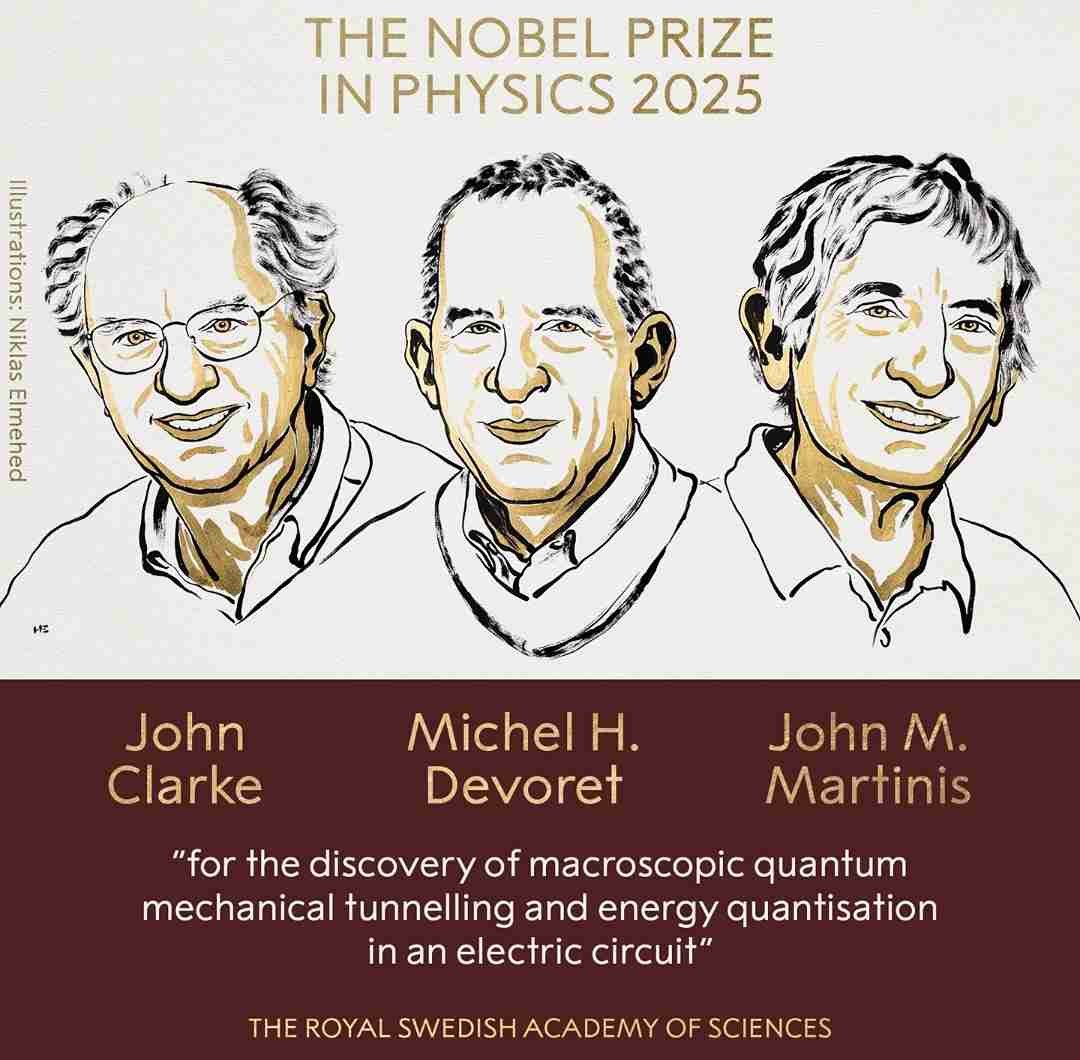
This new mastery is what makes quantum computers, quantum cryptography and ultra-precise quantum sensors possible. The 2025 Nobel Prize in Physics, awarded for showing that quantum behaviour can be engineered into a circuit large enough to hold, is very much a milestone of this second revolution.
Where it leads is not yet clear, but the direction is unmistakable. Having spent a century learning that the everyday world is quantum, we are now learning to weave the tapestry deliberately — turning the strangest features of reality from objects of wonder into tools of engineering.
That, in the end, is the quiet revelation of quantum physics. It did not reveal a hidden realm cut off from us; it revealed the hidden workings of the one we already live in. The whisper of the subatomic is not far away. It is the loom on which everything you see is woven.
Frequently asked questions
Is quantum mechanics really relevant to everyday life?
Entirely. It explains why atoms are stable, why matter is solid, why the sun shines, and how all modern electronics work. Transistors, lasers, LEDs and MRI scanners are all applied quantum mechanics. The everyday world is quantum through and through.
What is a superposition?
A quantum object existing in a blend of several possibilities at once, rather than a single definite state. It is described by the wavefunction, which gives the probability of each outcome. Measuring the object yields just one result, and the superposition appears to collapse.
Why does the sun need quantum mechanics to shine?
The nuclei that fuse in the sun repel one another and, by classical physics, would rarely collide even at its core temperature. Quantum tunnelling lets them pass through that barrier, allowing fusion to proceed steadily. Without it, the sun could not burn as it does.
Why is the large-scale world not visibly quantum?
Because of decoherence. Large objects constantly interact with their surroundings, which rapidly destroys their fragile quantum behaviour. The world looks classical not because quantum rules stop applying, but because the strangeness is washed out at everyday scales.
Does quantum physics mean consciousness creates reality?
No. That is a popular misreading. The measurement problem is a real scientific puzzle with several serious interpretations, but none licenses the claim that thoughts shape the physical world. Quantum mechanics is a precise, testable theory, not a basis for mysticism.
What is quantum entanglement?
A link between quantum objects such that their properties stay correlated however far apart they are. Confirmed by decades of experiments, it does not permit faster-than-light communication, but it is a real effect and the basis of quantum computing and cryptography.
Does the uncertainty principle mean our instruments are just too crude?
No. It is not a limit of measurement but a property of nature. A quantum object does not possess perfectly definite position and momentum at the same time. Better tools cannot beat it, because there is no hidden precise value waiting to be found.
When was quantum theory discovered?
It began in 1900 with Max Planck’s idea of energy quanta, was extended by Einstein in 1905 and Bohr in 1913, and reached its full mathematical form in the mid-1920s through Heisenberg, Schrödinger, Dirac and others. Its predictions have been confirmed ever since.
Further reading on Web News For Us
- Acharya, R. et al. (Google Quantum AI, 2025) — Quantum error correction below the surface code threshold. Nature 638:920-926.
- Quantum computing in 2026: how it works and what has been achieved
- The 2025 Nobel Prize in Physics: the quantum circuit behind the revolution
- The arrow of time: why physics says time moves only forward
- Zero-point energy: the restless quantum vacuum explained
Sources
Institutional and educational sources:
- NobelPrize.org — Physics 2025: quantum properties on a human scale
- NobelPrize.org — Physics 2022: entanglement and Bell inequality experiments
- US Department of Energy — DOE Explains: Quantum Mechanics
Baryon. (2025, August 27). Unveiling the Quantum Tapestry: How Our Everyday World Emerges from Subatomic Whispers. Web News For Us. https://webnewsforus.com/unveiling-the-quantum-tapestry/
Baryon. “Unveiling the Quantum Tapestry: How Our Everyday World Emerges from Subatomic Whispers.” Web News For Us, 27 August 2025, https://webnewsforus.com/unveiling-the-quantum-tapestry/. Accessed 17 October 2026.

Wow! That’s amazing peice of research backed article, I found your site by chance and it changed my perspective about science journalism. Keep it up.