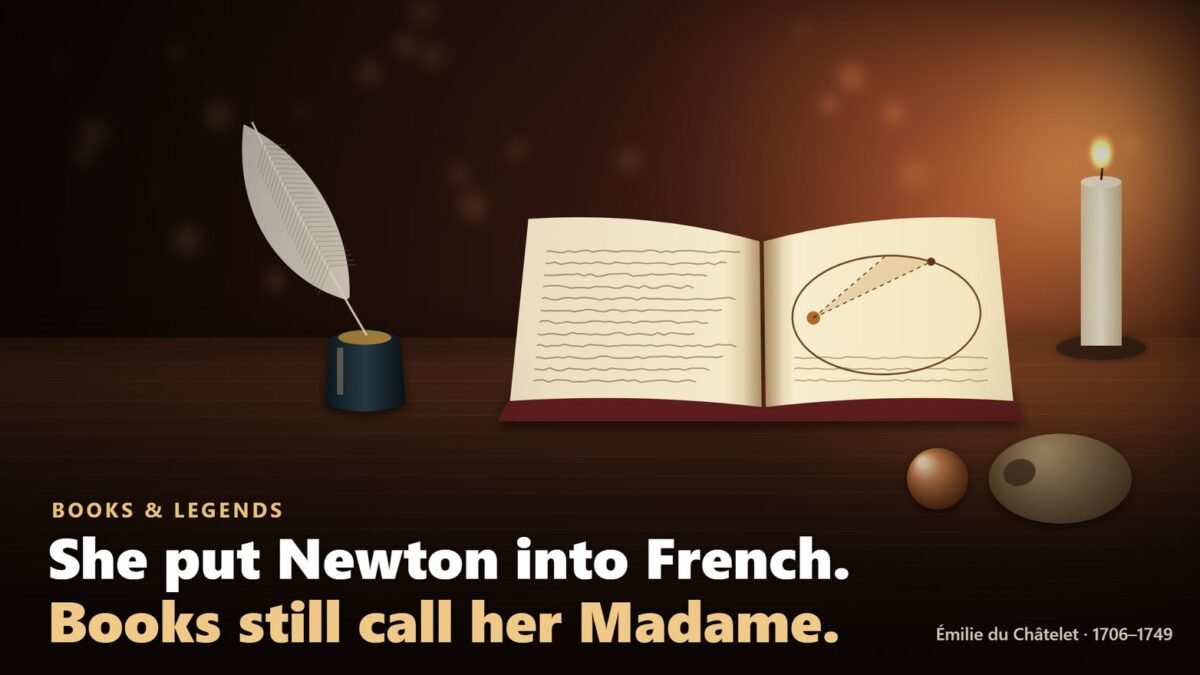
The standard French translation of Isaac Newton’s Principia does not print its translator’s first name. Its title page, dated 1756, says the work is “by the late Madame la Marquise du Chastellet”. For most of the two and a half centuries since, books have named her in much the same way.
She was born Émilie le Tonnelier de Breteuil in Paris on 17 December 1706 and married the marquis du Châtelet in 1725. She wrote a physics book for her son, argued in print with the permanent secretary of the French Academy of Sciences, and completed her Newton shortly before she died in 1749, at 42. Voltaire, her companion for the last sixteen years of her life, called her “a great man whose only fault was being a woman”.
We counted how the world has named her since. In Google’s scanned books, the share of mentions that use her first name rose from about one in a hundred in the first half of the twentieth century to about one in three in English books of the 2010s. In scholarly titles the change is almost complete: of 140 papers and books about her published since 2020, only 11 call her Madame. Her own books, taken in the order she wrote them, show why the scholars switched.
Cirey, 1733
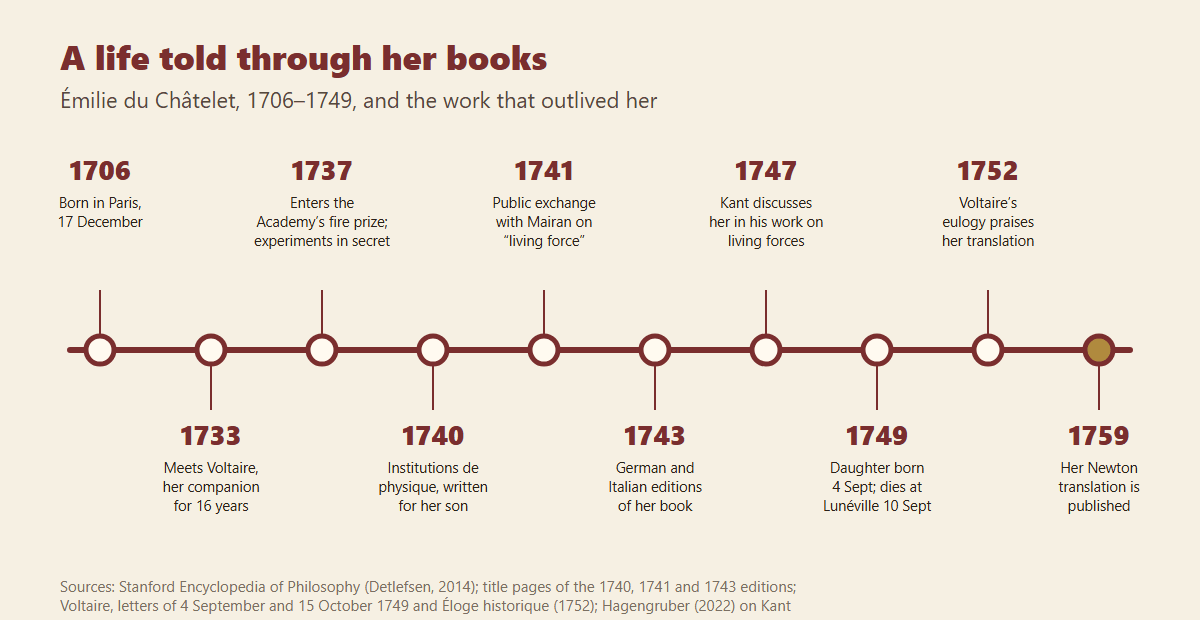
She met Voltaire in 1733. The two retired to Cirey, her husband’s estate, which was remodelled to include a laboratory with several instruments for their experiments, according to the Stanford Encyclopedia of Philosophy entry on her by the philosopher Karen Detlefsen.
Voltaire was then writing a popular account of Newton’s physics, the Éléments de la philosophie de Newton, published in 1738. Her mathematical training was better than his, and he implicitly acknowledged her contribution to the book, especially its more technical material. She had sought out lessons from several of Europe’s leading mathematicians, and she knew, corresponded with or was tutored by Pierre Louis de Maupertuis, Alexis-Claude Clairaut, Samuel Koenig and several members of the Bernoulli family.
In 1738 she published a letter in the Journal des savants about Voltaire’s book, arguing against those who accepted a Cartesian account of attraction. France was turning from Descartes’ physics towards Newton’s, and she helped to turn it.
1737: an essay on fire, written in secret
In 1737 she entered the Paris Academy of Sciences’ prize competition on the nature of fire, running her experiments in secret while Voltaire ran his own for a separate entry. Both essays set out to disprove the theory that fire is a material substance.
Neither won. The prize was shared by three other essays, one of them by Leonhard Euler, whose life we follow in our portrait of Euler. But both losing entries were printed alongside the winners. She kept returning to her Dissertation sur la nature et la propagation du feu, making significant revisions as her ideas about fire matured and changed.
1740: a physics book for her son
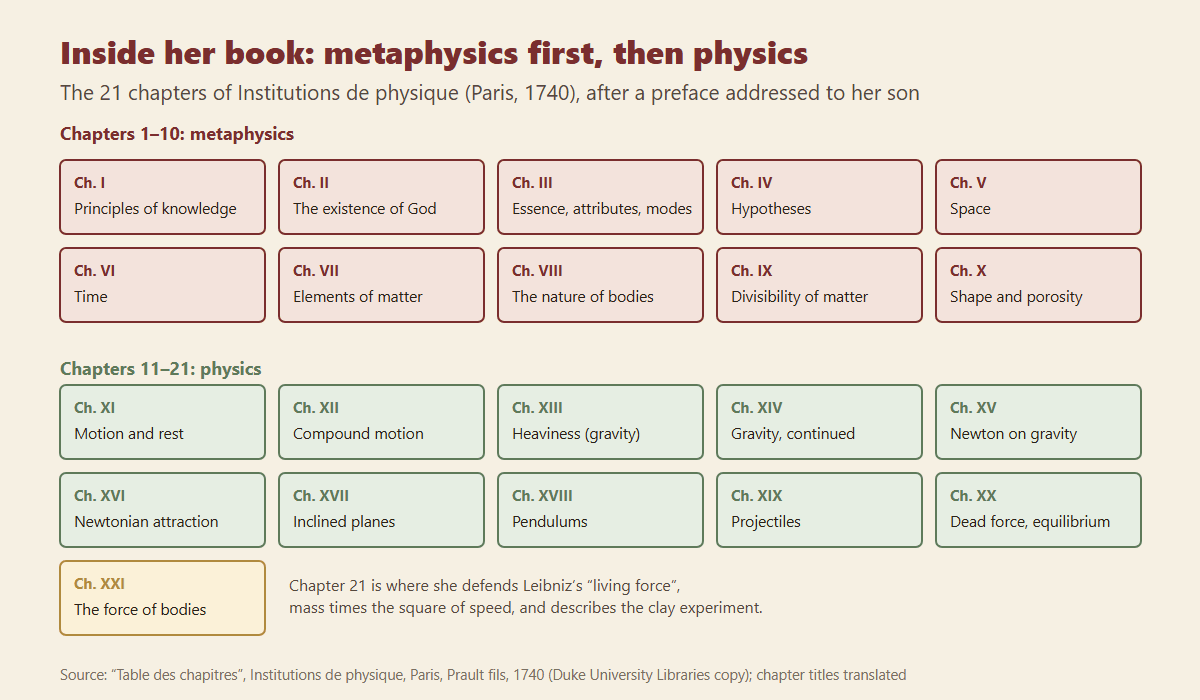
Her major work appeared in Paris in 1740 from the printer Prault fils: Institutions de physique, or Foundations of Physics. It had nearly come out two years earlier, but in 1738 she withdrew it from imminent publication to redraft it massively. The publisher’s notice called the finished book a first volume. No second volume was ever published.
It opens as a letter to her son. “I have always thought that the most sacred duty of human beings was to give their children an education that would keep them, at a more advanced age, from regretting their youth, which is the only time when one can truly learn,” the preface begins.
The book is more than a textbook. After an introduction come ten chapters of metaphysics: the principles of knowledge, God, essence, hypotheses, space and time, then four chapters on matter and bodies. Only from chapter 11 does it turn to motion, gravity, Newton’s discoveries, pendulums, projectiles and force. The Stanford Encyclopedia calls it her magnum opus, “ostensibly a textbook in physics for her son, but in reality a highly original work in natural philosophy”.
Her aim was to give Newton’s physics a metaphysical basis, and the metaphysics she supplied came from Gottfried Wilhelm Leibniz and from Christian Wolff, the German philosopher who built on his ideas. Her two primary first principles were the principle of contradiction and the principle of sufficient reason.
She did not want her son to pick sides out of loyalty. “Beware, my son, whatever side you take in this dispute among philosophers, of the inevitable stubbornness into which party spirit leads,” she wrote. The search for truth, she went on, “is the one thing in which love of your country must not prevail”, and it was quite wrong to have made the opinions of Newton and Descartes “a kind of national affair”. “When it comes to a book of physics, one must ask whether it is good, and not whether the author is English, German or French.”
She was frank about her companion’s book, too. Her son could learn a great deal about Newton’s attraction from the Éléments, which had appeared the year before, she wrote, and she would have left the subject out had its “illustrious author” covered more ground. But he had kept within limits so narrow that they could not spare her the task. Of geometry, she told her son to keep at it: it was “the key to all discoveries”.
The book travelled. A second edition followed in 1742. A German translation, Naturlehre an Ihren Sohn, was printed in Halle and Leipzig in 1743 with her portrait as its frontispiece, and an Italian translation, Instituzioni di fisica, came from the press of Giambattista Pasquali the same year.
It also brought the charge that would shadow her. Samuel Koenig, who had arrived at Cirey in 1739 to tutor her in mathematics, accused her of plagiarising his ideas. Yet when the censor Pitot approved her earliest version of the text, before Koenig’s lessons began, he noted that it already contained ideas from Leibniz. Given that, the Stanford Encyclopedia concludes, the charge “seems misplaced”.
Chapter 21: a dent in clay
Her most contested chapter was the last. Since at least 1686, Leibniz and the followers of Descartes had argued over how to measure the “force” of a moving body. The Cartesians multiplied bulk by speed. Leibniz multiplied bulk by the square of speed and called the result vis viva, living force, “akin to what we now call kinetic energy”, as George Smith puts it in a history of the dispute for Physics Today. Descartes’ quantity also ignored direction, Smith notes, so it was not yet the momentum of modern physics.
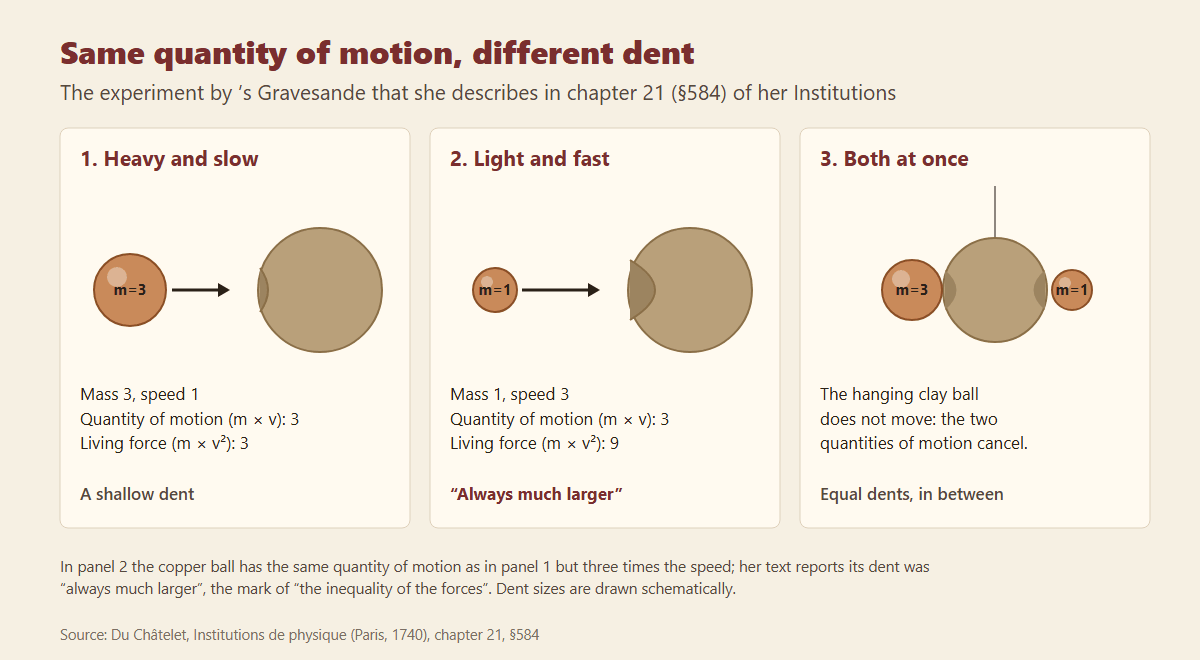
She sided with Leibniz, and in chapter 21 she describes an experiment devised by the Dutch natural philosopher Willem ’s Gravesande. He fixed a ball of clay in an apparatus known as Mariotte’s machine and struck it in turn with two copper balls: one with a mass of 3 moving at speed 1, the other with a mass of 1 moving at speed 3. Both carried the same quantity of motion, yet the dent made by the light, fast ball was “always much larger”, which she read as the mark of “the inequality of the forces”.
On Leibniz’s measure the two balls differ by a factor of three: 3 × 1² against 1 × 3². Then came the second half. When the same two balls struck a ball of clay hanging freely from a thread, from opposite sides at the same moment, it did not move at all. The copper balls came to rest equally sunk into the clay, and the two dents measured larger than the slow ball’s dent alone and smaller than the fast ball’s. In a collision like this, she explained, the only force used up is the force spent pushing in the clay.
Physics kept both quantities. Momentum, mass times velocity with its direction counted, is conserved in every collision, which is why the hanging ball stayed put. Kinetic energy, half the mass times the speed squared, survives intact only when bodies bounce perfectly. In a soft collision it turns into heat and deformation, which is exactly what a dent in clay records. The dispute is now usually told as momentum against kinetic energy, Smith writes, but “it was not that simple”, which helps explain why it ran on for so long.
1741: a pamphlet from the Academy’s secretary
Her chapter drew a public reply. Jean-Jacques Dortous de Mairan, permanent secretary of the Royal Academy of Sciences, published a 52-page Lettre … à Madame *** in Paris in 1741, “in response to the objections she makes to him on this subject in her Institutions de physique”, as its title page puts it. She replied in print the same year.
The exchange crossed borders within months. Also in 1741, Louise Adelgunde Victoria Gottsched translated both pieces into German, published in Leipzig as Zwo Schriften, two writings “concerning the measure of living forces”. When the Italian translation of the Institutions appeared in 1743, it came expanded with Mairan’s own dissertation on motive forces, so Italian readers had both sides of the argument in one volume.
In 1747 the young Immanuel Kant took up the controversy in his first book, Thoughts on the True Estimation of Living Forces, and devoted part of it to her analysis and her dispute with Mairan. He also praised her irony: she was, he wrote, “ridendo dicere verum”, telling the truth with a laugh. Ruth Hagengruber sets out the connection in a study of du Châtelet and Kant.
1749: Newton, finished at Lunéville
Sometime in the early 1740s she began her largest project: a two-volume translation of Newton’s Principia, with a commentary of her own. The second volume holds Newton’s “system of the world” and then her “abridged exposition” of that system, which draws on Alexis-Claude Clairaut’s book on the shape of the Earth.
She was still at it in September 1749, at Lunéville, pregnant at 42. On 4 September Voltaire wrote to the marquis d’Argenson on her behalf. That night, “at her writing desk, scribbling some Newtonian document”, she had felt a small need. “This small need was a daughter, who appeared on the spot. She was laid on a quarto book of geometry.” The mother went to bed. Voltaire added that he, for his part, had given birth to a tragedy, according to the letter.
Six days later she was dead. Voltaire’s eulogy records that she died in the palace at Lunéville on 10 September 1749. On 15 October he wrote to Frederick II of Prussia about “a great man whose only fault was being a woman” (« un grand homme qui n’avait de défaut que d’être femme »), a woman who “was capable of translating Newton and Virgil”, in a letter from Paris.
1759: the title page
The translation appeared in 1759, a decade after her death, under a title page dated 1756 that calls her “the late Madame la Marquise du Chastellet”. It is still the leading French translation of Newton’s book, according to the Stanford Encyclopedia.
Voltaire’s eulogy, first printed in the Bibliothèque impartiale in 1752, had opened with that translation: one “that the most learned men in France should have made”, which “a lady undertook and completed, to the astonishment and glory of her country”. “Two marvels have been seen,” he went on: “one, that Newton wrote this work; the other, that a lady translated it and made it clear.” His second sentence names the author in full: “Gabrielle-Émilie de Breteuil, wife of the marquis du Châtelet-Laumont”.
Mandeville, the Bible and happiness
Not all of her writing was physics. Her interest in ethics led her to translate portions of Bernard Mandeville’s Fable of the Bees. She wrote a book on theology and scripture titled Examens de la Bible, and a semi-autobiographical book on the source of human happiness, the Discours sur le bonheur. This work occasionally touched on women’s social roles and their education, the Stanford Encyclopedia notes. The Discours received a critical edition by Robert Mauzi, published in Paris by Les Belles Lettres in 1961.
The name on the spine
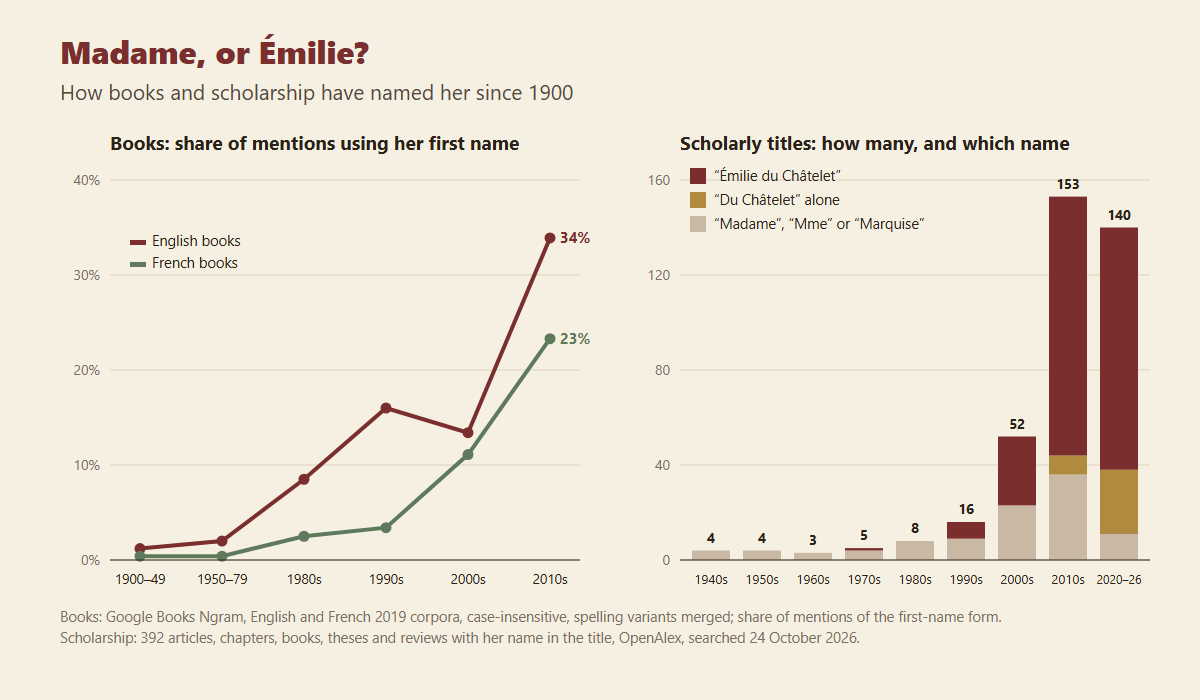
Naming her is a small act with a long history. To measure it, we used Google’s Ngram dataset, built from scanned books, and compared mentions of “Émilie du Châtelet” with “Madame”, “Mme” and “Marquise du Châtelet” in its English and French collections, which run to 2019, merging spelling and capitalisation variants.
In English books, the first-name form made up 1.2% of these mentions in 1900–1949 and 2.0% in 1950–1979. It reached 8.5% in the 1980s and 16% in the 1990s, slipped to 13% in the 2000s, then rose to 34% in the 2010s. French books moved more slowly, from 0.4% before 1980 to 23% in the 2010s. In books, “Madame” still wins.
Scholars have moved much further. Searching OpenAlex, an open index of research, on 24 October 2026, we found 392 articles, chapters, books, theses and reviews about her with “du Châtelet” in the title, after removing individual letters, archive records and works about the old Châtelet court of Paris, the Théâtre du Châtelet or other members of the family.
Of the 24 such titles from 1940 to 1989, 23 call her Madame, Mme or the Marquise and one uses Émilie. Of the 153 from the 2010s, 109 use Émilie. Of the 140 published since 2020, 102 use Émilie, 27 call her simply Du Châtelet, the way scholars write Newton or Leibniz, and only 11 call her Madame. The field has grown, too: 52 such titles in the 2000s, 153 in the 2010s and 140 from 2020 to October 2026.
Both counts are rough. Ngram depends on scanning and text recognition and counts phrases, not meanings; a writer who calls her only “Du Châtelet” is invisible to it. OpenAlex sees titles alone. The direction is still clear: the people who study her now use her name, and books written for everyone else are catching up slowly.
Original, or Voltaire’s echo?
For two centuries her reputation carried a question mark. Koenig’s charge lingered in one form or another until the mid-twentieth century, when William Barber concluded in 1967 that her thought was “essentially derivative” of a number of male contemporaries, particularly Voltaire. Others have argued for her originality, and apart from Barber that has been the dominant view since Ira O. Wade made his careful case for her intellectual independence in 1947, according to the Stanford Encyclopedia.
The strongest evidence is on her shelf. The Institutions criticises John Locke in several chapters, a distancing from Voltaire that Hagengruber calls remarkable, given how closely the two worked together. Its preface tells her son that Voltaire’s book on Newton kept within limits too narrow to spare her the subject. Its last chapter defends Leibniz against Mairan, who answered her as the Academy’s permanent secretary. And her Newton carries a commentary that works through Clairaut’s mathematics of the Earth’s shape. The title page called her the late Madame la Marquise. The people who read her now call her Émilie.
Where to read her
Her own books are free to read in scanned early editions: the 1740 Institutions, the fire essay, Mairan’s letter, the German and Italian translations and the second volume of her Newton are all linked in the sources below.
In English, Isabelle Bour and Judith Zinsser published a partial translation of the Institutions in Selected Philosophical and Scientific Writings (University of Chicago Press, 2009), and Lydia Patton translated its ninth chapter in 2014. A group at the University of Notre Dame translated the remaining chapters and posted them free online; it marked the complete translation with a conference in April 2018. The Stanford Encyclopedia entry is a thorough free introduction to her philosophy.
On this site, the Books & Legends shelf also holds our portraits of Leonhard Euler, one of the winners of the fire prize she entered, and Srinivasa Ramanujan.
Further reading:
- Iltis, C. (1971). Leibniz and the vis viva controversy. Isis 62, 21–35
- Iltis, C. (1977). Madame du Châtelet’s metaphysics and mechanics. Studies in History and Philosophy of Science 8, 29–48
- Hutton, S. (2004). Emilie du Châtelet’s Institutions de physique as a document in the history of French Newtonianism. Studies in History and Philosophy of Science 35, 515–531
- Hagengruber, R. (ed.) (2012). Emilie du Châtelet between Leibniz and Newton. Springer
- Reichenberger, A. (2018). Émilie Du Châtelet’s interpretation of the laws of motion in the light of 18th century mechanics. Studies in History and Philosophy of Science 69, 1–11
Sources
Her works and their early translations, in digitised copies:
- Du Châtelet — Institutions de physique, Paris: Prault fils, 1740 (Duke University Libraries copy and catalogue note)
- Du Châtelet — Institutions de physique, 1742 edition (Newberry Library copy)
- Du Châtelet — Dissertation sur la nature et la propagation du feu (Jagiellonian Library copy)
- Newton, trans. Du Châtelet — Principes mathématiques de la philosophie naturelle, tome second, Paris: Desaint & Saillant and Lambert, 1756 [published 1759]
- Mairan — Lettre … à Madame *** sur la question des forces vives, Paris: C.-A. Jombert, 1741, 52 pp. (Wellcome Library copy)
- Zwo Schriften … das Maaß der lebendigen Kräfte betreffend, trans. L. A. V. Gottsched, Leipzig: Breitkopf, 1741 (Bavarian State Library copy)
- Der Frau Marquisinn von Chastellet Naturlehre an Ihren Sohn, Halle and Leipzig: Renger, 1743 (Bavarian State Library copy)
- Instituzioni di fisica di madama la marchesa Du Chastellet, Giambattista Pasquali, 1743 (National Central Library of Florence copy)
- Du Châtelet — Discours sur le bonheur, critical edition by Robert Mauzi, Paris: Les Belles Lettres, 1961
Voltaire (Œuvres complètes, Garnier edition):
- Letter to the marquis d’Argenson, Lunéville, 4 September 1749 (no. 2012, vol. 37, p. 62)
- Letter to Frederick II of Prussia, Paris, 15 October 1749 (no. 2026, vol. 37, pp. 71–73)
- Éloge historique de madame la marquise du Châtelet, first printed 1752 (vol. 23, pp. 515–522)
Scholarship and translations cited:
- Detlefsen, K. — Émilie du Châtelet, Stanford Encyclopedia of Philosophy (substantive revision 13 June 2014)
- Smith, G. E. (2006). The vis viva dispute: a controversy at the dawn of dynamics. Physics Today 59(10), 31–36
- Hagengruber, R. E. (2022). Du Châtelet and Kant: claiming the renewal of philosophy. In Époque Émilienne, Springer, 57–84
- Brading, K. and the Notre Dame group — English translations of the Foundations of Physics
Data:
- Google Books Ngram Viewer — nine name forms, English 2019 corpus, case-insensitive, 1750–2019
- Google Books Ngram Viewer — the same forms, French 2019 corpus
- OpenAlex — works with “du Châtelet” in the title (1,790 records, fetched 24 October 2026)
- OpenAlex — works with “du Chatelet” in the title (66 records, fetched 24 October 2026)
Baryon. (2026, November 9). Émilie du Châtelet Translated Newton. History Kept Calling Her Madame.. Web News For Us. https://webnewsforus.com/emilie-du-chatelet-newton-principia/
Baryon. “Émilie du Châtelet Translated Newton. History Kept Calling Her Madame..” Web News For Us, 9 November 2026, https://webnewsforus.com/emilie-du-chatelet-newton-principia/. Accessed 13 November 2026.