Space · Astroparticle physics
Every second, about 65 billion neutrinos from the Sun pass through your fingernail, and not one of them leaves a mark. Francis Halzen spent more than three decades building an instrument that could catch their far rarer cousins: neutrinos flung across the universe by its most violent engines. That work has now won him the Nobel Prize in Physics.
The Royal Swedish Academy of Sciences announced the prize on 6 October 2026. It goes to Halzen, of the University of Wisconsin–Madison, “for decisive contributions to the IceCube Neutrino Observatory and the discovery of high-energy neutrinos of astrophysical origin”, and carries 12 million Swedish kronor. Halzen was born in Tienen, Belgium, in 1944, took his doctorate at KU Leuven in 1969 and has spent most of his career in Madison.
“His tenacity and scientific vision has paved the way for a new kind of astronomy,” said Mark Pearce, chair of the Nobel Committee for Physics, in the Academy’s press release. Earlier in the same Nobel week, the medicine prize went to the discovery of light-switched nerve cells; this one rewards a way of seeing the sky.
What follows explains what IceCube is, how a block of polar ice became a telescope, what it has found and how firm those findings are. It also counts something the announcements leave out: how the observatory shows up in the research literature year by year, and why a naive count of those papers misleads.
What the 2026 Physics Nobel was awarded for
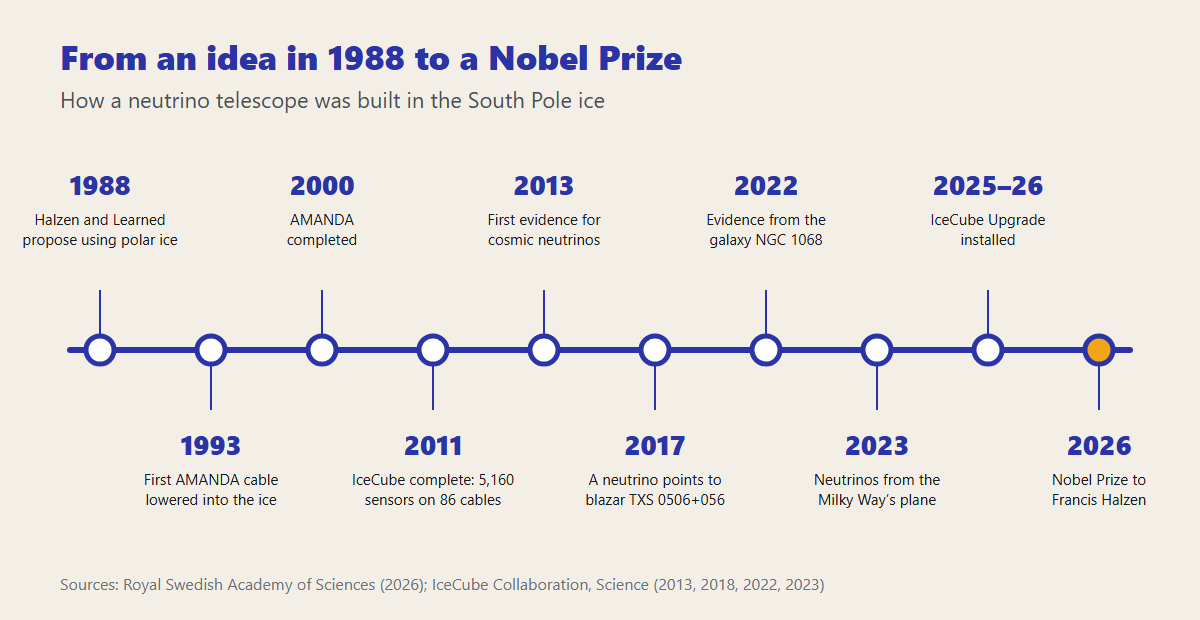
The prize honours an instrument and a discovery. The instrument is IceCube, an observatory frozen into the ice at the geographic South Pole. The discovery is that Earth is struck by high-energy neutrinos born far outside the solar system. Halzen proposed using the polar ice in the 1980s and, as principal investigator, carried the project from a sketch to a working observatory.
It is worth being clear about what changed. Before IceCube, the only individual neutrino sources astronomers had pinned down were the Sun and a supernova seen in 1987, as the IceCube collaboration itself noted in Science in 2018. IceCube added a third category: the distant, violent universe.
The collaboration that runs it now numbers about 450 scientists at 58 institutions in 14 countries, according to IceCube’s announcement of the prize.
The shyest particle in the universe
Neutrinos carry no electric charge and almost no mass. They are made in nuclear reactions inside stars, in radioactive decay and when cosmic rays strike the atmosphere. Because they barely interact with anything, almost all of them pass straight through planets, people and detectors.
That shyness is the whole point. The universe contains natural particle accelerators that fling protons and other atomic nuclei to energies up to a million times higher than any laboratory on Earth can reach, in the Nobel committee’s words. Those charged particles, called cosmic rays, are bent by magnetic fields on the way here, so by the time they arrive their direction says nothing about where they came from.
The same processes that accelerate protons should also make neutrinos. Neutrinos are not deflected and are rarely absorbed, so a high-energy neutrino points back to its birthplace. Gamma rays carry similar clues, but they can be absorbed along the way. Catch enough neutrinos and you can start to locate the accelerators, even ones hidden behind dust and gas that block ordinary light.
The catch is numbers. Cosmic neutrinos at the highest energies are rare, and only a tiny fraction of those crossing a detector ever collide with anything. Seeing even a handful a year requires an enormous volume of transparent material, watched by light sensors.
An idea sketched in 1988
Using natural water to catch neutrinos was first suggested around 1960. A neutrino that does hit an atomic nucleus produces a charged particle travelling in roughly the same direction, and that particle gives off a faint blue light. In clear water the light can be seen, and its pattern reveals the direction.
In the 1980s Halzen heard that Soviet researchers planned to listen for radio pulses from neutrino collisions in the Antarctic ice. He wondered whether light sensors frozen into the ice might work better. He talked it through with John G. Learned, who was working on DUMAND, a project to catch neutrinos in the deep ocean off Hawaii, and in 1988 the two presented a concept for a South Pole neutrino observatory at a conference in Poland, according to the Nobel committee’s popular science background.
The South Pole had practical advantages. A research station already operated there, with regular flights and support. Deep down the ice is permanently dark, free of the glowing marine life that troubles ocean detectors, low in radioactivity and geologically stable, with no earthquakes. The drawback is access: all construction has to happen in the brief Antarctic summer, roughly November to February.
Learned went back to his own project, and the idea might have stopped there. Instead, within a few years, researchers from several institutions had gathered around Halzen to try it.
AMANDA: learning what the ice could do
The first problem was how to put instruments a kilometre or more into a glacier. Glaciologists had an answer: a hot-water drill, in effect a sophisticated shower head that melts its way down. A cable strung with light sensors is lowered into the water-filled hole, which then freezes around it. Halzen has described each sensor as a lightbulb in reverse, turning light into an electrical signal.
After tests in the Greenland ice, the team began building a first detector at the Pole, called AMANDA. The first attempts to lower sensors into the glacier came in 1992, and Halzen has recalled sitting at the dinner table on Christmas Eve 1993, laptop on his knees, waiting for word that the first cable of optical modules was in place.
The early results were disappointing. The upper ice was full of air bubbles that scattered light in every direction and smeared out the information about each particle’s path. Deeper, the news was far better: below about 1,400 metres the ice was so pure that a flash could travel some 300 metres before being absorbed, much further than anyone had expected. One by-product of the neutrino hunt is a detailed picture of how ice behaves at different depths.
AMANDA was completed in January 2000. It worked as designed, but it was too small to catch the high-energy neutrinos from cosmic accelerators. The answer was to go much bigger.
Building a cubic kilometre
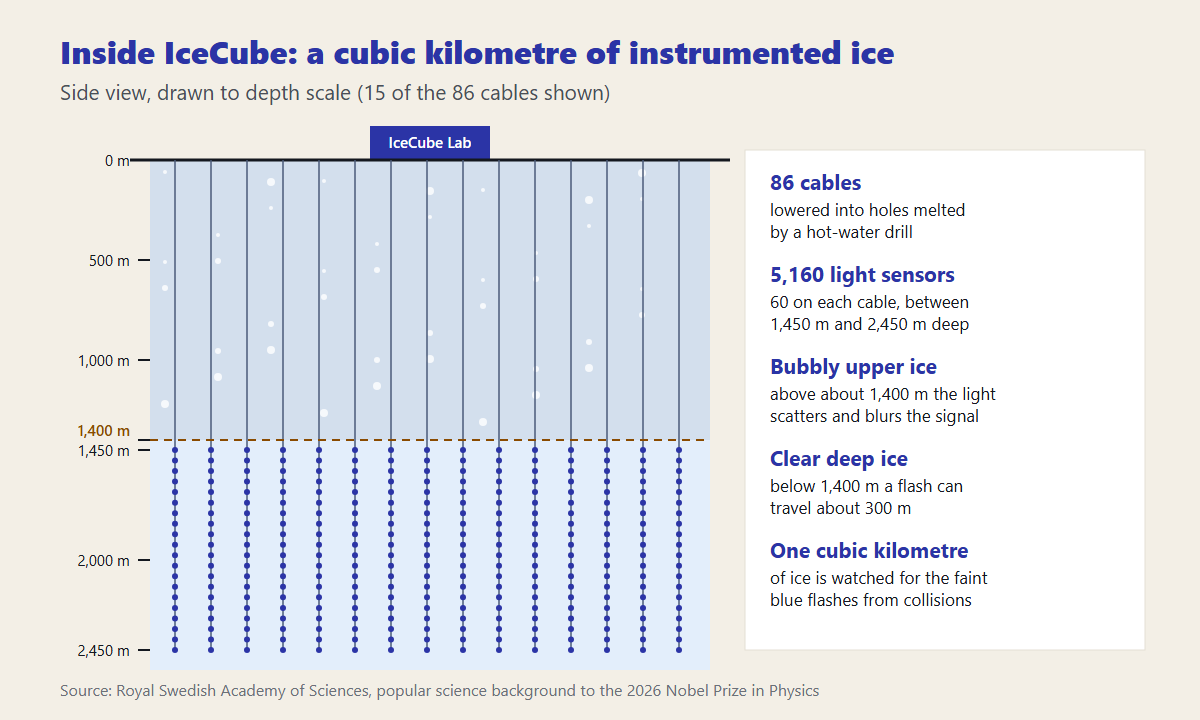
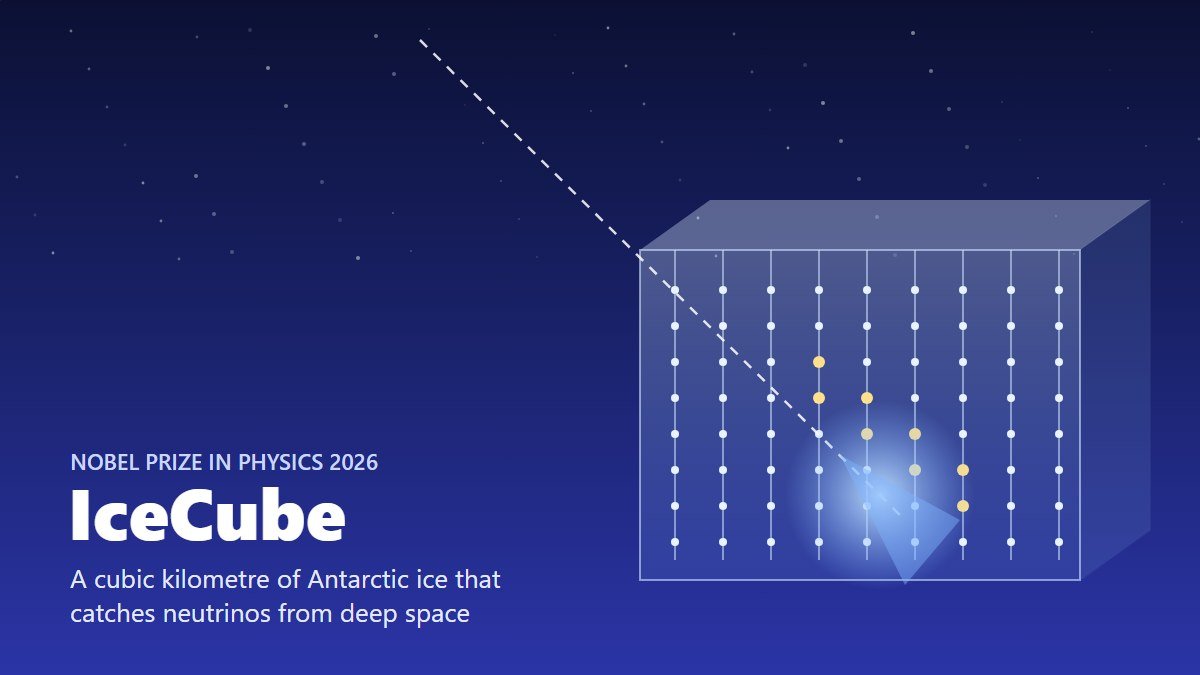
IceCube instruments a full cubic kilometre of ice. Its 5,160 light sensors hang on 86 cables, sixty to a cable, at depths between 1,450 and 2,450 metres. On the surface, the IceCube Laboratory gathers the data. The observatory reached its full size in 2011.
Each hole had to be melted and each cable lowered during an Antarctic summer, so construction ran over several seasons. The collaboration’s technical description of the finished instrument, published in 2017, sets out the electronics, timing and calibration in detail, a reminder of how much engineering sits behind the physics.
IceCube is a facility of the US National Science Foundation, operated by the University of Wisconsin–Madison. Its research is also funded by agencies in Australia, Belgium, Canada, Denmark, Germany, Italy, Japan, New Zealand, South Korea, Sweden, Switzerland, Taiwan and the United Kingdom.
How a neutrino becomes a flash of light
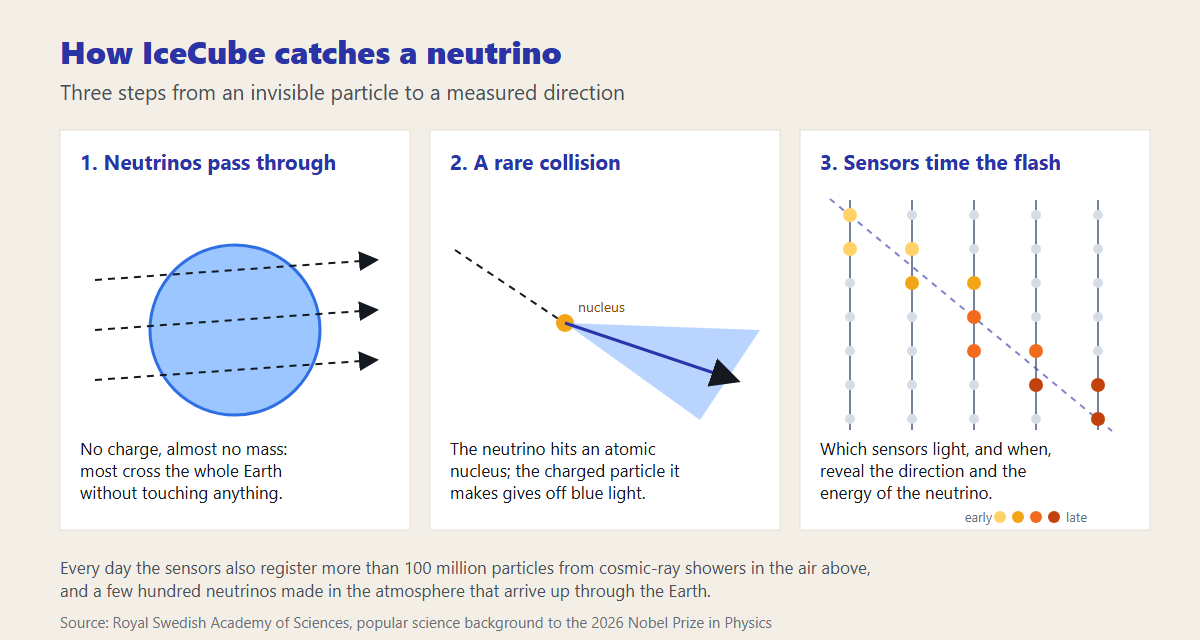
Almost every neutrino that crosses IceCube leaves no trace. Very rarely one strikes an atomic nucleus in the ice. The collision creates a charged particle that moves faster than light travels through ice and, a little like a boat outrunning its own bow wave, gives off a cone of blue light.
The sensors record when the light arrives and how bright it is. From that pattern of timings across thousands of sensors, computers reconstruct the direction the neutrino came from and how much energy it carried.
The hard part is everything else. Every day the sensors register more than 100 million particles from cosmic-ray showers in the air above Antarctica, and a few hundred neutrinos made in the atmosphere arrive by travelling up through the Earth from the northern hemisphere. Cosmic neutrinos have to be picked out from under all of that, which is why researchers judge them as a population: a single event can rarely be proven to be cosmic, but a set of events whose energies, directions and types do not fit the atmospheric pattern can.
2013: the first neutrinos from beyond the solar system
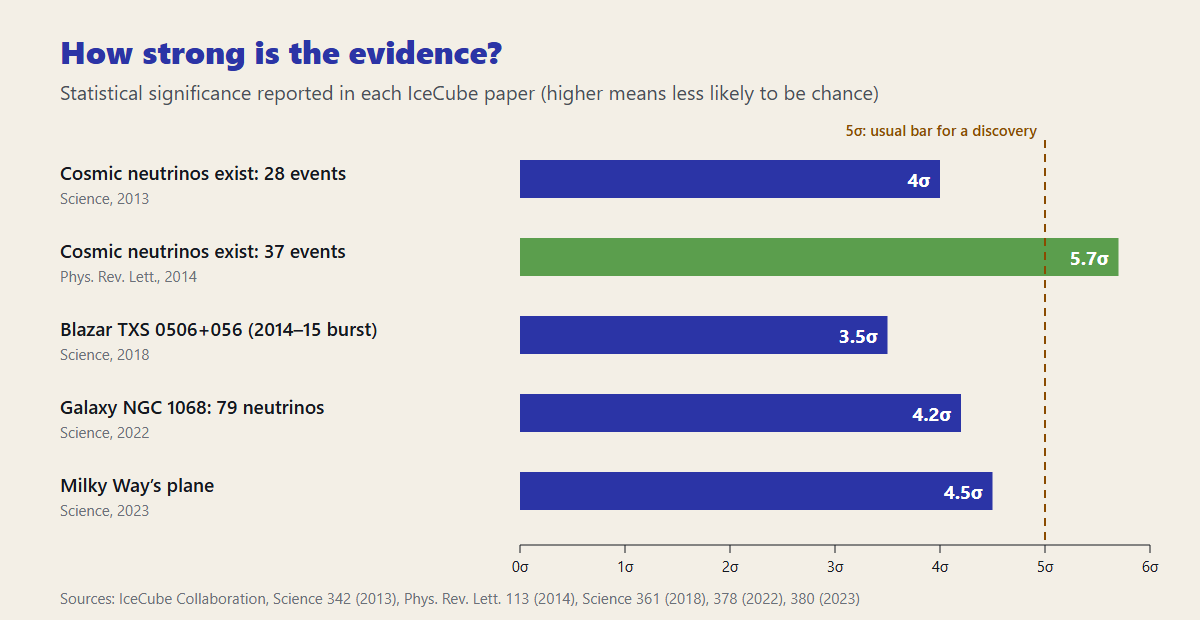
IceCube’s first breakthrough came from data recorded between May 2010 and May 2012, while construction was still being finished. Two events above a petaelectronvolt, a million billion electronvolts, had already turned up. A follow-up search found 26 more above about 30 teraelectronvolts. In November 2013 the collaboration reported in Science that the 28 events rejected a purely atmospheric origin at the 4σ level and fitted the expectation for a component of extraterrestrial origin.
A sigma (σ) measures how surprising a result would be if nothing new were going on. At 4σ, a fluke that large would turn up by chance roughly once in 30,000 tries. Particle physicists usually wait for 5σ, about one chance in 3.5 million, before calling something a discovery.
That bar was cleared the following year. With a third year of data from the complete detector, 988 days in all, IceCube counted 37 candidate events with energies from 30 to 2,000 teraelectronvolts and rejected a purely atmospheric explanation at 5.7σ, as reported in Physical Review Letters. The 2,000-teraelectronvolt event was then the highest-energy neutrino interaction ever observed. The flux was spread evenly across the sky and among the three neutrino types, a hint that it came from many sources rather than one.
Tracking down the sources
Knowing that cosmic neutrinos exist is different from knowing where they come from. Three results stand out.
On 22 September 2017 IceCube detected a neutrino of about 290 teraelectronvolts, catalogued as IceCube-170922A. Its direction matched TXS 0506+056, a blazar, which is a galaxy whose central black hole fires a jet towards Earth, and the blazar happened to be flaring in gamma rays. Telescopes from radio to gamma rays followed up, as described in one Science paper. Searching back through 9.5 years of archived data, IceCube then found an excess of neutrinos from the same direction between September 2014 and March 2015, at 3.5σ and independent of the 2017 flare, reported in a second paper. For more on how such jets form, see our guide to black holes.
In November 2022, using data from 2011 to 2020 and improved methods, IceCube reported an excess of about 79 neutrinos from NGC 1068, also known as Messier 77, an active galaxy about 47 million light-years away in the constellation Cetus, at a significance of 4.2σ (Science; IceCube release). The neutrino flux was at least ten times larger than the galaxy’s possible teraelectronvolt gamma-ray flux. That fits a source buried in gas and dust that traps light but lets neutrinos out.
In June 2023, applying machine learning to ten years of data, IceCube identified high-energy neutrinos from the plane of the Milky Way at 4.5σ (Science). The signal fits models in which cosmic rays collide with the thin gas between the stars, though a population of unresolved sources could also produce it.
None of the three reaches 5σ. The Nobel committee’s own background text is candid about NGC 1068, saying the evidence is not yet robust enough to identify the galaxy definitively as a neutrino source. The flux found in 2013 is firmly established; most of it still has no identified home.
What the paper trail shows
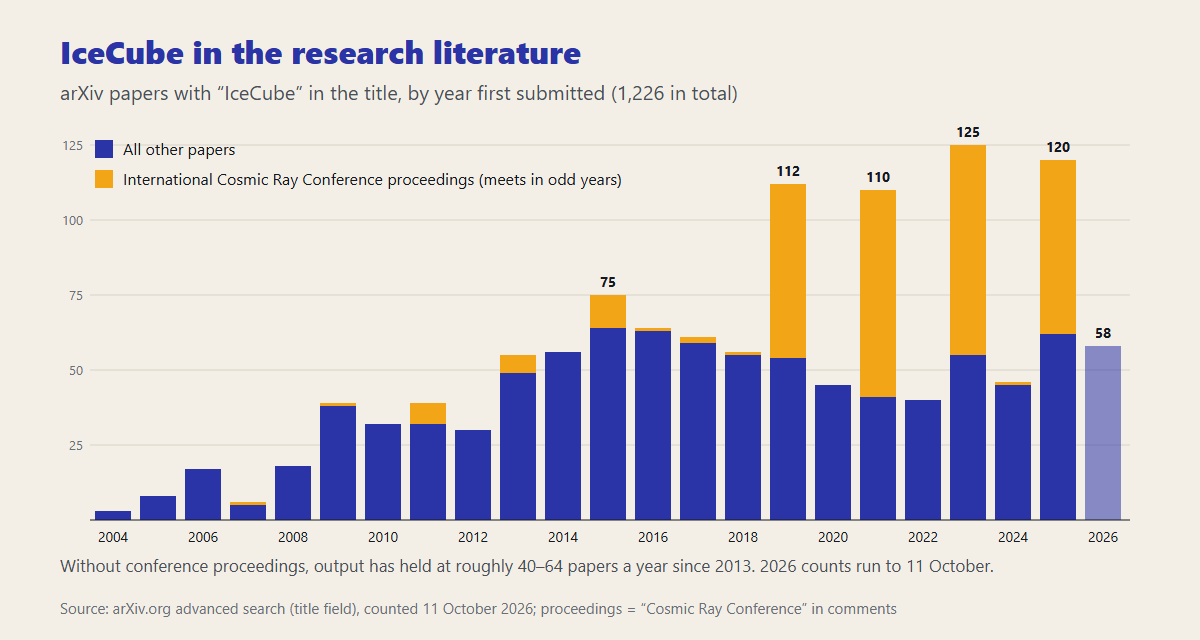
To see how IceCube has fed into research, we counted papers on arXiv, the open repository where physicists post their work, with the word “IceCube” in the title, by the year each was first submitted. On 11 October 2026 the count stood at 1,226.
The yearly totals climb from 3 in 2004 to 75 in 2015, then start to zigzag: 112 in 2019, 45 in 2020, 110 in 2021, 40 in 2022, 125 in 2023, 46 in 2024 and 120 in 2025. Taken at face value, that looks like a boom that comes and goes.
The zigzag has a simple cause. The International Cosmic Ray Conference meets in odd-numbered years, and the arXiv record shows that from 2019 onwards conference contributions about IceCube were posted there one by one. Papers whose arXiv comments name the conference number 58 in 2019, 69 in 2021, 70 in 2023 and 58 in 2025, against none or one in each year between. Before 2019 the most in any year was 11, in 2015.
Take the proceedings out and the picture flattens. Since 2013, the year of the first evidence, the remaining papers have run at roughly 40 to 64 a year: 49 in 2013, 64 in 2015, 54 in 2019, 40 in 2022 and 62 in 2025. The 2026 count had reached 58 by 11 October.
Title counts are a blunt tool. They miss papers that use IceCube data without naming it in the title, they include theorists’ papers that mention the detector without being written by the collaboration, and they say nothing about quality. What they do show is that research built on IceCube has been steady rather than booming since the discovery, and that spikes in this kind of count can be artefacts of a conference calendar. A chart of “IceCube papers per year” that ignores the conference would show a surge that is not really there.
A record neutrino from the Mediterranean
IceCube is no longer alone. On 13 February 2023 the ARCA detector of the KM3NeT telescope, about 3,450 metres down in the Mediterranean off Portopalo di Capo Passero in Sicily, recorded a muon with an estimated energy of 120 petaelectronvolts while only 21 of its detection lines were running. The collaboration reported the event, KM3-230213A, in Nature in February 2025.
A muon that energetic must have come from a neutrino of even higher energy. Simulations put the most likely neutrino energy at about 220 petaelectronvolts, with 90% of simulated cases between 72 petaelectronvolts and 2.6 exaelectronvolts, far above any neutrino detected before.
There is a puzzle. IceCube and the Pierre Auger Observatory have reported no neutrinos above tens of petaelectronvolts. A follow-up analysis by the KM3NeT collaboration put the tension between the Mediterranean event and those null results at about 2.5 to 3σ. Either the event was a lucky catch from a rare population, or something about neutrinos at the very highest energies is not yet understood. Only more data will tell.
Neutrinos and the Nobel Prize
Halzen’s prize continues a line of neutrino Nobels. Raymond Davis Jr and Masatoshi Koshiba were honoured in 2002 for detecting neutrinos from the Sun and, in Koshiba’s case, from the supernova that exploded in the Large Magellanic Cloud in 1987. Supernovae are the violent deaths of massive stars, a story told in our guide to stellar evolution.
Davis’s experiment counted only about a third of the solar neutrinos that theory predicted. The explanation, that neutrinos switch between three types on the way, earned Takaaki Kajita and Arthur B. McDonald the 2015 prize. Last year’s physics prize went to a different frontier entirely, quantum effects in electrical circuits.
The 2026 prize differs in kind. Davis and Koshiba showed that neutrinos could be used to study the Sun and a nearby supernova. IceCube showed that they can be used to study the distant universe.
What comes next
In the 2025–26 Antarctic summer the IceCube Upgrade was installed. It is designed to lower the energy threshold and to calibrate the ice more precisely, which should sharpen the reconstructed direction of every neutrino. The collaboration expects the first science data later in 2026, according to IceCube.
The bigger plan is IceCube-Gen2: an optical array with eight times IceCube’s volume, plus radio detection to reach even higher energies. In December 2023 the US Particle Physics Project Prioritization Panel, known as P5, recommended that the United States fund it (IceCube). A recommendation is not a budget, and IceCube still describes Gen2 as proposed.
Other neutrino telescopes, using water rather than ice, are being developed in Lake Baikal, in the Mediterranean, in the South China Sea and off the west coast of Canada. The project that first inspired Halzen, DUMAND, ended in 1995, but its lessons live on in these successors.
What IceCube cannot tell us yet
It cannot yet name the sources of most cosmic neutrinos. The diffuse flux discovered in 2013 is firmly established, but the leading candidates are still at the level of evidence, and the origin of most of the flux remains open.
It cannot produce pictures. Neutrino directions are far less precise than telescope images, so a match with a galaxy is a statistical association rather than a photograph of the source.
It cannot settle the highest-energy puzzle on its own. The KM3NeT event sits awkwardly against IceCube’s null results, and resolving that needs bigger detectors and more years of data.
And it has not yet shown exactly how the cosmic accelerators work. After the NGC 1068 result, Halzen described the roughly 80 neutrinos collected from the galaxy as a step towards neutrino astronomy but not yet enough to answer all the open questions.
Who is Francis Halzen
Halzen grew up in Belgium and was drawn to particle physics by the discoveries of the 1960s, working first on particles built from quarks. Soon after his doctorate he moved to the University of Wisconsin–Madison, where he is Vilas Research Professor and Gregory Breit Professor.
Over time he became interested in what particles from space could teach particle physics, and what particle physics could do for astronomy. As principal investigator he carried first AMANDA and then IceCube from the idea stage to finished measurements, in the Nobel committee’s description.
“It’s a great relief for me to finally deliver the recognition that this great collaboration deserves,” Halzen said on the day of the announcement, in remarks released by IceCube.
Why this prize matters
Neutrino astronomy began with a question about how the Sun shines. It now reaches galaxies tens of millions of light-years away, and it can see into places, such as the dust-shrouded heart of NGC 1068, that ordinary telescopes cannot.
The way it got there is as instructive as the result: a bold idea, a hostile environment, decades of patient engineering, early disappointments with bubbly ice, and an international collaboration funded by many countries. The prize goes to one person. The observatory, as Halzen himself said, belongs to many.
Frequently asked questions
Who won the 2026 Nobel Prize in Physics?
Francis Halzen of the University of Wisconsin–Madison, “for decisive contributions to the IceCube Neutrino Observatory and the discovery of high-energy neutrinos of astrophysical origin”. The Royal Swedish Academy of Sciences announced the prize on 6 October 2026, and it carries 12 million Swedish kronor.
What is IceCube?
A neutrino telescope at the geographic South Pole. It uses 5,160 light sensors on 86 cables, frozen into the ice between 1,450 and 2,450 metres deep, to watch a cubic kilometre of ice for the blue flashes made when neutrinos collide with atomic nuclei. It reached its full size in 2011.
Why are neutrinos so hard to catch?
They have no electric charge and almost no mass, so they rarely interact with matter. About 65 billion solar neutrinos pass through a fingernail every second without effect. Only a huge detector can catch the rare collisions of high-energy cosmic neutrinos.
What has IceCube discovered?
Neutrinos from beyond the solar system: first evidence in 2013 (4σ) and an observation at 5.7σ in 2014. It has since reported evidence of neutrinos from the blazar TXS 0506+056 (3.5σ), the galaxy NGC 1068 (4.2σ) and the plane of the Milky Way (4.5σ).
Why build a telescope in Antarctic ice?
Deep polar ice is dark, extremely clear below about 1,400 metres, low in radioactivity and geologically stable, and the South Pole already had a research station. Light from a neutrino collision can travel about 300 metres through the deep ice.
What comes next for neutrino astronomy?
The IceCube Upgrade, installed in 2025–26, is expected to deliver its first science data later in 2026. IceCube-Gen2, with eight times the volume, has been recommended for US funding but is still a proposal. Water-based telescopes such as KM3NeT in the Mediterranean are growing too.
Sources
Nobel Prize documentation:
- The Nobel Prize in Physics 2026 – press release (Royal Swedish Academy of Sciences, 6 October 2026)
- NobelPrize.org – Popular science background: Ice at the South Pole reveals cosmic particle accelerators
- NobelPrize.org – Scientific background to the Nobel Prize in Physics 2026
Primary peer-reviewed research:
- IceCube Collaboration (2013). Evidence for high-energy extraterrestrial neutrinos at the IceCube detector. Science 342, 1242856
- IceCube Collaboration (2014). Observation of high-energy astrophysical neutrinos in three years of IceCube data. Phys. Rev. Lett. 113, 101101
- IceCube Collaboration et al. (2018). Multimessenger observations of a flaring blazar coincident with high-energy neutrino IceCube-170922A. Science 361, eaat1378
- IceCube Collaboration (2018). Neutrino emission from the direction of the blazar TXS 0506+056 prior to the IceCube-170922A alert. Science 361, 147–151
- IceCube Collaboration (2022). Evidence for neutrino emission from the nearby active galaxy NGC 1068. Science 378, 538–543
- IceCube Collaboration (2023). Observation of high-energy neutrinos from the Galactic plane. Science 380, 1338–1343
- KM3NeT Collaboration (2025). Observation of an ultra-high-energy cosmic neutrino with KM3NeT. Nature 638, 376–382
- IceCube Collaboration (2017). The IceCube Neutrino Observatory: instrumentation and online systems. JINST 12, P03012
Preprints and data:
- KM3NeT Collaboration (2025). The ultra-high-energy event KM3-230213A within the global neutrino landscape. arXiv:2502.08173
- arXiv.org – papers with “IceCube” in the title (searched 11 October 2026)
Institutional sources:
- IceCube Neutrino Observatory – Francis Halzen, IceCube principal investigator, wins 2026 Physics Nobel Prize (6 October 2026)
- IceCube Neutrino Observatory – IceCube neutrinos give us first glimpse into the inner depths of an active galaxy (November 2022)
- IceCube Neutrino Observatory – Federal physics advisory panel recommends funding next-generation IceCube observatory (December 2023)
Baryon. (2026, October 11). 2026 Nobel Prize in Physics: How IceCube Caught Neutrinos from Deep Space. Web News For Us. https://webnewsforus.com/2026-nobel-prize-in-physics-icecube-neutrinos/
Baryon. “2026 Nobel Prize in Physics: How IceCube Caught Neutrinos from Deep Space.” Web News For Us, 11 October 2026, https://webnewsforus.com/2026-nobel-prize-in-physics-icecube-neutrinos/. Accessed 11 October 2026.