Science · Chemistry
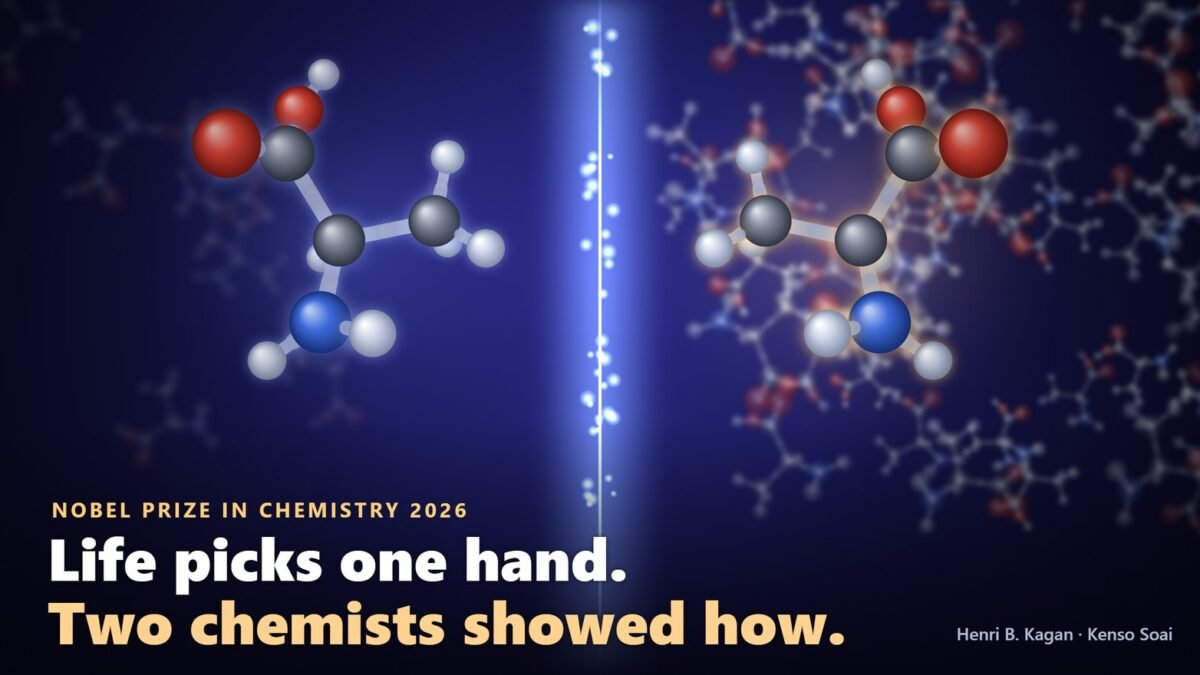
The amino acids that build your proteins are all left-handed, apart from one, glycine, which has no handedness at all. Make those molecules in a flask and you get left- and right-handed versions in equal measure. How a chemical reaction can tip that balance, and then keep tipping it until one hand wins, has now won the Nobel Prize in Chemistry.
The Royal Swedish Academy of Sciences announced the prize on 7 October 2026. It goes to Henri B. Kagan of the then Université Paris-Sud in France and Kenso Soai of the Tokyo University of Science in Japan, “for the discovery of non-linear effects and autocatalysis in asymmetric organic synthesis”, and the 12 million Swedish kronor is shared equally. Kagan was born in 1930 in Boulogne-Billancourt and took his doctorate at the Collège de France in 1960. Soai was born in 1950 in Hiroshima and took his at the University of Tokyo in 1979. Both are now emeritus professors.
“Henri Kagan and Kenso Soai have provided a solution to a chemical mystery that is over a century old: how homochirality can emerge spontaneously,” said Heiner Linke, chair of the Nobel Committee for Chemistry, in the Academy’s press release. The chemistry prize closed a science week that began with the medicine prize for optogenetics and continued with the physics prize for the IceCube neutrino observatory.
What follows explains what chirality is, what the two laureates discovered, why drug makers care and what the prize does not settle. It also checks two things the announcements pass over quickly: the thalidomide story that is often told alongside chirality, and how far the Soai reaction has travelled beyond the laboratory that found it. The publication record gives a striking answer to the second.
What the 2026 Chemistry Nobel was awarded for
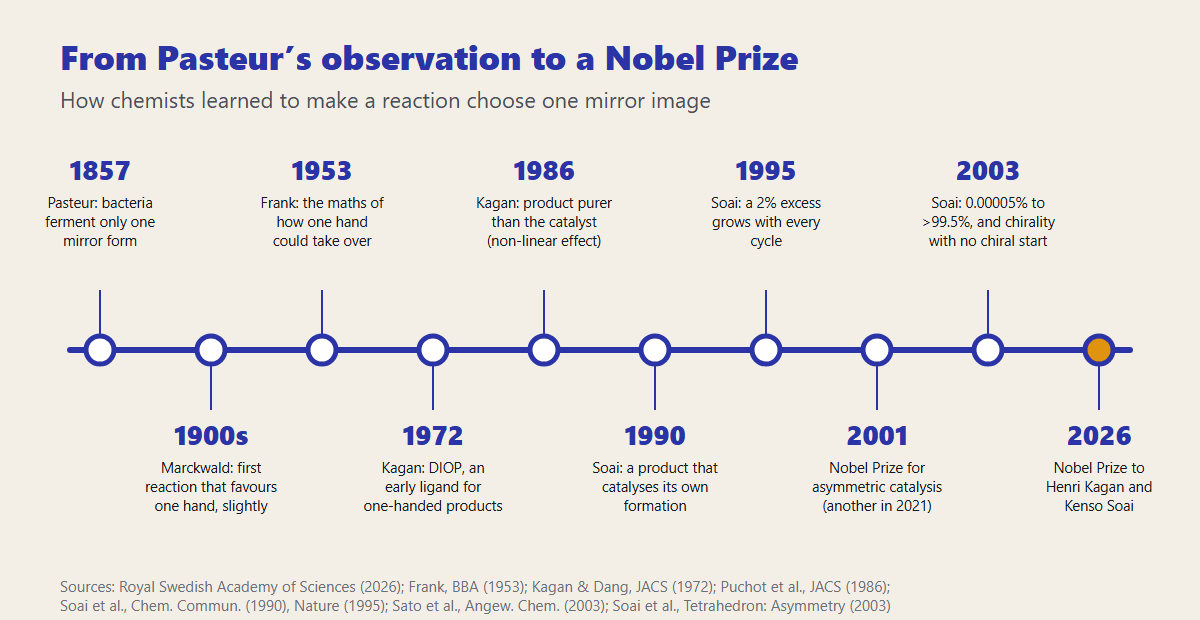
The prize rewards two linked discoveries. In 1986 Kagan showed that the chiral ingredient in a catalyst and the product it makes need not be equally pure: the product can be more lopsided than the catalyst. In 1995 Soai described a reaction whose product is also its own catalyst, so that a small lead for one mirror image grows each time the reaction is repeated. In 2003 his group pushed this to its limit.
The Nobel committee frames the two discoveries as the completion of a thought experiment published in 1953. That model said a chemical system could become entirely one-handed if three things came together: a catalyst that favours one mirror image, a way of suppressing the other, and a product that catalyses its own formation. Catalysts that favour one mirror image were honoured with the chemistry prizes of 2001 and 2021. Kagan supplied the second ingredient and Soai combined all three, in the committee’s account in its popular science background.
Left hands and right hands
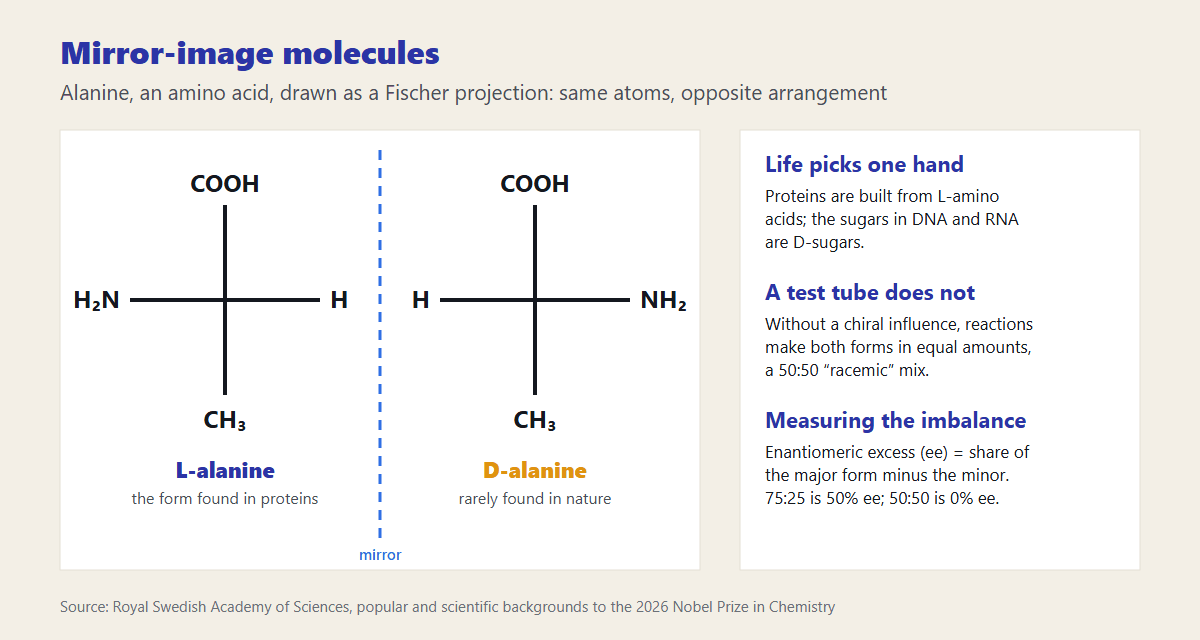
Hold your hands palm to palm and they match; lay one on top of the other and they do not. Many molecules behave the same way. They come in two forms with identical atoms and bonds, arranged as mirror images that cannot be superimposed. Chemists call such molecules chiral, and the two forms enantiomers.
The idea goes back to Louis Pasteur, who noticed that crystals of tartaric acid, a substance important in winemaking, came in two mirror-image shapes. He separated them with tweezers and found that solutions of one bent polarised light to the right and the other to the left, while a mixture left the light unaffected. In 1857 he went further: bacteria fermented the form found in grapes and left its mirror image untouched. That was the first hint that the chemistry of life is lopsided.
It is lopsided throughout. Every amino acid in your proteins that has a handedness is the left-handed form, written L, and the sugars in the backbones of DNA and RNA are all right-handed, written D. Chemists call this homochirality, from the Greek for “same” and “hand”. The mirror-image amino acids are rare in nature.
A flask behaves differently. When a reaction makes a chiral molecule from ingredients that are not chiral, and nothing chiral steers it, the two forms come out in equal amounts, a 50:50 “racemic” mixture. Chemists measure any imbalance as the enantiomeric excess, or ee: the share of the major form minus the share of the minor. A 75:25 mixture has an ee of 50%, and a racemic mixture has an ee of zero.
The imbalance matters because living things are built from one hand and respond to molecules accordingly. Many drug molecules exist in two mirror forms, and the committee notes that one can have the therapeutic effect while the other causes unnecessary and sometimes harmful side effects. The same applies to flavours, scents and agricultural chemicals, where the two forms of a molecule can smell, taste or act differently.
The thalidomide story, told more carefully
Accounts of chirality often reach for thalidomide, a sedative that caused birth defects in thousands of children in the early 1960s. The committee’s popular background repeats the usual version: when researchers analysed what had happened, they realised that it was the active substance’s mirror image that caused the harm.
That version needs a qualification. In 1995 a team at Malmö General Hospital in Sweden gave healthy volunteers each mirror form of thalidomide separately and measured what happened in their blood. The forms converted into each other rapidly in the body, with rate constants of 0.17 per hour in one direction and 0.12 per hour in the other. The authors concluded, in Chirality, that putative differences between the two forms “would to a large extent be abolished by rapid interconversion in vivo”.
In other words, selling only the “good” form would not have made thalidomide safe, because the body makes the other one from it within hours. The general lesson about mirror-image drugs holds; the textbook example of it is less clean than it is usually made to sound.
A puzzle set in 1953
For decades after Pasteur, some chemists thought one-handed chemistry might be unique to life. In the early 1900s the German chemist Willy Marckwald ran the first reaction that produced slightly more of one mirror image than the other, using a chiral catalyst. The difference was tiny, but it showed that ordinary chemistry could be nudged.
Nudging is not the same as choosing. In 1953 Charles Frank, a theoretical physicist at the University of Bristol, published a short paper, “On spontaneous asymmetric synthesis”, in Biochimica et Biophysica Acta. He described a substance that catalyses its own production and works against the production of its mirror image. In such a system a small random fluctuation in an initially even mixture would be amplified until one form dominated.
Frank closed with a laconic line the Nobel committee quotes: “A laboratory demonstration may not be impossible.” It took 42 years. His model became a kind of puzzle that lecturers set their students, the committee writes: how could these conditions be turned into real chemistry?
Kagan’s insight: a catalyst that pairs up
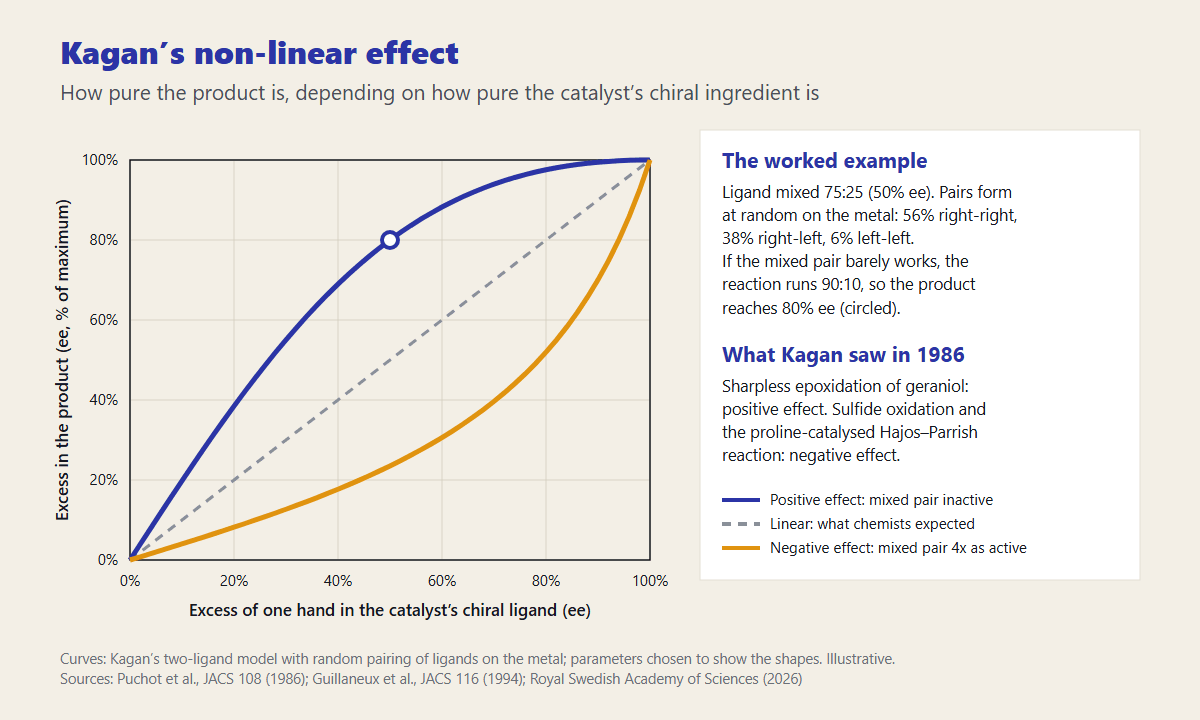
By the early 1980s chemists could build catalysts that favoured one mirror image, typically from a metal atom, which drives the reaction, and a chiral molecule called a ligand, which steers it. To get the purest possible product they used the purest possible ligand, on the assumption that the two were linked in a straight line. A ligand with an ee of 50% should give a product with half the maximum excess.
Kagan doubted it. Metal atoms usually bind several molecules at once, so he reasoned that the metal in such a catalyst might hold two ligands. If the ligand was a mixture of both hands, three kinds of catalyst would form: right-right, left-left and the mixed right-left. The two matched pairs would make opposite products. Everything depended on what the mixed pair did.
The committee’s background works through an example. Mix the ligand 75:25 and let the pairs form at random: 56% are right-right, 38% right-left and 6% left-left. If the mixed pair barely works, the reaction is driven almost entirely by the matched pairs, in a ratio of about 90 to 10. The product then has an excess of about 80% instead of the 50% the straight line predicts.
In 1986 Kagan and his co-workers Puchot, Samuel, Duñach, Zhao and Agami tested three reactions, as reported in the Journal of the American Chemical Society. None was linear. The Sharpless epoxidation of geraniol, named after Barry Sharpless, one of the few people to have won two Nobel Prizes, gave a positive effect, a product purer than expected. The oxidation of a sulfide and the proline-catalysed Hajos–Parrish reaction gave negative effects, a product less pure than expected. A simple model with a correction factor for the mixed catalyst reproduced both kinds of curve.
Kagan had contemplated the possibility as early as the late 1960s, according to the committee. In 1994 his group extended the model to catalysts carrying three or four ligands and to a “reservoir effect”, in which inactive mixed complexes soak up the minority hand (JACS, 1994). That paper also predicted a “hyperpositive” effect, in which the product could outdo even a fully pure catalyst. The first experimental example was reported only in 2020, in Nature Catalysis, and the committee notes that it works by a different mechanism from the one Kagan modelled.
Why chemists use non-linear effects every day
The first use is as a diagnostic. If a plot of product purity against ligand purity is a straight line, the active catalyst probably carries one ligand; if it curves, more than one ligand is involved in the step that decides the outcome. Chemists now widely use this test when they work out how a new asymmetric reaction operates, and later researchers, notably Donna Blackmond, extended Kagan’s mathematics to reaction rates.
The second use is practical amplification. Ryoji Noyori’s group found that in one zinc reaction a ligand with only 15% excess gave a product with 98% excess, because the mixed pairs lock each other away in an inactive form (JACS, 1989). Chemists at Merck, making an experimental drug candidate called L-699,392, used a reducing agent prepared from α-pinene of only 70% optical purity and still obtained the product with 95% ee, an example the committee highlights.
For industry, that means a cheaper, less pure chiral starting material can sometimes deliver a very pure product. The committee calls non-linear effects vital for every company that makes substances meant to interact with living things, from pharmaceuticals to flavours, scents and crop chemicals. A comprehensive review in Angewandte Chemie, co-written by Kagan, catalogued the many examples found in the two decades after 1986.
Soai’s reaction: a molecule that makes more of itself
Soai came to the problem through a reaction that adds zinc reagents to aldehydes, a family of reactions known for strong non-linear effects. Looking at the structures, he noticed that the catalyst and the product resembled each other. Could the product be made to serve as its own catalyst?
In 1990 his group added diisopropylzinc to pyridine-3-carbaldehyde with a catalyst prepared from the product alcohol itself (Chemical Communications). The reaction made more of its own catalyst while favouring that catalyst’s hand, the first asymmetric autocatalysis on record, but the purity fell rather than rose: a catalyst with 86% excess gave a product with 35%. Two of Frank’s conditions were met; the amplifying one was not.
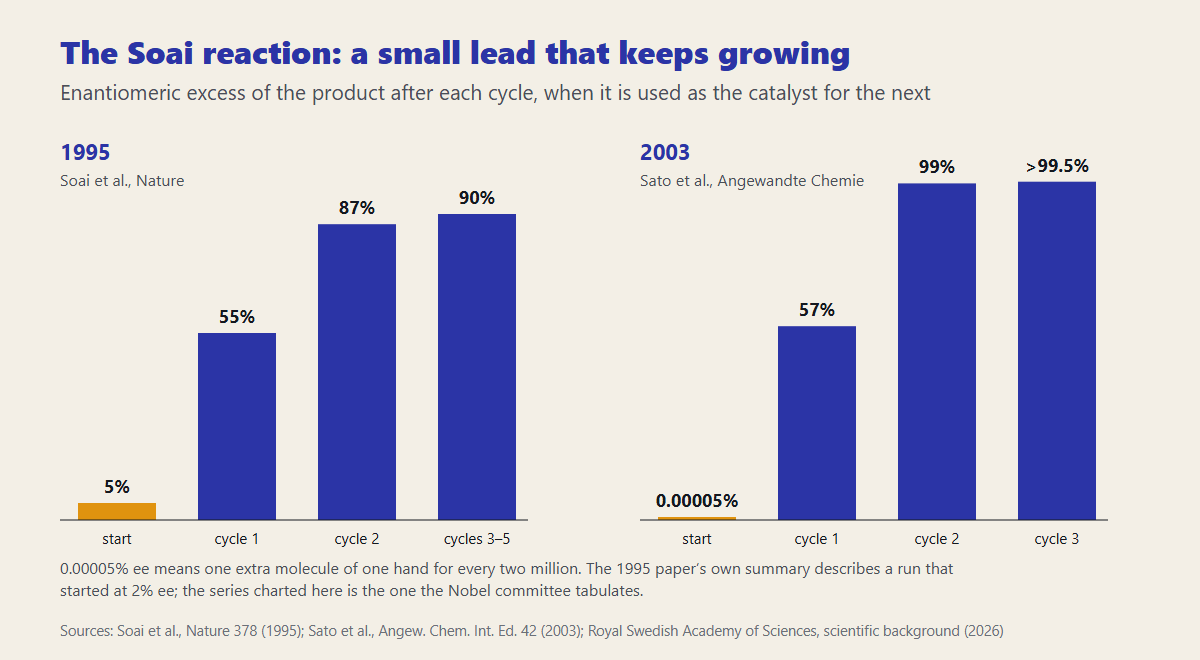
Five years later the group switched to a closely related molecule, a pyrimidine. Their report in Nature, written with Takanori Shibata, Hiroshi Morioka and Kaori Choji, describes a 5-pyrimidyl alkanol with a small excess, 2%, that generated more of itself with a higher excess. The committee’s scientific background tabulates a series from the same work that began at 5%: 55% after one cycle, 87% after two, levelling off at 90% after five.
Why amplification needs more than self-copying is easy to see. If a perfectly pure catalyst makes a product with 90% excess, and that product is used as the next catalyst, the excess slips to 81%, then lower, the committee points out. Only when the majority form also suppresses its rival, as Frank required, does the excess grow instead of decay.
In 2003 the group reported the most dramatic version in Angewandte Chemie. Starting from an excess of just 0.00005%, which amounts to one extra molecule of one hand for every two million, three cycles produced 57%, then 99%, then more than 99.5%. The reaction is now known simply as the Soai reaction.
Chirality from nothing at all
The deepest test is to add nothing chiral at all. If the starting mixture is perfectly even, random fluctuations will still leave one hand very slightly ahead at the molecular scale, and a sufficiently sensitive amplifier should seize on it. The outcome should then be random: sometimes one hand, sometimes the other.
That is what happened. In a Tetrahedron: Asymmetry paper in 2003, Soai’s group reported 37 runs of the reaction without any chiral additive. Eighteen ended with an excess of one form and 19 with the other, with excesses between 15% and 91%. Daniel Singleton and Loan Vo at Texas A&M University reached the same conclusion independently with a related version of the reaction (JACS, 2002).
The near-even split matters as much as the excesses. It shows that no hidden chiral impurity was choosing the winner; chance chose it, and the reaction locked the choice in. That is the behaviour Frank had predicted on paper half a century earlier. Later work showed that weak chiral influences, such as circularly polarised light or chiral crystals and minerals, can also steer which hand wins.
What the paper trail shows
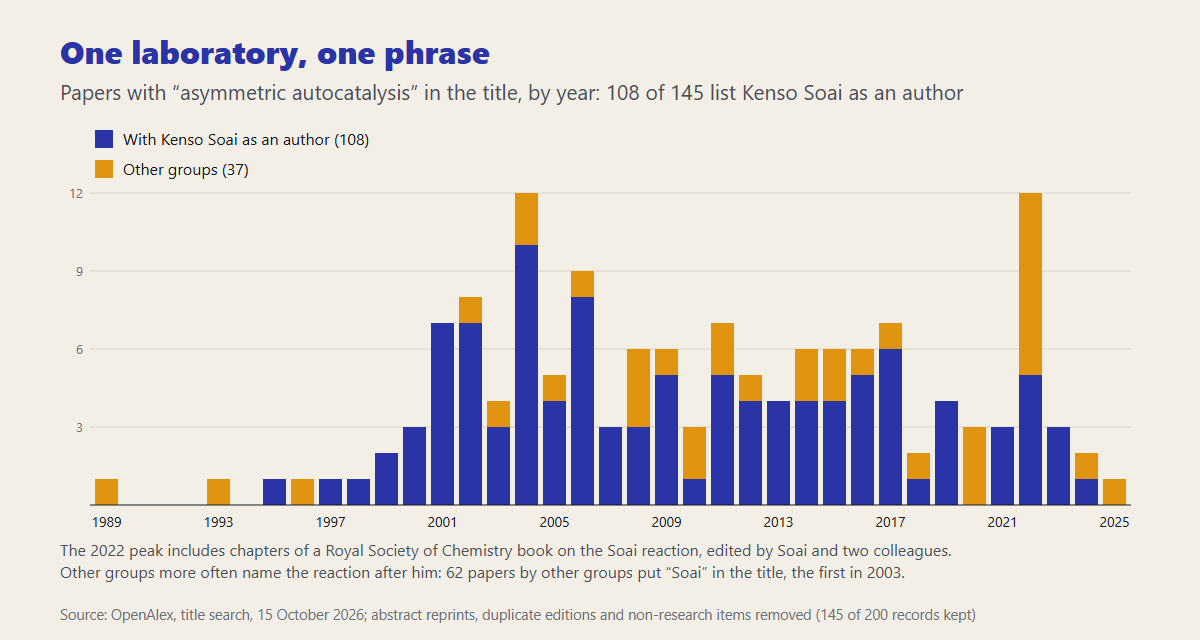
To see how far the Soai reaction has spread, we searched OpenAlex, an open index of the research literature, on 15 October 2026 for works with “asymmetric autocatalysis” in the title. The search returned 200 records. We removed 33 abstract reprints from the ChemInform service, 13 German-language duplicates of articles in Angewandte Chemie, 7 items that were not research papers and 2 duplicate titles, leaving 145.
Of those 145 papers, 108, or 74%, list Kenso Soai as an author, and 107 have at least one author based in Japan. Only 37 come from other groups, chiefly in Germany and the United Kingdom. The busiest years were 2004 and 2022, with 12 papers each; the 2022 total includes chapters of a Royal Society of Chemistry book on the reaction, which Soai edited with Tsuneomi Kawasaki and Arimasa Matsumoto.
Other groups tend to name the reaction after its discoverer instead. A second search, for “Soai” in the title, found 62 papers by other groups about the reaction, the first in 2003 and 56 of them since 2006, from laboratories in France, Hungary, Italy, Mexico, Russia, the United States, Germany and Britain. Most of them try to explain how the reaction works or to model it mathematically.
We also traced Frank’s 1953 paper. OpenAlex records 120 citations to it in the 42 years up to 1994 and 782 from 1995 onwards. Much of that rise reflects the growth of chemistry publishing as a whole. Adjusted for it, the rate roughly doubled, from about 1.0 citations per 10,000 chemistry papers a year in 1985–94 to 1.9 in 2015–24. A theory that had waited four decades for an experiment gained readers once it had one, but less dramatically than the raw count suggests.
These counts are blunt tools. They see only titles, they rely on OpenAlex’s matching of authors and affiliations, and older literature is less completely indexed. They say nothing about quality. What they do show is a reaction that one laboratory spent years finding and decades developing, and that few others have matched: the committee says amplifying asymmetric autocatalysis has been shown in only a few other systems, and that the Soai reaction is still the only one that also works without any chiral starting material.
How does the Soai reaction work? Still argued over
Thirty years on, chemists do not fully agree why the reaction amplifies. The committee’s scientific background describes two detailed proposals. In one, from Scott Denmark and colleagues (Nature Chemistry, 2020), the catalyst is a cluster of four zinc alkoxide units. The aldehyde fits neatly into a cluster built from one hand but not into a mixed one, which matches Kagan’s principle and Frank’s model.
In the other, from Oliver Trapp and colleagues, short-lived zinc hemiacetal complexes carry the reaction, and the amplification arises from a kinetically controlled state far from equilibrium, a mechanism the committee describes as different from the one Kagan and Frank envisaged. The group set out a kinetic analysis for both pyridyl and pyrimidyl substrates in Nature Communications in 2025.
The two models may both be right for different molecules, since they were developed with different substrates. The committee also lists puzzles that earlier proposals left unexplained, among them the narrow range of molecules that work and the reaction’s odd habit of running faster when it is cooled.
Does this explain why life is one-handed?
No, and the Nobel committee says so plainly. Frank’s model is one possible answer to an event that happened 3.5 to 4 billion years ago, it writes, and we will probably never have a definitive account. The Soai reaction uses a reactive zinc compound in an organic solvent, conditions nothing like the water of the early Earth, and the committee calls it an important proof of concept that is not relevant to how biological homochirality emerged in water.
Research on life’s origins has moved towards networks of reactions and towards processes in which the two hands react at different rates. What the Soai reaction settles is narrower but still fundamental: a purely chemical system, starting from nothing chiral, can end up overwhelmingly one-handed. Life’s lopsidedness need not have required anything beyond chemistry.
Who are Henri Kagan and Kenso Soai
Kagan has worked on asymmetric synthesis since at least the late 1960s. In 1972, with Tuan-Phat Dang, he described DIOP, a chiral diphosphine ligand for rhodium-catalysed asymmetric reduction, in a paper that has been cited more than 1,000 times according to Crossref. The Academy lists him as professor emeritus at the then Université Paris-Sud.
Soai is professor emeritus at the Tokyo University of Science. Before the autocatalysis work his group studied how chiral amino alcohols steer the addition of zinc reagents to aldehydes, the chemistry that led him to the self-copying reaction. As the counts above show, his laboratory has published the large majority of the work on it ever since.
Kagan’s 1986 paper has been cited 481 times and Soai’s 1995 Nature paper 1,080 times, according to OpenAlex. The later paper overtook the earlier one, which fits the prize’s shape: Kagan’s idea became a working tool, and Soai’s reaction became the demonstration that chemistry’s oldest asymmetry puzzle has a chemical answer.
Why this prize matters
Chirality touches anything that meets a living body: medicines, flavours, fragrances, crop protection. Kagan’s non-linear effects gave chemists both a tool for understanding their catalysts and a way to get purer products from imperfect ingredients. Soai’s reaction answered, in a flask, a question Pasteur raised in the 1850s and Frank put into equations in 1953.
The prize also rewards patience. Frank’s puzzle waited 42 years for its first demonstration, Soai searched for eight more years for the ultimate version, and the mechanism is still being argued over today. Not every answer arrives complete.
Frequently asked questions
Who won the 2026 Nobel Prize in Chemistry?
Henri B. Kagan of the then Université Paris-Sud in France and Kenso Soai of the Tokyo University of Science in Japan, “for the discovery of non-linear effects and autocatalysis in asymmetric organic synthesis”. The Royal Swedish Academy of Sciences announced the prize on 7 October 2026, and the 12 million Swedish kronor is shared equally.
What is chirality?
A chiral molecule exists in two mirror-image forms, called enantiomers, that cannot be superimposed, like left and right hands. The two forms have the same atoms and bonds but can behave very differently in living things.
What is a non-linear effect in asymmetric catalysis?
It is when the purity of a reaction’s product is not proportional to the purity of the chiral ligand in its catalyst. Kagan showed in 1986 that if catalysts carry two ligands, mixed pairs can behave differently, making the product purer or less pure than a straight line would predict.
What is the Soai reaction?
An addition of diisopropylzinc to a pyrimidine aldehyde in which the product alcohol catalyses its own formation and favours its own hand. Each cycle enlarges the excess: in 2003 Soai’s group took an excess of 0.00005% to more than 99.5% in three cycles.
Does the Soai reaction explain the origin of life?
No. It shows that chemistry alone can turn a tiny imbalance into near-total one-handedness, as a 1953 model predicted. But it runs in an organic solvent with a zinc reagent, and the Nobel committee says it is not relevant to how life’s homochirality arose in water.
Was thalidomide harmful because of its mirror image?
That is the usual story, but it is incomplete. A 1995 study in healthy volunteers found that the two forms of thalidomide convert into each other within hours in the body, so a drug containing only one form would soon contain both.
Sources
Nobel Prize documentation:
- The Nobel Prize in Chemistry 2026 – press release (Royal Swedish Academy of Sciences, 7 October 2026)
- NobelPrize.org – Popular science background: They solved chemistry’s asymmetric mystery
- NobelPrize.org – Scientific background: Non-linear effects and autocatalysis in asymmetric organic synthesis
Primary peer-reviewed research:
- Frank, F. C. (1953). On spontaneous asymmetric synthesis. Biochimica et Biophysica Acta 11, 459–463
- Kagan, H. B. & Dang, T. P. (1972). Asymmetric catalytic reduction with transition metal complexes. I. J. Am. Chem. Soc. 94, 6429–6433
- Puchot, C., Samuel, O., Duñach, E., Zhao, S., Agami, C. & Kagan, H. B. (1986). Nonlinear effects in asymmetric synthesis. J. Am. Chem. Soc. 108, 2353–2357
- Kitamura, M., Okada, S., Suga, S. & Noyori, R. (1989). Enantioselective addition of dialkylzincs to aldehydes promoted by chiral amino alcohols. J. Am. Chem. Soc. 111, 4028–4036
- Soai, K., Niwa, S. & Hori, H. (1990). Asymmetric self-catalytic reaction. J. Chem. Soc., Chem. Commun., 982–983
- Guillaneux, D., Zhao, S.-H., Samuel, O., Rainford, D. & Kagan, H. B. (1994). Nonlinear effects in asymmetric catalysis. J. Am. Chem. Soc. 116, 9430–9439
- Soai, K., Shibata, T., Morioka, H. & Choji, K. (1995). Asymmetric autocatalysis and amplification of enantiomeric excess of a chiral molecule. Nature 378, 767–768
- Eriksson, T. et al. (1995). Stereospecific determination, chiral inversion in vitro and pharmacokinetics in humans of the enantiomers of thalidomide. Chirality 7, 44–52
- Singleton, D. A. & Vo, L. K. (2002). Enantioselective synthesis without discrete optically active additives. J. Am. Chem. Soc. 124, 10010–10011
- Sato, I., Urabe, H., Ishiguro, S., Shibata, T. & Soai, K. (2003). Amplification of chirality from extremely low to greater than 99.5% ee by asymmetric autocatalysis. Angew. Chem. Int. Ed. 42, 315–317
- Soai, K. et al. (2003). Asymmetric synthesis of pyrimidyl alkanol without adding chiral substances. Tetrahedron: Asymmetry 14, 185–188
- Satyanarayana, T., Abraham, S. & Kagan, H. B. (2009). Nonlinear effects in asymmetric catalysis. Angew. Chem. Int. Ed. 48, 456–494
- Geiger, Y., Achard, T., Maisse-François, A. & Bellemin-Laponnaz, S. (2020). Hyperpositive nonlinear effects in asymmetric catalysis. Nature Catalysis 3, 422–426
- Athavale, S. V., Simon, A., Houk, K. N. & Denmark, S. E. (2020). Demystifying the asymmetry-amplifying, autocatalytic behaviour of the Soai reaction. Nature Chemistry 12, 412–423
- Möhler, P. et al. (2025). Mechanistic analysis and kinetic profiling of Soai’s asymmetric autocatalysis for pyridyl and pyrimidyl substrates. Nature Communications 16
Data:
- OpenAlex – works with “asymmetric autocatalysis” in the title (searched 15 October 2026)
- OpenAlex – works with “Soai” in the title (searched 15 October 2026)
- OpenAlex – works citing Frank (1953), by year (retrieved 15 October 2026)
Baryon. (2026, October 18). 2026 Nobel Prize in Chemistry: How Two Chemists Made Molecules Pick a Hand. Web News For Us. https://webnewsforus.com/2026-nobel-prize-in-chemistry-chirality/
Baryon. “2026 Nobel Prize in Chemistry: How Two Chemists Made Molecules Pick a Hand.” Web News For Us, 18 October 2026, https://webnewsforus.com/2026-nobel-prize-in-chemistry-chirality/. Accessed 18 October 2026.