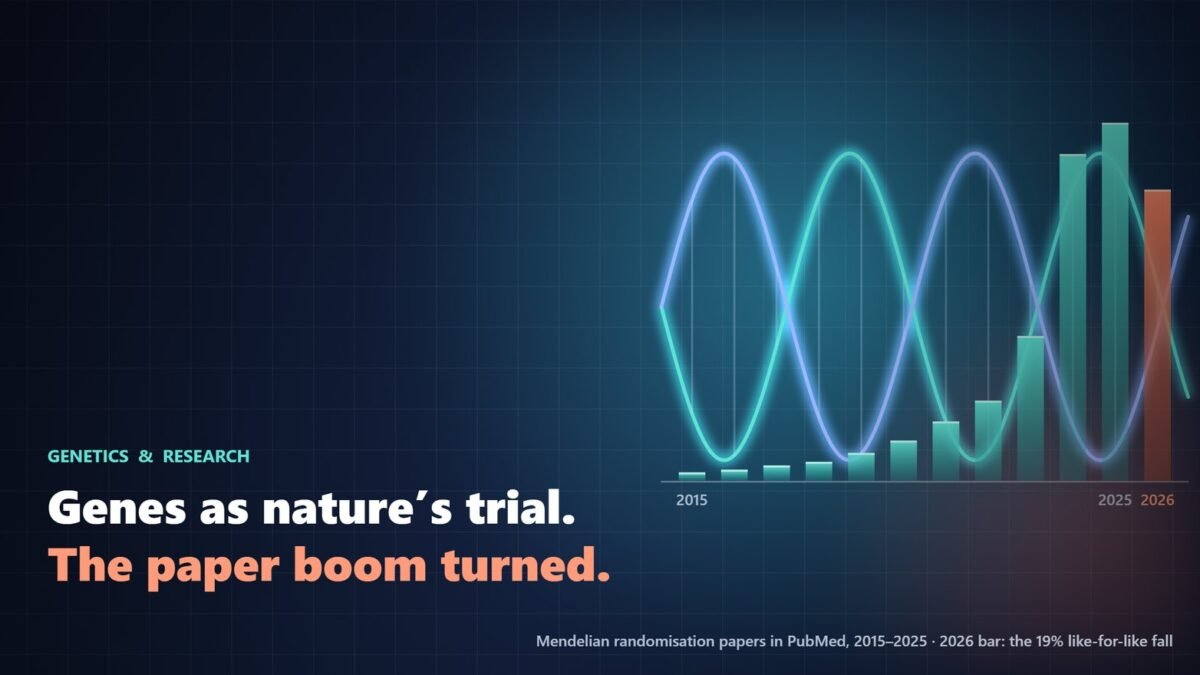
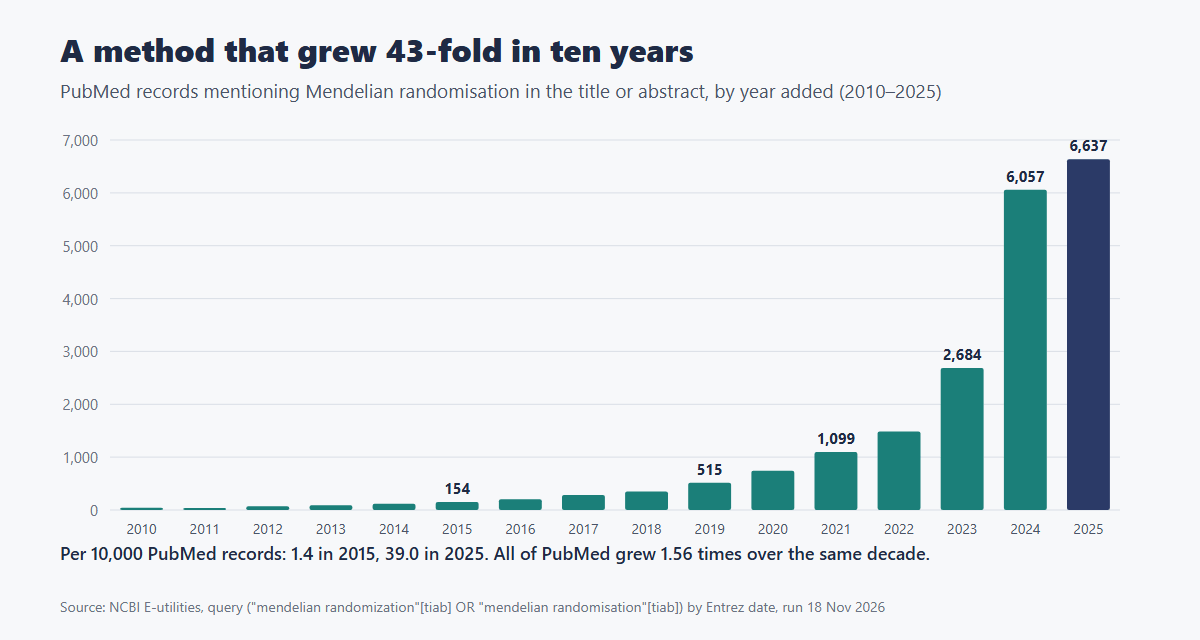
In 2015, PubMed added 154 papers on Mendelian randomisation, a way of treating the genes people inherit as nature’s own randomised trial. In 2025 it added 6,637. So far this year, for the first time since 2011, the number is going down.
We counted. Between 1 January and 17 November 2026, PubMed added 4,716 papers mentioning the method in their title, abstract or keywords, against 5,799 in the same weeks of 2025: a fall of 19%. Over the same weeks, PubMed as a whole grew by 4.4%. Every quarter of 2026 so far has come in below the same quarter of 2025, and the gap was far wider in the second half: down 11% from January to June, and 28% from July to 17 November.
The turn follows two years in which journals, one after another, raised the bar for a certain kind of paper: a quick run of public genetic data through standard software, written up as if it settled a question of cause and effect. The papers that remain look different, too. In 2024, nearly half carried the phrase “Mendelian randomization study” in their title. In 2026, about one in five do, while papers that bolt on cell-level or laboratory work have multiplied.
A coin toss at conception
Observational studies keep running into the same wall. People who drink more coffee, sleep less or carry a higher blood level of some marker differ from other people in a hundred ways at once, so a link between the habit and a disease cannot show which causes which. A randomised trial solves this by tossing a coin over who gets the treatment. For many questions, nobody can run that trial.
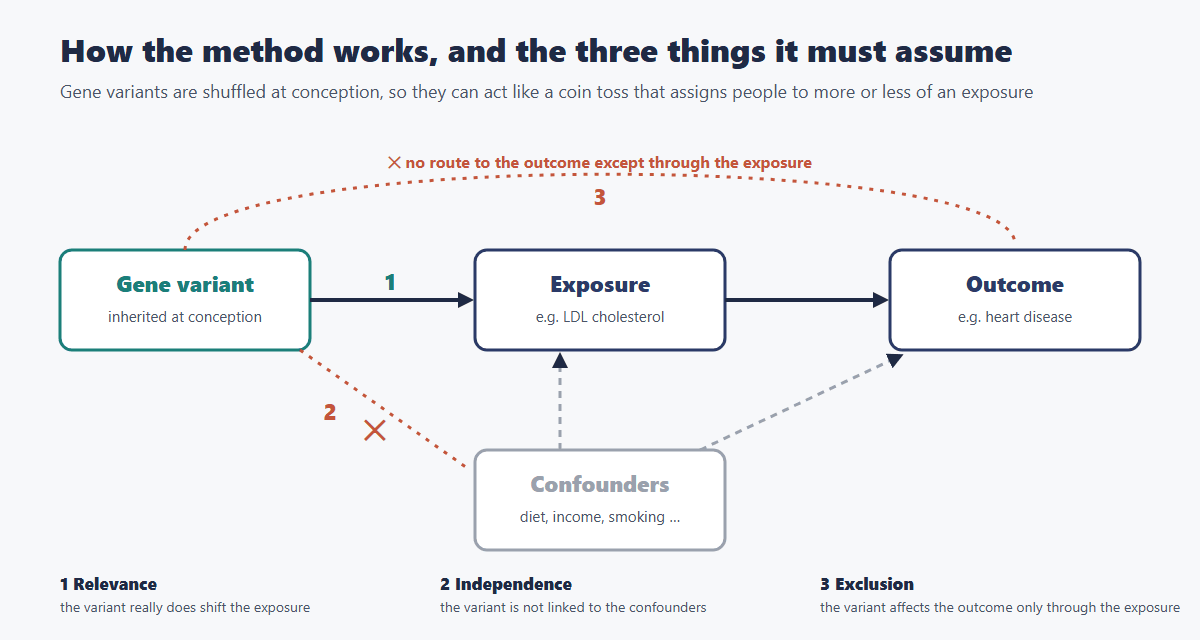
Genes offer a substitute. Which version of each gene a child receives from each parent is largely a matter of chance, settled as eggs and sperm form and meet, so a variant that nudges cholesterol up or down is handed out much as a trial would hand out a drug, and it stays in place for life. If people born with a cholesterol-lowering variant also turn out to have less heart disease, the cholesterol is probably doing the work, because the variant was not chosen by them and came before everything else in their lives.
The idea is usually traced to a 1986 letter in The Lancet by the Dutch nutrition scientist Martijn Katan. At the time, low cholesterol was suspected of causing cancer. Katan pointed out that a common variant of the apolipoprotein E gene lowers cholesterol from birth, so if low cholesterol really caused cancer, cancer patients should carry that variant more often than healthy people, as later accounts of the letter describe. The epidemiologists George Davey Smith and Shah Ebrahim set the method out at length in 2003, and by their own account the name was borrowed from a 1991 study of bone marrow transplants.
The trick only works if three things hold, which the STROBE-MR reporting guideline calls relevance, independence and the exclusion restriction. The variant must really shift the exposure. It must not be linked to the other things that could cause the outcome. And it must affect the outcome only through the exposure, not through some second route of its own, which geneticists call pleiotropy. Of the three, only the first can be tested directly.
When the genes and the trials agreed
At its best, the method has pointed the same way as expensive trials, and run ahead of some of them. The clearest case is HDL, the so-called good cholesterol. People with high HDL have fewer heart attacks, and drug companies spent years trying to raise it. In 2012, a study in The Lancet led by Benjamin Voight looked at a variant of the LIPG gene that raises HDL. Its carriers should have had about 13% fewer heart attacks. Across 20,913 cases and 95,407 controls, they had none fewer: an odds ratio of 0.99, with a 95% confidence interval from 0.88 to 1.11, according to the paper.
The trials agreed. Dalcetrapib raised HDL by 31 to 40% in 15,871 patients, and the dal-OUTCOMES trial was stopped for futility in May 2012, days before Voight’s paper appeared. Torcetrapib and niacin had failed earlier still. The genetics ran ahead only of the later trials: in ACCELERATE, reported in 2017, evacetrapib raised HDL by 133% and still did not reduce heart attacks, strokes or deaths. So the method did not predict every disappointment; it challenged the idea that raising HDL cholesterol would, by itself, lower the risk of a heart attack.
LDL, the cholesterol that clogs arteries, went the other way. In 2016, a team led by Brian Ference used variants in two genes, PCSK9 and HMGCR, the targets of a new class of drugs and of statins. Across 112,772 people, each 10 mg/dL of genetically lower LDL came with about 19% lower odds of a cardiovascular event, with an odds ratio of 0.81 for both genes, in the New England Journal of Medicine. A few months later the FOURIER trial of the PCSK9 drug evolocumab reported a hazard ratio of 0.85 in 27,564 patients.
The method can also point away from a suspect. People with more C-reactive protein, a marker of inflammation, have more heart disease. A 2011 collaboration pooling 194,418 people, 46,557 of them with coronary heart disease, found that variants raising CRP did not raise risk at all: a risk ratio of 1.00 per standard deviation, against 1.33 in the observational data, in the BMJ. CRP looked like a marker of heart disease rather than a cause. That cleared CRP itself, not inflammation in general.
And when the method itself misled
In 2021, The Lancet Diabetes & Endocrinology published a large analysis that used a newer, non-linear form of the method. It reported that in people with very low vitamin D, each 10 nmol/L of genetically higher vitamin D cut the odds of death by about 31%. Two years later the journal retracted it and published a corrected version that found no effect at any level of vitamin D, citing “concerns regarding the validity of the statistical methods used”, according to the notice.
The problem was an assumption buried in the statistics: that the genes nudge vitamin D by the same amount at every level. They do not. Stephen Burgess showed the genetic effect differed about five-fold across the population, in Human Heredity in 2023. A group led by Fergus Hamilton then ran the same kind of analysis on outcomes nobody can change, and found it implied that vitamin D and body weight “cause” a person’s age and sex, in the European Journal of Epidemiology. A second non-linear vitamin D paper, in the European Heart Journal, was retracted in 2025.
How a method became a template
The method’s own pioneers have described what drove the growth. Large genetic studies now publish their summary results openly, and web-based tools let anyone combine one study of the exposure with one of the outcome “at the touch of a button”. This two-sample version can now be run “at an industrial scale” by anyone with an internet connection, Stephen Burgess and colleagues wrote in BMC Medicine in 2024, and it has “fuelled an explosion of poor-quality Mendelian randomization publications”. They also blamed pressure to publish as often as possible, and predatory journals willing to print the results.
The numbers bear that out. In 2015, PubMed added 154 papers on the method; in 2025, 6,637. That is about 1.4 papers per 10,000 PubMed records rising to 39, while PubMed itself grew by a factor of 1.56. The European Journal of Epidemiology reported that the method’s share of all its submissions rose from 3.1% in 2020 to 13.0% in 2024, and that the main public platform for these analyses went from about 20,000 users a year in 2020 to about 150,000 visitors in 2025, in an editorial by Gibran Hemani, Davey Smith and colleagues.
Some researchers close to the method, one of its founders among them, lost patience. “Sadly, MR has run off the rails,” Stefan Stender, Helene Gellert-Kristensen and Davey Smith wrote in Lipids in Health and Disease in 2024, advising editors to reject papers that report only a two-sample analysis with nothing else to support it. Every pairing of exposure and outcome in the main public database, they noted, can already be browsed online, so such results are in effect already published.
Journals raised the bar, one by one
The response came journal by journal, mostly in editorials that set out new rules. Some of the clearest are below, with the month each was published.
| When | Journal | What changed |
|---|---|---|
| Apr 2024 | PLOS One | Staff pre-screen requiring the STROBE-MR checklist; by Nov 2025 it also rejects papers without a justified question or validation in a second independent dataset |
| Jun 2024 | Front Endocrinol | Rejects papers without STROBE-MR; 552 submissions in 2023 against 4 in 2020 |
| Sep 2024 | Addiction, Tobacco Control, NTR | Joint editorial: summary-data papers get low priority unless they genuinely add knowledge |
| Mar 2025 | SLEEP | Two checklists required before peer review |
| Apr 2025 | J Epidemiol Community Health | Board decided in late 2023 to raise standards; fewer papers sent for external review |
| Jul 2025 | Diabetologia | Ten-point guidance; acceptance rate had fallen from 24% to 4% |
| Jul 2025 | PLOS Genetics | Routine automated analyses “almost invariably rejected” at editorial review |
| Nov 2025 | Eur J Epidemiol | No review without STROBE-MR, and stringent screening |
Dates are the publication dates of each editorial, except PLOS One, whose screening began in April 2024 and was described in its editorial note of 18 November 2025. The Journal of Epidemiology and Community Health’s editorial, published in April 2025, dates its board’s decision to late 2023. Scientific Reports’ policy page also requires the STROBE-MR checklist, but gives no start date.
PLOS One alone received nearly 1,800 submissions using the method in 2024 and 919 by August 2025, its editors reported in an editorial note. By April 2024 close to all rejections of these papers were being made by staff at the first screen rather than by academic editors.
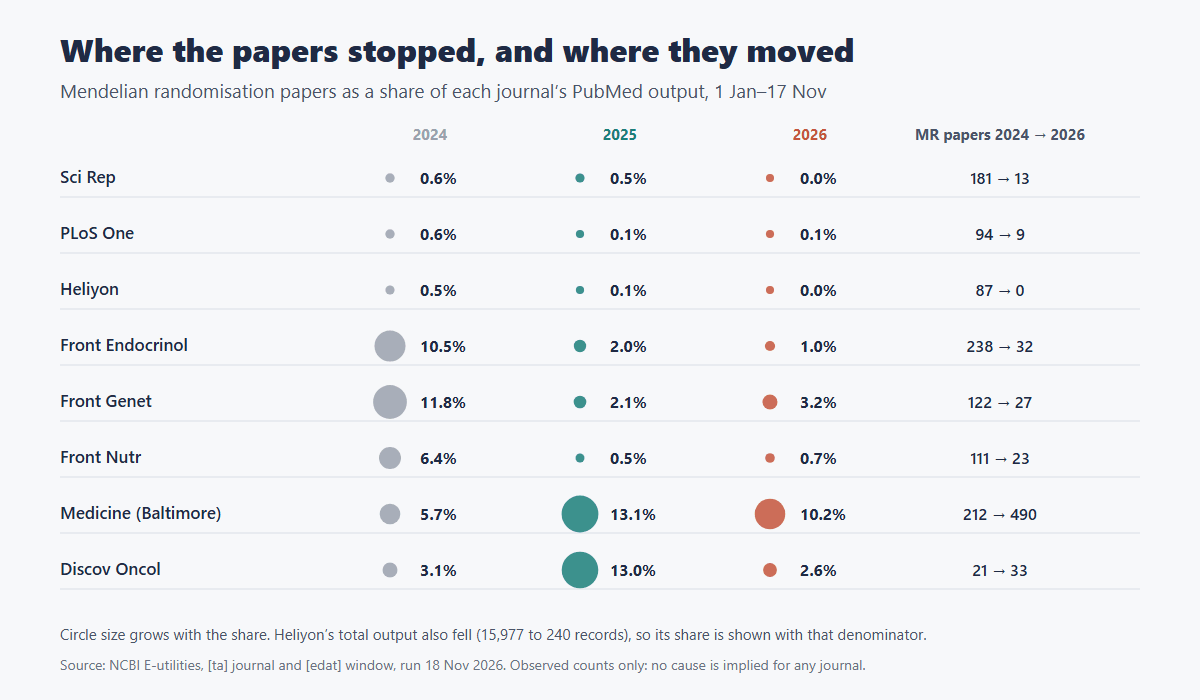
Journals that announced screening mostly published far fewer of these papers afterwards, though the timing does not always line up and the counts cannot prove cause. In the same January-to-November window, Scientific Reports published 209 of these papers in 2025 and 13 in 2026, out of roughly 40,474 and 29,474 records in all. Frontiers in Endocrinology went from 238 in 2024 to 32 in 2026, while its total output grew. Heliyon’s fall, from 87 such papers in 2024 to none, mirrors the journal’s near-disappearance from PubMed: 15,977 records in the 2024 window, 240 in 2026.
Output also shifted between journals rather than simply shrinking. Medicine (Baltimore) published 212 of these papers in 2024 and 604 in 2025, when they made up 13% of everything it published. Journal counts cannot show whether these were the same manuscripts sent elsewhere.
Those four journals do not explain the fall on their own. Leaving out Scientific Reports, PLOS One, Frontiers in Endocrinology and Heliyon altogether, the count still fell from 5,521 to 4,662, or -16%. Much of the rest came from a few more journals. Leave out six more as well (Discover Oncology, Medicine (Baltimore), the Journal of Affective Disorders, Brain and Behavior, Archives of Dermatological Research and Skin Research and Technology) and the fall shrinks to -6%, against 4.4% growth for PubMed as a whole.
Frontiers, which publishes Frontiers in Endocrinology, Frontiers in Genetics and Frontiers in Nutrition, said in September 2025 that it began requiring independent validation for these studies in mid-2024, had rejected 5,513 of them since July 2024 and had seen submissions fall by more than 70%. Those are the publisher’s own figures, given in a news post.
Some papers came back out after publication. PubMed marks 76 records that mention the method as retracted, most of them research papers, out of 25,329 records on the topic in all, or about 0.3%. Forty-seven came from a single journal, Skin Research and Technology, which retracted them one at a time in waves between May and October 2025, 32 of them on 8 and 9 October. The notices that can be read give the same reason: the paper was accepted after insufficient peer review and “does not adequately present the biological rationale necessary to support the valid application of Mendelian Randomization”. In most of them, the authors are recorded as disagreeing. No other journal retracted more than two such papers in 2025 or 2026.
The year the count turned
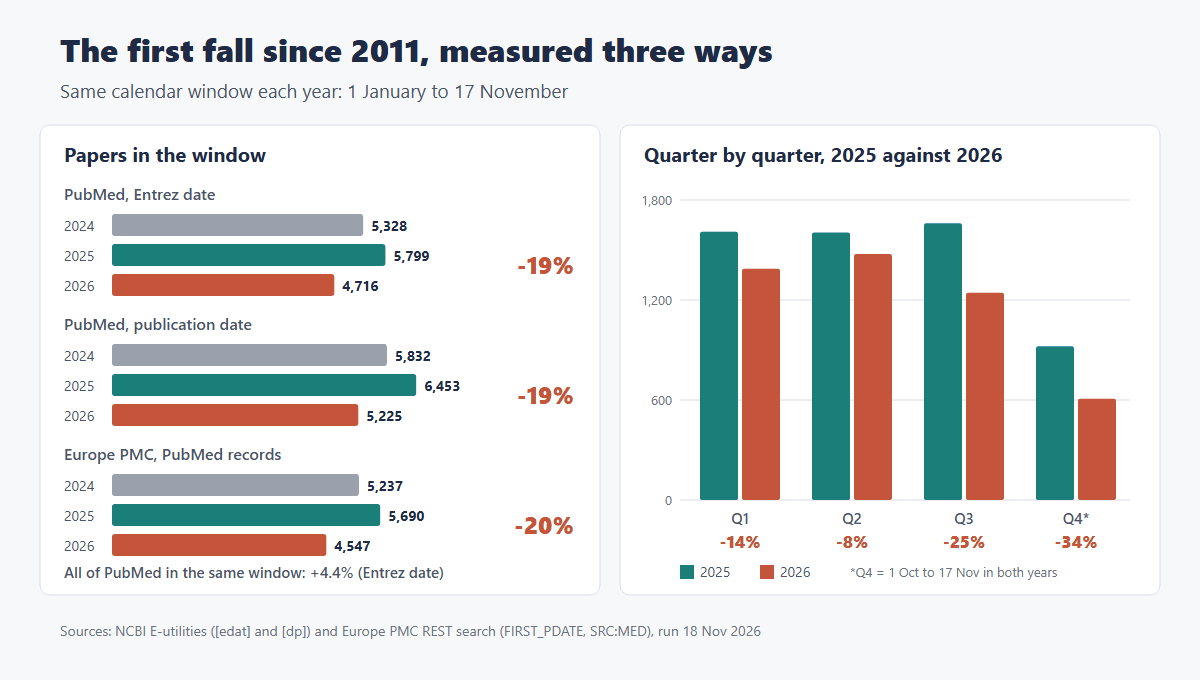
Counts of papers are noisy, so we checked the fall against three different dates over the same weeks of each year. By the date PubMed added each record, papers fell from 5,799 to 4,716 (-19%). By the publication date printed on each paper, they fell from 6,453 to 5,225 (-19%). In Europe PMC, which mirrors the same PubMed records but dates them by first publication, the count fell from 5,690 to 4,547 (-20%). All three rest on PubMed’s records, so they rule out a quirk of dating, not a change in what PubMed indexes.
The decline deepened in the second half: -14% in the first quarter, -8% in the second, -25% in the third and -34% from 1 October to 17 November, each against the same period of 2025. The last time the yearly count fell at all was 2011, when PubMed added 39 papers against 41 the year before.
We found no earlier report of a 2026 fall. A bibliometric study in Frontiers in Genetics, searched on 15 February 2026, did find fewer papers in 2025 than in 2024, but its authors warn that the 2025 figure may reflect incomplete indexing, and PubMed’s own records show 2025 above 2024. A Perspective in Nature Genetics by Eleanor Sanderson and colleagues, published online in April 2026 but submitted in July 2025, included a brief bibliometric analysis that predates the 2026 data.
Fewer formula titles, more add-ons
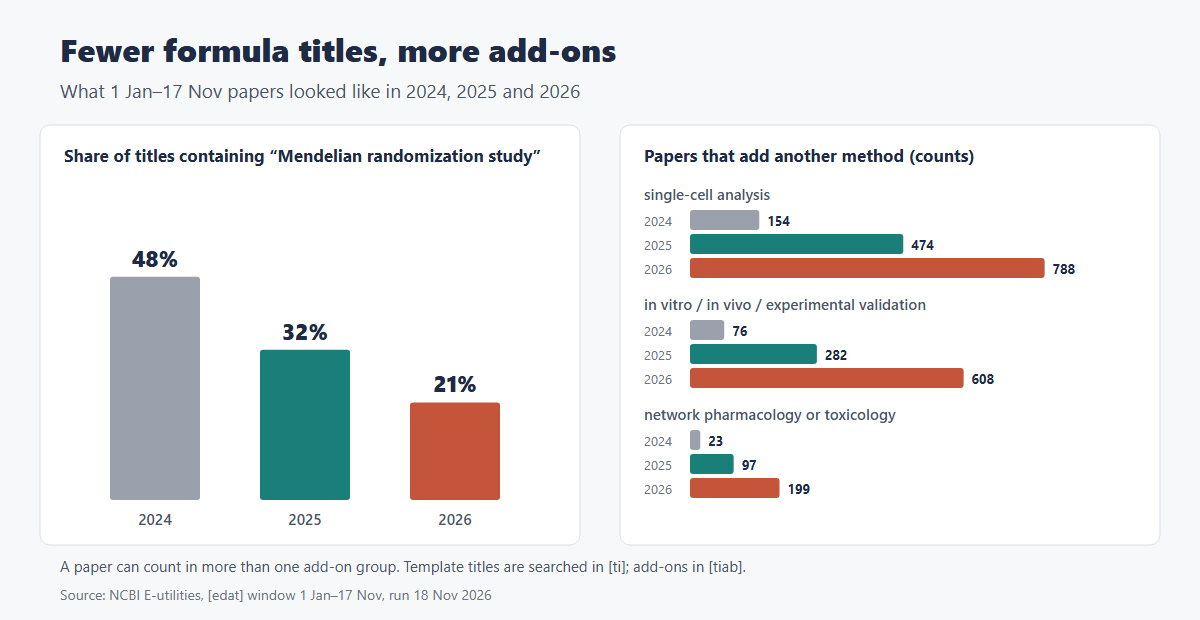
Part of the change is in what the papers look like. In the January-to-November window of 2024, 2,550 of 5,328 papers, or 48%, had the phrase “Mendelian randomization study” in their title. In 2025 the share was 32%, and in 2026 it is 21%.
Over the same windows, papers that combine the method with single-cell analysis rose from 154 to 474 and then 788, and papers that mention laboratory work, in vitro or in vivo experiments or “experimental validation” rose from 76 to 282 and then 608. Journals had asked for evidence beyond the genetic analysis itself, and PLOS Genetics, for one, called experimental follow-up strongly encouraged though not strictly necessary. Whether the new add-ons supply that evidence, or simply decorate the same analysis, is a question a title count cannot answer.
The same template has turned up elsewhere. A 2025 study in PLOS Biology found that papers linking a single factor to a disease using the US NHANES health survey had averaged 4 a year from 2014 to 2021, then reached 190 in 2024 by 9 October. Its authors compared the surge with Mendelian randomisation, “another area which has seen a tsunami of formulaic manuscripts”, and adapted the template rejection that Stender, Gellert-Kristensen and Davey Smith had written for peer reviewers.
Who writes the papers
Most of these papers list at least one author with an affiliation in China: 3,818 of the 4,716 added in the 2026 window, against 5,019 of 5,799 in 2025. The fall is concentrated there, -24%, while papers with no affiliation in China rose from 780 to 898. Papers with an affiliation in the United States held roughly level, at 441 and 451, and the United Kingdom went from 356 to 339.
These are counts of affiliations, not judgements about anyone’s work. The rise in quick analyses was not confined to one country: in the European Journal of Epidemiology’s submissions, the method’s share climbed from 6.0% to 17.8% for authors in the United Kingdom and from 7.9% to 21.5% for authors in China between 2020 and 2024, according to the same editorial, whose authors warned against lazy stereotyping.
Access to the data changed too. The most widely used public database for these analyses, OpenGWAS, required every user to sign in from 1 May 2024, after what its team described as months of “extremely high traffic”, and new personal users started on a small allowance from autumn 2024, later raised, according to its blog and archived copies of its documentation. Output still grew in 2025, so the change cannot by itself explain the fall in 2026.
How to read a “genes show” headline
None of this makes the method worthless; the HDL, LDL and CRP results show what it can do. It does mean that a headline saying genes prove some habit or blood level causes a disease deserves a few questions, drawn from the STROBE-MR checklist and the pitfalls listed by Burgess and colleagues.
- Do the variants really move the exposure? Weak genetic instruments give unstable answers.
- Could the genes act some other way? Look for tests of pleiotropy and results that survive several sensitivity analyses.
- Was it checked in a second, independent dataset? PLOS One now asks for exactly that before a paper reaches review.
- Is the question new, and does it engage with what is already known? Many papers re-run pairings already browsable in public databases.
- Does it agree with other kinds of evidence, such as trials, animal work or biology?
- Does it claim a threshold or a sweet spot? Non-linear claims, like the vitamin D one, rest on the shakiest assumptions.
The method’s founders put the principle most simply in PLOS Medicine in March 2026: the genetic difference has to stand in faithfully for the exposure it is meant to mimic. When it does, Mendelian randomisation is one of the best tools medicine has. When it does not, it is a fast way to publish a confident wrong answer.
How we counted
Every count we made can be re-run on public databases. We searched PubMed through NCBI’s E-utilities for the phrase “mendelian randomization” or “mendelian randomisation” in the title, abstract or author keywords (PubMed’s [tiab] field), on 18 November 2026. Unless stated, years are counted by Entrez date, when PubMed added the record, and the 2026 comparisons use the same window, 1 January to 17 November, in every year. The counts include all article types, from research papers to letters, and shift slightly as PubMed adds older records, so a re-run may differ by a handful of papers.
| What | Query | Result |
|---|---|---|
| Papers per year | PubMed, Entrez date by year | 154 (2015), 6,637 (2025) |
| Like-for-like, 2025 | 1 Jan–17 Nov, Entrez date | 5,799 |
| Like-for-like, 2026 | 1 Jan–17 Nov, Entrez date | 4,716 |
| All of PubMed, 2025 and 2026 | same window, no topic filter | 1,482,807 and 1,547,575 |
| By publication date | 1 Jan–17 Nov, [dp] | 6,453 (2025), 5,225 (2026) |
| Europe PMC | PubMed records (SRC:MED), first publication date | 5,690 (2025), 4,547 (2026) |
| Template titles | [ti] phrase | 986 of 4,716 (2026) |
| Affiliations | China[ad], and the same with NOT | 3,818 and 898 (2026) |
| Single-cell add-on | [tiab] terms | 788 (2026) |
| Laboratory add-on | [tiab] terms | 608 (2026) |
| US and UK affiliations | UK query; US uses USA[ad] OR “United States”[ad] | US 441 and 451, UK 356 and 339 |
| Ten journals left out | the four below plus Discov Oncol, Medicine (Baltimore), J Affect Disord, Brain Behav, Arch Dermatol Res, Skin Res Technol ([ta]), run 21 Nov 2026 | 4,368 (2025), 4,088 (2026) |
| Four journals left out | [ta] journal field, NOT | 5,521 (2025), 4,662 (2026) |
Affiliation searches match text in the address field, so a paper with authors in several countries counts in each, and some Hong Kong and Taiwan addresses can match “China”. Journal counts use PubMed’s journal abbreviation field.
Sources
Data:
- NCBI E-utilities (esearch counts), queries run 18 November 2026
- Europe PMC REST search, queries run 18 November 2026
Method and test cases:
- Davey Smith G, Ebrahim S. ‘Mendelian randomization’: can genetic epidemiology contribute to understanding environmental determinants of disease? Int J Epidemiol 2003;32:1–22
- Sheehan NA et al. Mendelian randomisation and causal inference in observational epidemiology. PLoS Med 2008;5:e177 (describing Katan MB, Lancet 1986;1:507–508)
- Davey Smith G et al. Mendel’s laws, Mendelian randomization and causal inference in observational data. Eur J Epidemiol 2020;35:99–111
- Skrivankova VW et al. The STROBE-MR statement. JAMA 2021;326:1614–1621
- Skrivankova VW et al. STROBE-MR: explanation and elaboration. BMJ 2021;375:n2233
- Voight BF et al. Plasma HDL cholesterol and risk of myocardial infarction: a mendelian randomisation study. Lancet 2012;380:572–580
- Schwartz GG et al. Effects of dalcetrapib in patients with a recent acute coronary syndrome. N Engl J Med 2012;367:2089–2099
- Lincoff AM et al. Evacetrapib and cardiovascular outcomes in high-risk vascular disease. N Engl J Med 2017;376:1933–1942
- Ference BA et al. Variation in PCSK9 and HMGCR and risk of cardiovascular disease and diabetes. N Engl J Med 2016;375:2144–2153
- Sabatine MS et al. Evolocumab and clinical outcomes in patients with cardiovascular disease. N Engl J Med 2017;376:1713–1722
- CRP CHD Genetics Collaboration. Association between C reactive protein and coronary heart disease. BMJ 2011;342:d548
- The Editors of The Lancet Diabetes & Endocrinology. Retraction and republication. Lancet Diabetes Endocrinol 2024;12:8
- Burgess S. Violation of the constant genetic effect assumption can result in biased estimates for non-linear Mendelian randomization. Hum Hered 2023;88:79–90
- Hamilton FW et al. Non-linear Mendelian randomization: detection of biases using negative controls. Eur J Epidemiol 2024;39:451–465
- Davey Smith G, Hemani G, Ebrahim S. Gene-environment equivalence: the fundamental principle of Mendelian randomization. PLoS Med 2026;23:e1005013
Critiques, policies and prior counts:
- Burgess S et al. Addressing the credibility crisis in Mendelian randomization. BMC Med 2024;22:374
- Stender S, Gellert-Kristensen H, Davey Smith G. Reclaiming mendelian randomization from the deluge of papers and misleading findings. Lipids Health Dis 2024;23:286
- Hemani G et al. The rapid growth in Mendelian randomization studies. Eur J Epidemiol 2025;40:1165–1171
- Pruller J, Mockridge J, Vousden G. Expectations for Mendelian randomization research in PLOS One. PLoS One 2025;20:e0337199
- Williams SM et al. Expectations for papers performing Mendelian randomization analyses. PLoS Genet 2025;21:e1011767
- Tobias JH et al. The proliferation of derivative and redundant studies in endocrinology. Front Endocrinol 2024;15:1400583
- Munafò MR et al. Managing the exponential growth of Mendelian randomization studies. Nicotine Tob Res 2024;26:1273–1275
- Evans DS et al. Mendelian randomization in SLEEP: avoiding pitfalls with MR-SLEEP guidelines. Sleep 2025;48:zsaf054
- Bell S, Batty GD. Navigating the shifting Mendelian randomisation landscape. J Epidemiol Community Health 2025;79:733–736
- Corbin LJ et al. Raising the bar for publication of Mendelian randomisation studies in Diabetologia. Diabetologia 2025;68:2088–2091
- Scientific Reports, editorial and publishing policies: Mendelian randomization studies (accessed 18 November 2026)
- Zhang J et al. Methodological challenges … in Mendelian randomization research: a bibliometric and content analysis. Front Genet 2026;17:1853737
- Sanderson E et al. Challenges and future directions for Mendelian randomization. Nat Genet 2026;58:984–994
- Retraction notice: Causal association of micronutrients and supplements with pressure ulcer: a Mendelian randomization study. Skin Res Technol 2025;31:e70199 (one of 47 such notices)
- Frontiers. Cutting through fast-churn science: how Frontiers raised the bar. Frontiers news, 15 September 2025
- OpenGWAS team. User authentication is now live. OpenGWAS blog, 21 April 2024
- OpenGWAS team. Managing traffic to the OpenGWAS API. OpenGWAS blog, 20 March 2024
- Suchak T et al. Explosion of formulaic research articles … based on the NHANES US national health database. PLoS Biol 2025;23:e3003152
Baryon. (2026, November 18). Mendelian Randomisation Papers Are Falling for the First Time Since 2011. Web News For Us. https://webnewsforus.com/mendelian-randomisation-papers-falling-2026/
Baryon. “Mendelian Randomisation Papers Are Falling for the First Time Since 2011.” Web News For Us, 18 November 2026, https://webnewsforus.com/mendelian-randomisation-papers-falling-2026/. Accessed 21 November 2026.